 EasyTicket
 Travel cancellation penalties come down less to “why you cancel” than to “how many days ahead you cancel”. For international package tours, 30 days before departure is effectively the last penalty-free window; for peak-season lodging, it’s 10 days before the scheduled stay. Once you cross that line, the deduction rate rises day by day. If you already have a peak-season booking, the quickest way to save is to count backward from today’s date and work out your D-day.
Who Sets the Cancellation Penalty Standards, Anyway?
The “travel cancellation penalty standards” we commonly refer to stem from the Consumer Dispute Resolution Standards announced by the Fair Trade Commission. For travel, lodging, and airline bookings, they lay out in a table how much you get back depending on how many days before the date of use you cancel.
However, these are benchmarks for settlement or mediation when a dispute arises, not a law that binds businesses. In an actual contract, the provider’s terms apply first. But if those terms are significantly more unfavorable to consumers than these standards, you may have grounds to challenge them as invalid under the Act on the Regulation of Terms and Conditions.
Remember the order. ① Check the terms of your booking → ② Compare them with the Consumer Dispute Resolution Standards → ③ If the difference is substantial, raise an objection. If you only bring the table, you’ll hit a wall at “Our terms are different.”
Package Tour Cancellation Penalty Standards (International and Domestic)
The standard terms for international travel and the Consumer Dispute Resolution Standards are tiered by how far ahead of the trip start date you cancel. When the cancellation is due to the traveler, the standards are as follows.
| Cancellation timing (international package) | Traveler’s share |
|---|---|
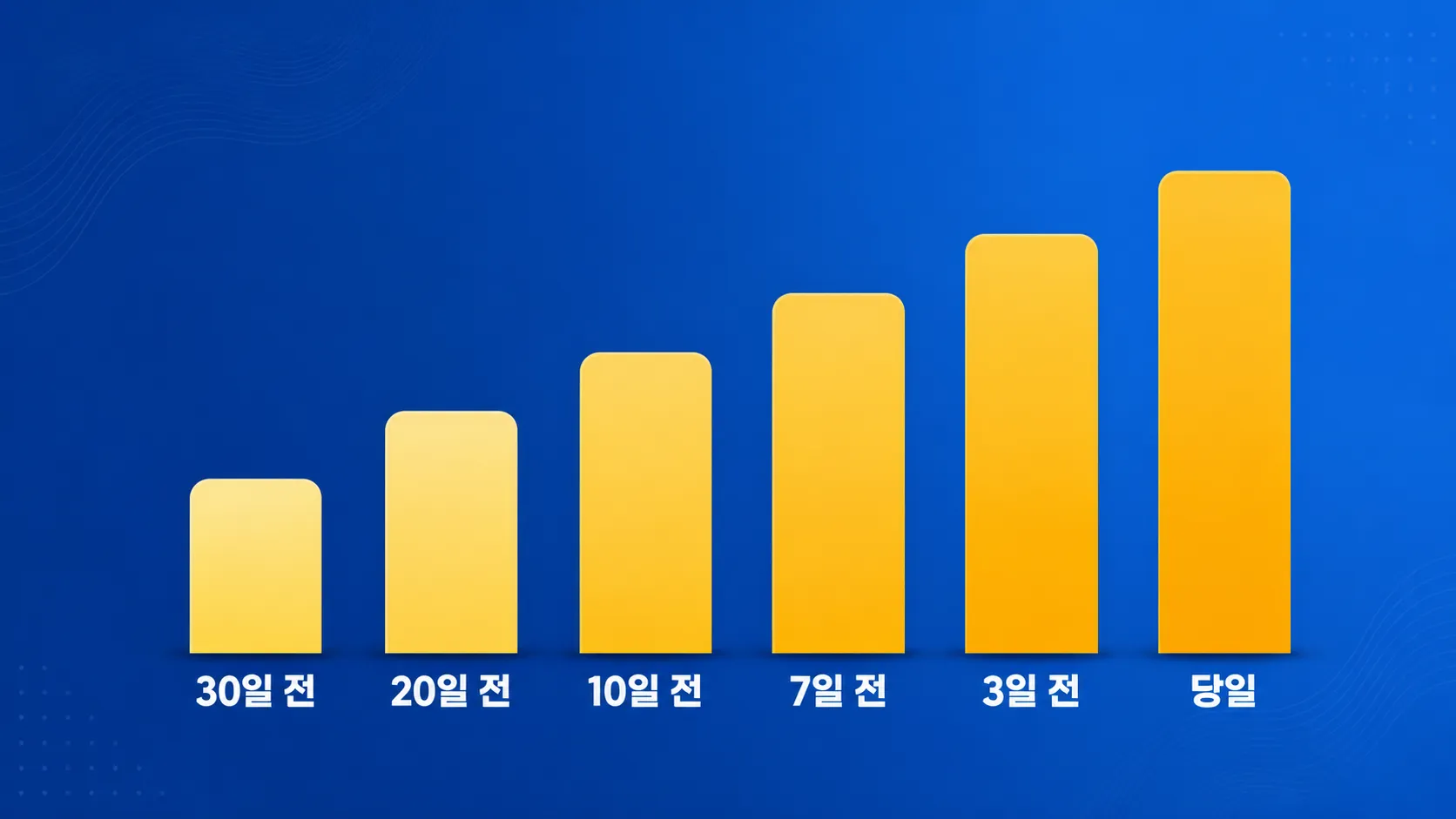
| Up to 30 days before | Contract deposit refunded (no penalty) |
| Up to 20 days before | 10% of the trip price |
| Up to 10 days before | 15% of the trip price |
| Up to 8 days before | 20% of the trip price |
| Up to 1 day before | 30% of the trip price |
| On the day of the trip | 50% of the trip price |
Domestic packages have a much shorter window. If you cancel for a reason attributable to the traveler, the standard is a full refund up to 5 days before departure, then 10% two days before, 20% one day before, and 30% on the day (source: Fair Trade Commission Consumer Dispute Resolution Standards).
I recounted the D-10 and D-8 windows several times while putting this together. The difference between 20 and 19 days out is 5 percentage points of the fare — on a KRW 3 million family package, that’s KRW 150,000 decided by a single day.
Accommodation Refund Rules — Peak-Season Weekends Cost the Most
Accommodation splits into four cases: peak season or off-season, and weekday or weekend. Follow the period marked in the provider’s terms; if no period is specified, the Fair Trade Commission standards treat July 15~August 24 in summer and December 20~February 20 in winter as peak season. Weekends are Friday, Saturday, and the day before a public holiday.
| Cancellation timing | Peak-season weekday | Peak-season weekend |
|---|---|---|
| Up to 10 days before | Contract deposit refunded | Contract deposit refunded |
| Up to 7 days before | 10% of total price deducted | 20% of total price deducted |
| Up to 5 days before | 30% deducted | 40% deducted |
| Up to 3 days before | 50% deducted | 60% deducted |
| 1 day before~same day | 80% deducted | 90% deducted |
Off-season rules are much more lenient: the contract deposit is refunded up to 2 days before the scheduled date, with 10~20% deducted one day before and 20~30% deducted on the day.
Cancel a peak-season weekend stay three days out and you lose 60% of the total price. For a KRW 400,000 pension, that’s KRW 240,000. I found it much less stressful to mark the cancellation deadline (D-10) on the calendar first.
Airline Ticket Cancellation Fees Come in Two Layers
An airline ticket doesn’t come with just one fee. The airline refund penalty + travel agency (platform) cancellation fee are charged separately. Even when the airline’s penalty is waived, the travel agency’s fee may still be charged under its own rules, so check each fee item on the payment screen.
Recently, a court also found platform terms that locked in “free cancellation only on the day of purchase” invalid. The decision was based on the cooling-off right under the E-Commerce Act (within 7 days from the day you received the contract details), so if you change your mind right after payment, it’s worth asking even if several days have passed.
Conversely, if you can’t travel because the airline is at fault, it’s a compensation issue, not a penalty. For domestic flights, if carriage isn’t performed, compensation is 20% of the fare for the affected segment when an alternative flight is provided within 1~3 hours, and 30% if it takes more than 3 hours. For delays, the standard is 10% for 1~2 hours, 20% for 2~3 hours, and 30% for 3 hours or more.
A 5-Minute Checklist Before You Cancel
- Save a screenshot of the cancellation-policy clause in your booking confirmation (it can serve as evidence later)
- Count backward from today — package D-30 and D-20, and lodging D-10 and D-7, are the turning points
- Check whether your lodging terms specify a peak-season period
- For airline tickets, check the airline penalty / travel-agency fee separately
- If you’re within 7 days of payment, ask whether the cooling-off right applies
- If you can’t reach an agreement, file a damage-relief request with the Korea Consumer Agency (1372 Consumer Counseling Center)
Frequently Asked Questions
What if the peak-season period isn’t written in the lodging terms?
If the terms don’t specify a period, use the Fair Trade Commission standard: July 15~August 24 in summer and December 20~February 20 in winter are treated as peak season. For a stay on August 25, you may have grounds to claim the off-season standard.
If a travel agency asks for more than the table says, can I automatically get the penalty reduced?
No, not automatically. The Consumer Dispute Resolution Standards aren’t binding, so the provider’s terms apply first. However, you can challenge a clause that is significantly more unfavorable than the standards as invalid; if you can’t reach an agreement, you can seek damage relief or dispute mediation through the Korea Consumer Agency (source: Korea Consumer Agency).
If I cancel only the airfare from a package tour, will the penalty be lower?
A package combines air travel and lodging into a single travel contract, so partial cancellation isn’t always freely allowed. Because it’s often treated as canceling the contract itself, the rate for the relevant timing may still apply unchanged. First ask the travel agency whether this is a change in the number of travelers or a cancellation of the contract.
Do I have to pay a penalty if a typhoon or infectious disease keeps me from traveling?
When force majeure or an infectious disease makes it difficult to achieve the purpose of the trip, separate standards may apply instead of the ordinary cancellation rules, so the rates in the table may not apply as written. Gather supporting materials such as weather warnings or official announcements, then consult the provider first.
Peak-season bookings ultimately come down to the calendar. Even just marking your current booking’s cancellation deadline on the calendar can protect half the money you’d otherwise pay later.