 EasyTicket
 During summer vacation season, a one- or two-hour difference in departure time on the expressway can turn into a two- or three-hour difference in arrival time. Based on traffic forecast data from the Korea Expressway Corporation, this article covers summer vacation expressway congestion hours, patterns by direction and day of the week, and tips for using detour routes — all in one place.
Summer Vacation Expressway Congestion Hours at a Glance
During summer vacation season, average daily expressway traffic runs about 5.37 million vehicles — sharply higher than usual (source: Korea Expressway Corporation). Even on the same route, how bad the congestion gets depends entirely on your departure time and direction.
| Direction | Congestion Starts | Worst Time | Congestion Clears |
|---|---|---|---|
| Toward the provinces (outbound/vacation) | 8~9 AM | 12~1 PM | 6~7 PM |
| Toward Seoul (returning) | 10~11 AM | 5~6 PM | Around midnight |
When heading to the provinces, the safest bet is to leave before 5 AM or after 8 PM. That way you skip the midday congestion peak entirely.
Congestion Patterns by Direction — Toward the Provinces vs. Toward Seoul
Even during the same vacation season, congestion hours differ depending on which direction you’re heading. Just knowing this ahead of time and adjusting your departure time can save you two to three hours.
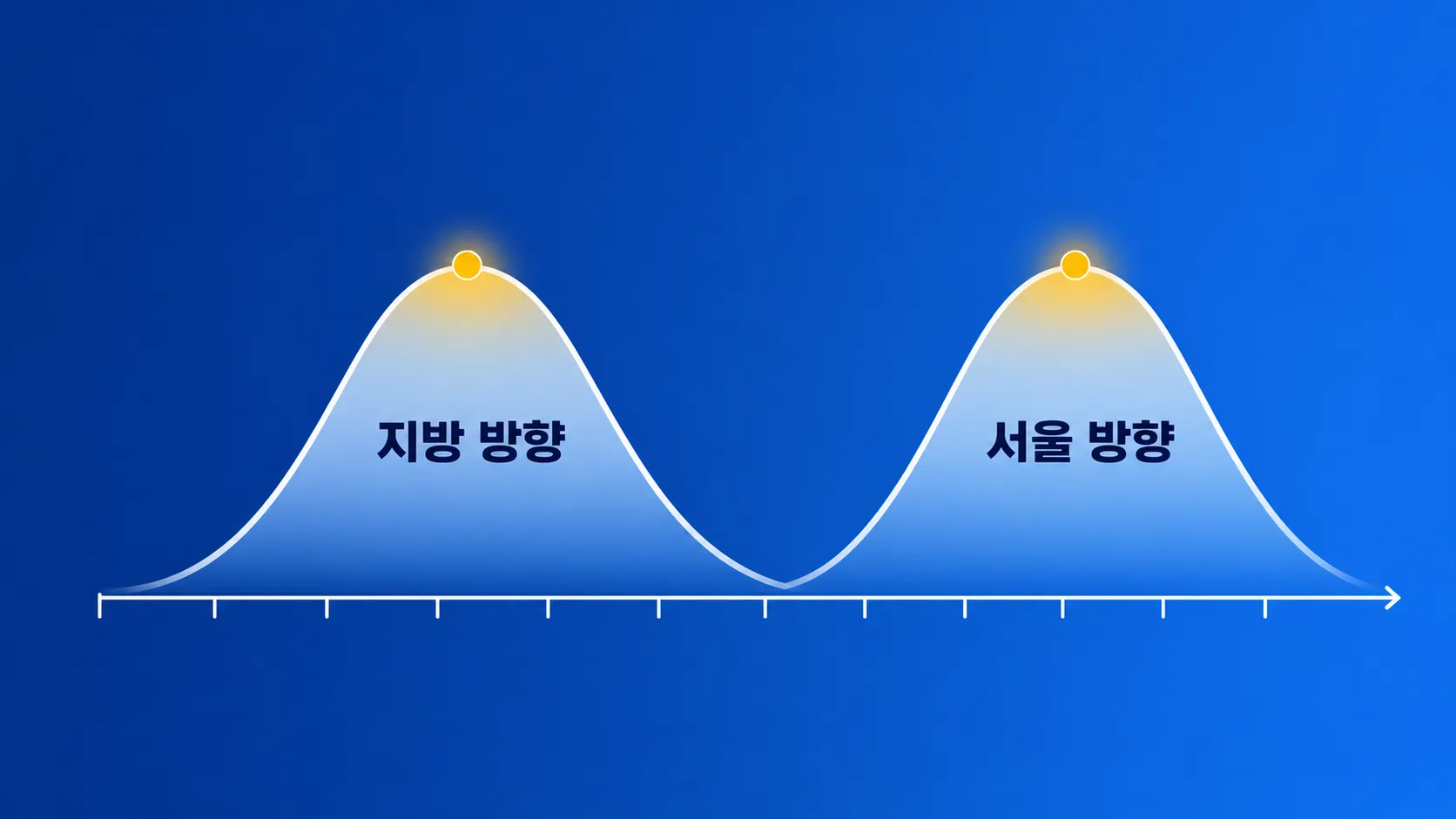
Toward the Provinces (Heading Out on Vacation)
- Main-line congestion starts around 8~9 AM — commuter traffic overlaps with vacation traffic
- Peaks at 12~1 PM — the most vehicles converge around lunchtime
- Clears up around 6~7 PM
Toward Seoul (Returning from Vacation)
- Congestion starts around 10~11 AM — cars that had breakfast at their vacation spot before setting off join the flow
- Worst around 5~6 PM — the peak on Sundays and the last day of vacation
- Congestion continues until around midnight — even a late-night departure isn’t fully safe
Differences by Departure Day — Which Days Are Less Crowded?
Vacation departure dates aren’t evenly spread out — they cluster around specific weeks. According to a survey by the Korea Tourism Organization and the Korea Expressway Corporation, July 27~August 2 had the highest share of departures at 19.2%, followed by August 10~16 (12.2%) and August 3~9 (8.8%).
| Departure Period | Congestion | Recommendation |
|---|---|---|
| Late Jul-Early Aug (7/27~8/2) | Very Heavy 🔴 | Leave at dawn |
| 2nd week of August (8/10~16) | Heavy 🟠 | Leave on a weekday |
| 1st week of August (8/3~9) | Moderate 🟡 | Relatively fine |
| Mid-July or late August | Light 🟢 | Best choice |
Weekdays vs. Weekends
- Weekday departure (Tue/Wed/Thu): Even on the same route, you can get through 30~40% faster than on a Saturday
- Friday evening: The worst — vacation traffic overlaps with weekend outing traffic
- Saturday morning: The single most congested time slot
- Sunday afternoon: The peak of return-trip congestion — jammed until midnight
If you can take Friday off, Thursday dawn departure → Sunday morning return is the best combination for avoiding congestion. Departing Saturday and returning Sunday evening is the pattern to avoid most.
Using Detour Routes — Routes Recommended by the Korea Expressway Corporation
When the main line is jammed, a detour is the answer. The Korea Expressway Corporation analyzes real-time traffic information, travel patterns, and road structure to recommend routes for major sections (source: Korea Expressway Corporation).

Examples of Common Detour Routes
- Gyeongbu Expressway, Daejeon section detour: Biryong JCT (Gyeongbu Expressway) → Daejeon Southern Ring Expressway → Sannae JCT → Daejeon~Jinju Expressway. Drivers headed to eastern Jeonbuk or western Gyeongnam can cut main-line congestion significantly by taking this route.
- Yeongdong Expressway detour: Spreading out onto the Jungbu Naeryuk or Jungbu Expressway can help you avoid congestion when entering Gangwon Province.
- Seohaean Expressway detour: Switching to an east-west route like the Pyeongtaek~Jecheon Expressway or the Dangjin~Yeongdeok Expressway lets you sidestep main-line congestion.
How to Check Real-Time Congestion and Detours
- Road Plus (roadplus.co.kr) — Expected-congestion traffic maps, weekend forecasts, and estimated travel times between major cities
- Expressway Traffic Information app — The Korea Expressway Corporation’s official free app, with real-time CCTV and detour guidance
- Expressway call center (1588-2504) — Get voice guidance while driving
Congestion-Avoidance Checklist
Just checking off these items before you leave can significantly cut the time you’d otherwise waste stuck in traffic.
- 1 day before departure: Check Road Plus’s weekend forecast (preview estimated travel times)
- 1 day before departure: Install the expressway traffic information app and register your favorite routes
- Day of departure: Plan to leave before 5 AM or after 8 PM
- Day of departure: Save one alternate detour route in advance (as a navigation favorite)
- Avoid crowded rest areas — use the next rest area instead of the popular one
- Return day: Avoid the 5~6 PM Sunday peak by leaving Saturday night or early Sunday morning
- While driving: Check real-time detour info via voice guidance at 1588-2504
Saturday morning is the single most congested time slot. The same distance can take 1.5~2 times longer than on a weekday, so it’s best to avoid it if you can.
FAQ — Frequently Asked Questions
When is the most congested week for summer vacation expressway traffic?
The last week of July~the first week of August, commonly called ‘late July, early August’, marks the peak. About 19% of vacationers depart during this single week. If possible, leaving after the second week of August or in mid-July is much smoother.
Does leaving at dawn really avoid the traffic?
Heading to the provinces before 5 AM gets you ahead of when main-line congestion begins. However, since more people leave at dawn during vacation season, things already start backing up after 6 AM, so departing between 4~5 AM is the safer bet.
Is a detour route really faster than the main line?
In sections where main-line congestion is severe, the detour often takes less time. That said, detour routes can also get jammed by accidents or construction, so check the travel times for both routes on Road Plus before you leave.
What should I do when a rest area is too crowded?
During vacation season, even the parking lots at large rest areas (Gapyeong, Jukjeon, Anseong, Sintanjin, etc.) can be hard to get into. Pushing on to the next rest area is often the faster strategy overall.
The traffic seemed to clear up, but then it jams again. Why?
Traffic clears temporarily after you pass a bottleneck (an IC junction, tunnel, or construction zone), then jams up again at the next one. Check congestion by section ahead of time on Road Plus’s ‘expected-congestion traffic map’ and adjust your departure time accordingly.
Summer vacation should be enjoyable. Just shifting your departure time earlier or later by an hour or two can dramatically cut the time you spend on the road. The day before you leave, take a quick look at the weekend forecast on the Korea Expressway Corporation’s Road Plus.