 EasyTicket
 If you got your July bill and wondered, ‘Why did it come out like this?’, the culprit is usually the progressive electricity tariff. In summer, running the air conditioner hard for just a few days can send your usage soaring, and once it crosses a certain threshold, the per-unit rate jumps up a tier. The bottom line: simply knowing which tariff tier your home is in can help you avoid most bill shocks. This guide covers the summer tier thresholds, how to calculate your bill yourself, and practical savings tips for 1~2-person households.
Why can summer electricity bills suddenly skyrocket?
Residential electricity rates rise per kWh as usage increases under a three-tier progressive tariff. Even if you use the same 100 kWh, your bill can differ by more than 2.5 times depending on whether that 100 kWh falls within Tier 1 or Tier 3.
As of 2026, the energy charges for residential (low-voltage) electricity are structured as follows.
- Tier 1: 120 won/kWh
- Tier 2: 214.6 won/kWh
- Tier 3: 307.3 won/kWh
The Tier 3 rate is about 2.56 times more expensive than Tier 1 (source: Korea Electric Power Corporation, or KEPCO). On top of that, once monthly usage exceeds 1,000 kWh—the so-called ‘super user’ threshold—the excess is charged at a punitive rate of 736.2 won/kWh. 1~2-person households rarely get that far, but all you need to remember is that the per-unit rate climbs like a staircase.
Summer tariff tiers work differently
Thankfully, the government widens the tier thresholds in summer. For usage from July 1~August 31, when air-conditioning demand peaks, the upper limit for each tier rises, so the same usage can stay in a lower tier.
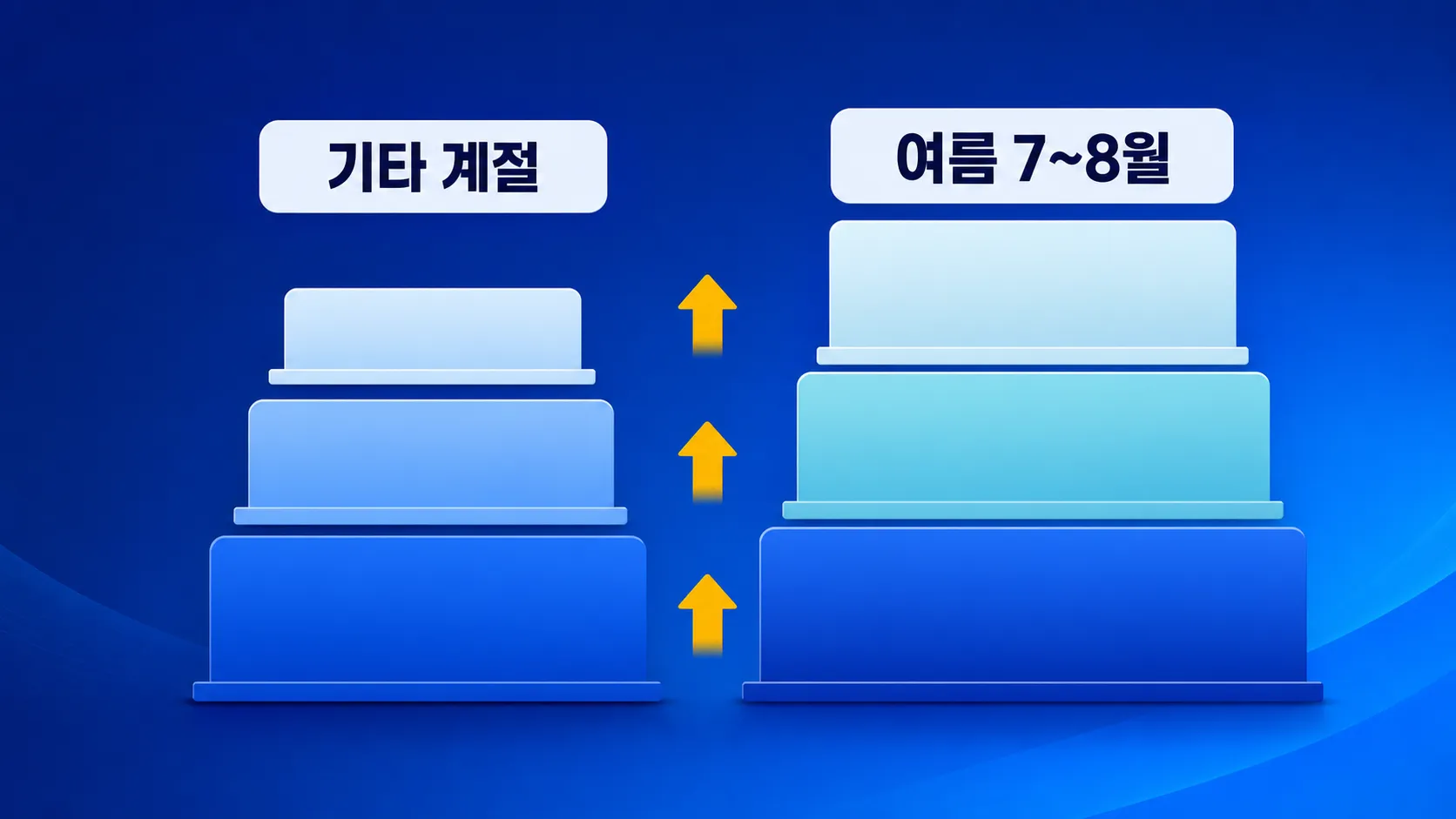
| Tier | Other seasons (9~6 months) | Summer (7~8 months) | Rate |
|---|---|---|---|
| Tier 1 | 200 kWh or less | 300 kWh or less | 120 won/kWh |
| Tier 2 | 201~400 kWh | 301~450 kWh | 214.6 won/kWh |
| Tier 3 | Over 400 kWh | Over 450 kWh | 307.3 won/kWh |
In summer, the Tier 1 cap rises by 100 kWh, from 200 to 300 kWh, and the Tier 2 cap expands by 50 kWh, from 400 to 450 kWh. In other words, staying at or below 450 kWh lets you avoid the most expensive Tier 3.
Your basic charge also varies by tier: 910 won for Tier 1 → 1,600 won for Tier 2 → a sharp jump to 7,300 won in Tier 3. Entering Tier 3 is a ‘double hit’: both the energy charge and the basic charge rise, with the latter increasing more than fourfold, so be especially careful.
How to calculate the progressive electricity tariff (try it yourself)
The key to calculating a progressive tariff is ‘split your usage across the tiers, then multiply each portion by its rate.’ You don’t multiply everything once; you divide it into layers and add them together. Here’s an example using the summer (7~8 months) rates.
Example 1) Monthly usage: 350 kWh
- Tier 1: 300 kWh × 120 won = 36,000 won
- Tier 2: 50 kWh × 214.6 won = 10,730 won
- Total energy charge = 46,730 won
- Add basic charge (Tier 2): 1,600 won
Example 2) Monthly usage: 500 kWh (entering Tier 3)
- Tier 1: 300 kWh × 120 won = 36,000 won
- Tier 2: 150 kWh × 214.6 won = 32,190 won
- Tier 3: 50 kWh × 307.3 won = 15,365 won
- Total energy charge = 83,555 won
- Add basic charge (Tier 3): 7,300 won
350 kWh and 500 kWh differ by 1.4 times in usage, but the energy charges widen to about 1.8 times. That’s because the rate jumps sharply as soon as usage crosses 450 kWh.
That covers the energy charge + basic charge. Your actual bill also includes the climate and environment charge, fuel cost adjustment charge, 10% value-added tax, and the electric power industry infrastructure fund. For the final amount, check KEPCO’s Cyber Branch electricity bill calculator or the KEPCO ON app.
How much air conditioning is too much for 1~2-person households?
People living alone or as a couple often use around 200~250 kWh a month. Since the summer Tier 1 cap is 300 kWh, most stay within Tier 1 under normal usage. The problem is Jul~Aug, when they start running the AC in earnest.
- Running a high-power floor-standing air conditioner for 8~10 hours a day every day can add 100~200 kWh a month.
- That can push a household normally using 220 kWh past 400 kWh into the upper end of Tier 2, and a little more can take it beyond 450 kWh into Tier 3.
That makes the hard limit for 1~2-person households ‘450 kWh or less for the summer month.’ Stay under it and you avoid both the most expensive Tier 3 and the 7,300-won basic charge. See this guide to summer electricity tiers, air-conditioner savings, and energy cashback for a combined rundown of energy cashback and savings tips.
You can check your home’s real-time usage in the KEPCO ON app. Take a look around mid-month; if you’re approaching 450 kWh, adjusting your AC use for the remaining days is the surest way to avoid a bill shock.
Practical tips for cutting your air-conditioning bill
If you can’t change the rate, reduce your usage. Here are the proven tips worth trying.
- ✅ Keep the target temperature at 26°C: Each 1°C lower setpoint increases power consumption by 7~10%. Keeping it at 26°C instead of 24°C can cut the bill considerably for the difference in comfort.
- ✅ Leave inverter air conditioners running: New inverter models are more efficient with continuous operation after fixing the target temperature than with repeatedly turning them off and on. Before reaching the setpoint, the outdoor unit runs hard; after reaching it, it runs gently.
- ✅ Clean the filter once every two weeks: Simply cleaning a dusty filter greatly improves cooling efficiency and can reduce electricity use.
- ✅ Clear and shade the outdoor unit: If the front of the outdoor unit is blocked or it receives direct sunlight, heat can’t escape and efficiency drops. Creating shade helps.
- ✅ Start on high fan, then switch to low/Auto: Quickly bring the temperature down on high, then switch to low or Auto mode to save power.
Block sunlight with curtains or blinds and run a fan alongside the AC to circulate cool air; then it stays comfortable even if you raise the set temperature. Stick to the inverter + 26°C + filter cleaning + curtains combination and you can usually avoid a bill shock even with the AC running 24 hours a day.
Get money back on your bill with energy cashback
There’s also a program that lets you get back in cash-like credit what you save. KEPCO’s Residential Energy Cashback program pays cashback per kWh based on the amount you reduce if your electricity use falls compared with the previous two years. Starting in July 2026, the savings threshold drops so that even a 1% reduction qualifies, with up to 120 won per kWh depending on the savings tier.
- Application: KEPCO ON (online) or the KEPCO customer center
- Eligibility: Residential customers, including apartment and detached-house residents
- How it works: Usage reduction × tiered rate, deducted from your bill or paid out
Build savings habits and claim cashback too, and you can ease the burden of summer cooling costs in two ways.
Frequently asked questions (FAQ)
I moved in the middle of July. How does the progressive tariff tier work?
The tier caps are prorated based on the number of days you use electricity. For example, if you use electricity for only half a month, the Tier 1 cap of 300 kWh is also reduced to roughly half. 1~2-person households that move or relocate frequently can end up in a higher tier than expected even over a short period.
Why is the progressive rate different in my studio apartment or officetel?
An officetel where the whole building uses general-use (commercial) rates may be billed at general-use rates rather than the residential progressive tariff. In that case, there is no summer tier relief, so check first with building management or on the bill whether the contract category is ‘residential’.
Is leaving the AC on 24 hours really cheaper?
If it’s an inverter model, leaving it on is often more economical than turning it off and on frequently for short periods. Older fixed-speed (non-inverter) units, however, keep drawing the same amount of power the longer they run, so leaving them on can cost more. Check whether your AC is an inverter model first.
Is there a way to check in real time if I’m worried about the bill?
Yes, the KEPCO ON app shows this month’s real-time usage and estimated bill. Check once around mid-month; if you’re nearing 450 kWh, adjust your usage for the remaining period to avoid Tier 3.
The key to summer electricity bills is simple: don’t let your summer-month usage exceed 450 kWh. Check your current tier in KEPCO ON once, keep up basic habits like 26°C and cleaning the filter, and your cooling costs will drop sharply. This summer, don’t dread opening the bill—do the math in advance and stay cool.