 EasyTicket
 Tapsa Temple sits inside Maisan Provincial Park in Jinan, Jeonbuk. It’s known for its roughly 80 stone pagodas, all stacked by hand over a lifetime by a lay Buddhist named Lee Gap-ryong. If you’re planning a trip to Maisan Tapsa in Jinan, here’s everything in one place — how to get there, parking, hours, hiking routes, and the legend behind the stone pagodas.
What Is Maisan Tapsa?
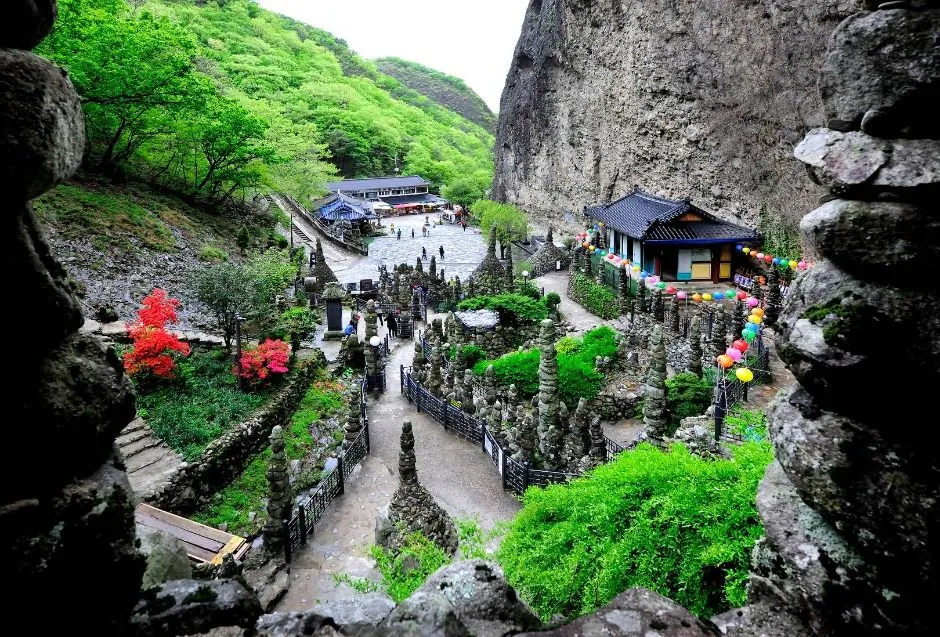
Maisan Tapsa is a temple located at 367 Maisannam-ro, Maryeong-myeon, Jinan-gun, Jeonbuk State. It sits inside Maisan Provincial Park, and it’s known as a route that pairs well with hiking.
Its biggest draw is the stone pagodas that densely fill the temple courtyard and surrounding area. Pagodas of every shape and size — straight columns, cone shapes, and more — stand at the foot of the mountain, and many visitors describe the sight as almost otherworldly. Behind the temple, a massive cliff wraps around like a folding screen, adding to the striking atmosphere.
The Legend Behind the 80-Some Stone Pagodas
The stone pagodas of Maisan Tapsa are said to have been built over an entire lifetime by a lay Buddhist named Lee Gap-ryong, who entered the mountain at age 25 and stayed until his death at 98. The story goes that during the turbulent years following the Imo Mutiny and the execution of Jeon Bong-jun, Lee lamented the troubled state of the world and, driven by a single-minded resolve to save the nation, retreated into the mountains to pray and build the pagodas.
The Names and Meanings of the Main Pagodas
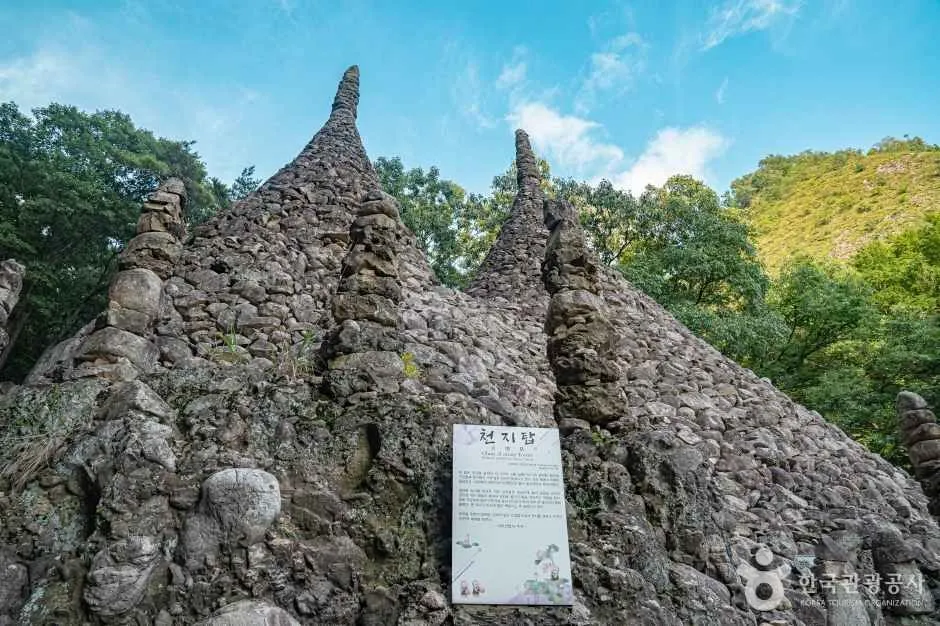
- Cheonjitap: A pair of pagodas standing behind the main hall (Daeungjeon). The largest and most iconic pagodas at Tapsa.
- Obangtap, Wolgwangtap, Ilgwangtap: Modeled after the cardinal directions and celestial bodies, each said to carry its own meaning.
- Yaksatap, Jungangtap, Wolgungtap, Yonggungtap, Sinjangtap: Each of these pagodas has its own distinct role and symbolism.
Most of the pagodas are either straight columns or cone-shaped, and their sizes vary widely. Of them all, the pair of Cheonjitap pagodas behind the main hall are the largest.
Visitor Info (Hours, Parking, Contact)
It’s worth checking the operating details before you go. Maisan Tapsa’s hours shift slightly between summer and winter.
| Item | Details |
|---|---|
| Hours (summer, Mar~Nov) | 08:00 ~ 18:00 |
| Hours (winter, Dec~Feb) | 08:00 ~ 18:30 |
| Closed | Open year-round |
| Parking | Available |
| Contact | 063-433-0012 |
| Address | 367 Maisannam-ro, Maryeong-myeon, Jinan-gun, Jeonbuk State |
Admission fees and operating policies for Maisan Provincial Park can change depending on the season. It’s a good idea to double-check the latest details on the Jinan County official website or by calling the number above before you visit.
Getting There and Hiking Routes
Since Maisan Tapsa sits inside Maisan Provincial Park, the usual route is to enter through the parking lot at the park entrance and walk up along the trail.
By Car
Your navigation app will get you there most accurately if you search “367 Maisannam-ro, Maryeong-myeon, Jinan-gun, Jeonbuk State” or “Maisan Tapsa.” There’s a parking lot inside the provincial park, but it can get crowded on weekends and holidays, so it’s best to head out early.
Hiking Route Guide
The trail connecting the park entrance to Tapsa is a relatively gentle walking path. Maisan gets its name from its two peaks, which are said to resemble a horse’s ears — and as you climb, you can take in that distinctive peak scenery along the way.
It’s an easy enough route for family trips or casual hikes. That said, some sections have stairs and slopes that can get slippery after rain, so it’s best to wear sneakers or proper hiking shoes.
Nearby Spots Worth Visiting
If Maisan Tapsa alone feels like too short a trip, here are a few points inside the provincial park you can add to your route.
Eunsusa Temple
Eunsusa is another temple inside Maisan Provincial Park, alongside Tapsa. It sits along the same trail leading from Tapsa, so the two are often recommended as a combined visit.
The Maisan Provincial Park Trail
The park is well known for its scenery in spring and fall, so if you have extra time, it’s worth continuing on for a light hike up to the park’s ridge as well.
Pre-Visit Checklist
- Check the hours (summer 08:00~18:00 / winter 08:00~18:30)
- Bring sneakers or hiking shoes (for slippery spots and stairs)
- Leave early on weekends and holidays (parking can fill up)
- Double-check the latest operating details on Jinan County’s official website
- Bring a camera, water, and a light snack
Frequently Asked Questions (FAQ)
Q. Is there an admission fee?
Maisan Provincial Park’s fee policy can vary by season and area. The most accurate way to check is on Jinan County’s official website or by calling ahead (063-433-0012).
Q. Are there any closed days?
Maisan Tapsa is open year-round. That said, access to certain areas may be restricted depending on weather conditions or temple events.
Q. Can I bring a stroller?
There’s no separate stroller accessibility information provided for this site. Since the route includes slopes and stairs, it’s better to use a baby carrier if you’re traveling with a young child.
Q. Did one person really build all of the stone pagodas?
According to the story that’s been passed down, a lay Buddhist named Lee Gap-ryong entered the mountain at age 25 and spent the rest of his life there until he passed away at 98, building the pagodas along the way. That’s how roughly 80 pagodas — including Cheonjitap, Obangtap, Wolgwangtap, Ilgwangtap, and Yaksatap — came to stand here.
Maisan Tapsa in Jinan is one of Korea’s standout destinations, thanks to the striking sight of roughly 80 stone pagodas rising out of the natural landscape. As long as you plan ahead for the hours, parking, and directions, it’s an easy trip to fit into a single day.
Image credits2
- 마이산 탑사 - 한국관광공사 (출처표시+변경금지)
- 마이산탑사 (5) - 한국관광공사 (출처표시)