 EasyTicket
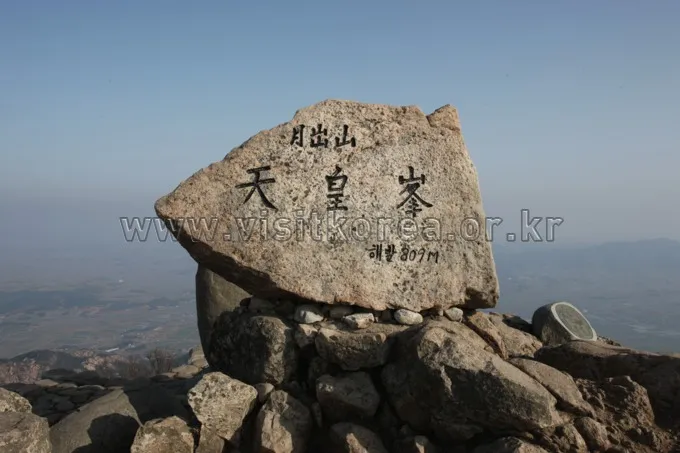
 The Wolchulsan Suspension Bridge in Yeongam can be visited on a round-trip course of 3.0 km that starts from the Cheonhwang Visitor Center and takes about 2 hours. There’s no national park admission fee, and if you’re new to hiking, the smart move is to turn back at the suspension bridge instead of pushing on to the summit (Cheonhwangbong Peak). That said, the short distance packs in some steep sections, so it matters a lot more to know in advance where you’re likely to run out of steam.
What Kind of Bridge Is the Wolchulsan Suspension Bridge?
It’s a suspension bridge connecting the rocky ridges of Maebong and Sirubong peaks. It hangs at a point 510 m above sea level and 120 m above the ground, spanning 54 m in length with a walking width of 1 m. When it was first built in 1978, it was a one-way bridge only 0.6 m wide; it was replaced with its current form in May 2006, which made two-way crossing possible.
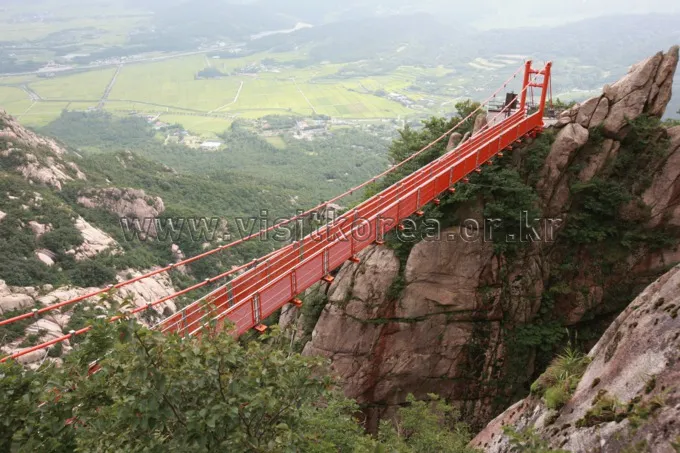
In other words, it’s less a “swing bridge experience” and more a pass-through section built into the middle of the trail. So the whole course really comes down to how you handle the 40 to 60 minutes it takes to climb up to the bridge, not just the bridge itself.
Difficulty and Time by Section, for Beginners
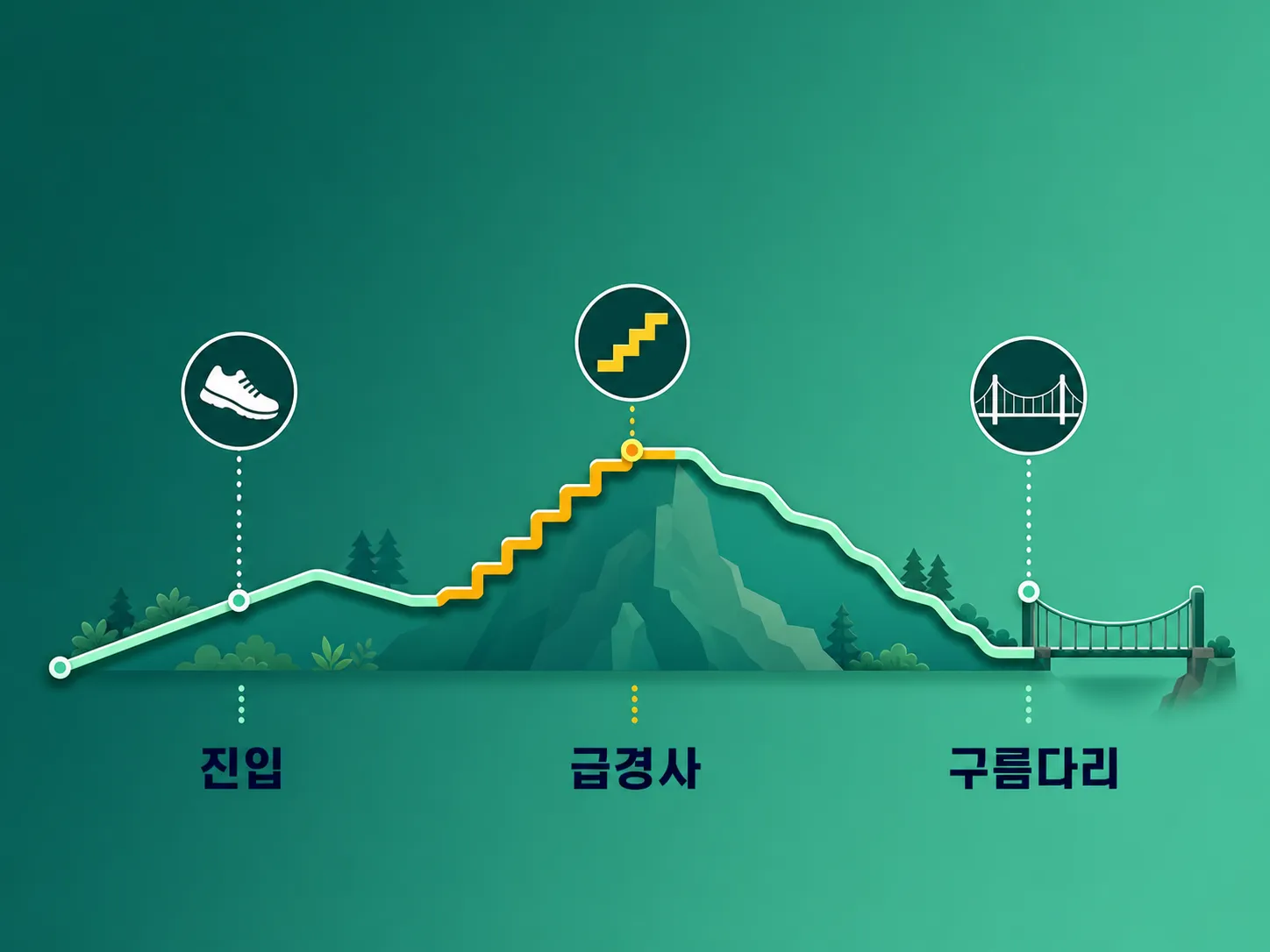
The route runs from the Visitor Center → Cheonhwangsa Temple → the suspension bridge → Barampokpo (Wind Falls) Junction → back to the starting point. After laying out the map and reworking the route a few times, I found that beginners feel more at ease thinking of it in the three chunks below.
| Section | Standard Time | What Beginners Feel |
|---|---|---|
| Visitor Center → Cheonhwangsa Temple | 15 min | Gentle approach road, a warm-up stretch |
| Cheonhwangsa Temple → Suspension Bridge | 40–60 min one way | Steady steep slopes and stairs — this is where people struggle |
| Suspension Bridge → Barampokpo Junction → back to start | 3.0 km round trip, about 2 hrs total | Mostly downhill, hard on the knees |
Cheonhwangsa is a small temple you reach about 15 minutes up the approach road. It burned down in a fire in 2001, and three of its buildings were restored in 2017. Up to this point it feels more like a stroll — you might think, “this is easier than I expected” — but the real climb starts right after.
The suspension bridge section is classified as beginner-friendly because it’s short, but it’s packed with continuous steep slopes that drain your stamina. Warming up and bringing enough water before you set out are essential.
Before You Go: Entry Hours and Parking
The thing that trips people up most is the designated entry-hours system. Even I got confused checking the summer and winter schedules — here’s how it breaks down.
| Item | Details |
|---|---|
| Entry hours (summer, Apr–Oct) | 4:00 AM – 3:00 PM |
| Entry hours (winter, Nov–Mar) | 5:00 AM – 2:00 PM |
| Admission fee | None (free) |
| Parking | Cheonhwang Parking Lot, 439 spaces, paid |
| Inquiries | Wolchulsan National Park Office |
Here, 3:00 PM (or 2:00 PM) is the cutoff time for entering the trail, not the time you need to be back down. Since the round trip is about 2 hours, beginners are safer starting in the morning rather than right before the cutoff. In spring (March to late April) and fall (mid-November to mid-December), parts of the trail may be closed, so check the control status on the national park’s official website the day before you go (Source: Korea National Park Service).
Beginner Checklist — Just Pack These
- At least 1 L of water (no shops along the steep section)
- Hiking boots that support your ankles — the trail is mostly stairs and rocky paths, so sneakers get slippery on the way down
- A pair of trekking poles (to protect your knees on the descent)
- A thin windbreaker — the suspension bridge sits on a ridge, so wind cuts through
- Check the entry cutoff time before you leave, and set a target time to be back down
If it were me, I’d plan to take photos at the suspension bridge and turn back right away. Continuing on to Cheonhwangbong Peak calls for traverse-level stamina, and even just the Cheonhwangsa–Dogapsa section alone takes 6 hours.
A Meal After the Hike — Yeongam’s Dokcheon Octopus Street
If you’ve come all the way to Yeongam, it’d be a shame to skip Dokcheon Octopus Street. Around 15 octopus restaurants cluster around the Dokcheon five-day market in Haksan-myeon, and the market finished a facilities modernization in 2019 (Source: Yeongam County).
The signature dish is gallaktang, a soup of beef short rib broth with octopus. As the story goes, it started around 1981, when the completion of the Yeongsan River Estuary Bank shrank the local octopus mudflats — a resident began tossing octopus into galbitang (short rib soup), and the dish was born. It’s now considered one of Yeongam’s signature local foods, running around 20,000 won depending on the restaurant. There’s no better combination for refueling after a hike than a bowl of this broth.

Frequently Asked Questions (FAQ)
Is it okay to just go up to the suspension bridge and come back down?
Yes, that’s the standard beginner course. The route from the Visitor Center to Cheonhwangsa Temple to the suspension bridge to Barampokpo Junction and back to the start is officially listed as one course, at 3.0 km and about 2 hours total. If you want to continue on to the summit, you’ll need a completely different plan for stamina and time.
If the entry cutoff is 3:00 PM, what time should I start?
The summer cutoff is 3:00 PM, and the winter cutoff is 2:00 PM. Since the round trip takes about 2 hours, starting right before the cutoff means you’ll be coming down as it’s getting dark. For beginners, starting in the morning is recommended.
I’m afraid of heights — can I still cross it?
It’s a 1-meter-wide bridge, 120 meters above the ground. Since the 2006 replacement, two-way crossing has been possible, so there’s now room to step aside when you meet someone coming the other way — but the structure that lets you see straight down beneath your feet hasn’t changed. If that feels like too much, hiking just up to the viewpoint in front of the bridge still gives you a full view of the gorge.
Does the trail get closed in spring or fall?
Yes. In spring (March to late April) and fall (mid-November to mid-December), parts of the trail may be closed due to wildfire-prevention periods and similar measures. Be sure to check whether the suspension bridge section is open before you set out.
In short, the Wolchulsan Suspension Bridge is a course that’s short on distance but heavy on incline. If you go in trusting only the numbers — 3.0 km, 2 hours — you’ll be caught off guard by the stairs behind Cheonhwangsa Temple; but if you brace yourself for the steep climb instead, you’ll likely reach the bridge faster than expected. As long as you respect the entry cutoff time and bring water, this makes a solid first national-park course for a hiking beginner.
Image credits4
- 📷 박성근 / 한국관광공사 포토코리아 (공공누리 출처표시)
- 📷 관광환경개선팀 / 한국관광공사 포토코리아 (공공누리 출처표시)
- 영암_월출산국립공원 (2) - 한국관광공사 (출처표시+변경금지)
- 월출산 촬영:한국관광공사 김지호 / 한국관광공사 포토코리아 (공공누리 제1유형)