 EasyTicket
 When you’re filling up your overseas shopping cart, the most confusing question is always “do I have to pay tax on this?” The short answer: if the item price is US$150 or less (US$200 or less for items shipped from the US), customs duty and VAT are waived. That one line covers almost everything about direct-purchase import taxes — but if you don’t know how “item price” is actually calculated, or why going even slightly over the limit suddenly triggers a tax bill, it’s easy to lose money. EasyTicket put together the customs thresholds and clearance process from scratch, written for anyone about to make their first direct overseas purchase.
The Duty-Free Threshold for Direct Overseas Purchases: Just Remember This One Number
The first number to remember is $150. If an item you bought for personal use is priced at $150 or less, both customs duty and VAT are waived. There’s one exception, though: items shipped from the US are duty-free up to $200, thanks to a special courier-shipment provision in the Korea-US FTA.
The key point to watch is that this “$200 threshold” doesn’t apply just because it’s a US brand — it only applies when the item is an express-courier shipment actually sent from the US. Even for the same US brand, if the warehouse is in Europe or China, the $150 threshold applies instead.
| Shipping Country | Duty-Free Threshold (Item Price) | Basis |
|---|---|---|
| Express courier from the US | $200 or less | Korea-US FTA special provision |
| All other countries | $150 or less | Customs Act low-value exemption |
These amounts are in US dollars, not Korean won. The won equivalent of the limit shifts slightly depending on the exchange rate.
What Exactly Counts Toward the “Item Price”?
This “item price” is exactly what trips people up when figuring out the duty-free limit. It’s not just the sticker price of the product. It’s calculated as item price = product price + any tax and local shipping fees incurred within the shipping country.
So if you bought a $130 piece of clothing on a US site and local tax plus domestic US shipping added $25, the item price comes out to $155. This is exactly how people end up getting taxed after assuming “I’m under $150” by looking only at the product price.
On the other hand, international shipping (the overseas~Korea delivery fee) to Korea is not included in the item price used to determine duty-free eligibility. That said, once tax is actually calculated (the dutiable value), international shipping does get added in — so you need to keep the eligibility check and the tax calculation separate.
Only Pay Tax on the Amount Over $150? No — the Whole Amount Gets Taxed
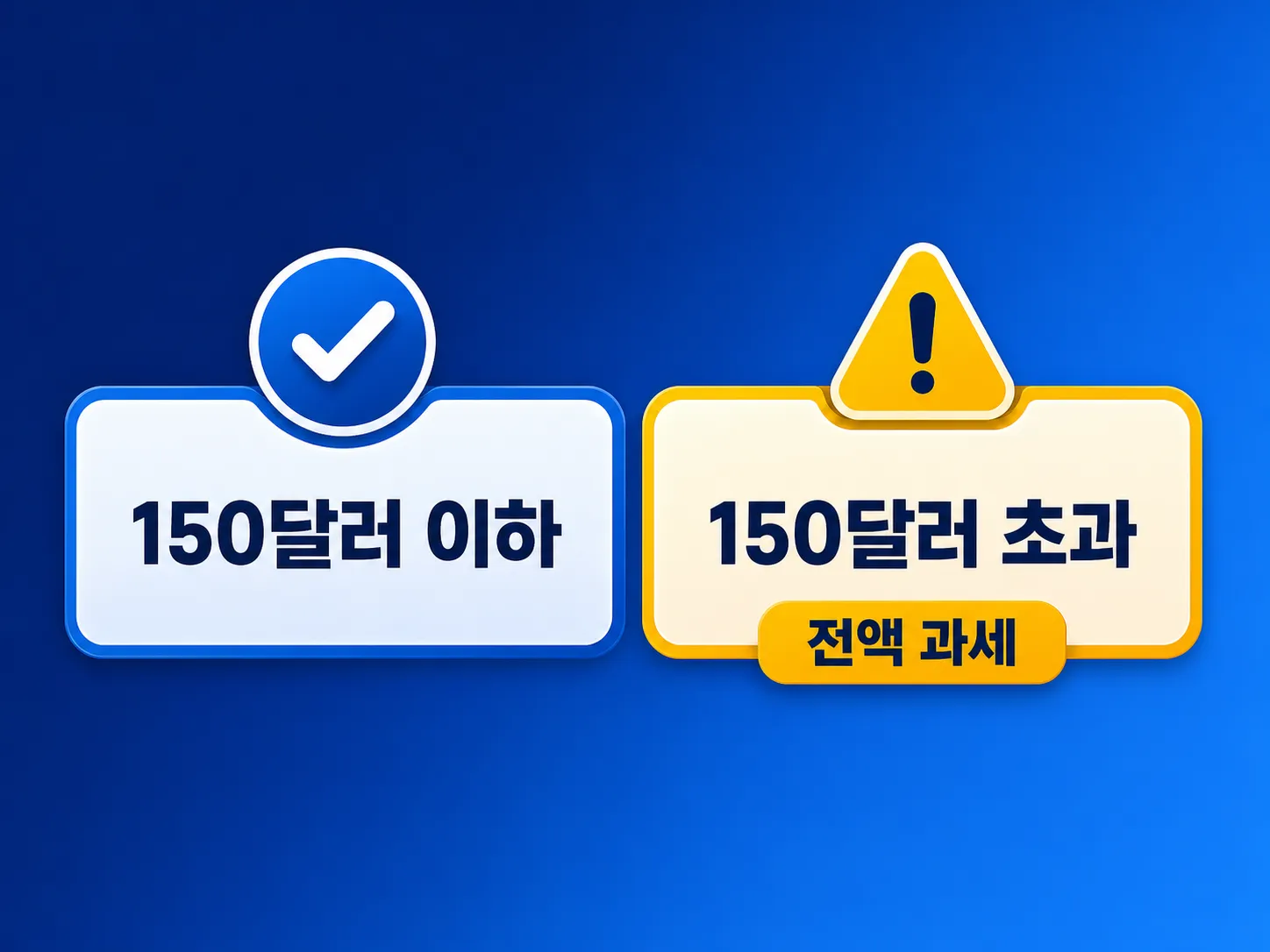
This is the most commonly misunderstood part. Once you go over the duty-free limit, it’s not just the excess that gets taxed — the entire amount becomes taxable.
For example, if you bought $205 worth of goods, tax isn’t calculated on the $5 you went over — it’s calculated on the dutiable value of the full $205 plus international shipping. That means being just $5 over the limit could cost you tens of thousands of won more. That’s why, when you’re hovering around $150 (or $200), it often pays to trim your cart.
List Clearance vs. General Clearance: What’s the Difference?
When your direct-purchase order enters Korea, it goes through customs one of two ways. Understanding the difference explains why some items get taxed and others don’t.
- List clearance: For personal-use items priced at $150 or less ($200 or less from the US), the courier simply submits a manifest and skips a formal import declaration. No customs duty or VAT, and clearance is faster.
- General clearance: If you’re over the duty-free limit, or the item is excluded from list clearance, a formal import declaration is required. This is when customs duty and VAT get charged.
Items Excluded From List Clearance — Regardless of Price
This is the key trap. The items below are subject to a formal import declaration even at $150 or under — they don’t qualify for list clearance — so you can end up owing customs duty and VAT with no duty-free benefit at all.
Medicines, medical devices, health functional foods (dietary supplements), food products, alcohol, tobacco, agricultural products and herbal medicine ingredients, and items subject to quarantine are all excluded from list clearance. Buying supplements or vitamins is the classic case that runs into this.
If you bought $100 worth of health functional foods and still got a tax bill, this exclusion rule is exactly why.
How Are VAT and the Simplified Tariff Rate Calculated?
Once an item becomes taxable, VAT is calculated like this: VAT = (dutiable value + customs duty + individual consumption tax + education tax, etc.) × 10% (source: Korea Customs Service). The dutiable value is the CIF value — the item price plus international shipping and insurance.
Duty rates vary by item category, but for personal direct purchases, most are calculated simply using a simplified tariff rate. If you want the exact figure, you can enter the item and price into the Korea Customs Service’s Estimated Tax Calculator for Overseas Direct Purchases to check in advance. It’s a good habit to calculate your real total cost, tax included, before you check out.
Combined Taxation — Splitting Your Order Doesn’t Help
If you place multiple orders from the same overseas seller on the same day, the amounts get combined for tax purposes. Splitting your cart into two orders to dodge the $150 limit doesn’t work if it’s the same seller on the same day. However, since November 2022, items bought from different sellers are exempt from combined taxation even if they arrive on the same date (source: Korea Customs Service). In other words, if the sellers are different, you don’t need to worry.
Personal Customs Clearance Code: Renewal Required Every Year Starting 2026
The Personal Customs Clearance Code (PCCC) is what you use instead of your resident registration number when making a direct purchase. It’s a 13-digit code starting with “P,” issued for free on the Korea Customs Service’s UNI-PASS website. Since December 2020, submitting this code has been mandatory for list clearance too.
A big change arrives in 2026. Until now, once you got this code, you could keep using it indefinitely — but now a 1-year validity period has been introduced.
- If you get your code from 2026 onward: valid for 1 year from the issue date
- If you got your code before 2026: it expires on your birthday in 2027
- If you don’t renew within 30 days before or after the expiration date, it’s automatically cancelled
- Updating your info or reissuing the code within the validity period automatically extends it 1 year from that date
If the address or postal code registered to your customs code doesn’t match your actual delivery address, clearance can get held up. If you’ve moved, update your information before making your next direct purchase.
Checklist Before Your First Direct Purchase
- Personal Customs Clearance Code issued (check validity period and address)
- Confirm the item price is $150 or less ($200 or less from the US)
- Judge based on product price plus local tax and shipping combined
- Check whether the item is excluded from list clearance (supplements, medicines, etc.)
- Check for duplicate same-day orders from the same seller (combined taxation)
- If it’s borderline, calculate the tax in advance with the Customs Service’s estimated tax calculator
Frequently Asked Questions (FAQ)
My Supplements/Vitamins Were Under $150 — Why Was I Still Taxed?
Health functional foods are excluded from list clearance, so they require a formal import declaration regardless of price. That means customs duty and VAT can apply even under $150. Always check whether an item is on the exclusion list before you buy.
Is Anything From a US Brand Automatically Duty-Free Up to $200?
No. The $200 threshold only applies to express-courier shipments actually sent from the US. Even for a US brand, if it ships from another country, the $150 threshold applies.
If I Go Over $150, Am I Only Taxed on the Excess?
No. Tax is charged on the dutiable value of the entire amount plus international shipping — not just the excess. If you’re close to the limit, it’s worth trimming your cart.
I Got My Customs Code a While Ago — Can I Keep Using It as Is?
A validity period was introduced starting in 2026, so if you got your code before then, it expires on your birthday in 2027. If you don’t renew within 30 days before or after that date, it’s automatically cancelled — so take care of it ahead of time.
Just keeping these thresholds in mind before you add items to your cart can go a long way toward avoiding unexpected taxes or clearance delays. The customs code validity period, in particular, is a brand-new rule this year, so if it’s been a while since your last direct purchase, we’d recommend checking your code’s status first.
Sources
- Easy-to-Find Living Legal Information - Taxation and Duty Exemption for Overseas Direct Purchases, Calculating Customs Duty and VAT
- Korea Customs Service - Estimated Tax Calculator for Overseas Direct Purchases
- Korea Customs Service - Personal Customs Clearance Codes Must Be Renewed Annually Starting 2026
- Korea Customs Service - Combined Taxation Exempted for Overseas Direct-Purchase Items Even With the Same Arrival Date
- Government24 - Issuing a Personal Customs Clearance Code