 EasyTicket
 When you’re getting ready for your child’s first trip abroad, there’s a moment when you wonder, “Do I really need travel insurance?” The short answer: for family trips abroad, it’s safer to get travel insurance. Kids especially tend to need a doctor more often than you’d expect — jet lag, unfamiliar food, and the change of water all add up — and overseas medical bills can run anywhere from tens of thousands of won to well over a hundred thousand, even for something as simple as a cold. In this article, we’ll break down how to choose overseas travel insurance coverage by category, and the catch with free credit-card insurance, from the perspective of parents in their 30s and 40s.
Why Do Families Need Overseas Travel Insurance?
Travel insurance covers the risks that can come up on a trip abroad — bodily injury, illness, damaged or stolen belongings, liability for harming others — all in one policy. Even if you already have domestic indemnity health insurance, that doesn’t mean your medical bills overseas are automatically covered. That’s why you need to check your limits for overseas injury and illness medical coverage separately.
There’s a reason family trips make this coverage even more important.
- Kids get sick more easily: Jet lag and unfamiliar food can bring on a fever or upset stomach, and a trip to a local pediatrician or ER can run into the hundreds of thousands of won in places like the US or Europe.
- More travelers, more chances of an accident: If your child breaks something at the hotel or causes harm to someone else, liability coverage has you covered.
- More baggage, more risk: Strollers, cameras, laptops — the more you bring, the higher the risk of damage or theft.
Children under 19 can be enrolled under a separate child plan. Signing up as a “family plan” that covers everyone under one policy is easier to manage than buying separate policies for each person.
How to Choose Coverage, Category by Category
Travel insurance is built by combining riders (coverage categories). Here they are, ranked by priority for family trips.
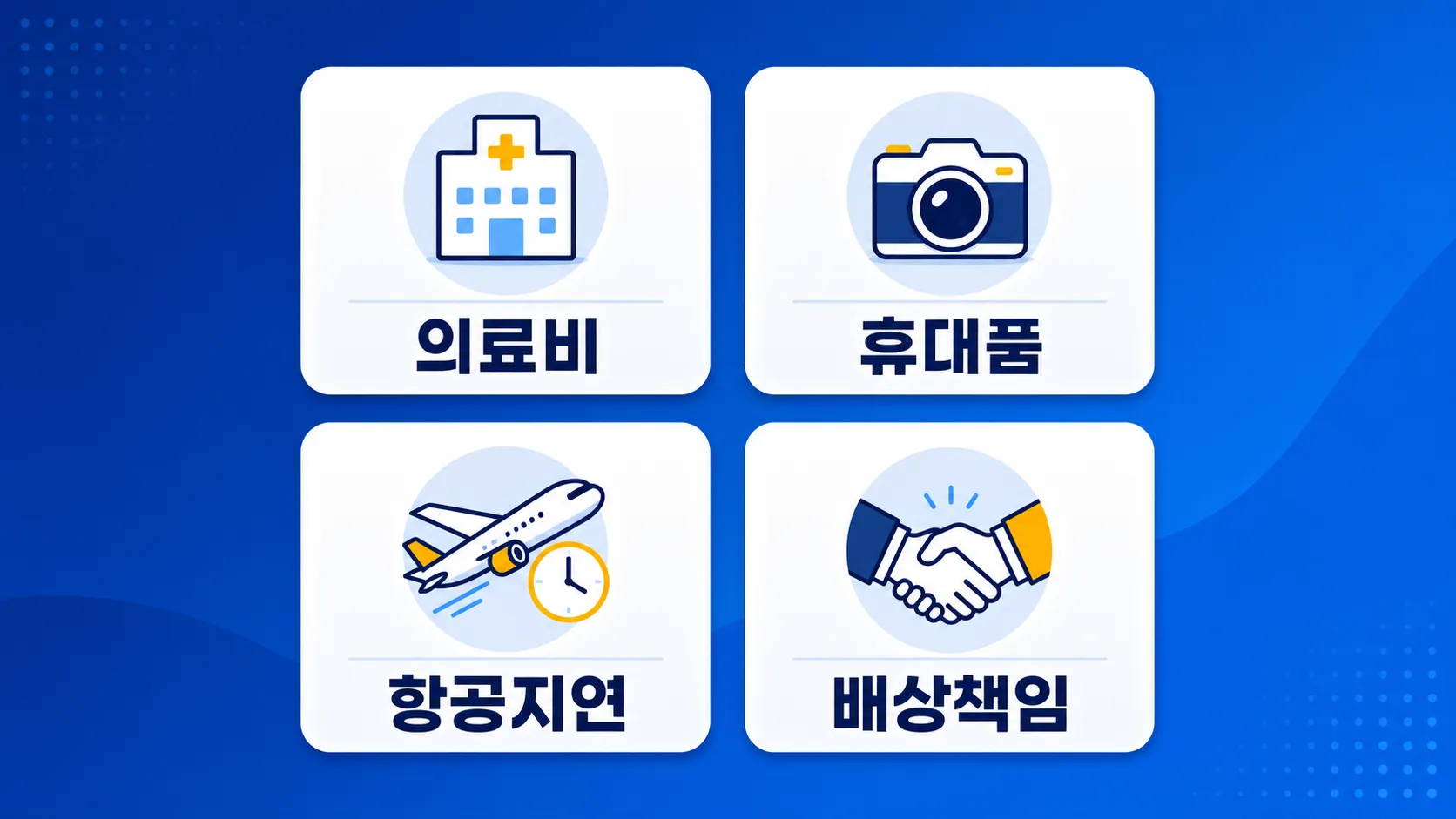
Priority 1: Overseas Medical Expenses (Most Important)
This is the first thing to check. Confirm your injury and illness medical limits separately. As a general rule, aim for at least 10 million won in coverage, and if you’re headed somewhere with high medical costs like the US or Canada, 50 million won or more is the safer bet. If you’re traveling with kids, it’s worth padding the limit further to account for pediatric visits and ER trips.
Priority 2: Personal Belongings
This covers damage or theft of your phone, camera, laptop, or luggage. That said, most policies exclude simple loss (as opposed to theft), and cash or credit cards inside a wallet aren’t covered either. There’s usually a per-item limit (say, 200,000 won) and a deductible, so if you’re bringing expensive gear, look for a policy with a higher limit.
Priority 3: Flight Delay Compensation
If your flight is delayed or canceled beyond a certain point, this covers your lodging and meal costs. Most policies reimburse actual expenses once the delay passes six hours. Waiting at the airport with kids tends to rack up more in food and snacks than you’d expect, so this is worth having if you have a layover or you’re traveling in peak season.
Priority 4: Liability
This protects you if you accidentally cause bodily harm or property damage to someone else during the trip. It’s a genuinely useful rider for family trips, where a child might break something at the hotel or bump into another guest.
Premiums and Coverage at a Glance
Even for the same 4-night, 5-day trip, your premium varies by age, destination, coverage amount, riders, and whether you’re insuring the whole family together. Here’s how it typically breaks down into three tiers.
| Tier | Premium (Per Person) | Medical Limit | Belongings | Flight Delay |
|---|---|---|---|---|
| Basic | 5,000–8,000 won | 10 million won (injury) | Not covered | Not covered |
| Standard | 10,000–15,000 won | 30 million won (injury + illness) | 500,000 won | Partial |
| Premium | 20,000–30,000 won | 100 million won (injury + illness) | 1 million won | Included |
Even insuring a family of four with a standard plan for a 4-night, 5-day trip usually only adds up to tens of thousands of won in total. Given the risk of a child needing medical care, it’s worth going with at least a standard plan that includes illness coverage, rather than the basic tier.
Can You Rely on Free Credit Card Travel Insurance Alone?
Some credit card companies offer free travel insurance as a card perk or a booking incentive. It’s convenient, but the coverage is often thin, so trusting it blindly can be risky.
- Free policies often pair a large death benefit (say, 100 million won) with surprisingly low injury and illness medical limits.
- For example, auto-enrolled card insurance may cap belongings coverage at as little as 200,000 won per item (with a 10,000 won deductible).
- Some cards only trigger automatic enrollment if you pay for your entire round-trip airfare on that card.
Don’t assume “my card already includes travel insurance” is enough. Always check the enrollment conditions, medical limits, and whether family members are covered — and if it falls short, fill the gap with a separate travel insurance policy. Pay special attention to whether the medical limit for your child is sufficient.
I Already Have Health Insurance — Isn’t Travel Insurance Redundant?
This trips a lot of people up. The key concept is proportional reimbursement. Travel insurance’s medical rider pays out based on your actual medical expenses, up to the policy limit — so any domestic medical costs already reimbursed by your indemnity health insurance won’t be paid out twice.
- Domestic medical costs: If you already have indemnity health insurance, travel insurance won’t pay out on top of it (proportional reimbursement applies).
- Overseas medical costs: This falls outside what indemnity health insurance covers, which is exactly where travel insurance’s overseas medical rider earns its keep.
So carrying both a life-insurance-type and a general-insurance-type travel policy for the same trip is inefficient. The simplest way to think about it: keep your indemnity health insurance as-is, and use travel insurance to fill the gaps — mainly overseas medical expenses, belongings, and flight delays.
Filing a Claim: The Documents You Need
If you don’t gather the right paperwork on the ground, it’s hard to get reimbursed later. Here’s what to prepare for each situation.
- Hospital treatment: Medical certificate (with diagnosis code or diagnosis name), medical receipt, itemized billing statement, prescription
- Theft of belongings: Report it to local police and be sure to get a police report → file your claim after you return home
- Damaged belongings: Photos of the damage, repair estimate or receipt
- Flight delay: Delay/cancellation confirmation, receipts for any extra lodging or meals
For theft, compensation is nearly impossible without a local police report. If something is stolen, don’t panic — head to the nearest police station and get a report filed first. Also keep in mind that cash and cards inside a stolen wallet generally aren’t covered.
Frequently Asked Questions (FAQ)
Can my child be insured separately from the rest of the family?
Yes — children under 19 can be enrolled under a child plan. That said, if you’re traveling together as a family, putting parents and children on a single family policy tends to be easier to manage and file claims for.
Is a family member who’s pregnant or has a pre-existing condition covered?
Coverage related to pregnancy and childbirth, or pre-existing conditions, may be limited or excluded depending on the policy. Be sure to check the exclusions in the terms before signing up, and contact the insurer directly if you need to confirm whether a rider applies.
Can I sign up at the airport on the day I leave?
You can, but signing up online in advance is usually cheaper and gives you more room to fine-tune your coverage. Make sure to enter your exact travel dates when signing up so your coverage doesn’t end up starting after your actual departure time.
Is simply losing something covered too?
No. Belongings coverage pays out for theft or damage, and most policies exclude simple loss (like leaving something behind). Even for theft, you’ll need a police report before a claim can move forward.
Final Checklist
Going through your family’s overseas travel insurance in this order helps you avoid mistakes.
- Check your overseas medical limit first (50 million won or more if you’re headed to the US or Canada)
- Confirm illness coverage is included, not just injury
- If you’re bringing expensive gear, check the belongings limit and deductible
- If you have a layover or you’re traveling in peak season, make sure flight delay coverage is included
- Remember that free credit card insurance tends to be thin — fill the gap with a separate policy
- Keep your indemnity health insurance as-is, and lean on travel insurance mainly for overseas medical expenses
When you’re traveling with your kids, “what if they get sick” is probably your biggest worry. Setting a generous medical limit from the start makes the whole trip easier to enjoy. Compare a few options and pick the one that fits your family’s travel style.