 EasyTicket
 “Is it okay to eat last night’s delivery leftovers today?” “Will the lunchbox I left on my desk still be fine by lunchtime?” Come summer, everyone wonders this at least once. The short answer: 90% of summer food poisoning prevention comes down to “temperature.” It’s all about how quickly you get food out of the 5~60℃ range that bacteria love most. We’ve pulled together just the essential numbers, geared toward office workers who live on lunchboxes and delivery, and families prepping baby food and snacks.
🌡️ The Most Important Number: The 5~60℃ Danger Zone
If you remember only one thing about food poisoning prevention, make it this: 5℃~60℃ is the “danger zone” where food poisoning bacteria multiply most aggressively. Within this range, bacteria explode in number. They grow fastest of all around 32~43℃ — right around indoor and in-car temperatures in summer.
So the rule is simple: keep cold food at 5℃ or below, and hot food at 60℃ or above. The key is spending as little time as possible passing through this danger zone.
| Range | Temperature | Status |
|---|---|---|
| Frozen storage | -18℃ or below | Safe (growth stopped) |
| Refrigerated storage | 5℃ or below | Safe (growth suppressed) |
| Danger zone | 5~60℃ | Dangerous (rapid bacterial growth) |
| Hot holding | 60℃ or above | Safe (growth suppressed) |
You need to pass through the danger zone quickly, within 4 hours. When cooling food, cool it from 60℃ to 21℃ within 2 hours, then from 21℃ down to 5℃ within another 2 hours.
❄️ What’s Your Fridge Temperature Right Now?
Have you ever actually checked your refrigerator’s temperature? The Ministry of Food and Drug Safety (MFDS) recommends keeping refrigerated food at 5℃ or below and frozen food at -18℃ or below. But in summer, when the door gets opened and closed constantly, the actual temperature can easily creep higher than that.
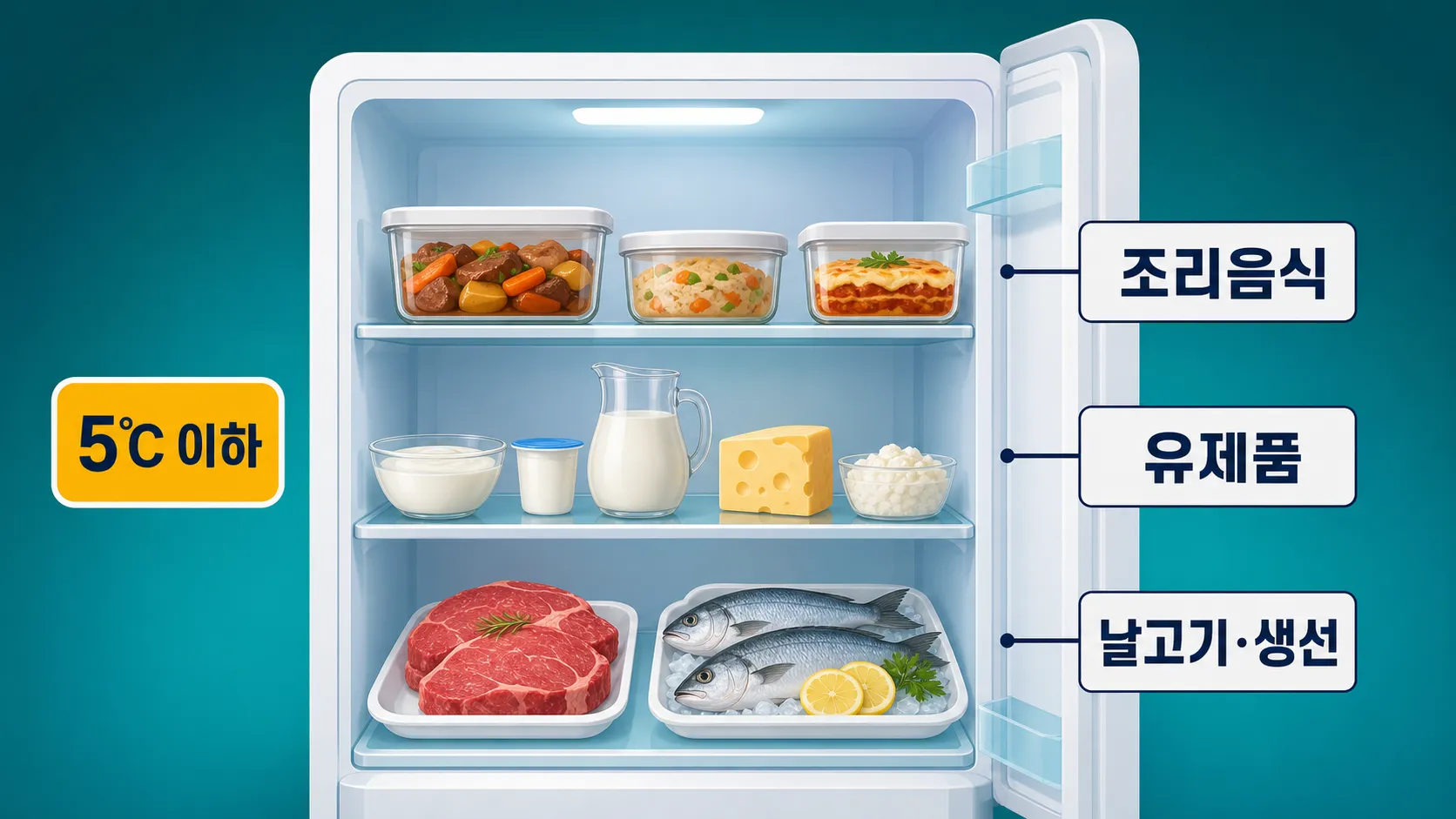
- Keep the fridge compartment at 5℃ or below — check with a thermometer, and don’t pack it too full (it blocks cold air circulation).
- Keep the freezer at -18℃ or below — at this temperature, bacteria stop growing (though they aren’t killed).
- The door shelves run warmer — store sensitive items like milk and eggs further back, in the interior.
Arranging food to prevent cross-contamination matters too. Keep cooked food on upper shelves and raw meat or fish on the bottom shelf, so that any drips from raw food fall downward without contaminating cooked food.
🍱 The “2-Hour Rule” for Lunchboxes and Delivery
If you’re an office worker, sticking to just this one rule gets you halfway there: don’t leave cooked or purchased food at room temperature for more than 2 hours. And on heatwave days when the daytime temperature tops 30℃, cut that down to within 1 hour (Source: Ministry of Food and Drug Safety).
- Leaving a lunchbox packed in the morning on your desk is risky — bacteria grow even at office room temperature. Refrigerate it if you can, and if not, an ice pack plus an insulated bag is a must.
- Refrigerate delivery leftovers immediately — put them in the fridge before you finish eating and clean up, not after. Leaving food at room temperature and refrigerating it later is too late.
- Food that’s spent a long time in the danger zone isn’t safe even after reheating — toxins produced by some bacteria don’t disappear even when boiled.
For gimbap or lunchboxes on outings and picnics, use a cooler or insulated bag with an ice pack to keep food at 5℃ or below. A car trunk can reach 60℃ in summer, so never store food there.
It also helps to know how long leftover delivery food keeps in the fridge.
| Food | Refrigerated Shelf Life | Note |
|---|---|---|
| Fried rice / rice dishes | Within 24 hours | Risk of Bacillus cereus growth |
| Pizza | Up to 2 days | Reheat thoroughly |
| Fried chicken | Up to 3 days | Reheat until piping hot inside |
🥚 Summer’s Biggest Threat: Salmonella and Eggs
Salmonella is a name that comes up constantly in summer food poisoning news, and eggs are its main source. Salmonella thrives best around 37℃ — right at human body temperature and summer room temperature.
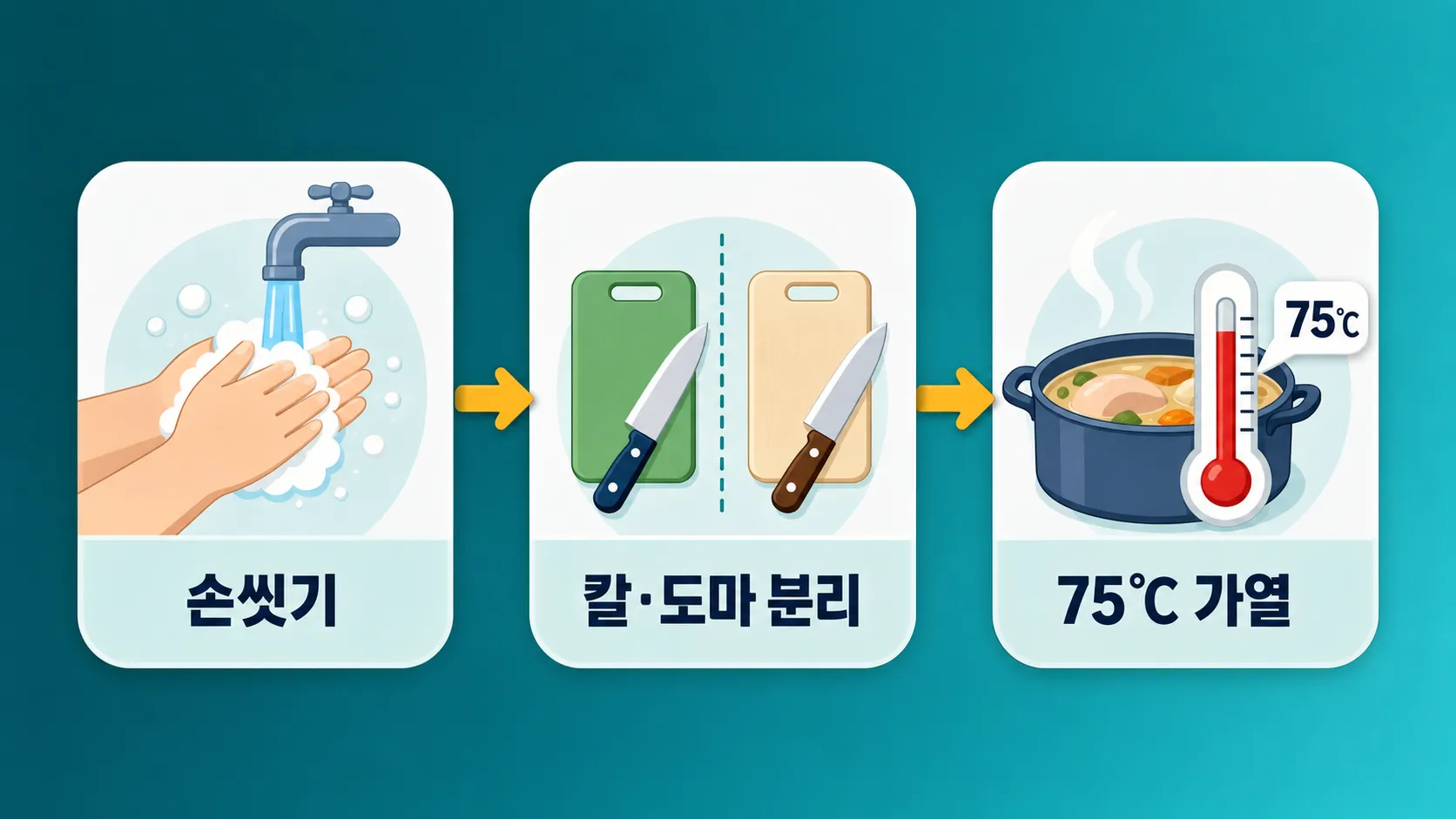
The key is keeping eggs refrigerated at 4℃ or below. Research shows that refrigerated eggs have Salmonella growth strongly suppressed (Source: Rural Development Administration). Don’t leave them at room temperature.
- Wash your hands with soap under running water for at least 30 seconds after touching eggs, raw chicken, or meat.
- Wash and sanitize knives and cutting boards that touch raw egg or chicken right away — keep them separate from the ones used for vegetables.
- Cook thoroughly — chicken and poultry need a core temperature of 75℃ for at least 15 seconds, and shellfish/seafood need 85℃ for at least 1 minute, to kill off Salmonella.
✅ Checklist: 6 Key Rules for Preventing Summer Food Poisoning
These are the basics recommended by the MFDS for preventing summer food poisoning. Check them off one by one.
- Wash your hands — soap and running water for 30+ seconds, always before cooking and before meals
- Keep things separate — raw and cooked food, and separate knives/cutting boards
- Cook thoroughly — meat to a core temp of 75℃, shellfish/seafood to 85℃ for 1+ minute
- Wash and sanitize — keep ingredients and cooking tools clean
- Boil your drinking water — always bring it to a boil first
- Keep proper storage temperatures — refrigerator 5℃ or below, freezer -18℃ or below
Families with young children should be extra careful. Kids can develop severe symptoms even from small amounts of bacteria. Feed baby food and snacks as soon as they’re made, and if any is left over, it’s safest to throw it out right away.
🔍 Frequently Asked Questions (FAQ)
Is my lunchbox okay sitting on my office desk until lunchtime?
Even in an air-conditioned office, room temperature still falls within the danger zone. Leaving a lunchbox packed that morning sitting out for 4~5 hours is risky. Refrigerate it if you can, or use an ice pack and insulated bag to keep it at 5℃ or below. During a summer heatwave, it’s safest not to go past 1 hour after cooking.
Can I reheat and eat yesterday’s leftover delivery fried rice?
Rice dishes carry a risk of Bacillus cereus, so it’s recommended you eat them within 24 hours. If you refrigerated it right after the meal, reheat it until piping hot all the way through before eating. But if the rice sat out at room temperature for a long time, toxins can remain even after reheating, so it’s safer to throw it out.
Should I let hot soup or stew cool before putting it in the fridge?
Putting it in while still hot raises the temperature of the whole fridge, putting your other food at risk. But leaving it at room temperature for a long time isn’t safe either. The right approach is to divide it into shallow containers, cool it quickly (within 2 hours), and then refrigerate it.
Does freezing kill bacteria?
No. At -18℃, bacteria just “stop” growing — they don’t die. Once thawed, they start growing again, so don’t refreeze thawed food; cook it right away instead.
Preventing summer food poisoning may look complicated, but it all comes down to one sentence: “5℃ or below, or 60℃ or above — keep the danger zone as short as possible.” Start by checking your fridge temperature today, and just sticking to the 2-hour rule (1 hour during a heatwave) for lunchboxes and delivery food will block most of the risk. Get the temperature right, and your whole family can get through this summer safe and sound.