 EasyTicket
 If you’re spending three days in Luang Prabang, the itinerary pretty much writes itself: alms-giving at dawn, Kuang Si Falls in the morning, and Mount Phousi followed by the night market in the evening. There’s a reason this sequence has become the standard — you can only see the alms-giving ceremony before sunrise, and Kuang Si Falls fills up with tour groups in the afternoon. I’ll add one more thing to that: the alms-giving ceremony isn’t a spectacle, it’s a religious ritual repeated every single day, so deciding in advance where to stand and how to watch is the single most important thing to prepare for in this city.
Here’s How I’d Split Up Three Days
It’s tempting to cram your itinerary full, but Luang Prabang is a small, old town designated in its entirety as a UNESCO World Heritage site, so trying to fit in more than one main stop a day actually works against you. A layout with one big activity per day, and the rest left open for walking, suits this city far better.
| Time | Day 1 | Day 2 | Day 3 |
|---|---|---|---|
| Dawn 05:30~07:00 | Arrival, rest | Watch the alms-giving ceremony | Stroll through the morning market |
| Morning 08:00~12:00 | Walk the temple lanes | Late breakfast, café | Kuang Si Falls (right after 08:00 opening) |
| Afternoon | Stroll along the Mekong | Village across the river, rest | Head back into town, pack |
| Evening 17:00~ | Sunset at Mount Phousi | Night market food | Final night market visit |
There’s a reason I put the alms-giving ceremony on the second day. Getting up at 5:30 AM on your arrival day is rough with jet lag and travel fatigue, and forcing yourself out means you’ll just be pointing a camera around with half-closed eyes. It works much better to sleep one night first, let your body settle into the city’s rhythm, and go the next morning.
For the Dawn Alms-Giving Ceremony, Pick Your Spot First
What time does it start?
The alms-giving ceremony (Sai Bat) begins every morning before sunrise. It runs 5:30~6:30 AM from March~October, and 6:00~7:00 AM from November~February (source: Luang Prabang Tourism Department). Since the timing shifts by a full 30 minutes depending on the season, if you visit in November and head out at 5:30, you could end up shivering and waiting around for half an hour. The most reliable move is to ask your guesthouse the evening before: “About what time does it pass by tomorrow?”
The procession moves slowly in a line along the old streets around Wat Xieng Thong. I redrew my route on a map a few times, and kept landing on the same conclusion: a quiet lane near your guesthouse beats the middle of the main street. The main street draws crowds, and you’ll mostly end up looking at the backs of other people’s heads as they take photos.
What to Keep in Mind
Here’s what the tourism department and local guides consistently emphasize.
- Keep a distance of at least 5m — no physical contact with the monks
- Wear clothing that covers your shoulders, chest, and legs
- No camera flash, and don’t follow the procession around to shoot photos
- Once you’ve picked a spot, stay there until the procession has passed
- Don’t follow the procession by bus or car (being physically higher than the monks is a serious breach of etiquette)
- If you’re making an offering, never put money directly in the alms bowl
If you want to make an offering, it’s best to skip the sticky rice sold on the street. It may be a few days old and can contribute to food poisoning among monks. It’s safer to ask your guesthouse to prepare freshly cooked sticky rice, or buy it yourself at the morning market. And if you’re only taking part for a photo, quietly observing from a distance is by far the better choice.
Why Visit Kuang Si Falls in the Morning?
Admission and Hours
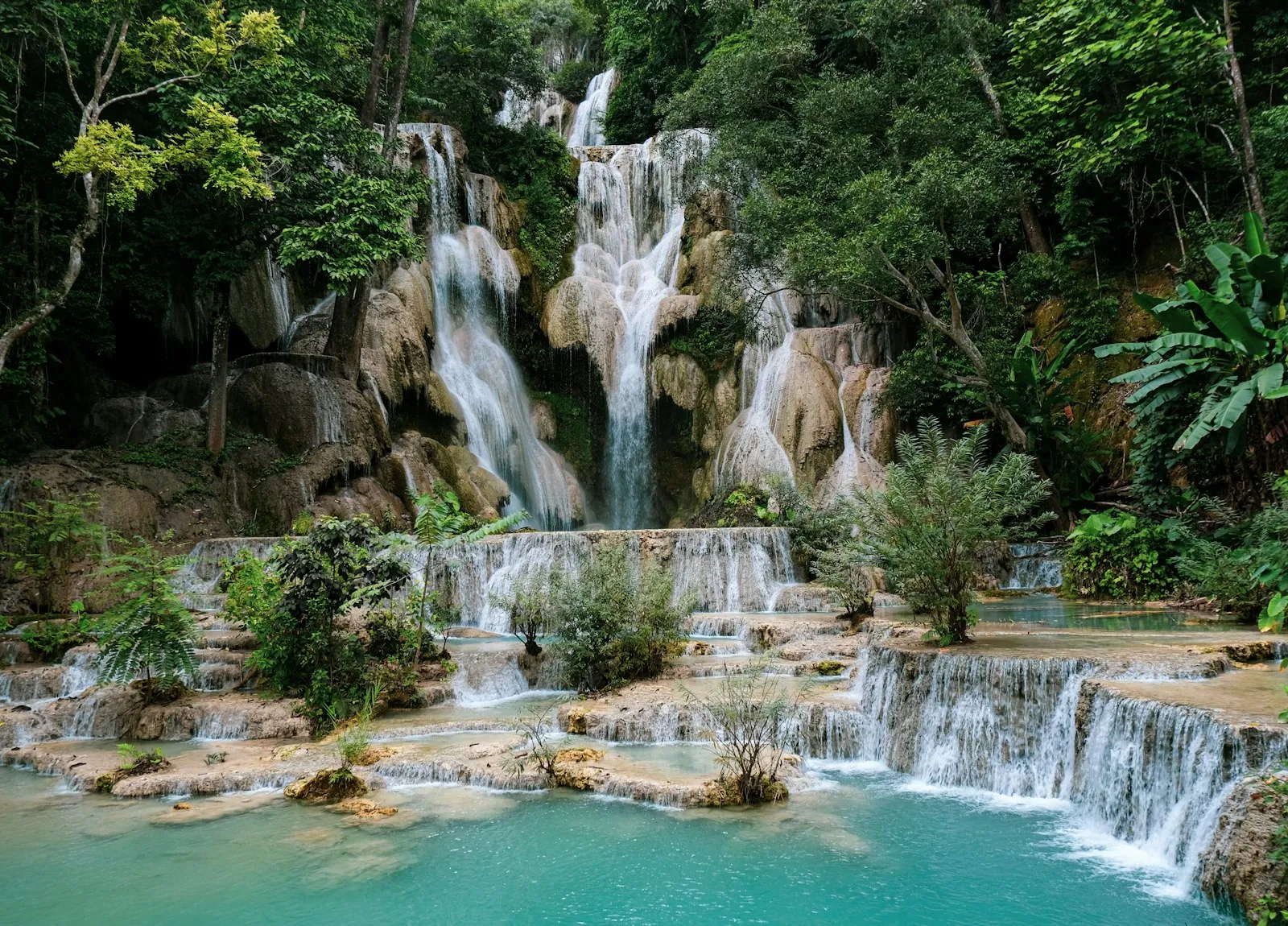
Kuang Si Falls is open 08:00~17:30, and admission for foreign visitors is 60,000 kip per person (roughly $2.50). That ticket includes the electric shuttle that takes you from the parking lot to the entrance of the falls.
| Item | Details |
|---|---|
| Hours | 08:00~17:30 |
| Admission | 60,000 kip per person |
| Shuttle | Included in admission |
| Distance from town | About 29 km |
| Travel time | About 50 minutes~an hour by car |
The reason to go in the morning is simple. It’s an hour’s drive one-way from town, so making the 08:00 opening means leaving before 7:00 AM — and not many travelers are up and moving that early. In the afternoon, on the other hand, tour buses pile in and the upper swimming pools get crowded. On top of that, the moon bear rescue centre (Free the Bears), which you can enter on the same ticket, keeps the same 08:00~17:30 hours — so going in the morning lets you take your time at both the falls and the bear rescue centre and still be back in town before lunch.
Getting There and Tuk-Tuk Fares
There’s no public transit, so you’ll need a tuk-tuk or a minivan. Sharing a ride with other travelers runs around 100,000 kip per person, while a private round trip runs 400,000~550,000 kip. Once you run the numbers, sharing makes sense for two people, while booking a private ride pays off once you’re a group of four or more. Shared rides are usually arranged the evening before through travel agencies or guesthouse notice boards in town, so it’s worth asking around while you’re out at the night market anyway.
Sunset at Mount Phousi Means 328 Steps
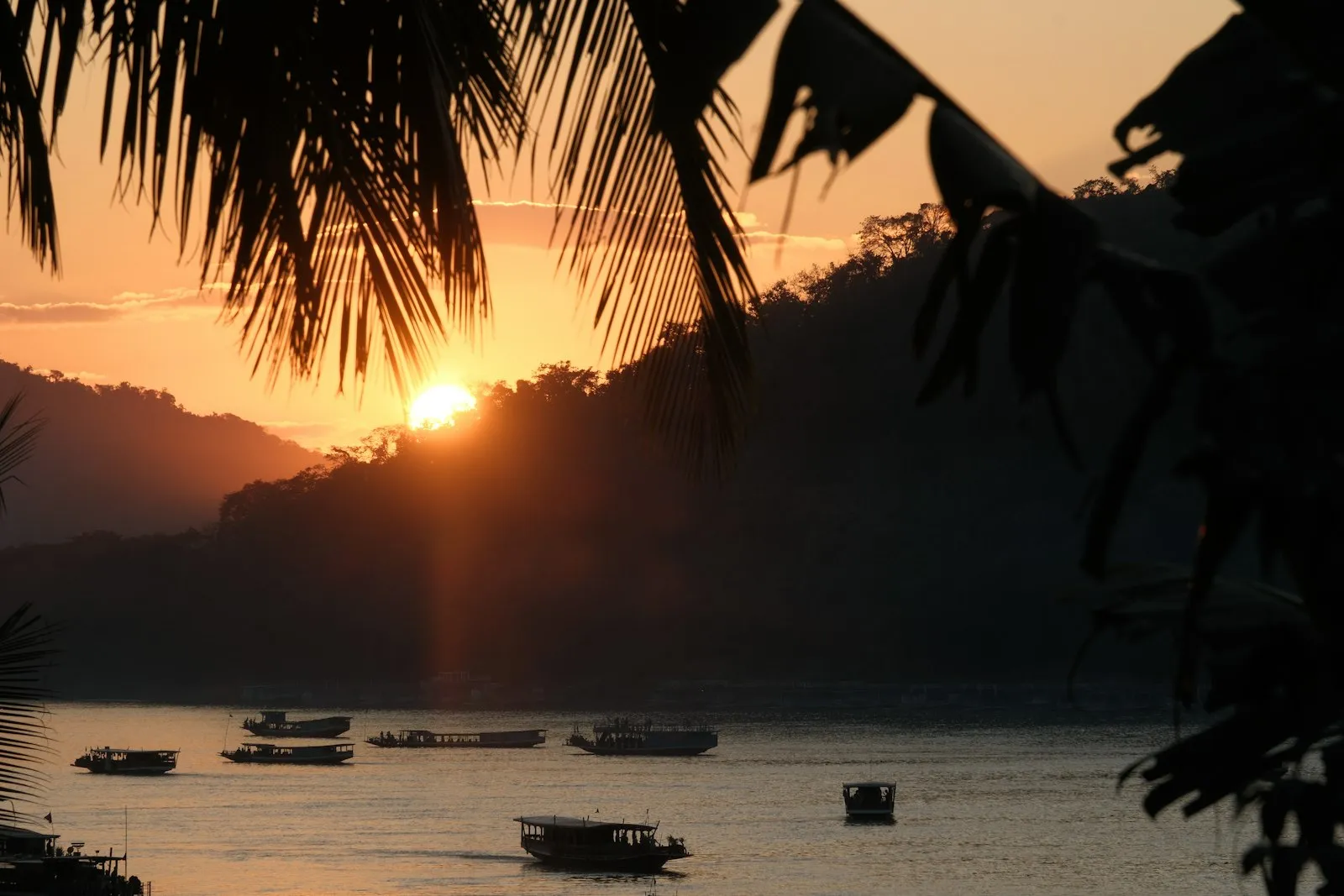
Mount Phousi is a low hill rising right in the middle of town, so you can walk there from anywhere. Admission is around 20,000 kip, and reaching the summit means climbing 328 steps on one of the stairways. The climb itself is short, but the humidity will have you sweating more than you’d expect, so bring a bottle of water.
The catch is timing. If you go up right around sunset, the narrow summit fills up and it’s hard to find a spot at the railing. Going up 40~50 minutes before sunset to claim a spot first is really the only way to manage it. Personally, I’d seriously consider skipping sunset and going up in the morning instead — you get the same view of the Mekong and the old town, and far fewer people.
Where to Eat in Luang Prabang: Night Market and Morning Market
Evenings Mean the Hmong Night Market
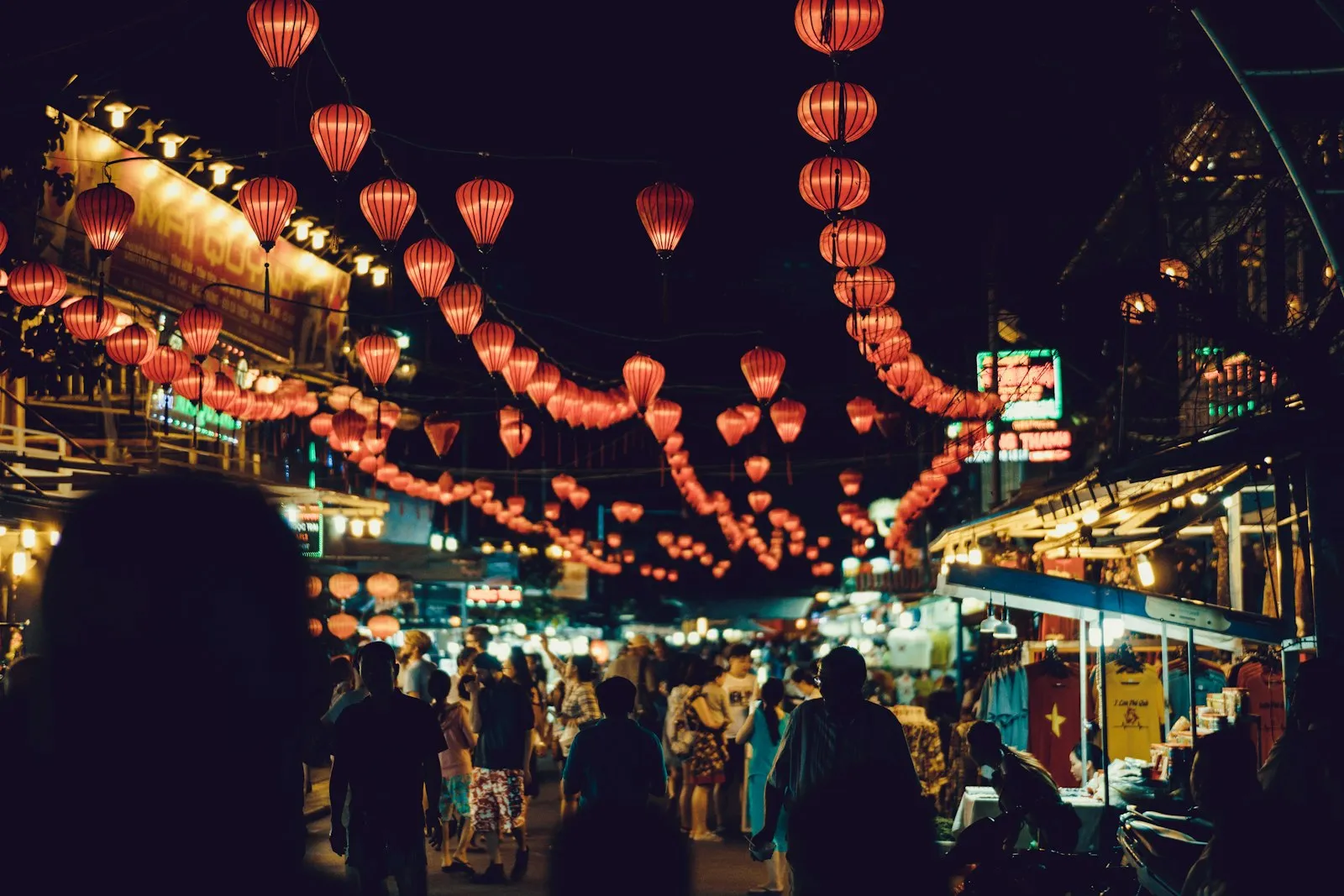
Once the sun sets, about 500 meters of Sisavangvong Road turns into one long night market. It runs 16:30~22:30. Handmade silk scarves and silver items are the well-known souvenirs, but for slow travelers, the real fun is in the food alley tucked behind the stalls.
- Khao piak — Lao-style rice noodle soup, with a thick broth and soft noodles
- Sindat — Lao-style grill-and-hotpot, great for sharing with a group
- Lao sandwich — a baguette stuffed with vegetables and meat, the classic street food option
- Mango smoothie, fried banana, and fried jackfruit — easy snacks to eat on the go
- Lao coffee — the beans are also a popular souvenir to bring home
Mornings Mean the Morning Market
The alms-giving ceremony ends right around when the morning market opens. So instead of heading straight back to your guesthouse after watching it, the most natural move is to keep walking to the market and grab a bowl of noodles for breakfast. It’s also where people go if they want to buy sticky rice for the alms-giving ceremony themselves.
The food stalls at the night market are mostly cash-only. Breaking your kip into small bills ahead of time makes bargaining and paying a lot easier.
Pre-Trip Checklist
- Passport valid for at least 6 months — Korean regular passport holders can stay visa-free for 30 days for tourism (source: Embassy of the Republic of Korea in Laos)
- Long pants and a long-sleeved top, or something that covers your shoulders, for the alms-giving ceremony (also works for temple visits)
- A light jacket for early mornings — dawns are cool from November~February
- Cash in kip — the night market, tuk-tuks, and admission fees are mostly cash-only
- Book train seats in advance if you’re traveling by rail — walk-up tickets are hard to get and seats sell out early
If you’re arriving from Vientiane on the Laos-China Railway, the trip takes about 2 hours. Fares vary by seat class: roughly 140,000 kip for standard class, 198,000 kip for second class, and 313,000 kip for first class. Just be sure to factor in that Luang Prabang’s train station is more than 30 minutes by car from the town center — it’s an easy detail to forget when you’ve got an evening plan lined up right after arrival.
Frequently Asked Questions
Can I take photos of the alms-giving ceremony?
Photography itself isn’t banned, but there are conditions. Flash is strictly off-limits, keep at least 5m from the monks, and don’t move along with the procession. The standard approach is to find a spot across the street, sit down, and shoot quietly from there.
Where should I buy sticky rice for the offering?
Sticky rice sold near the procession route may be a few days old, so it’s not recommended. It’s better to ask your guesthouse in advance to prepare freshly cooked rice, or to buy it yourself at the morning market. Never put money directly into the alms bowl.
Can you swim at Kuang Si Falls?
Plenty of travelers swim in the tiered pools. That said, changing space is limited, so it’s more convenient to wear your swimsuit under your clothes beforehand, and bring your own towel. The falls close at 17:30, so plan your timing if you want to get in the water.
I heard the train station is far from town — how far exactly?
Luang Prabang’s train station sits on the outskirts, more than 30 minutes by car from the town center. Make sure to budget separate time and transportation for getting into town after you arrive, so it doesn’t throw off your first day.
Isn’t three days too short?
Splitting the three pillars — the alms-giving ceremony, Kuang Si Falls, and Mount Phousi — one per day fits neatly into three days. If you want to add the village across the river or a temple-hopping day, tacking on an extra day is a much better way to enjoy this city than cramming everything into three.
Luang Prabang isn’t really a city for sightseeing at speed — it’s a city for sitting still. Quietly holding your spot at dawn, taking your time at the falls in the morning, and ending the day over a bowl of noodles in the evening is more than enough.