
Hand a bug to an AI and plausible-looking code appears in no time. In a survey released by Linux Foundation Research on October 20, 2026, open-source contributors and maintainers estimated that AI cuts coding time by 52% on average. In the same survey, 25% of incoming pull requests (PRs, which are requests to merge your code into a project) were flagged as low quality. “AI slop PR” refers to a low-quality code proposal made with generative AI and sent to an open-source project, and in 2026 it became the reason large projects like Godot rewrote their contribution rules.\n\nEasyTicket does not see this as something that happened because AI is bad. The bottleneck has moved from the writing side to the reading side. That is why we think the standard for contributing has shifted from “Does it run?” to “Can I explain it and take responsibility for it?”\n\n## Code Got Cheap, but Reading It Didn’t\n\nAshley Wolf, GitHub’s open source program director, wrote in a February 2026 post that the cost of creating has come down but the cost of reviewing has not. Four months later, a notice from the Godot Foundation pointed to the same structure: the effort to create has shrunk, while the work of reviewing PRs and the number of people who do it have stayed the same.\n\nThe numbers in the Linux Foundation survey point the same way. Respondents said writing code gets 52% shorter, but time spent discussing proposals drops by only 19%. Writing can be finished alone with an AI, but deciding whether a change fits the project is something people have to do together.\n\n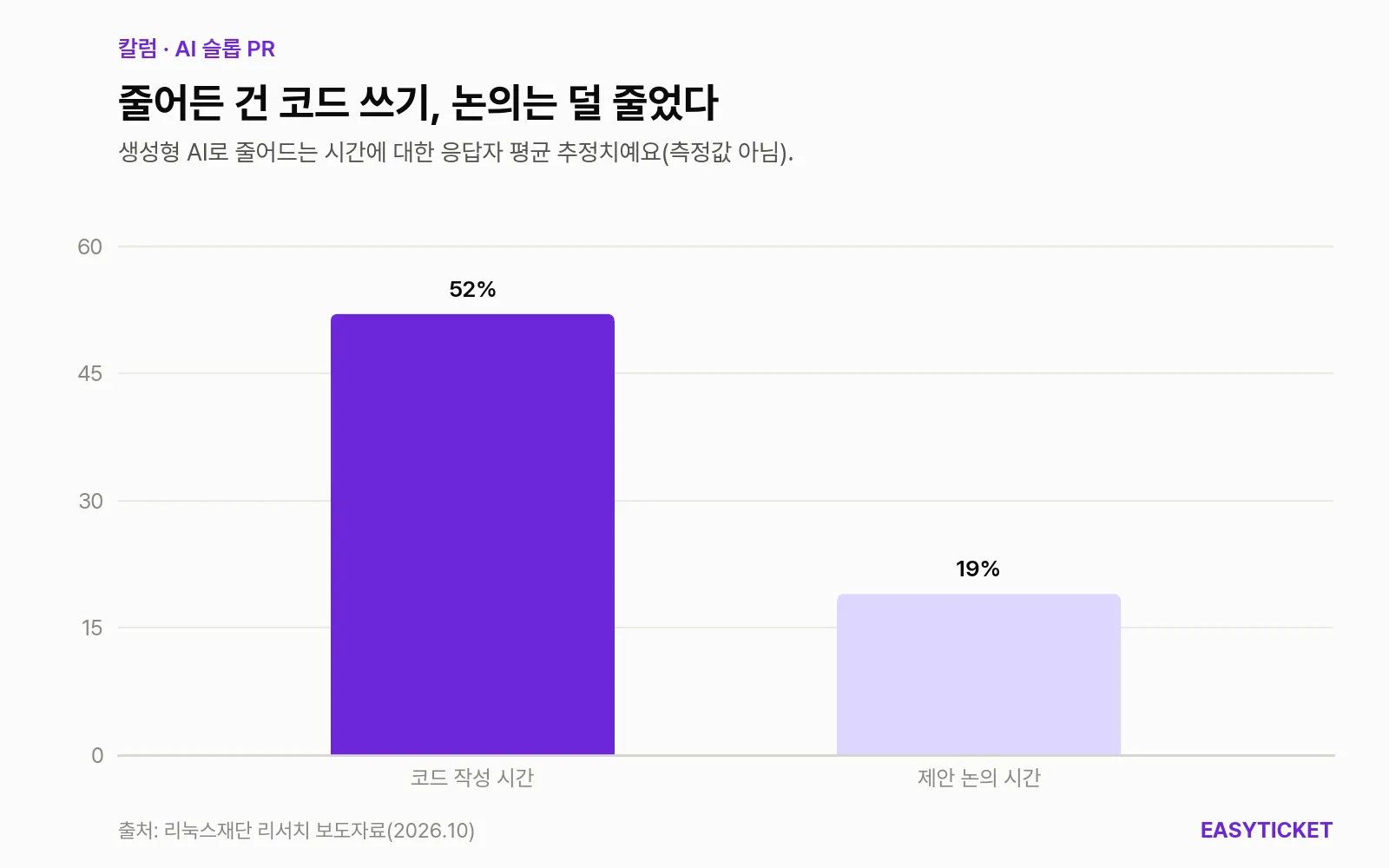 \nTime savings as estimated by respondents. The gap between coding and proposal discussion is wide.\n\nWhen costs fall out of balance, the burden shifts to the receiving side. The sender may have spent a few minutes, but the receiver has to read unfamiliar code from scratch, find what is wrong, and explain it too. An inbox collapses not only because the letters are bad, but because the number of people writing replies stays the same.\n\n## The Biggest Projects Jam Up First\n\nIn the same survey, 59% of maintainers said contribution volume had grown since generative AI arrived. Narrowing to large projects with more than 50 contributors, that rises to 69%, and the estimated slop share jumps from 25% to 31%. According to Help Net Security’s summary of the report, the top worry for large projects is burnout, while smaller projects worry about code quality first.\n\n
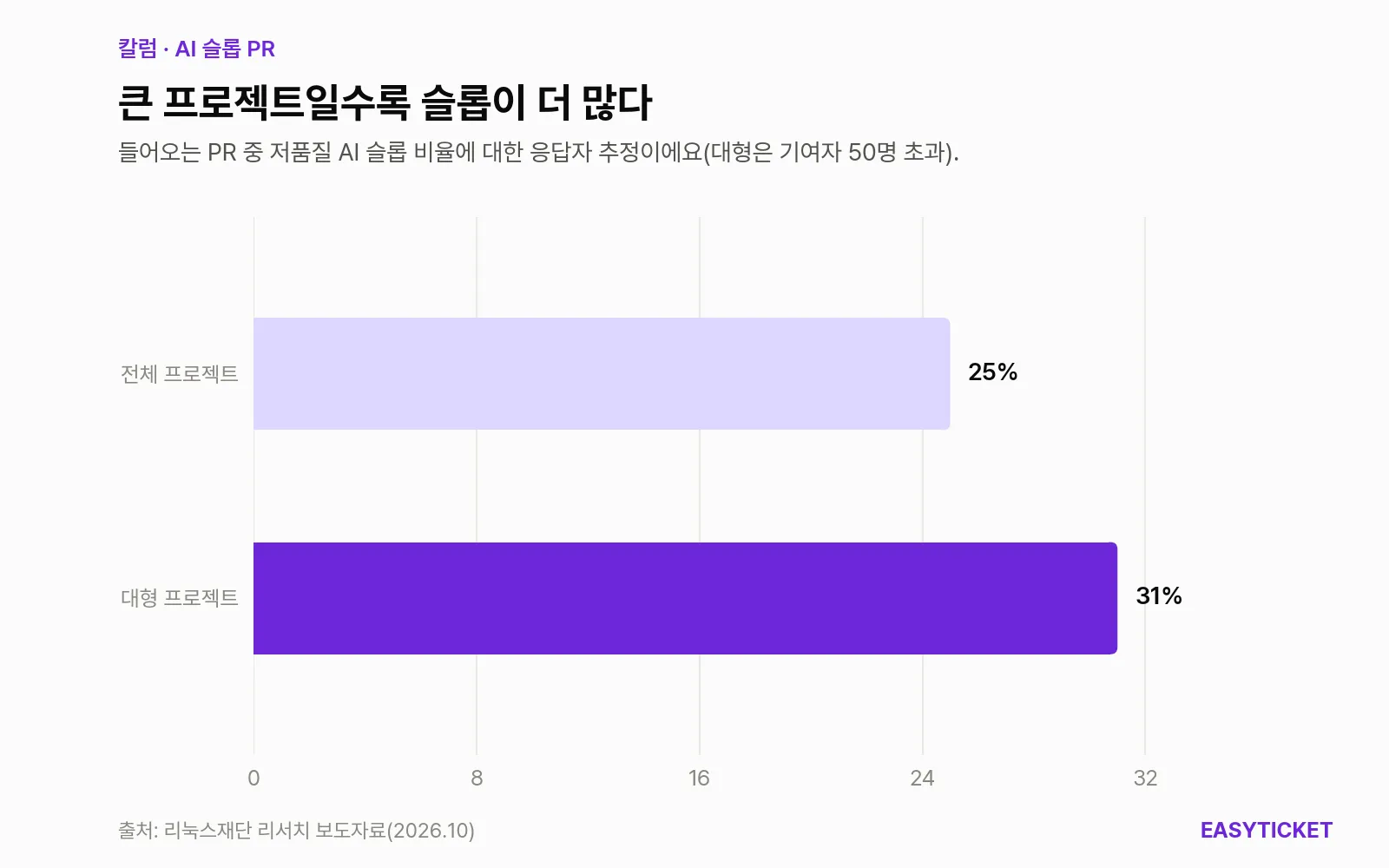 \nThe estimated share of incoming PRs that are AI slop. It is higher in large projects with more than 50 contributors.\n\nThe more famous a project is, the sooner it catches the eye of someone trying a first contribution with AI, and the sooner its maintainers’ time wears down. The volume itself has changed too. According to GitHub’s Octoverse 2026, merged PRs from October 2025 through September 2026 reached 1.3 billion, more than triple the 402 million in 2024. Agent-drafted PRs, at 17% in March 2026, passed 40% in September. That counts only the agents GitHub can detect, so the real share may be higher. The tally also includes private repositories, so it is not a figure for outside open-source contributions alone.\n\n## Why Is Open Source Blocking AI PRs?\n\nLumping it all under “blocking” hides how different the approaches are. In a June 30, 2026 post, the Godot Foundation announced a ban on autonomous AI agents and vibe coding. A substantial amount of AI-generated code is also off the table, and only trivial tasks such as code completion, regular expressions, and find-and-replace are allowed, on the condition of disclosure. New contributors with three or fewer merged PRs cannot submit new features or large refactors without a maintainer’s permission.\n\nThe reason is worth noting. Godot wrote that AI cannot take responsibility and cannot learn from feedback. In other words, a review is a code check, but it is also mentoring that grows the maintainers of the future.\n\nThe terminal app Ghostty arrived at the same point from the opposite side. It says the project itself was written with a lot of AI help, yet it asks outside contributors to disclose the tools used and the degree of assistance, and to be able to explain their changes without AI. Anyone who submits obvious slop is added to a public list and blocked from contributing afterward. Maintainers are exempt from this rule, on the grounds that they have already proven their judgment.\n\n
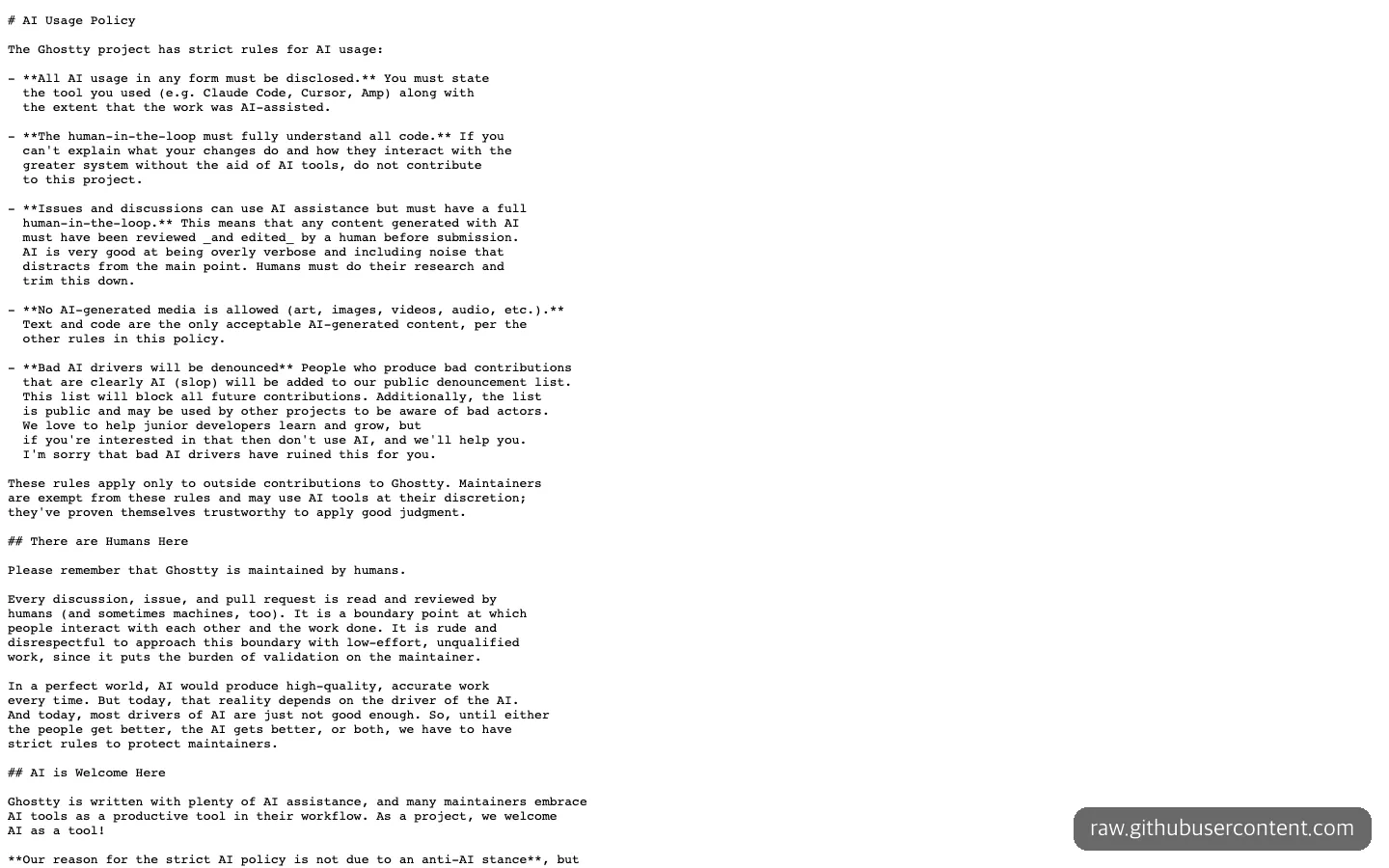 \nThe original text of Ghostty’s AI usage policy. It says to disclose your tools and to be able to explain your changes without AI.\n\nPlace the two rules side by side and the differences become clear.\n\n| Comparison | Godot | Ghostty |\n| --- | --- | --- |\n| Attitude toward AI | Bans autonomous agents and vibe coding | The project itself was written with a lot of AI help |\n| AI use accepted in outside contributions | Trivial tasks such as code completion, regular expressions, and find-and-replace | Allowed on condition of disclosure and understanding |\n| Disclosure requirement | Yes | Yes (tools used and degree of assistance) |\n| Threshold for contributors | With three or fewer merged PRs, a maintainer’s permission is needed for new features and large refactors | Must be able to explain the change without AI |\n| What the rule blocks | A substantial amount of AI-generated code | People who submit obvious slop (added to a public list, blocked from later contributions) |\n\nOne bans and the other welcomes, yet what both documents protect is the same: whether there is a person behind the code who will take responsibility. Many projects still don’t have even this kind of document. In the Linux Foundation survey, 35% had a formal policy allowing AI use, and 32% had neither a policy nor plans for one.\n\n
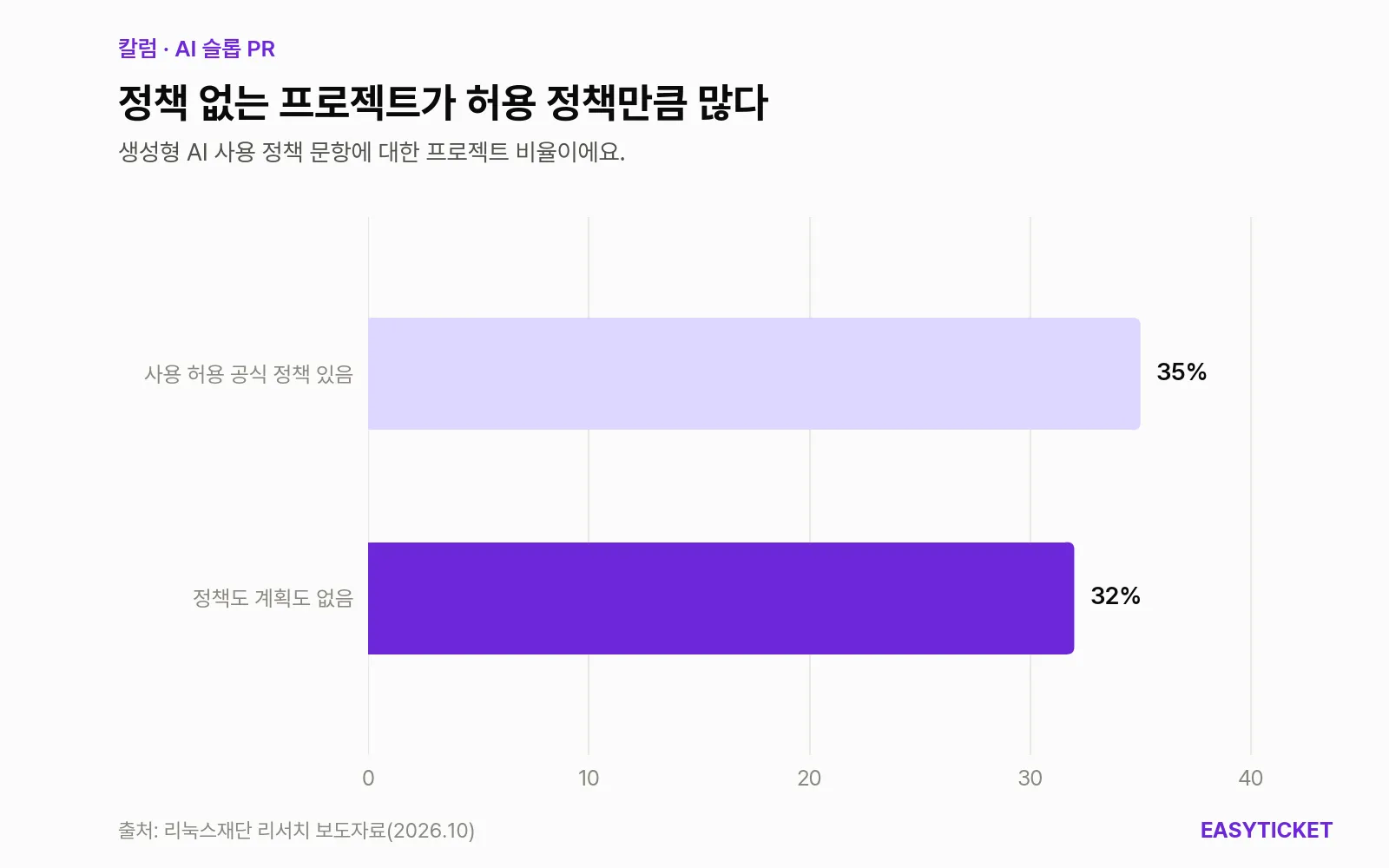 \nAnswers on generative AI usage policies. Projects with a policy that allows use and projects with no policy or plans are about even.\n\n## The Limits of the 25% and Other Ways to See It\n\nFirst, it would be a mistake to read the 25% as “one in four PRs is garbage.” It is not a count of PRs but an estimate from respondents. According to It’s FOSS, the survey covered 234 people, and the 25% estimate rests on the answers of 111. Respondents were recruited through partner channels such as the Linux Foundation and Red Hat, so the sample may be skewed, and Red Hat is also a sponsor of this report. The meaning of slop also varies a bit from outlet to outlet, so it is hard to tell from public materials how well it was separated from low-quality PRs submitted by humans.\n\nThere is counter-evidence in the same materials.\n\n- In Octoverse, 90% of agent PRs in September 2026 were merged within two weeks, higher than the roughly 86% for the comparison group. However, that figure includes private repositories, and GitHub is a company that sells Copilot.\n- In the Linux Foundation survey, 71% of maintainers agreed that generative AI lowers the barrier to entry. And 61% of contributors said they review AI code in detail and test the full functionality before submitting.\n- According to Help Net Security, respondents who use AI said their review time also fell by more than 40%, and three out of four maintainers use AI tools in review.\n\nThat last number directly tests this column’s argument. If reviewing is getting faster too, isn’t it wrong to say the cost of review stays the same? EasyTicket thinks it is only half right. AI can speed up reading, but deciding whether to accept a change and taking on its aftermath is still a human job. The same survey also showed large projects reporting the most complaints about review delays. A felt drop in one’s own time and complaints about a longer queue are showing up together.\n\nThe most interesting counterexample is curl. Maintainer Daniel Stenberg wrote in an October 2026 post that bogus security reports made up by AI have effectively disappeared since spring, and that the problem now is a high volume of high-quality reports. He also said that reports should not be dismissed just because AI was used. It is a story about security reports, so it can’t be carried over to PRs as is, but it shows that even when quality improves, people’s time can still run short. That suggests the problem may not end even when the slop does.\n\n## Before a Vibe Coder Sends a PR\n\nIf there is an open-source project you want to fix, the better move is to change the order of steps rather than turn AI off. Read the repository’s contribution rules before you build anything, so you don’t waste effort on a project like Godot that doesn’t accept vibe coding at all. As Wolf put it, most contributors act in good faith, but good faith can’t pay for the maintainers’ time. Just ask yourself four things before you send.\n\n- With AI closed, can you explain in words what this change does and where it connects to the rest of the system?\n- Did you run it yourself in your own environment and test the full functionality?\n- Did you note in the PR which AI tool you used and how much?\n- If it’s a large feature or refactor, did you ask a maintainer first, before building the code?\n\nIf you get stuck on even one, that PR is closer to spending maintainers’ time than saving it. If you run a repository yourself, the homework is simpler. Whether you allow or ban AI, write a short one-page AI contribution rule. According to Help Net Security’s summary, about one in five contributors never discloses AI use at all, and if you don’t ask, you don’t get an answer.\n\n## Three Things to Watch Next\n\nFirst is the share of agents. If the curve that rose from 17% in March to more than 40% in September continues, the premise that a person reads every PR is bound to start to shake.\n\nSecond is whether AI on the review side actually shortens the queue. Most of what we have so far is respondents’ impressions and estimates, so we need figures that measure review wait times project by project before we can judge.\n\nThird is the shape of the threshold. Godot’s three-merge rule and Ghostty’s public list protect maintainers, but they also narrow the entrance for newcomers. Taken together with the 46% of maintainers who said the need to mentor new contributors is growing, the homework ahead looks less like filtering out slop and more like how to raise the next generation of maintainers.\n\nEasyTicket’s judgment comes down to one thing. If you can’t write the PR description without AI, that code isn’t ready to be sent yet.\n\n## Frequently Asked Questions\n\n### Can’t I send AI-written code to open source?\n\nIt depends on the project. Godot bans a substantial amount of AI code, and Ghostty accepts it on condition of disclosure and understanding. According to Help Net Security’s summary, about a third have a formal policy allowing it, and one in 10 has a policy banning it.\n\n### Can I contribute to open source even if I’m not good at coding?\n\nYes, but the path of handing everything to AI is getting narrower. Ghostty wrote that beginner developers who want to learn should come without AI, and that it will help them. Building up merge experience with small fixes also helps you clear the threshold at projects like Godot.\n\n### Is the situation similar for Korean open-source projects?\n\nThere is no basis to judge yet. As of November 2026, no reliable survey targeting only Korean open-source maintainers has been found, and the numbers in this article come from global materials from the Linux Foundation and GitHub.\n
Sources 8
- New LF Research Survey Shows Generative AI Cuts Open Source Coding Time in Half, but 25% of Incoming Pull Requests are Considered AI Slop (Linux Foundation)
- Octoverse: Commits, pushes, reach new highs in 2026 as developers build with agents (GitHub Blog)
- Welcome to the Eternal September of open source (GitHub Blog)
- Contribution policy 2026 (Godot Foundation)
- AI_POLICY.md (ghostty-org/ghostty)
- "ignore the slop" (daniel.haxx.se)
- AI slop is piling up highest on the biggest open-source projects (Help Net Security)
- Red Hat Funded a Report That Found a Quarter of Incoming Pull Requests May Be AI Slop (It's FOSS)
AI helped with research and the first draft; the operator tried the subject firsthand, checked and edited this article before publishing. Let us know if you spot a mistake.