
The leaderboard changed overnight. One day after launch, the new model scored 65 on independent evaluator Artificial Analysis’s Intelligence Index and took first place (as of Nov. 10, 2026). That model, Claude Fable 5.2, is Anthropic’s top-tier AI model, released on Nov. 9, 2026 (U.S. time). It shares a foundation with Mythos 5.2, which came out the same day, but ships with safeguards so that it can be opened to all users.
The numbers look impressive. Still, the model’s character shows up better in what people have actually built with it than in a benchmark table. We start with the official figures and the independent evaluation, then go through the creations collected on Threads, and finish with our own hands-on time with a game made with Fable 5.2.
How do Fable 5.2 and Mythos 5.2 differ?
According to Anthropic’s official announcement, the two share the same base model. The difference is how wide the door is open. Fable has strong cybersecurity and biology safeguards and is open to everyone, while Mythos is available only to organizations that pass a vetting program.
API pricing (as of November 2026) is $8 per million input tokens and $40 per million output tokens. Fast mode, which generates tokens up to 2.5 times faster, costs double that ($16 and $80). Standard mode is also said to output up to 30% faster than 5.1. Etoday, a Korean business outlet, citing Nikkei, reported that the price is 20% lower than before.
There are conditions for subscribers too. Pro plans and Team standard seats can use Fable for up to 50% of their weekly usage limit, and they receive one to three Fable usage resets depending on how long they have subscribed. One point deserves attention: Anthropic itself recommends starting most coding and knowledge work with Opus 5.5. Fable, it explains, is meant for the hardest, most open-ended technical work.
The benchmark numbers Anthropic published
On coding benchmarks, the lead is clear. On FrontierCode 2.0, Fable 5.2 (Xhigh) scored 49.1%, up 16.7 percentage points from the previous 5.1 (32.4%).
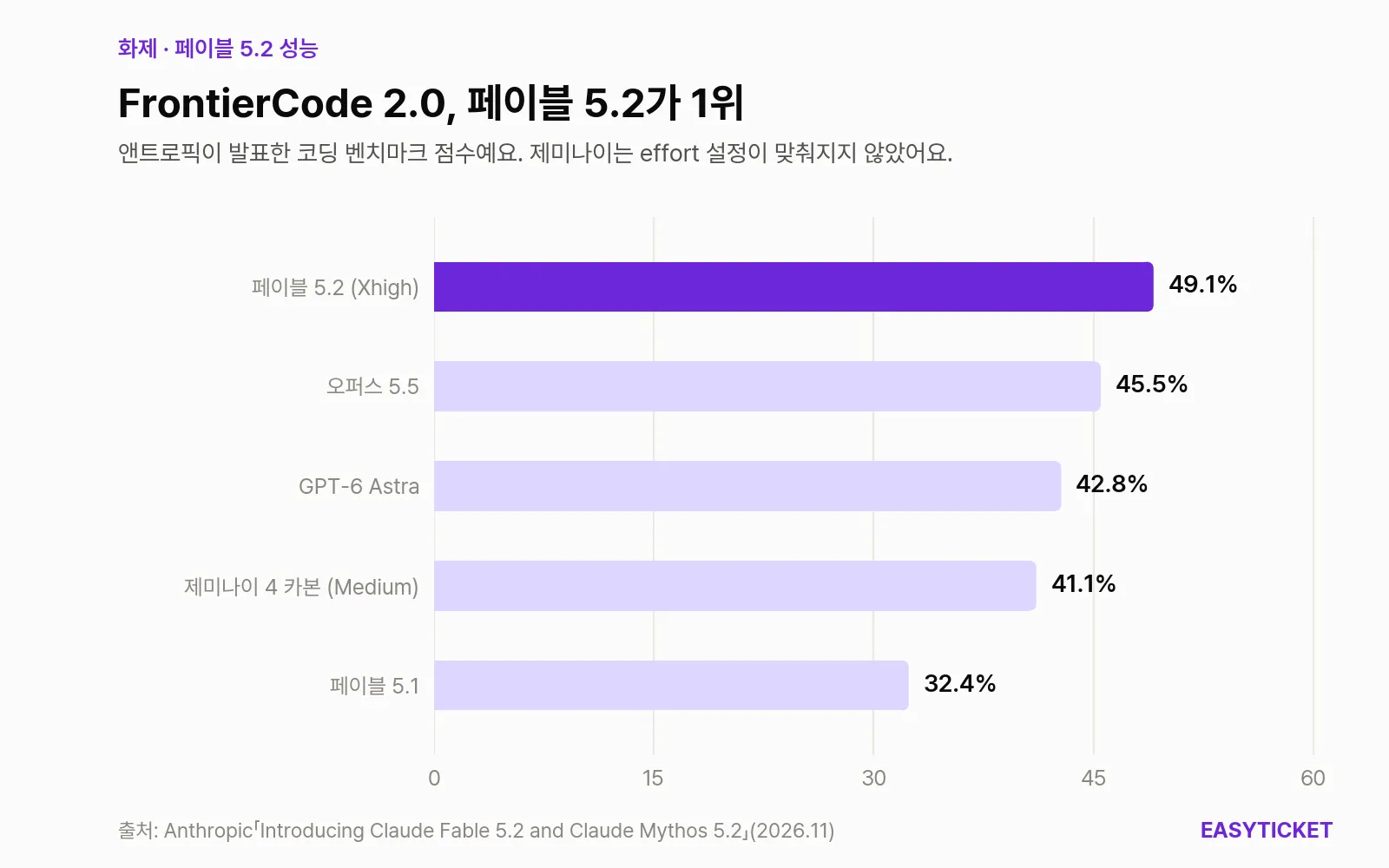
FrontierCode 2.0 scores published by Anthropic. Fable 5.2 leads Opus 5.5 by 3.6 percentage points.
It also tops FrontierSWE v2, a practical software engineering test, at 69.9%. That is 4.4 points ahead of GPT-6 Astra (65.5%) and 13.6 points above 5.1.
But read the full table in the same announcement and Fable does not win every row. You need to see that to read the numbers correctly.
| Benchmark | Fable 5.2 | Compared with | Takeaway |
|---|---|---|---|
| Remote Labor Index | 41.3% | Fable 5.1: 17.9% | Real remote-work tasks; more than doubled |
| BenchCAD 2.1 (Max) | 83.5 points | Opus 5.5: 65.3 points | Large gap in design and CAD work |
| AutomationBench | 51.4% | Gemini 4 Carbon: 53.9% | Gemini leads in work automation |
| AA-Briefcase Elo | 1785 | Opus 5.5: 1800 | Opus is slightly ahead in document and knowledge work |
Anthropic also published OSWorld 2.1 (offline subset) at 89.3% and Humanity’s Last Exam (with tools) at 74.2%. Two caveats apply. All of the Fable figures were released by Anthropic itself, and on FrontierCode Gemini was run at Medium settings, so the conditions are not matched.
A more interesting number lies elsewhere. Fable 5.2 at the next-lower High setting scored 45.3% on FrontierCode, nearly equal to Opus 5.5’s best score (45.5%), and Anthropic said the cost per task was about half. In other words, the top setting is not the only way to use Fable.
No. 1 in independent testing, but also the slowest and most expensive
The figures verified outside the company come from Artificial Analysis. On the site, Fable 5.2 (Max) ranks first among 74 models with an Intelligence Index of 65. In the same chart, Gemini 4 Carbon (high) scores 60, Opus 5.5 (max) scores 59, and GPT-6 Astra scores 57.
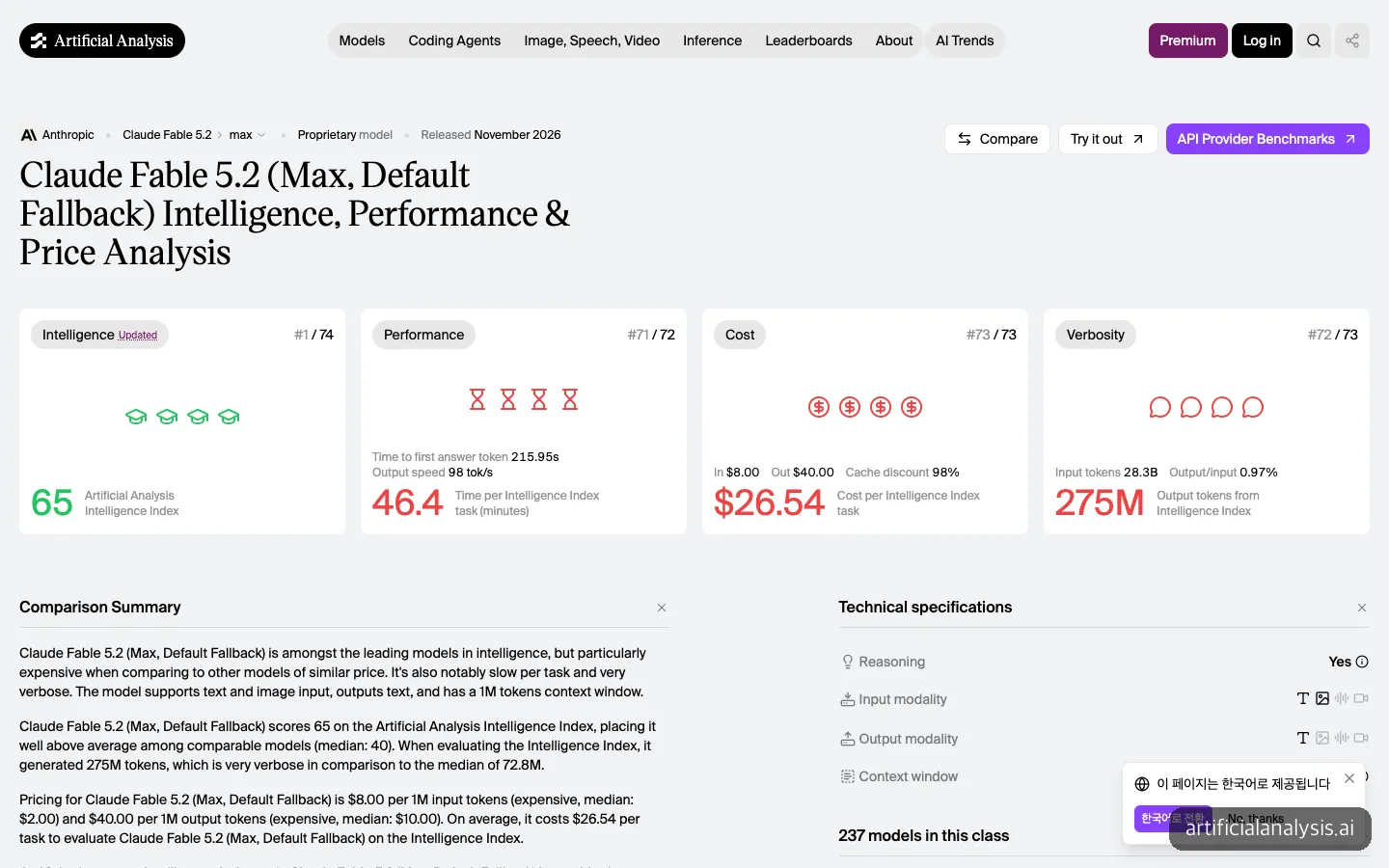
It ranks first in intelligence among 74 models, but the speed and cost cards right next to it show red numbers.
The problem is the neighboring cards. It ranked 71st of 72 in performance (speed), 73rd of 73 in cost, and 72nd of 73 in verbosity (output volume). It takes close to 216 seconds to produce a first answer, and solving a single evaluation task takes 46.4 minutes on average. With the comparison models’ median at 12.6 minutes, that is roughly four times as long to think. The output tokens used in one evaluation run came to 275 million, 3.8 times the median (72.8 million). The page summary itself says “particularly expensive” and “notably slow per task and very verbose.”
| Model (setting) | Intelligence Index | Time per task | Cost per task |
|---|---|---|---|
| Fable 5.2 (max) | 65 | 46.4 min | $26.54 |
| Gemini 4 Carbon (high) | 60 | about 26 min | about $7.8 |
| Opus 5.5 (max) | 59 | about 25 min | $10.04 |

The intelligence bar is tallest on the far left, while the time and cost bars are tallest on the far right.
To gain 6 points, you spend nearly double the time and more than 2.6 times the money. EasyTicket’s take is that running everyday questions through Fable just because it is No. 1 is a losing trade. The reason Anthropic tells people to start with Opus 5.5 can be read straight off this table.
17 Fable 5.2 creations collected on Threads
If you would rather judge performance by results than by numbers, a Korean Threads post is a good place to start. It strings together 17 Fable 5.2 creations that were posted on X (formerly Twitter), one per reply, and it passed 21,000 views in under a day (checked Nov. 10, 2026). The poster did not make them personally. It is a roundup of videos each creator published, so every number and description below is the creators’ own claim. EasyTicket opened each video in the replies and checked the scenes, then grouped them by field.
Games: from an FPS left running for 8 hours to Worm Rider built with 10 prompts
Games make up the largest share of the 17. No. 1 is a case where Fable 5.2 was asked to build a high-quality FPS and then left running for about 8 hours with no human feedback. It built the 3D models, textures and sound effects from scratch, and the cost was reportedly about 445 million input tokens, 2.7 million output tokens, and roughly $550 at API rates.
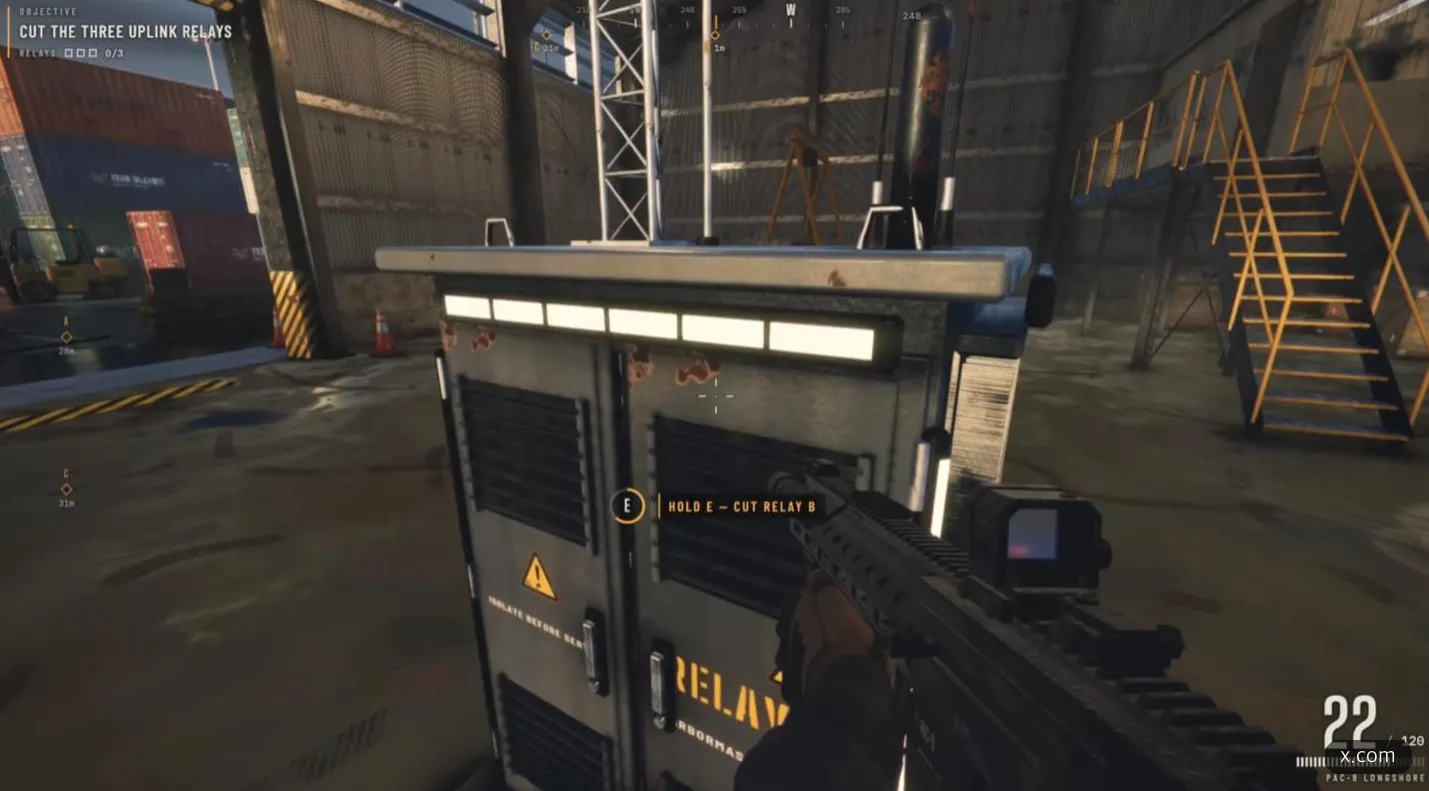
An FPS said to have been made with no human hands over 8 hours. Fable reportedly built even the 3D models, textures and sound effects from scratch.
No. 4 is a 3D FPS in which players teleport through portals and fight each other. Anthropic employees reportedly tested it by playing multiple matches in the office. No. 7, “Gilt & Gutter,” is a one-on-one FPS that runs in the browser, where bullets in your own color recharge your weapon and bullets of other colors deal damage.

The one-on-one FPS “Gilt & Gutter.” The character bodies were generated with Tripo3D, and Fable added the skeleton and animation.
No. 9 is a 3D sword-fighting action game, and No. 12, “Turbo Tails,” is a 3D kart racer for the browser. Six racers compete with drifts, jump ramps and items, and it supports both solo play and multiplayer. This article’s cover image is the opening scene of Turbo Tails. No. 15, “Worm Rider,” is a 3D game made with just 10 prompts. All of the 3D models were built from scratch in Claude Code, and it comes to about 3,400 lines of code (220KB) with roughly 10 minutes of human touch-up, according to the creator.
3D animation and video: shooting scenes with Blender and code
No. 2 is a case where a single prompt produced a Blender animation featuring a desk, a MacBook, lighting and a character. It includes 13 camera scenes, keyboard input and lighting that changes over time, and it took 52 minutes to render in 4K on 10 cloud GPUs at a cost of $5.75.
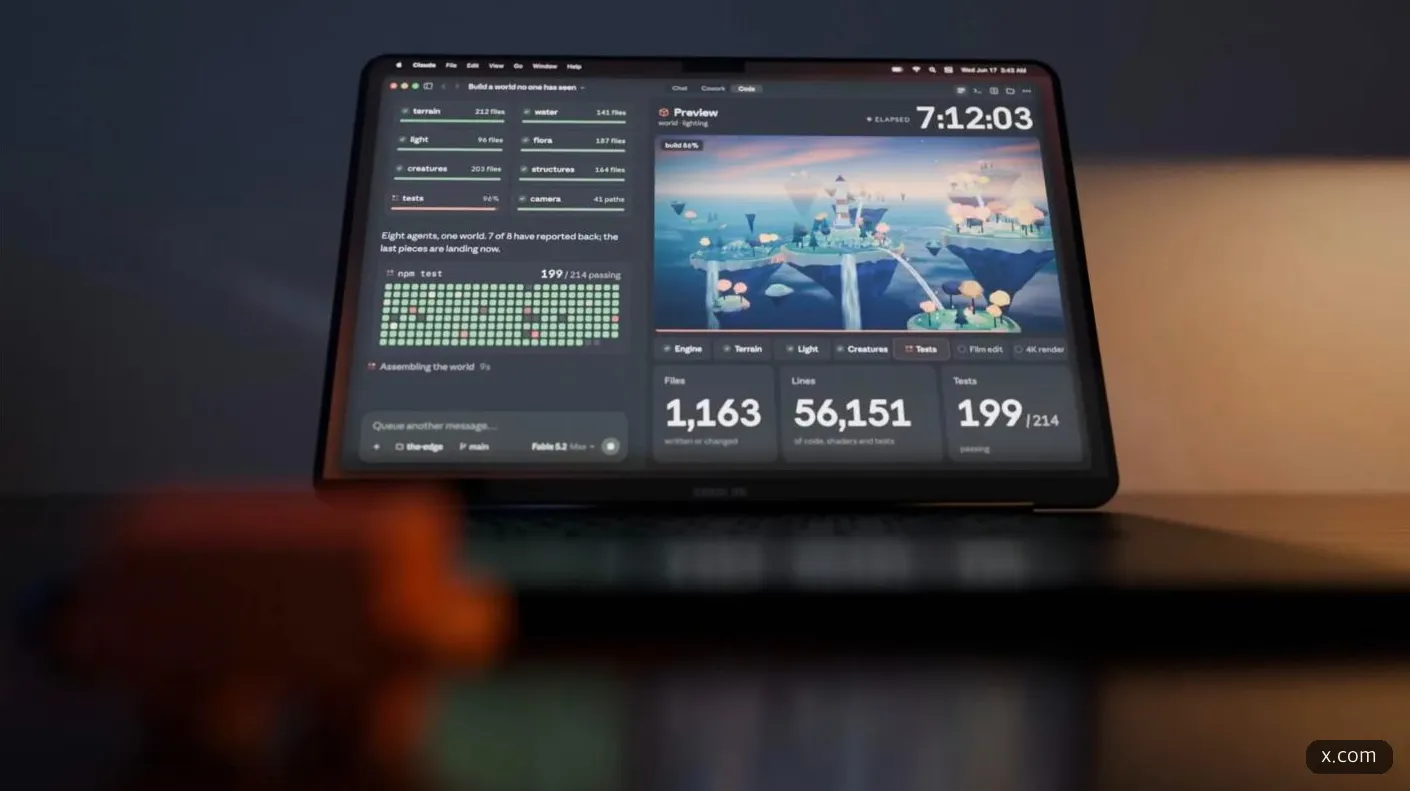
A scene from the Blender animation made with a single prompt. Even the numbers on the laptop screen were rendered inside the video.
No. 16 is also Blender, but the approach is different. Fable wrote the Python code that drives Blender itself, building a 3D world from scratch and rendering it. No. 3 used Blender together with the music program Reaper to make video and sound. Sounds recorded on an iPhone were handed over and used for sound effects, and the creator judged that the sound effects came out better than the music.

A 3D world built with Python code that Fable wrote itself to drive Blender.
No. 14 is the most eye-catching scene in the collection. It shows sunlit fabric swaying in the wind, made with code alone and no image or video generation model. That covers the folds of the cloth, light passing through it, the camera movement and even the sound effects.

A scene made with code alone, without an image or video generation model. The way light passes through the cloth and the wrinkles swaying in the wind were reportedly all calculated.
No. 11 is a case where the only instruction was “make the most beautiful video you can,” with the scenes and methods left to the AI. No. 5 is a screen with 3D elements and a dotted background effect, made in about 10 minutes. No. 17 fixed the problem of a 3D character’s facial expressions and clothing clipping into the body, then had it dance on a Unity stage. The creator, who had long been stuck on mouth shapes and teeth, said Fable solved it.
Art, cities and education: reading documents and maps, then rebuilding
No. 6 took a PDF of Leonardo da Vinci’s invention notebooks and turned the machines drawn on paper into models you can actually operate. No. 8 answered a request for a painting indistinguishable from a photo by simulating about 700,000 brushstrokes and layering them.
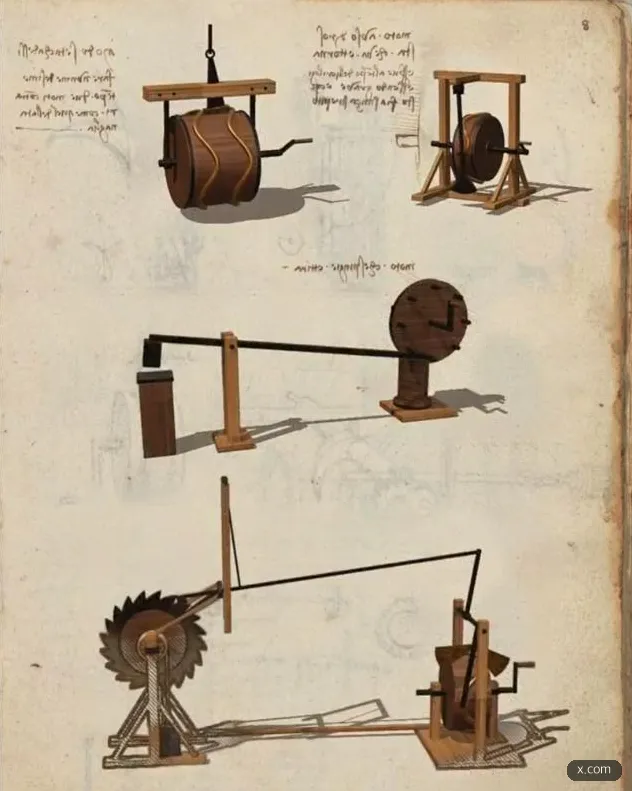
A case that read a PDF of da Vinci’s 500-year-old invention notebooks and turned the blueprints on the page into models you can run.
There are two city recreations as well. No. 13 built 1 square kilometer of the Indiranagar area of Bengaluru, India, from map data and a single prompt, and the result is open on a website where you can explore it directly. No. 10 recreated Istanbul, Türkiye, at the Max setting, and the creator said a single run cost up to $2,618 while testing dozens of prompts.

One square kilometer of Indiranagar in Bengaluru, India, recreated from map data and a single prompt.
All 17 in one table
| No. | Field | Creation | What the creator said |
|---|---|---|---|
| 1 | Game | High-quality FPS | About 8 hours with no human feedback; about 445 million input and 2.7 million output tokens; about $550 via API |
| 2 | 3D animation | Blender desk and MacBook scene | 1 prompt, 13 camera scenes, 4K render in 52 minutes for $5.75 |
| 3 | Video and sound | Blender and Reaper video with sound effects | Sound effects made from iPhone recordings |
| 4 | Game | Portal-teleporting multiplayer FPS | Anthropic employees tested it in office matches |
| 5 | Visual effects | Screen with 3D and dot effects | About 10 minutes |
| 6 | Education | Da Vinci invention notebook to working models | Read and recreated from an invention notebook PDF |
| 7 | Game | One-on-one FPS Gilt & Gutter | Characters from Tripo3D; skeleton and animation by Fable |
| 8 | Art | Photo-like painting | About 700,000 simulated brushstrokes |
| 9 | Game | Sword action game | No numbers given |
| 10 | City | Istanbul recreation | Up to $2,618 for a single run |
| 11 | Video | ”The most beautiful video” | AI decided scenes and methods |
| 12 | Game | Kart racer Turbo Tails | 6 racers, solo and multiplayer |
| 13 | City | 1 km² of Indiranagar, Bengaluru | Map data plus 1 prompt |
| 14 | Video | Sunlit fabric | Code only, no generation models |
| 15 | Game | Worm Rider | 10 prompts, about 3,400 lines of code, about 10 minutes of touch-up |
| 16 | 3D | Blender 3D world | Fable wrote the Blender control code |
| 17 | 3D character | Character dancing in Unity | Fixed expression and clothing clipping |
Lined up in a table, the ways of using Fable 5.2 split into two camps. One is like the FPS in No. 1, where a person steps back and lets it run alone for hours. With more than 400 million input tokens, the bill reaches hundreds of dollars. The other is like Worm Rider in No. 15, where a person gives 10 short instructions and spends 10 minutes touching things up. That a 3,400-line game came out of that little human effort is the most striking point in this collection.
The numbers need filtering. The $5.75 in No. 2 is the GPU cost for rendering, not what was paid to the model. Conversely, the $2,618 in No. 10 is the maximum for a single run, so handing off a whole city is a job that costs a lot of money for an individual doing it for fun. And of the 17, only three disclosed their costs, so for the rest we cannot know how much they cost.
The reactions under the replies are worth a look too. One user wrote, “It must be the same Fable 5.2 as mine, but the quality is so different.” Even with the same model, results diverge sharply depending on the prompt, the budget and how long you run the agent. Someone also asked about hitting a security safeguard in both Opus 5.5 and Fable while doing reverse engineering.
The cases Anthropic cites itself are a step up in scale. About 1,000 Fable 5.2 agents finished translating Fermat’s Last Theorem into the Lean proof language in 30 hours. The earlier formalization took 11 days. One engineer started from an empty folder and coordinated more than 1,000 sub-agents over 8 days to build a bootable operating system prototype, and ZDNet Korea reported that this OS actually ran on a real laptop. Three electronic devices built by partner Diodes reportedly worked without circuit revisions.
The Threads cases and Anthropic’s cases share something. They are long tasks that run on their own for hours to days, not a single short conversation. That is exactly where Fable earns its price.
Playing a game that holds a nephew’s dream
Among the creations, one you can try right away without logging in is Aiden’s Revenge. Developer Lex Toumbourou made this side-scrolling fighting game with Fable 5.2, based on designs and sketches by his nephew. According to his blog post, it has 18 heroes, 12 bosses and 12 stages, supports 4 controllers, and took about 600 requests and roughly 340 million Claude tokens over two days. He said the art was made separately with an OpenAI model, and the music and sound effects with ElevenLabs.

The opening screen of Aiden’s Revenge, built from characters the nephew drew.
Open it in a desktop browser and the title appears after about 5 seconds of loading. The menu offers Start Game, Stage Select, Mode and Controls. The controls screen lists WASD plus J, K, L and I for Player 1, the arrow keys for Player 2, and up to four gamepads. It has the grammar of the genre down: a combo of three punches ending in a kick, running by double-tapping a direction key, and a special-move gauge that fills as you land hits.
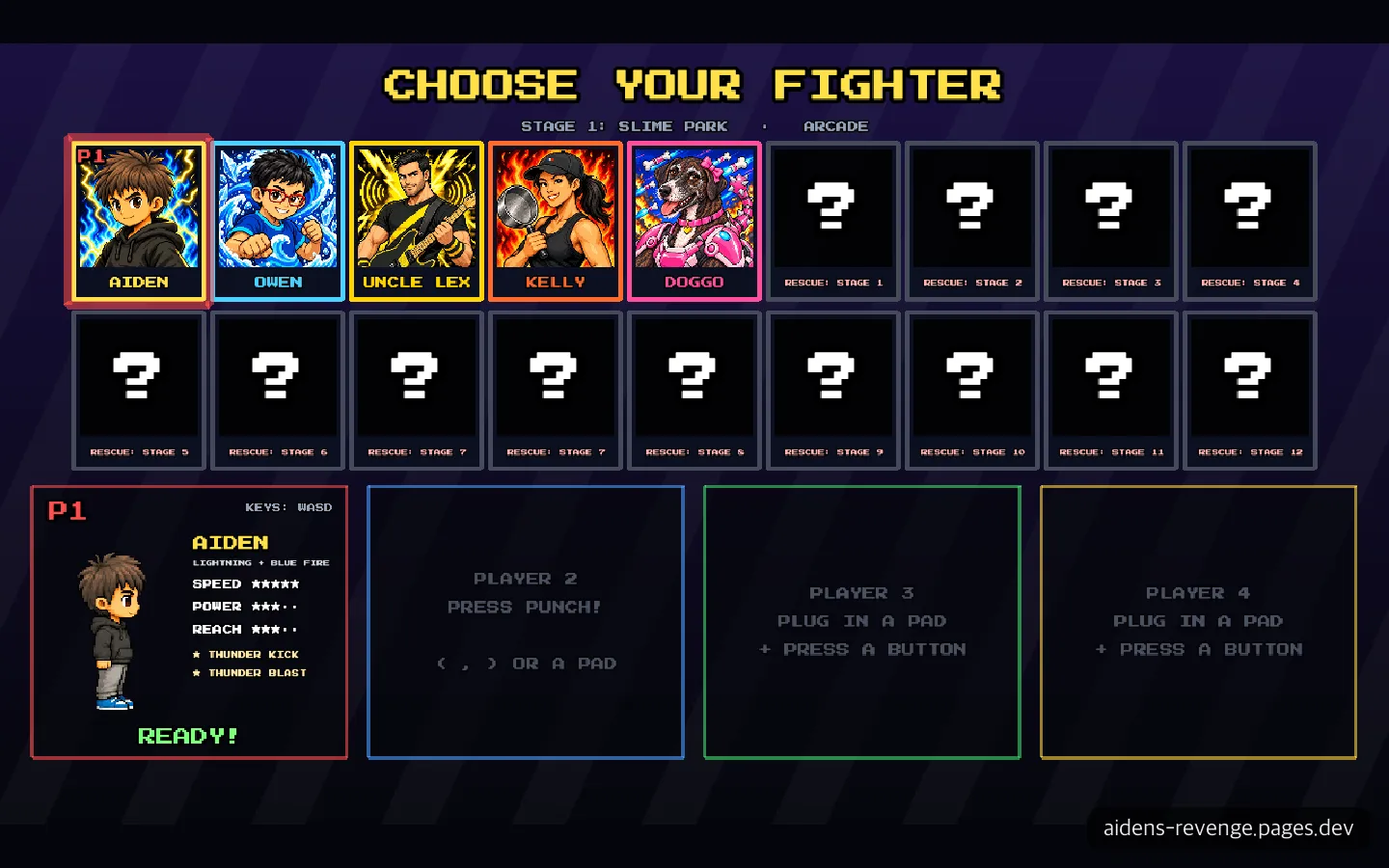
The character select screen. One locked slot opens each time you clear a stage.
When you start, a cutscene with English subtitles plays, then you move on to character select. The first unlocked characters are five: Aiden, Owen, Uncle Lex, Kelly and Doggo, and the other 12 slots are locked behind question marks. Each character has its own speed, power and reach star ratings and a named special move. In Stage 1, Slime Park, walking right brings out two enemies in yellow hoods. After trading a few blows, my health dropped and my special gauge filled.
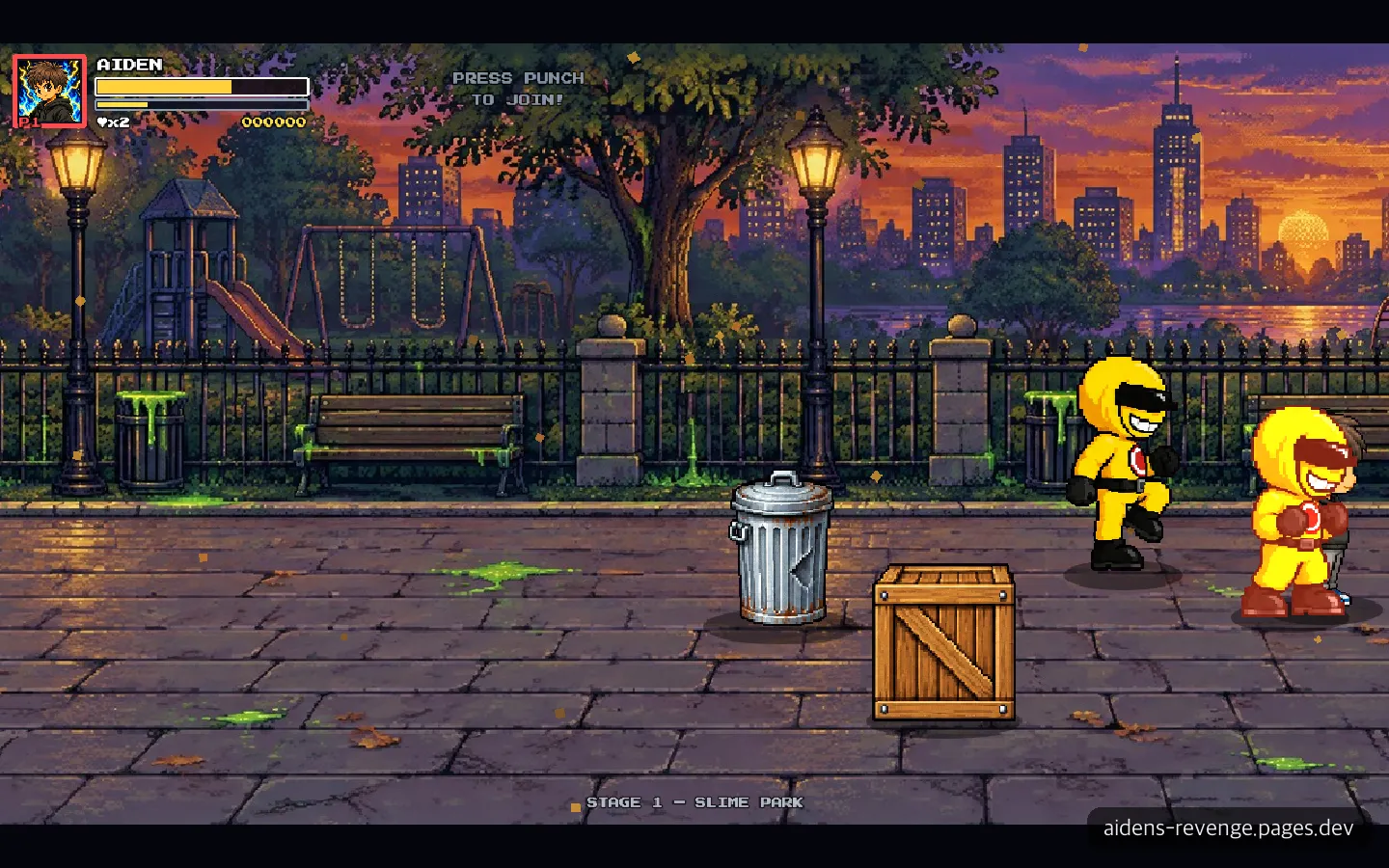
The first enemies in Stage 1, Slime Park.
This time we played only the early part of Stage 1, so we could not confirm the bosses or the 18 heroes on screen. Even so, a setup that runs from cutscene to select screen to scoreboard to multiplayer join slots is hard to accept as a two-day solo project. There was one snag. A quick tap of the start key did nothing, and the menu opened only with a slightly longer press. That could be down to our test environment, so it is hard to call it a defect in the game.
The downsides, and the claim of “made in one shot”
The biggest wall is cost, as expected. The Threads cases alone list figures from a few hundred dollars to the low thousands, and Aiden’s Revenge alone took more than 300 million tokens. Subscribers can use only half of their weekly limit on it, so a few long jobs and you see the bottom quickly.
The phrase “made in one shot” also deserves a grain of salt. The Aiden’s Revenge blog post drew 306 points and 221 comments on Hacker News (checked Nov. 10, 2026), and one user pointed out that calling something one-shot hides many rounds of revision. It is hard to call 600 requests a one-shot, they argued. The author himself wrote that he compromised on one character by using a transformation instead of a proper special move, and that he did not test with Opus 5.5, so he does not know whether the previous model could have done it. There was also criticism that the art has the same look as generic AI art, and our own impression was similar. It is clean and consistent, but it is pixel art that feels like something you have seen before. Some commenters also said the gameplay is better than what Opus 5.5 produces.
If your work is in security, lower your expectations. Blocking by the safeguards is down about 55% from 5.1 (about 60% for cyber and about 40% for biology), but Anthropic itself says Fable 5.2’s safeguards block most cybersecurity work. The reverse-engineering question in the Threads replies ran into the same wall.
Who gets their money’s worth
Fable 5.2 is closer to “a worker you leave a job with for a long time” than to a “smart chatbot.” If you plan to run games, 3D work or large coding jobs of hours to days as agents and can absorb the cost, it is the strongest option right now. For short coding or everyday questions, Opus 5.5 is enough, and if you do want to try Fable, EasyTicket’s take is that it is better value to use the High setting instead of the top one and start with one small game like Worm Rider.
Frequently asked questions
Can I use Claude Fable 5.2 for free?
Anthropic says it has opened Fable to all users. However, the usage terms spelled out in the announcement are for paid plans. Pro plans and Team standard seats can use up to 50% of their weekly usage limit on Fable (as of November 2026).
How much does it cost through the API?
It is $8 per million input tokens and $40 per million output tokens, and fast mode is double that. This model tends to produce long output, so your actual bill depends more on output volume than on the per-token price.
Can I make a game with Fable 5.2 without knowing how to code?
There are many cases built with text instructions alone. But even Aiden’s Revenge involved nearly 600 requests over two days, and the art and music were made separately with other AI tools. A job finished with a single instruction is rare, so starting with one small game is the realistic approach.
Sources 7
- Introducing Claude Fable 5.2 and Claude Mythos 5.2 (Anthropic)
- Claude Fable 5.2 (max) - Intelligence, Performance & Price Analysis (Artificial Analysis)
- 페이블 5.2 결과물 17가지 모음 (Threads 게시물)
- 앤스로픽, IPO 앞두고 최상위 AI 모델 출시… 성능 1위 탈환 (이투데이)
- [AI는 지금] IPO 앞둔 앤트로픽, '페이블·미토스 5.2' 공개…에이전트 협업 강화 (ZDNet Korea)
- Fable 5.2 One-Shotted My Nephew's Dream Game (NotesByLex)
- Fable 5.2 one-shotted my nephew's dream game (Hacker News)
AI helped with research and the first draft; the operator tried the subject firsthand, checked and edited this article before publishing. Let us know if you spot a mistake.