
You have probably seen it: a page that sits for several seconds on “Performing security verification.” The site is working out whether the visitor that just arrived is a person or a program, and that question is becoming harder to answer. An AI agent is an AI program that takes a task from a person and then visits websites on their behalf to search, book and even pay. By summer 2025, services like ChatGPT agent were already roaming the web.
On November 5, 2026, Cloudflare laid out 14 problems that these new visitors cause for websites in a blog post, Agents aren’t humans (but they kinda are). EasyTicket reads the core of the post as being less about technology than about “who pays.” When the visitor changes from a person to an agent, the site can no longer see the real user, and most of the cost that falls into that gap lands on the people who built the site.
Automated requests now outnumber people
The numbers show the change came faster than expected. According to Tech Times, Cloudflare CEO Matthew Prince shared data on June 3, 2026 from Cloudflare Radar showing that, among requests for HTML content, automation accounted for 57.5% and humans for 42.5%. At SXSW in March of the same year, he had predicted this reversal would arrive around 2027, so it came almost a year early.
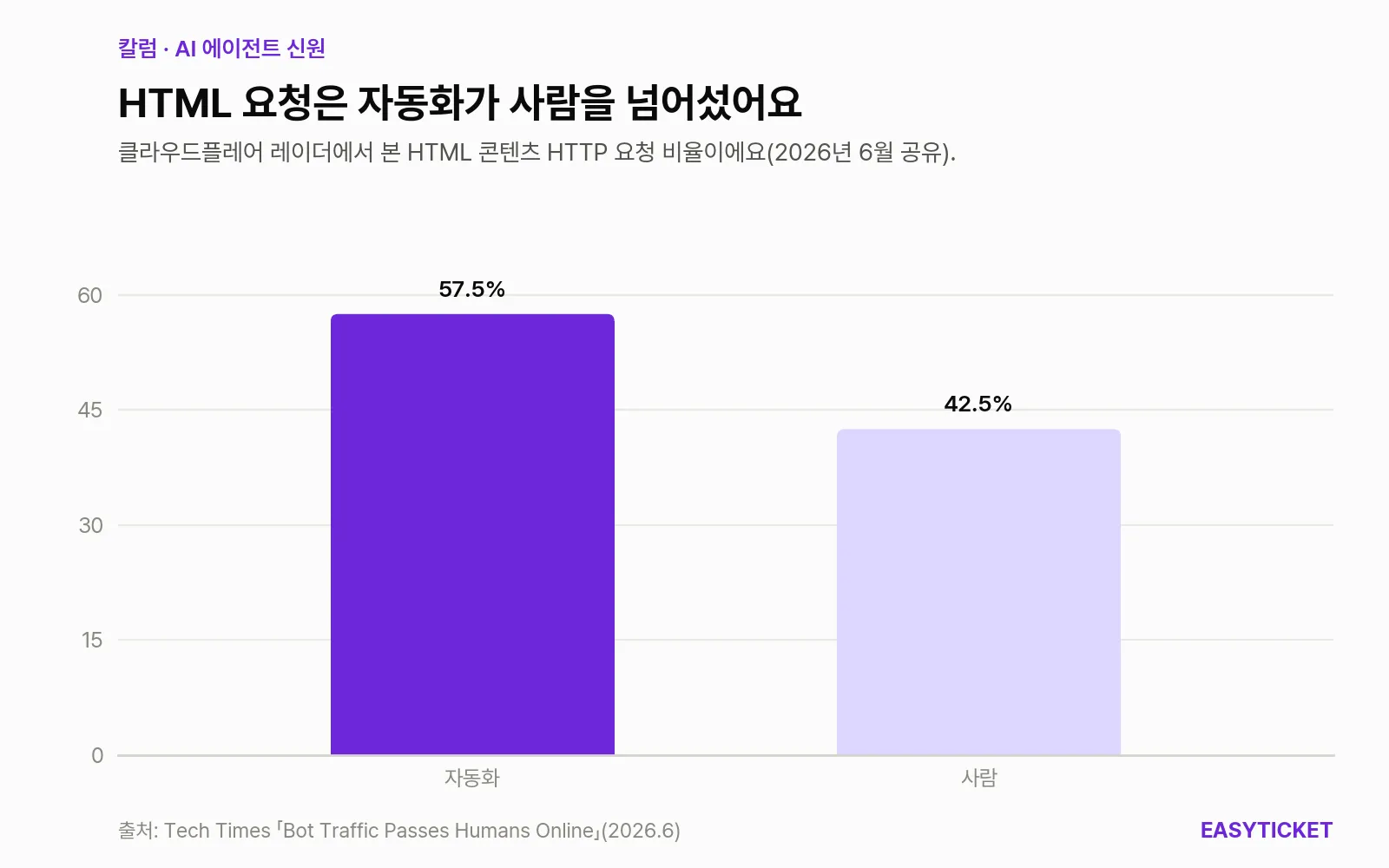
In figures Cloudflare shared in June 2026, automated traffic surpassed human traffic in requests for HTML pages.
Note, though, that this is a count of requests. It does not measure how long people stayed on a page or how much they cared, and it reflects only the sites Cloudflare protects. Still, the direction is clear.
The more painful number is the gap between what bots take and what they give back. In figures Cloudflare published on its blog on August 28, 2025, nearly 80% of AI bot crawling in the first week of that August was for training. Measured as pages scraped per visitor sent back, the ratios were 118 to 1 for Perplexity, 887 to 1 for OpenAI and roughly 50,000 to 1 for Anthropic. That means that for every 118 pages Perplexity took, one person came through to the site. For a site that lives on ads or subscriptions, visitors rise while revenue stays flat.
What are the 14 problems Cloudflare listed?
If you want to understand in one pass why agents are a headache for sites, start with Cloudflare’s premise. The post treats the agent as an “intermediary” that sits between the user and the site. Having read it directly, I find that three diagrams explain the problem most briefly.
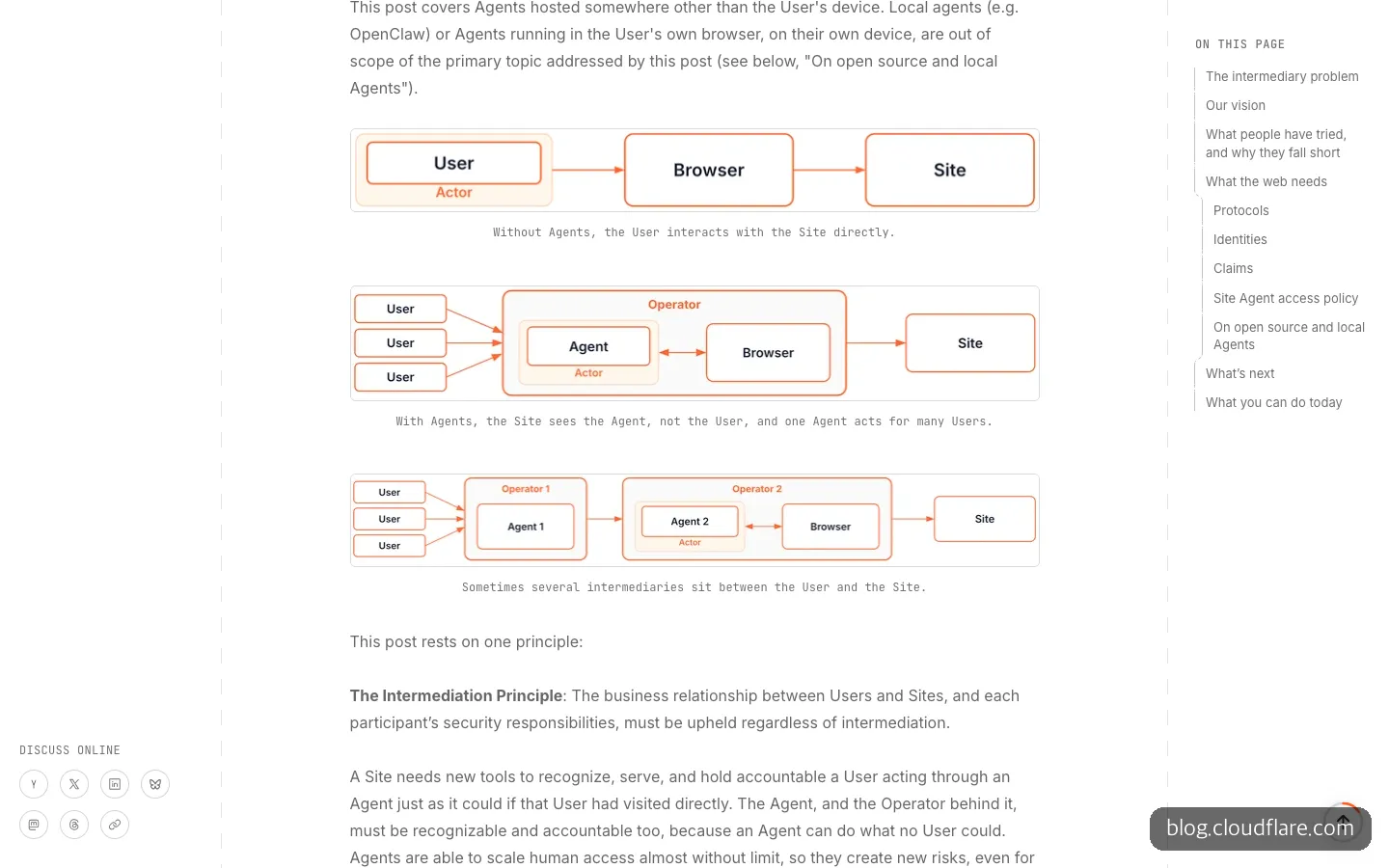
From the top: a user using a site directly, one agent acting for many users, and several intermediaries stacked in between.
The site sees only the agent. It cannot see how many people stand behind it or who they are. So the post sets out a principle, “the transactional relationship and security responsibilities between user and site must hold no matter what sits in between,” and lists 14 problems that arise when it breaks. EasyTicket sorted them into four groups.
| Group | Problems | What happens on the site |
|---|---|---|
| Unknown identity | Account sharing, identity spoofing, bypassing identity-based policies, inability to tell users apart | Several people use one paid subscription, but it looks like one account. Attackers copy the user-agent string of a well-known agent, and personalization and rewards features break |
| Verification fails | Regulatory compliance, defeated human checks, broken identity verification, broken risk-based authentication | Agents cannot pass age or region checks. A CAPTCHA only shows that a person is present, not who they are, and agents running in the cloud look different from the usual device and location |
| Where money moves | Friendly fraud, malfunctions, inability to tell unauthorized card use | A purchase is approved and then disputed later, and there is no device or IP evidence to separate mistakes such as the wrong date or duplicate orders |
| Resources and revenue | Resource exhaustion, mixed traffic, uncompensated consumption | Endless refreshes and used-up free trials appear, and blocking one problem agent also blocks that agent’s legitimate users. Content goes out with no ad revenue |
The post concludes that in almost every item, the site bears the main cost. Not the agent company, and not the user who gave the instruction.
Visitors wearing name tags are still rare
The starting point of the fix is for an agent to prove “who I am and which company I belong to.” In August 2025, Cloudflare introduced Web Bot Auth, a method that attaches a cryptographic signature to requests, and grouped ChatGPT agent, Goose, Browserbase and Anchor Browser as the first “signed agents.” The question is how many visitors actually wear this name tag.
A third-quarter report released on October 20, 2026 by Acoz Labs, a bot detection company, gives an answer. In real traffic from customers across eight industries between July 1 and September 30, 97.7% of the AI agent visits that Acoz classified as legitimate had no verified signature. It is worth noting that this is the share within visits Acoz judged legitimate, not within all agent traffic.
In the same report, ChatGPT agent signed 78.4% of its visits, making it the only agent signing at scale. In other words, one agent is diligent and the rest mostly go around barefaced. On September 30 alone, 65.2% of Acoz customers saw AI agents in sensitive stages such as login, sign-up and checkout.
Microsoft Clarity data shows how far agents go. Clarity analyzed and published more than 5.2 million visits classified as agents, across more than 230,000 projects, from August 13 to September 9, 2026.
The share of visits with a checkout event was 25.21% for agent visits and 14.65% for human visits. Clarity itself noted that this is not the same as completed orders, and that visits where a person took over midway may be mixed in. Even so, it is enough to show that the “where money moves” problems in the table are not remote. Visitors without name tags often make it all the way to the checkout screen.
Other views, and the limits of these numbers
Not everyone agrees with the push to “recognize agents and hold them accountable.” On August 4, 2025, Cloudflare announced that when Perplexity is blocked, it switches to a Chrome-like user-agent and crawls while ignoring robots.txt, and removed it from its list of verified bots. In the same test, Cloudflare said, ChatGPT-User stopped when it saw the disallow signal. In a report by The Register, Perplexity pushed back, saying that it fetches pages because a user asked a question, so it should be treated like a human visit, and that treating this as malicious would put email apps and browsers under suspicion too. The logic that “an agent a user sent is an extension of that user” has some merit.
There is also worry that identity verification creates a new gatekeeper. Cloudflare itself acknowledged part of this concern. In a post published on April 21, 2026, also available in Korean, titled “Beyond the bot-versus-human comparison,” it wrote that without credentials that protect anonymity, sites would lean more on logins and device tracking, weakening the open web. That ties into the point that, depending on who manages the signature list, gatekeeping power could concentrate in one place.
The sources of the numbers deserve scrutiny as well. PPC Land pointed out that many of the figures backing this issue came from companies that make money from bot detection. The Acoz report did not disclose its original visit counts and was not externally audited. Cloudflare’s November post contains no traffic statistics itself, and it gives no figure for when agents will overtake human browsing. The scope is also narrow. The post says it deals with agents running outside the user’s device, and that agents running inside the user’s browser are not the main subject. Public statistics on agent traffic reaching Korean sites are still hard to find.
So EasyTicket thinks it is right to read these numbers as signals of “which direction” rather than “exactly how big.”
The homework left for people building small services
Why does this matter to someone who shipped a single web app with vibe coding? Because of the 14 problems, “resource exhaustion” reaches you first. A web app that calls a paid AI API on every button press, or a service that hands out free credits at sign-up, goes straight to a bill if an agent keeps hammering it. Visit numbers need a second look too. More page opens do not guarantee more people stopped by.
If your service has a free trial or expensive AI calls, it is right to decide how to treat agents before launch. There are broadly three options.
- Block: robots.txt and blocking rules. These work only on agents that obey them, and they also block legitimate users’ agents.
- Accept: if your site benefits from content spreading widely, leave it open but guard only the stages such as checkout and sign-up.
- Recognize: allow signed agents and slow down the rest. Cloudflare named per-agent allow and block policies and a security analytics view as things you can use now, while its account abuse defense feature is still in early access.
Either way, the answer depends on what the service earns money from. A site that earns from content and one that earns from payments cannot have the same answer.
Three things to watch next
The first is standards. On November 3, 2026, Cloudflare published a draft of the MOLE protocol, which limits rates without any user identifier. This Internet-Draft expires on May 7, 2027. Whether the next version appears before then is the first signal.
The second is the face of the coalition. Cloudflare said it is forming a “Trusted Agent Delegation” coalition to bring the issue to the IETF, the international standards body, but it has not named the participants. Whether the big companies that build agents sign on will decide its success.
The third is the signature rate. In Acoz’s next quarterly report, whether that 2.3% moves will show right away whether a name-tag culture is spreading.
The change in visitors cannot be undone. The smallest preparation you can make now is to settle, in a single line, whether you will block, accept or recognize the agents coming into your service.
Frequently asked questions
Can I block AI agents just by writing a robots.txt file?
It only works on those who obey it. In Cloudflare’s August 2025 test, ChatGPT-User stopped when it saw the disallow signal, but Cloudflare announced that Perplexity ignored it while changing its user-agent (Perplexity disputes this). For checkout or expensive features, it is safer to protect them with separate blocking rules or rate limits.
Isn’t blocking all AI agents the safest approach?
Not necessarily. In the Clarity data, agent visits reached the checkout stage more often than human visits. Some human customers also arrive by sending an agent, so blocking everything can cost you those customers too. Cloudflare also listed “mixed traffic” as one of the 14 problems.
Does this apply to Korean sites too?
As of November 2026, public statistics that count only AI agent traffic to Korean sites are hard to find. However, the numbers above came not from a specific country but from sites across those using Cloudflare, Acoz Labs and Clarity, so it is natural to think Korean services are on the same trend.
Sources 8
- Agents aren't humans (but they kinda are) – Cloudflare Blog
- Websites pay for nearly all 14 AI agent problems, Cloudflare argues – PPC Land
- 97.7% of legitimate AI agent sessions carry no verified ID, Arkose finds – PPC Land
- What AI Agents Do on Websites: Insights From 5.2 Million Sessions – Microsoft Clarity Blog
- Bot Traffic Passes Humans Online: Cloudflare Says Agentic AI Drove 57.5% Share – Tech Times
- A deeper look at AI crawlers: breaking down traffic by purpose and industry – Cloudflare Blog
- 봇과 인간의 비교를 넘어서기 – Cloudflare 블로그
- Perplexity vexed by Cloudflare's claims its bots are bad – The Register
AI helped with research and the first draft; the operator tried the subject firsthand, checked and edited this article before publishing. Let us know if you spot a mistake.