 EasyTicket
 A sudden, big hospital bill can make your mind go blank. Fortunately, the government runs several programs that ease the burden of medical costs, and if you qualify, you can get anywhere from a few million to tens of millions of won back. EasyTicket has pulled together the 8 most essential government medical expense support programs in one place, based on data from the Ministry of Health and Welfare, the Korea Disease Control and Prevention Agency (KDCA), and the National Health Insurance Service (NHIS). We’ve also included a comparison table and checklist to help you quickly find and apply for the program that fits your situation.
8 Government Medical Expense Support Programs at a Glance
First, here’s a table showing who each of the 8 programs is for and how much you can receive. Find the row that applies to you, then check the detailed requirements for each program below.
| Program | Eligibility | Support Limit | Where to Apply |
|---|---|---|---|
| Catastrophic Medical Expense Support | Household income at or below 100% of median (up to 200% with individual review) | Up to KRW 50 million/year | NHIS |
| Copayment Ceiling System refund | All National Health Insurance subscribers | Amount exceeding the income-tier ceiling of KRW 870,000–8,080,000 | NHIS |
| Advance Payment for Unpaid Emergency Medical Bills | Emergency patients unable to pay | Full advance payment of emergency treatment and transport costs | Hospital administration office |
| Cancer Patient Medical Expense Support (Adults) | Medical Aid recipients, near-poverty households | Up to KRW 3 million/year, up to 3 years | Public health center |
| Cancer Patient Medical Expense Support (Children) | Cancer patients under age 18 | Up to KRW 30 million/year, until age 18 | Public health center |
| Rare Disease Patient Medical Expenses | Registered under the special copayment reduction program, household income below 140% of median | Copayments, caregiving costs (KRW 300,000/month), etc. | Public health center, helpline |
| Rare Disease Diagnosis Support | Patients suspected of an undiagnosed rare disease | Whole-genome sequencing costs | Participating hospitals (34) |
| Drug Cost Copayment Difference Support | Patients on anticancer or rare-disease drugs | Part of the drug copayment | NHIS |
| Near-Poverty Copayment Reduction | Household income at or below 50% of median + dependent support requirement | Inpatient/outpatient copayment reduced to 14% | Community service center |
3 Universal Support Programs Open to Everyone
Let’s start with the universal programs that have relatively broad disease and income requirements. If you’ve just been hit with a large hospital bill right after admission, check these three first.
Catastrophic Medical Expense Support Program
This program is there for when medical costs are so high relative to income that they destabilize a household’s finances. It doesn’t discriminate by illness, and broadly covers both non-covered (out-of-pocket) treatment and insured items that fall outside the Copayment Ceiling System.
- Support limit: Up to KRW 50 million per year, for up to 180 treatment days per year (Source: Ministry of Health and Welfare)
- Support rate: 80% for basic livelihood security recipients and near-poverty households, 70% for those at or below 50% of median income, 60% for 50–100%, and 50% for 100–200%
- Eligibility criteria: Must meet all three — income (100% of median or below, up to 200% with individual review), assets (KRW 700 million or below), and medical costs (exceeding 10% of annual income)
- How to apply: Within 180 days of discharge, apply in person at NHIS (☎1577-1000)
Once 180 days have passed since discharge, you can no longer apply at all. Prepare your hospitalization receipts, medical certificate, and family relationship certificate in advance.
National Health Insurance Copayment Ceiling Refund
If your annual copayment exceeds a set limit, NHIS automatically notifies you — no application needed. If you spent a lot on medical care, you’ll get a notice by mail or text around August of the following year.
For 2024 treatment, the individual ceiling ranges from KRW 870,000 to 8,080,000, depending on income tier (KRW 10,500,000 for long-term care hospital stays exceeding 120 days). If the copayments you paid over the year exceed this amount, you can get the excess refunded. However, non-covered treatment, fully self-paid items, selectively covered treatment, dental implants, hospitalization fees for 2- and 3-person rooms, Chuna manual therapy, and copayments for minor conditions treated as outpatient at tertiary general hospitals are excluded.
- Where to apply: NHIS website (www.nhis.or.kr), the “The건강보험” app, or in person, by fax, or by mail at any NHIS branch nationwide
- Application deadline: Ongoing (within 3 years of the date NHIS sends the notice)
Advance Payment for Unpaid Emergency Medical Bills
If you’re rushed to the emergency room and can’t afford to pay right away, the government pays the bill first, and the patient (or their family) repays it later in installments.
- Coverage: Copayments for treatment from the start to the end of emergency care, plus ambulance transport and treatment fees
- How to apply: Apply directly with the emergency advance payment officer at the hospital’s administration office, and fill out the “Application for Advance Payment of Unpaid Medical Bills (Repayment Obligor’s Consent Form)”
- Note: Specialist selection fees, additional room charges, and meals not covered by health insurance are excluded. If you don’t repay it, the government can take steps such as seizing assets to recover the debt.
3 Disease-Specific Support Programs
Conditions that require long-term treatment, like cancer and rare diseases, get thicker support through separate tracks. Check whether you’re eligible as soon as you receive a diagnosis.
Cancer Patient Medical Expense Support
This program covers medical costs continuously, from diagnosis through treatment, for low-income cancer patients. The criteria differ for adults and children.
- Adult cancer patients: Medical Aid recipients, and National Health Insurance subscribers who qualify for the near-poverty copayment reduction → Up to KRW 3 million per year, for up to 3 consecutive years
- Child cancer patients: Under age 18, Medical Aid recipients, near-poverty households, or National Health Insurance subscribers who meet the income/asset criteria → Up to KRW 30 million per year, until age 18
- How to apply: Visit the public health center that covers your registered address, and submit a registration form, medical certificate, health insurance card, etc.
- Inquiries: Your local public health center, or the National Cancer Center’s Cancer Patient Medical Expense Support officer (☎031-920-2029)
Rare Disease Patient Medical Expense Support Program
For those registered under the special copayment reduction program for rare diseases, this covers copayments, caregiving costs, and more — provided the patient’s household and the household of their legal supporter meet income and asset requirements.
- Income requirement (patient’s household): Below 140% of the Standard Median Income (KRW 3,589,933 for a 1-person household / KRW 9,092,633 for a 4-person household)
- Legal supporter’s household: Below 200% of the Standard Median Income
- Coverage: Copayments for medical care benefits, chronic kidney disease care costs, assistive device purchase costs, ventilator and cough-assist device rental fees, caregiving costs of KRW 300,000/month, and special dietary formula purchase costs
- Covered conditions: 1,413 diseases (as of the data update on 2026-04-21)
- Where to apply: Visit the public health center at your address, or apply online via the Rare Disease Helpline (helpline.kdca.go.kr)
- Inquiries: KDCA call center (☎1339)
Rare Disease Diagnosis Support
This program provides genetic testing support for patients who can’t move forward with treatment because they don’t yet have a confirmed diagnosis. Unlike a simple medical expense refund, this program lets you receive the test itself for free — don’t get the two confused.
- What’s covered: Whole-genome sequencing analysis for patients suspected of having an undiagnosed rare disease
- How to apply: Visit one of the 34 designated participating institutions for consultation and referral
- Checking participating institutions: Rare Disease Helpline → Support Programs → Genetic Diagnosis Support Program → List of Participating Institutions
- Inquiries: Pusan National University Yangsan Hospital, referral institution (☎055-360-3724)
2 Additional Support Programs: Drug Costs and Near-Poverty
For costs that the 6 programs above don’t fully cover, there are two more tracks — one for drug costs and one for near-poverty households.
Drug Cost Copayment Difference Support
This program refunds part of the drug copayment for patients prescribed expensive anticancer drugs or rare-disease treatments. NHIS notifies eligible people first, so if you’ve received a notice, don’t miss the chance to apply.
- How to apply: NHIS website or the “The건강보험” app (log in with a digital certificate to check or apply for your refund), by text message (send a photo to 1668-0712), by fax (033-749-9631), or by mail
- Deadline: You can no longer apply once 3 years have passed from the date the first notice was sent
- Inquiries: Pharmaceutical Management Department (☎033-736-3240)
Near-Poverty Copayment Reduction Support
This program lets near-poverty households pay a much lower copayment than regular subscribers whenever they visit a hospital. Once you’re registered, it’s applied automatically every time you receive care, making it one of the most noticeable benefits.
- Eligibility: Patients with rare, severe intractable, or severe illnesses; patients with chronic conditions; and those under 18 (up to age 20 for middle and high school students)
- Income requirement: At or below 50% of the 2026 Standard Median Income (KRW 1,282,119 for a 1-person household / KRW 3,247,369 for a 4-person household)
- Benefits:
- Rare, severe intractable, or severe illness patients: Inpatient and outpatient medical care benefit costs waived, 20% for meals
- Chronic disease patients and those under 18: 14% for inpatient care + 20% for meals, 14% for outpatient care (some flat-rate items KRW 1,000–1,500)
- Where to apply: Visit the community service center (eup/myeon/dong) where you live
- Inquiries: Ministry of Health and Welfare Call Center (☎129), NHIS (☎1577-1000)
Checklist: What to Prepare Before You Apply
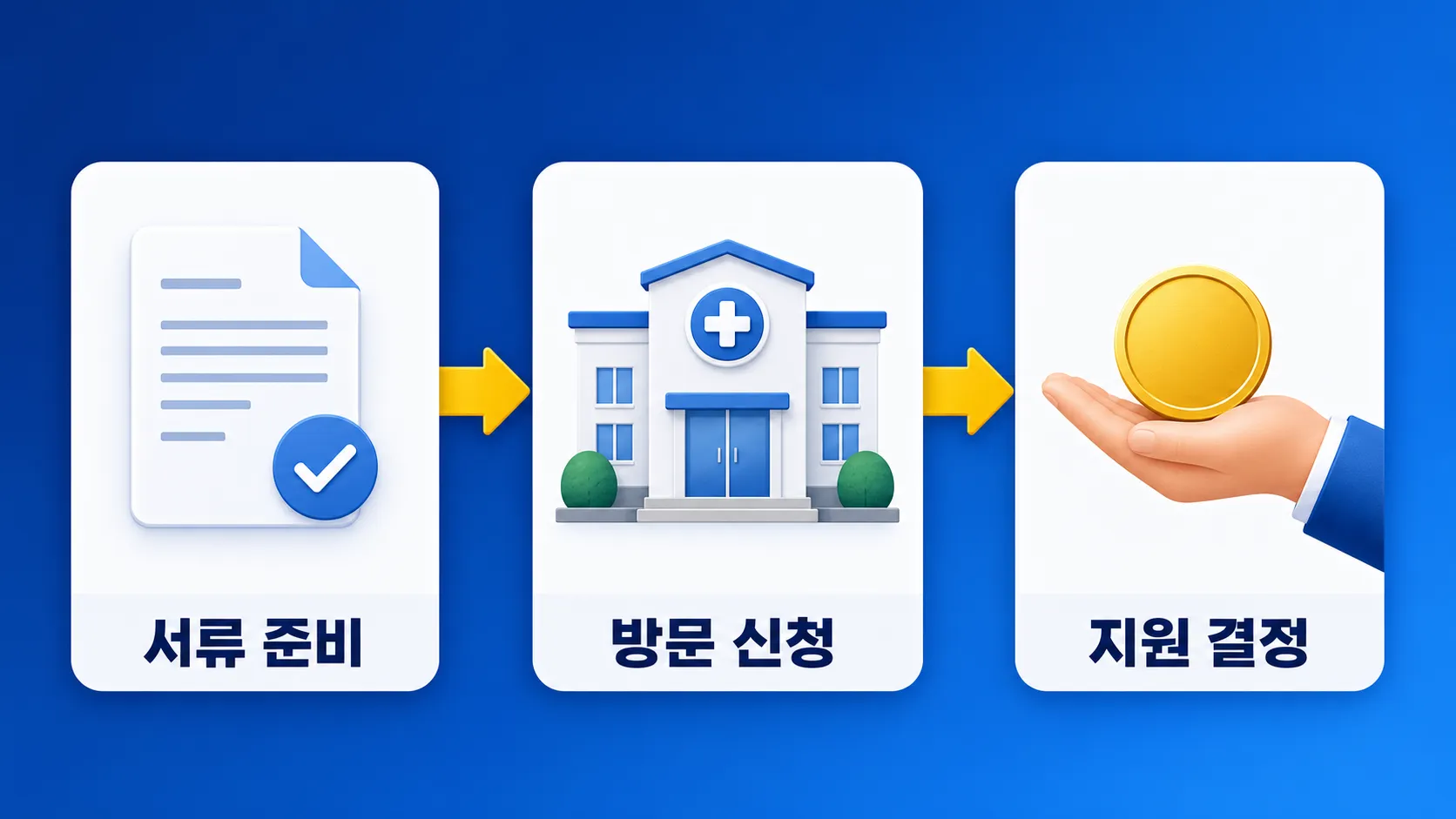
You can apply for multiple programs at once, but missing documents or missed deadlines are the most common reasons applications get blocked. Start gathering the following items right after hospitalization.
- Prepare admission/discharge confirmation and medical bill receipts (including the original and itemized statement)
- One copy of a medical certificate (issued within the last 3 months)
- One copy of a detailed family relationship certificate — to verify your legal supporter
- Copy of your health insurance card or Medical Aid card
- Private insurance enrollment documents — needed for the Catastrophic Medical Expense Support review
- Income and asset documents — lease agreement, bankbook copy, etc.
- Apply for Catastrophic Medical Expense Support within 180 days of discharge — the deadline people miss most often
- Apply for drug cost or Copayment Ceiling refunds within 3 years of receiving the NHIS notice
If it’s hard to check every program at once, start by getting your household’s health insurance premium payment certificate. It’s the starting point for determining near-poverty and median-income eligibility, so any consultation goes much faster.
Frequently Asked Questions (FAQ)
Can I receive both Catastrophic Medical Expense Support and the Copayment Ceiling refund at the same time?
Yes — the two programs cover different items, so you can receive both at once. The Copayment Ceiling System reimburses copayments for insured (covered) treatment, while Catastrophic Medical Expense Support covers non-covered treatment and items the ceiling system doesn’t reach. That said, any overlapping amount is deducted during the review process, so you can’t be reimbursed twice for the same medical cost.
What happens if I miss the application deadline?
In principle, you can no longer apply once the deadline passes. For Catastrophic Medical Expense Support, that’s 180 days after discharge; for drug cost differences and Copayment Ceiling refunds, it’s 3 years from the date NHIS sends its notice. Near-Poverty Copayment Reduction and Rare Disease Medical Expense Support can be applied for anytime, but they aren’t retroactive to costs incurred before you apply — so it’s best to register as soon as you’re diagnosed.
Can I get support for non-covered (out-of-pocket) items too?
The Copayment Ceiling System excludes non-covered items, but Catastrophic Medical Expense Support also covers non-covered treatment and copayments for selectively covered treatment. If you’re facing heavy non-covered costs from cancer treatment or major surgery, look into Catastrophic Medical Expense Support first.
Public health center, community service center, or NHIS — where should I go?
- Catastrophic medical expenses, Copayment Ceiling, drug cost differences → NHIS
- Cancer or rare disease patient medical expenses → Your local public health center (or the Rare Disease Helpline online)
- Near-Poverty Copayment Reduction → The community service center (eup/myeon/dong) where you live
- Unpaid emergency medical bills → The administration office at the hospital where you were treated
A big medical bill is rarely solved by just one program. Combining two or three programs that fit your situation can significantly cut your actual burden, so save the table and checklist above and act right after diagnosis or discharge. For detailed application forms and the latest guidance, we recommend double-checking with the National Health Insurance Service, the Korea Disease Control and Prevention Agency’s helpline, or your local public health center.
References
- Guide to the Catastrophic Medical Expense Support Program - National Health Insurance Service
- Catastrophic Medical Expense Support Program | Civil Service Guide and Application - Government24
- Guide to the 2024 Copayment Ceiling Amount - National Health Insurance
- KRW 2.8 Trillion in Copayments Refunded from 2024 Treatment Costs - Ministry of Health and Welfare Press Release
- Korea Disease Control and Prevention Agency Rare Disease Helpline
- Cancer Patient Medical Expense Support | Civil Service Guide and Application - Government24