
One press of a button, and I was Fang Junjie, a boy born in Jinan, China, in February 2026. Life expectancy: 74.9 years. Chance of dying before age five: 0.7%. Right below that sat a small table showing that if I had been born in South Korea, where I actually was born, the numbers would have been 81.2 years and 0.3%. One in 8 Billion (80억 분의 1) is a free life simulation web game released on October 5, 2026 by a solo developer using the pseudonym “Jinhwieoseu,” made together with Anthropic’s Claude. It uses real statistics from 172 countries and regions to let you live one random life up to its life expectancy.
From the first prompt to publishing the link took about 4 hours (Kukmin Ilbo interview). Within a month that link had spread across Korea and Japan, and spinoffs followed, including a version for office workers and one for animals.
What kind of game is One in 8 Billion?
As of November 2026, the version is v0.9.99 beta. According to the official site, public statistics from sources such as the UN, the World Bank, WHO, and UNESCO determine your country of birth, family circumstances, parents, illnesses, and accidents. One life takes about 30 minutes, 1 hour, or 1 hour 30 minutes depending on your settings. It is for ages 15 and up, and there is no sign-up.
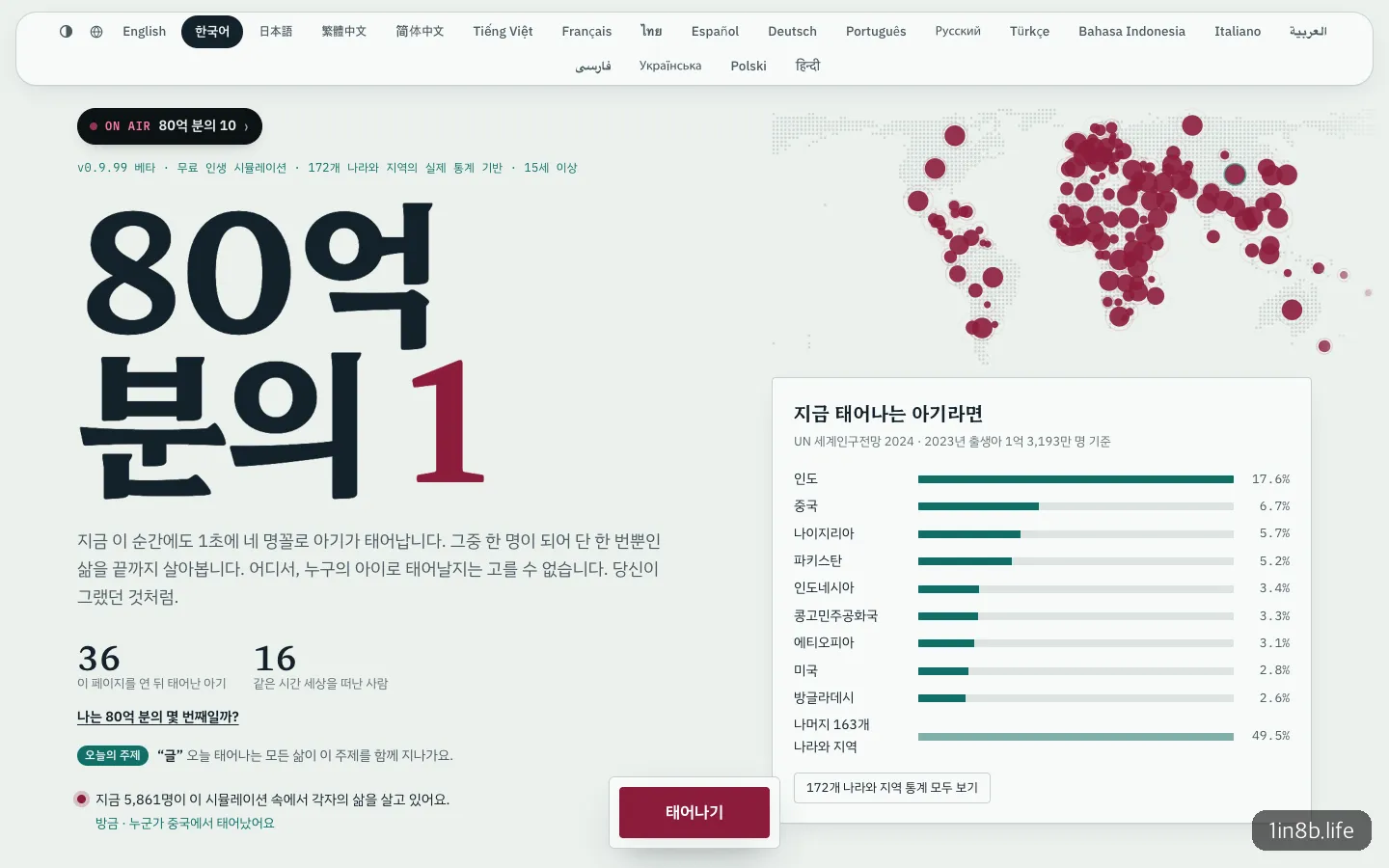
The start screen. A table showing which countries babies are being born in right now, plus the Be Born button, come first.
The mood is set from the very first screen. Counters for babies born and people who have died keep climbing after you open the page, and a table on the right lists the odds that a baby born right now is Indian at 17.6%, Chinese at 6.7%, or Nigerian at 5.7% (based on UN World Population Prospects 2024). You can choose the birth basis: “babies born right now” or “the 8 billion people alive today.” There is also a memorial hall that collects lives that have ended, a record of past lives, an option for classroom use, and a free essay about how the game was made, titled Eight Lines.
One Threads post, 7 times the visitors two days later
The path to going viral was simple. According to a written interview Kukmin Ilbo conducted on October 9, the developer posted only on Threads, and the link spread through online communities, X, and KakaoTalk (Korea’s dominant messaging app). On October 7, two days after launch, daily visits were nearly 7 times the previous day’s, and about 58% of the lives that were started were played through to the end. Cumulative visitor numbers have not been disclosed.
The Japanese game outlet AUTOMATON reported that the developer had no plan to release the game publicly at first, but rushed to buy a domain after the Threads post drew attention. In Japan, results circulated under the hashtag #80億分の1, and according to Real Sound, even Yuji Horii, creator of Dragon Quest, posted his play results on social media. In Korea, Gameple noted that starting with the Hangul Day holiday weekend (the October holiday celebrating the Korean alphabet), popular streamers played on air, picking choices by viewer vote.
The reasons the press gave were word of mouth, streamer broadcasts, and shared results. Having played it myself, I would add one more: the result sums up in a single line. A sentence like “I was born in rural Nigeria and died at this age of this cause” reads instantly in a group chat without any explanation. And with no installation or sign-up, the moment the recipient taps the link, their own life begins.
What the birth card does
When I went in and tried it, I didn’t need to touch a single setting. The game read my browser language and had already picked South Korea as my “actual birthplace,” and when I pressed the Be Born button, a birth card appeared right away.
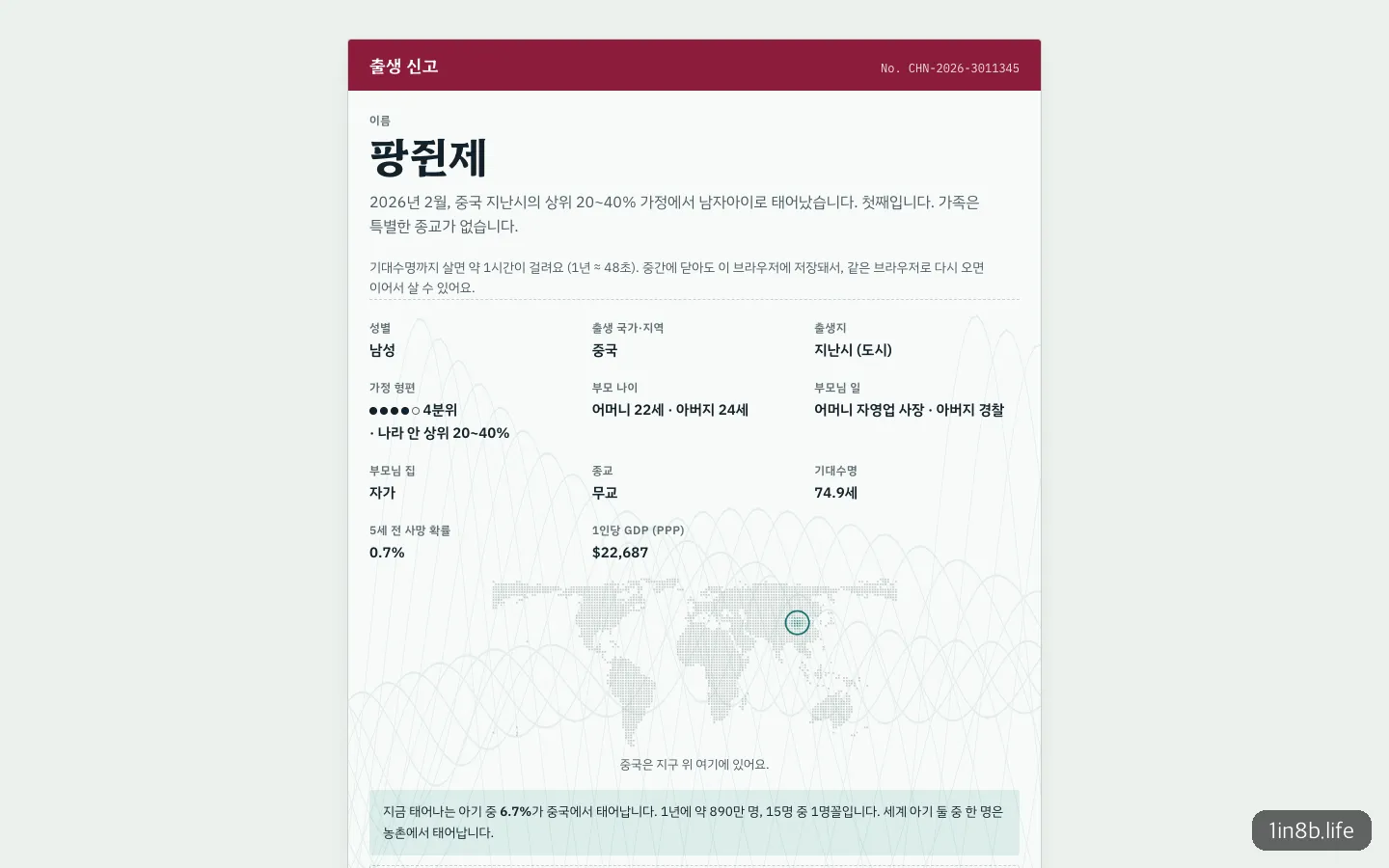
The birth card that appeared after pressing Be Born. Country, family income, parents’ jobs, and life expectancy are all set on a single card.
My mother was a 22-year-old self-employed worker, my father a 24-year-old police officer, the home was owned, and the family was in the top 20 to 40% in the country. I think the heart of this game is the “if you had been born on the same day” table below that. South Korea’s GDP per capita of $54,029 sits beside China’s $22,687, and statistics you would normally skim past in the news suddenly become personal. Four other babies born in that same second, in India, Malawi, Myanmar, and Malaysia, are shown alongside.
What happens after you press Be Born
Press “Start Life” and a pixel-art scene opens, with bars for health, happiness, knowledge, and relationships, and a life map where each square is one year. Speed goes from 1x to 16x, but even at 16x it took about 18 seconds to reach age five.
Decision windows pop up along the way. At age two, you get four choices, such as studying the dirt, running off, or going to a crying child, with an explanation below that cites twin studies. The age-five scene stayed with me the longest.
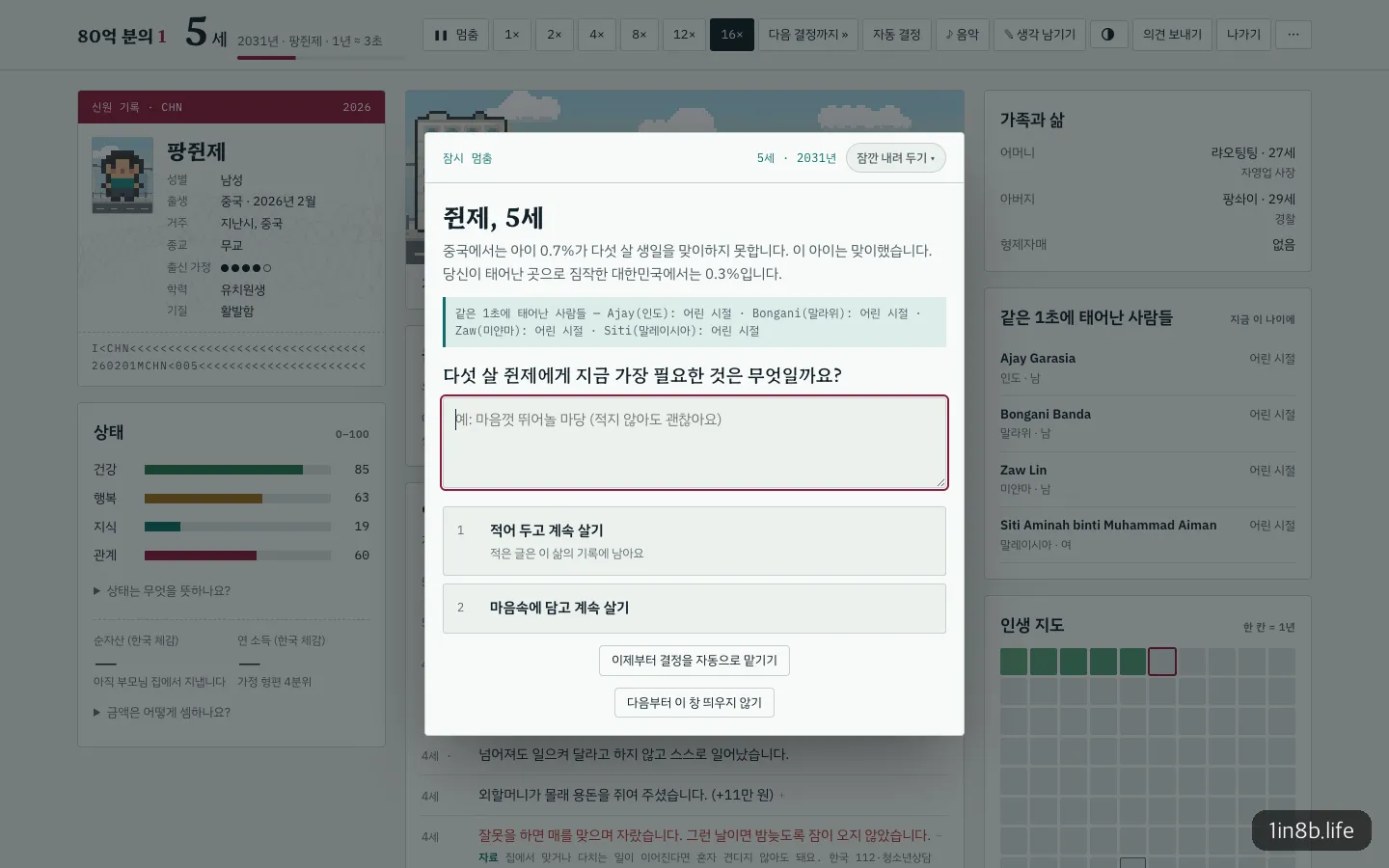
The age-five scene. It shows the under-five mortality rates of China and South Korea side by side and asks you to write what a child needs.
After the single sentence “This child made it,” a blank appears asking what a five-year-old needs most right now. You can write something or just hold the thought and move on. It is closer to a device for making you think than a game where you raise a score.
From age five on, I handed decisions over to automatic mode. At thirteen, a “Want a cigarette?” window appeared, citing the 45% tobacco use rate among Chinese men (WHO 2020). Around the same time, a line in the life record went by saying my grandmother had died of lung cancer at 68.
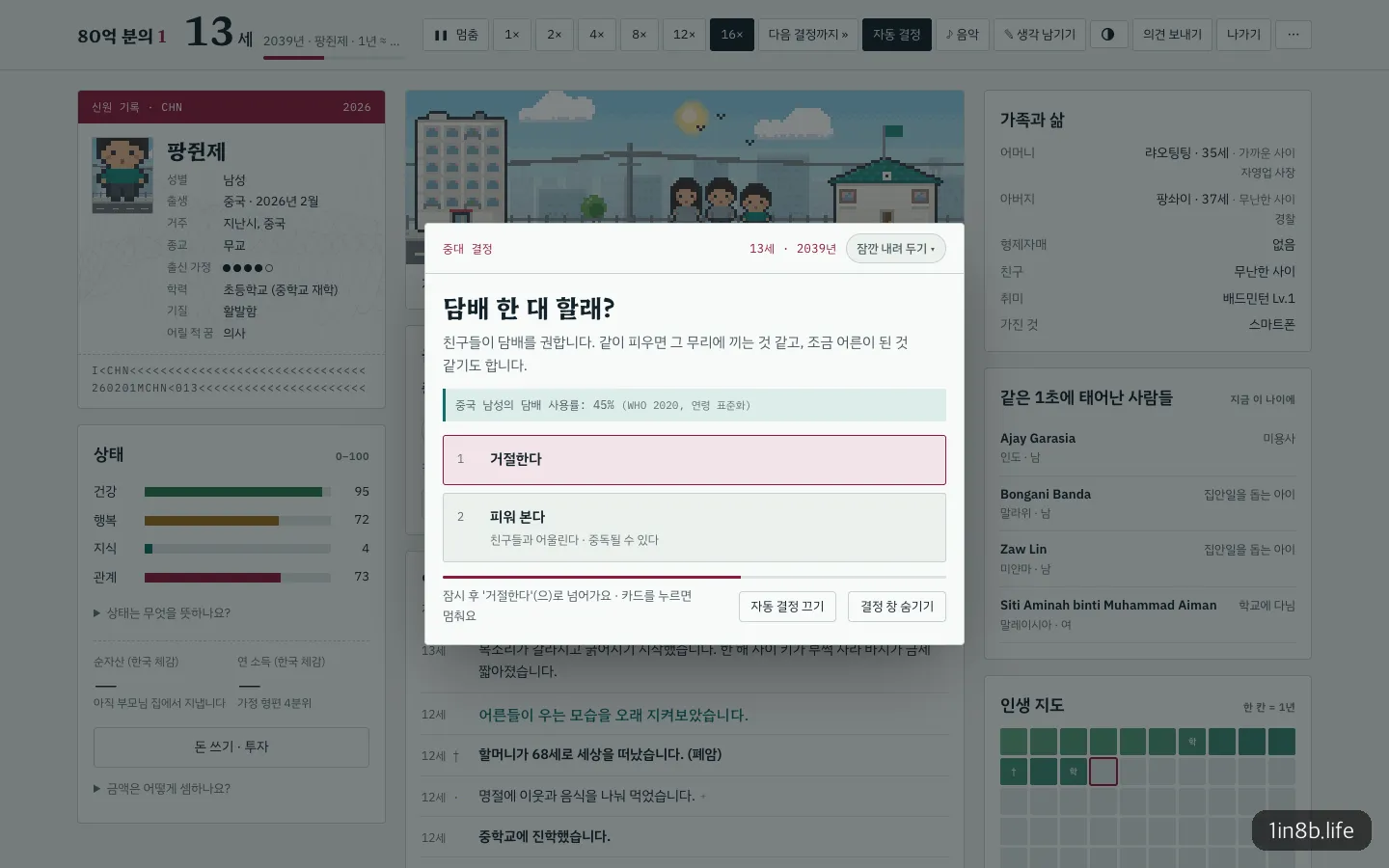
The cigarette decision window at age thirteen. In auto-decision mode, the bar fills and the default choice goes through.
Even in auto mode, the window flashes up at important moments and then moves on with the default choice. That means you can leave the screen on, do something else, and look in now and then.
An office worker version, an animal version
As the game grew popular, similar games followed one after another. Gameple named the working-life game Random Hire Game (랜덤입사게임), the soccer career game “From the Bench to the Ballon d’Or,” and the Project Moon fan game “Born as One Person in the City.” In Japan, on October 14, an individual developer released 人間に生まれる確率 (The Odds of Being Born Human), which widens the scope to all animals. Here are the two I opened myself, set beside the original.
| One in 8 Billion | Random Hire Game | The Odds of Being Born Human | |
|---|---|---|---|
| Statistics scope | People in 172 countries and regions | 22 million wage earners in Korea | All animals on Earth |
| Length of one run | About 30 minutes to 1 hour 30 minutes | About 30 minutes | Varies by creature |
| How it plays | Time passes, with decisions along the way | Choices made by flipping one card at a time | Managing a survival bar day by day |
| Relationship to the original | The original | States it is a separate game, inspired by the original | States it was inspired by the original |
Random Hire Game opens with “You’re 27, a college graduate.” Your family situation is set as “tight” (the 26.4% of households with net assets under 100 million won) and your IQ as 93, and you pick one of six job-hunting strategies. When I chose “Apply to whatever comes,” the fields on the acceptance letter, covering industry, company size, role, and first monthly salary, opened one by one. Unlike the original, where time flows, it uses cards, so the pace is much quicker.
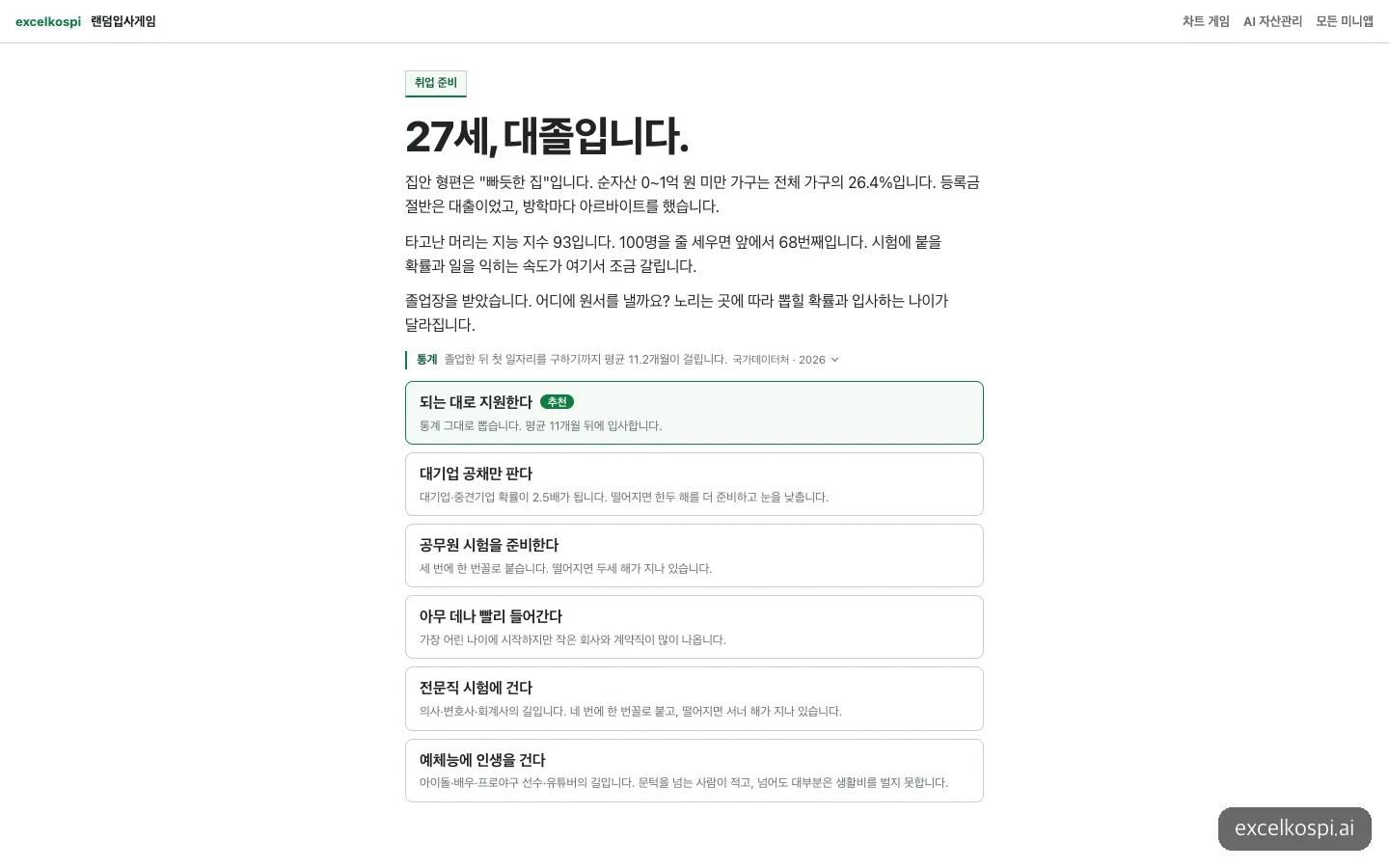
The opening scene of Random Hire Game. Family situation and IQ are set along with statistics, and you pick one of six job-hunting strategies.
Company assignment follows Korea’s National Data Office employment administrative statistics (2024). Fewer than two in ten people land at a large company, and six in ten join a small or midsize one. There are 242 occupations and 38 endings, and the game states that company names, events, and stock gains and losses are made up. A feature the original lacks is that when you share your result, a friend can join the same company and try making different choices.
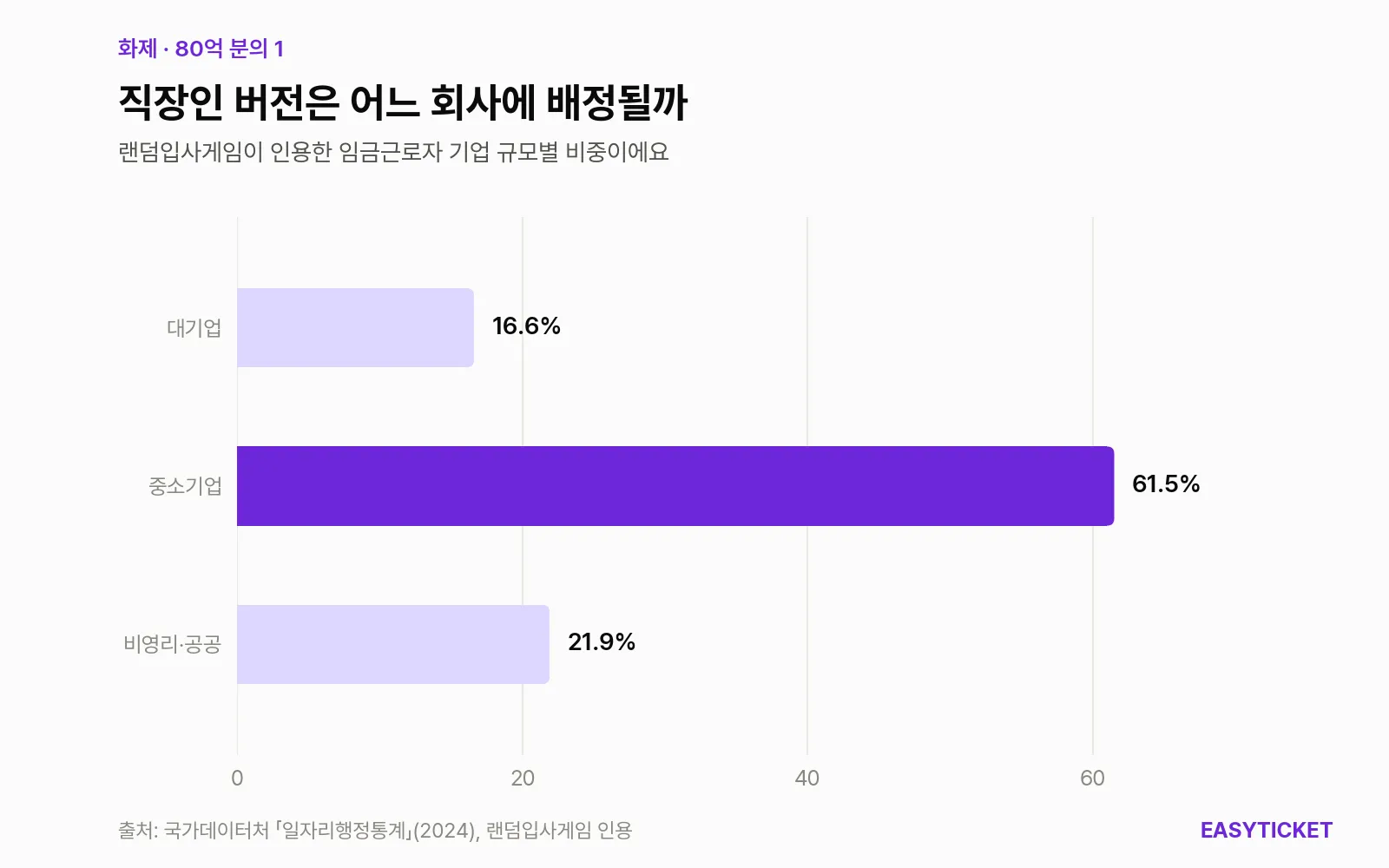
The company-size shares Random Hire Game uses when assigning your employer. Six in ten people join a small or midsize company.
The Japanese spinoff flipped the question entirely. Among all animals, the chance of being born human is 1 in 101.1 billion, and 86% are born as nematodes. Even if you narrow it to mammals alone, the chance of being human is 1 in 16. When I switched to mammals, I got a rodent with a lifespan of about 11 months, and a field guide card listing its predators appeared first.
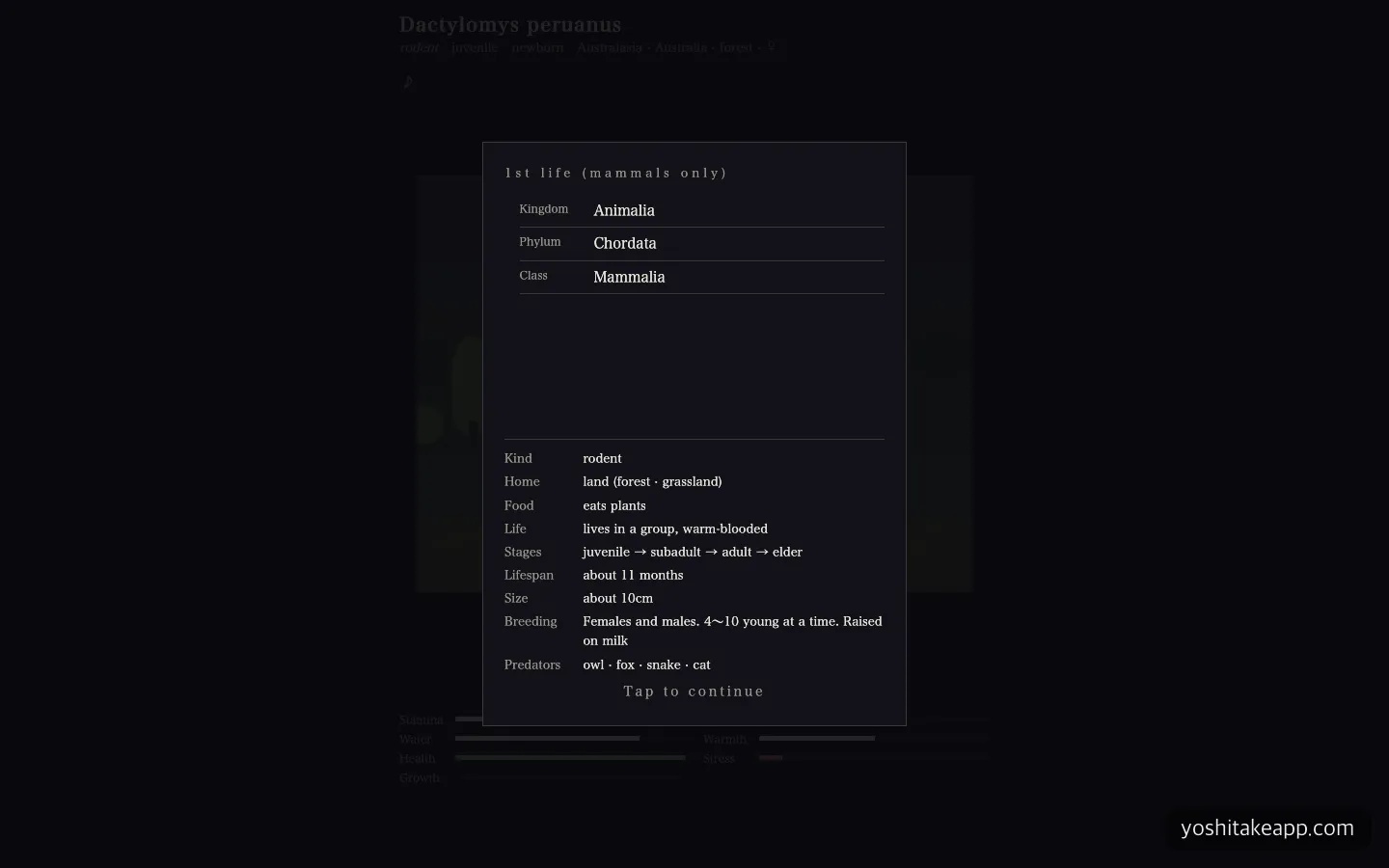
The first life that came up when I picked mammals only in The Odds of Being Born Human. A rodent with a lifespan of about 11 months.
If you can only pick one of the three, the deciding factor is time. If you can clear an hour in the evening and want to follow one person’s life, the original is the one. If you’re an office worker who wants a light laugh over lunch, Random Hire Game suits you better, because the cards flip by quickly.
Drawbacks and a heavy subject
The first snag is length. Even at 16x, it took about a minute and a half to reach age thirteen, and getting to life expectancy on the 1-hour setting means staying with it for quite a while. This time I stopped at thirteen, so I did not see the ending screen or the process of being added to the memorial hall. It is some comfort that you can close it midway and pick the life back up in the same browser. The flip side is that continuing on a different device looks difficult.
The subject matter isn’t light either. Suicide, illness, acquired disability, and war occur at real statistical rates. GameMeca raised this point, along with the risks of vibe-coded web games, where copycats pour out after one becomes popular. The original does not depict such scenes and also tells players where to get help, and it puts a “remove scary scenes” option and the 15-and-up label on the first screen. On the first screen’s “Lives Shared” card, messages left by other users appear as they are, and since they include light jokes, the weight is eased, but I also felt the tone was uneven.
Several sites with similar names have also appeared. The official site says it has no relationship with similarly named sites, so if you receive a link, it is safer to check first that the site name is “One in 8 Billion (1in8b).”
Part of why a game built in 4 hours spread was surely luck, but holding up by fixing things every day after it spread seems the harder task. The official site says the text and code are written together with AI, while people decide and verify what goes in. If you want to make something similar, decide how you will cite your statistical sources before you worry about the idea.
Frequently asked questions
Is One in 8 Billion free?
Yes. The first screen says “Lives and endings are all free,” and you start right away without signing up or logging in. As of November 2026, no separate pass is offered in Korea either.
Can I play it on a phone?
The first screen lays out well in portrait on a phone, and the Be Born button is fixed at the bottom of the screen so you can tap it with your thumb. Still, one run is long, so it takes quite a bit of time even with the speed turned up.
Can I make a game like this with Claude too?
The first version was built by a single developer giving Claude spoken instructions, in about 4 hours. Building the screens is within reach, but the strength of this game lies in weaving many public statistics together with their sources. Reading the developer’s making-of essay, Eight Lines, first will give you a feel for it.
Sources 8
AI helped with research and the first draft; the operator tried the subject firsthand, checked and edited this article before publishing. Let us know if you spot a mistake.