
Scroll through your feed and a post about “building an app in a day with AI” goes by several times a day. Yet in the “2025 Internet Usage Survey,” released by Korea’s Ministry of Science and ICT on March 31, 2026, only 44.5% of Koreans had ever used generative AI. The AI usage rate is the share of people who have used generative AI within a given period. In Korea, the Ministry of Science and ICT and the Korea Media and Communications Commission, together with KISDI (the Korea Information Society Development Institute), publish this figure every year. For country-by-country comparisons worldwide, Microsoft publishes it every quarter.\n\nFlip that around, and more than half of Koreans (55.5%) have never used it. EasyTicket believes the noise around AI and vibe coding is well ahead of actual adoption. That gap is closing fast, though, and it is exactly where vibe coders should look.\n\n## Half of Koreans Have Never Tried It\n\nThe Internet Usage Survey is a large statistical study covering 50,750 people aged 3 and older in 22,671 households nationwide. The share who had tried generative AI was 33.3% in 2024, so the 11.2-percentage-point rise in a year is a clear upward trend. Still, usage is heavily concentrated in one service. The order was ChatGPT at 41.8%, Gemini at 9.8%, Copilot at 2.2%, and CLOVA X at 2.0% (multiple answers allowed). In Korea right now, “I’ve used AI” means almost the same thing as “I’ve used ChatGPT.”\n\nFar fewer people pay. Only 7.9% of respondents subscribed to a generative AI service, and the rate was highest among professionals and managers at 20.6%. Fewer than one in ten people pay, and those who do skew toward using it for work.\n\nThe reasons for not using it differ by age. Among those aged 12 to 19, 68.2% chose “no interest or need,” as did 56.0% of those in their 20s. In their 60s (25.3%) and 70s and older (26.1%), “don’t know how to use it” was more common than in other age groups. Younger people haven’t yet found a reason to use it, rather than lacking the know-how, while older people are stuck at the first hurdle.\n\n## What Is Korea’s AI Usage Rate?\n\nThere is no single answer. Three official surveys released in the first half of 2026 gave three different numbers.\n\n| Survey (release date) | Respondents | Generative AI usage/experience rate |\n|---|---|---|\n| Ministry of Science and ICT Internet Usage Survey (March 2026) | 50,750 people aged 3 and older | 44.5% |\n| Korea Media and Communications Commission and KISDI Intelligent Information Society User Panel Survey (May 2026) | 4,324 people aged 18 to 72 who use the internet on a smartphone every day | 38.9% |\n| Ministry of Science and ICT Value-Added Telecommunications Business Survey (June 2026) | 2,500 people aged 19 to 69 (surveyed October to December 2025) | 78.1% |\n\n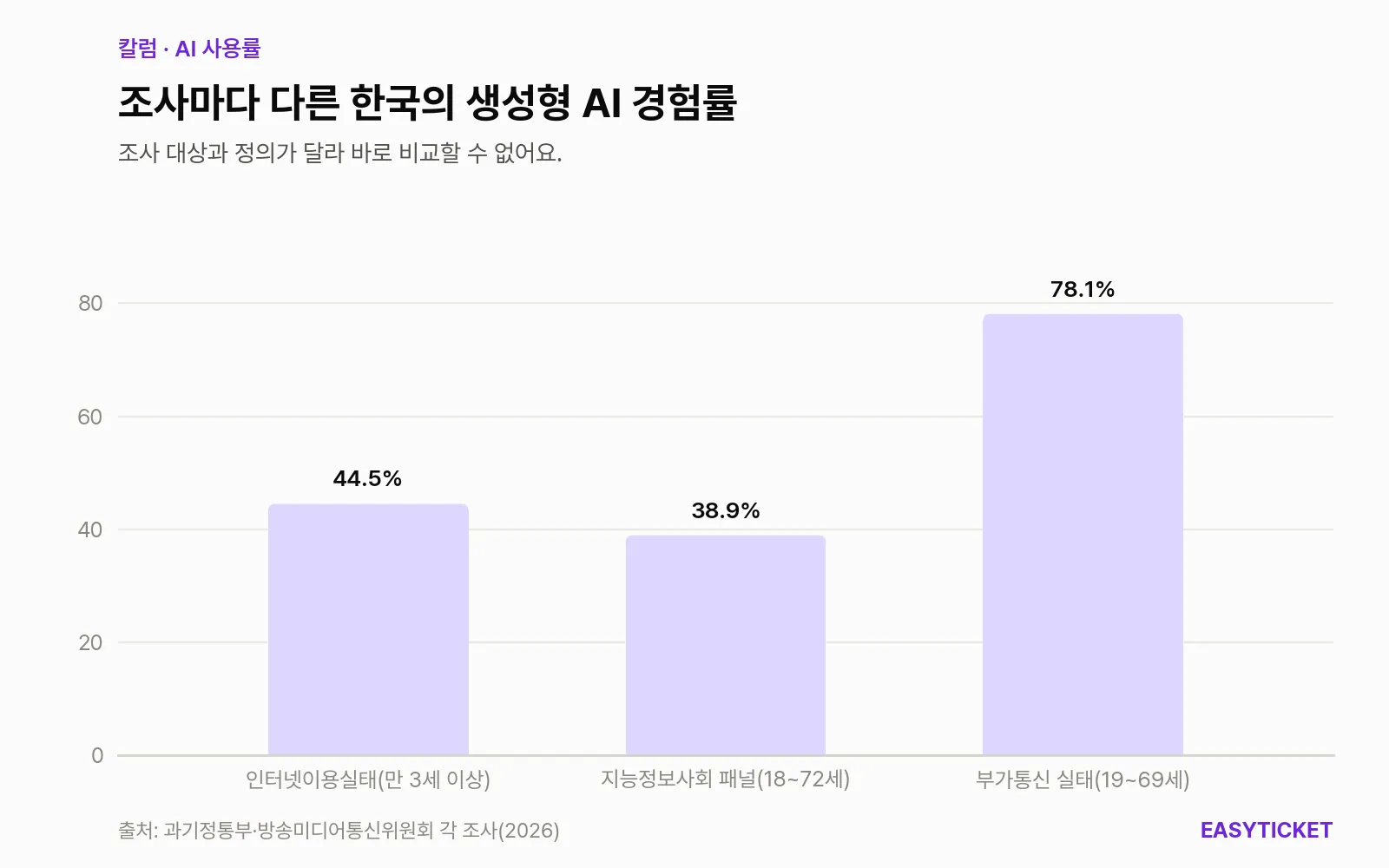 \nEven for the same country, the experience rate ranges from 38.9% to 78.1% depending on the survey, because the age ranges and the way the question is asked differ.\n\nThe gap between 78.1% and 38.9% is twofold, but neither is wrong. The age ranges and question wording differ, so the three can’t be averaged or compared side by side. Within each survey, though, the trend points the same way. The KISDI survey went from 12.3% in 2023 to 24.0% in 2024 and 38.9% in 2025, tripling in two years, and users spent an average of 49.6 minutes a day on it. In the Value-Added Telecommunications Business Survey, the experience rate among people in their 20s was 92.6%.\n\nThis is why, when someone states “Korea’s AI usage rate is X%,” you should first ask who was counted and how. A survey that asked only adults aged 19 to 69 found eight in ten had tried it, while a survey that included children and older adults found fewer than half.\n\n## Widen the View to the World, and It’s One in Five\n\nFor data that compares countries on the same yardstick, there is the Q2 2026 Global AI Diffusion Report from Microsoft’s AI Economy Institute, released on September 28, 2026. As of June 2026, it counted the share of people aged 15 to 64 who used a generative AI product during that period. The UAE was first (73.3%), followed by Singapore (64.3%), Ireland (49.9%), and France (49.6%). Korea ranked 12th at 40.6%.\n\n
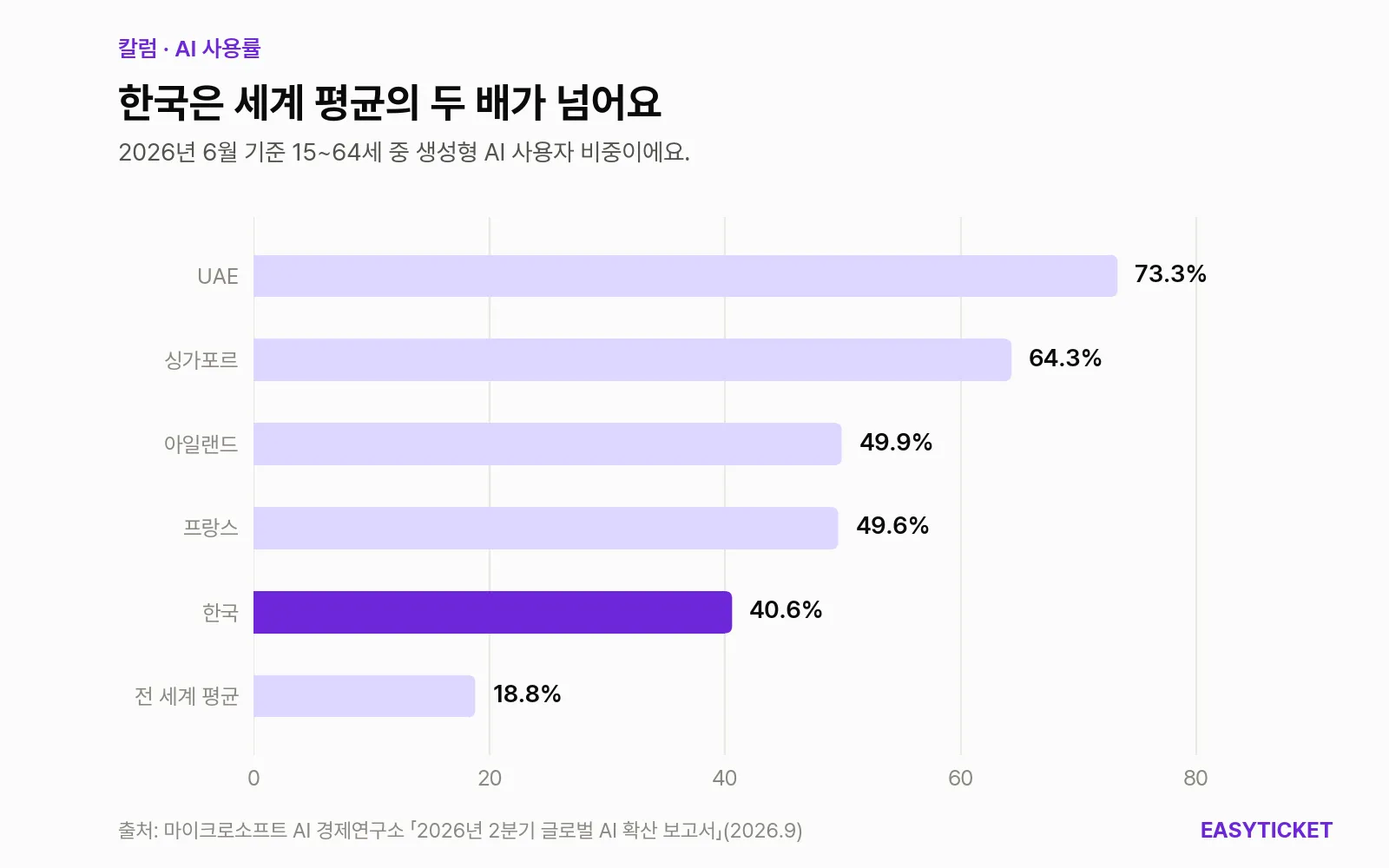 \nAs of June 2026, Korea’s share of generative AI users was 40.6%, more than double the global average of 18.8%.\n\nA global average of 18.8% means fewer than one in five working-age people use it. It rose only 1 percentage point in a quarter, from 17.8% in Q1. Korea gained 3.5 percentage points over Q1, climbing from 16th to 12th. The gap between wealthy and less wealthy countries actually widened. The Global North stood at 28.8% and the Global South at 16.2%, and that gap grew from 10.6 percentage points in the second half of 2025 to 12.6 percentage points in Q2 2026.\n\nThe United States is also far from “everyone uses it.” When the Pew Research Center surveyed 5,119 U.S. adults from February 17 to 23, 2026, 49% said they use AI chatbots.\n\n
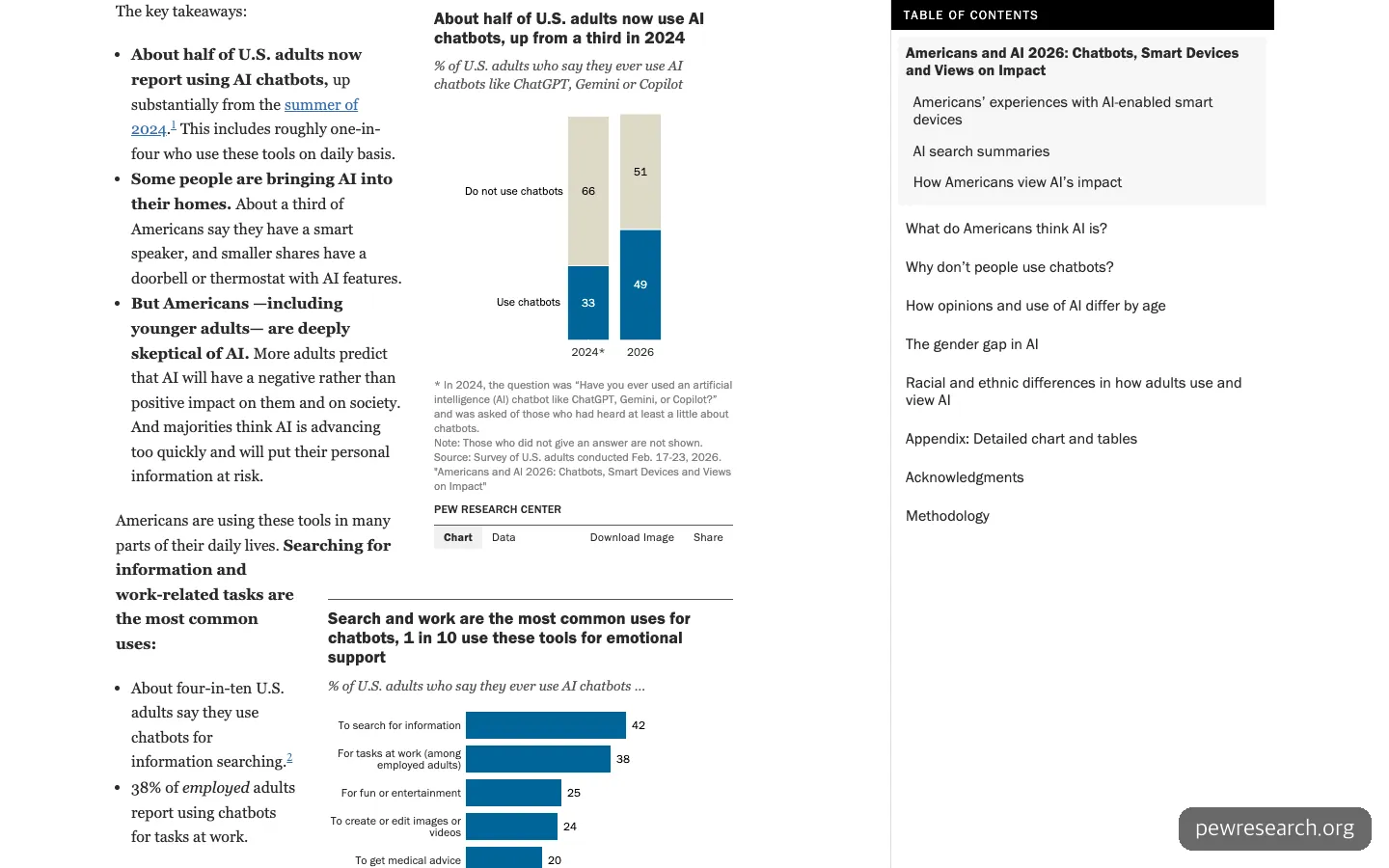 \nThe share of U.S. adults who use AI chatbots grew to 49% in 2026, but non-users (51%) are still slightly more numerous.\n\n## Between “Tried It” and “Use It Every Day”\n\nThe biggest gap between the noise and reality shows up in frequency. In the Pew survey, 24% of U.S. adults use AI chatbots every day, about half of those who have tried them. A survey by the Reuters Institute for the Study of Journalism, covering six countries (Argentina, Denmark, France, Japan, the United Kingdom, and the United States) in June and July 2025, found a similar pattern. 61% said they had used AI, but only 34% said they use it weekly.\n\nNarrow it to vibe coding, and the numbers get smaller still. In the Stack Overflow 2025 Developer Survey, when asked whether vibe coding is part of their work (26,564 responses), 11.9% answered “Yes” and 0.4% answered “Yes, strongly.” “No” was 72.2% and “No, strongly” was 5.3%. Even among people who work with code every day, only a little over one in ten does vibe coding as part of the job.\n\nDevelopers do use AI tools themselves a lot. In the same survey, 47.1% said they use them every day. But favorable views of AI tools, which were above 70% in 2023 and 2024, fell to 60% in 2025. Trust is the problem. Only 3.1% said they “highly trust” the accuracy of AI output, and those who “somewhat distrust” or “highly distrust” it add up to 45.7%. Using it every day but double-checking the results is closer to the real picture for working developers.\n\n## The Counterargument: It Is Moving Fast\n\nIt is tempting to read all this and conclude that “AI is a bubble,” but there is another side to the numbers. The authors of the Reuters Institute report wrote that there is a lot of unfounded exaggeration around AI’s capabilities and adoption, yet they also said their data shows people in every country have started using it quickly. The share using it weekly across the six countries nearly doubled in a year, from 18% to 34%. The tripling in two years in Korea’s KISDI survey, and Pew’s finding that U.S. ChatGPT usage rose from 18% in 2023 to 44% in 2026, point the same way (Pew changed its question wording in 2026, so the year-over-year comparison is approximate).\n\nKorea’s pace is especially steep. In the same Microsoft count, it was 25.9% in the first half of 2025, 30.7% in the second half, and 37.1% in Q1 2026, and it reached 40.6% in Q2, a jump of about 15 percentage points in a little over a year.\n\nThe numbers themselves have limits, too. Microsoft’s figures are not from a survey. They are estimates built from anonymized usage records of its own products, adjusted for operating system and device share, internet penetration, and population. Microsoft itself says there is no perfect yardstick. That is why Microsoft’s 40.6% for Korea and the Ministry of Science and ICT’s 44.5% have different definitions and can’t be placed side by side.\n\nSurveys have their own weakness: respondents differ on where they draw the line around “AI.” When the same Internet Usage Survey broadens the question to include AI services in housing, transportation, and education, the experience rate rises to 67.0% in 2025 (32.4% in 2021). If you count cases where people use AI without knowing it, such as recommendations or automatic summaries, even more people may actually be touching AI. In the end, “everyone uses it” is wrong, and so is “no one uses it.” We are about halfway there, and the number is climbing fast.\n\n## What These Numbers Mean for Vibe Coders\n\nThe AI talk in your feed is mostly a conversation among people who already use it every day. But more than half of Koreans have still never used generative AI, and only 7.9% pay for it. The supply side is growing much faster. According to the Microsoft report, the number of runnable AI apps and demos (Spaces) on Hugging Face grew from about 124,000 at the end of 2023 to about 1.46 million at the end of August 2026. Builders are multiplying faster than users.\n\nEasyTicket reads two things in this. One is that “made with AI” is not a reason for anyone to choose an app. More than half of teens and people in their 20s said they don’t use AI because they have no interest or need, so an app that leads with the problem it solves, rather than with AI, reaches a wider audience. The other is the barrier to entry. One in four people in their 60s and older said they don’t use AI because they don’t know how. If you are building an app for your parents’ generation, it is better to decide in advance which button to press than to leave a lone empty input box. To a first-time user, “ask me anything” looks less like guidance and more like homework.\n\n## Numbers to Watch Next\n\n- Whether the Internet Usage Survey’s 44.5% passes half in the next round. The moment it does, “most Koreans have tried it” becomes true for the first time.\n- How much the 7.9% paid subscription rate moves. The distance between trying AI and paying for it is the real size of the AI app market.\n- The global average of 18.8% and the North-South gap in Microsoft’s quarterly report. Microsoft said that adding new AI tools to its count would raise the figures for almost every country. When the numbers rise, we will need to separate real growth from a change in how they are counted.\n\nIf you want to know where the AI era really stands, look at the numbers for “use it every day” and “pay for it” instead of “tried it.”\n\n## Frequently Asked Questions\n\n### What AI do Koreans use the most?\nChatGPT. In the Ministry of Science and ICT’s Value-Added Telecommunications Business Survey (released June 2026), which covered 2,500 adults aged 19 to 69, 68.1% named ChatGPT as the service they mainly use. In the Internet Usage Survey, which covers everyone aged 3 and older, ChatGPT (41.8%) also led Gemini (9.8%) by a wide margin.\n\n### I haven’t tried AI yet. Is it too late to start now?\nIt isn’t too late. In the 2025 Internet Usage Survey, 55.5% of Koreans had still never used generative AI, and in Microsoft’s count, 18.8% of the working-age population worldwide used it as of June 2026. Non-users are still the majority.\n\n### How many people use AI for work?\nIn Pew’s 2026 survey, 38% of working U.S. adults said they use chatbots for work. In Korea’s Internet Usage Survey, the paid subscription rate was highest among professionals and managers at 20.6%, so people who pay tend to be those using it for work.\n
Sources 8
- 머니투데이 「국민 10명 중 4.4명 "생성형 AI, 나도 써봤다"」(2026-03-31)
- 한국기자협회 「AI 이용 경험 2년새 3배 급증… 일평균 50분 사용」(2026-05-28)
- 뉴시스 「과기정통부, '2025 부가통신사업 실태조사' 결과 발표」(2026-06-02)
- Microsoft Source Asia 「마이크로소프트, 2026년 2분기 글로벌 AI 확산 보고서 발표」(2026-09-28)
- Microsoft On the Issues 「The continued state of global AI diffusion in 2026」(2026-09-21)
- Pew Research Center 「Americans and AI 2026」(2026-06-17)
- Stack Overflow 2025 Developer Survey: AI
- Reuters Institute 「Generative AI and news report 2025」(2025-10-07)
AI helped with research and the first draft; the operator tried the subject firsthand, checked and edited this article before publishing. Let us know if you spot a mistake.