
Type ‘AI chat’ into the Google Play search bar, and the first screen alone shows 15 apps in a row. Between ChatGPT and Gemini sit apps named ‘AI Chat,’ ‘AI Chat App,’ and ‘Chat AI,’ nearly identical names, each from a different developer. The current surge of AI apps in the app market is a phenomenon that began in 2025: AI coding tools made apps easier to build, and the stores filled with new apps, especially ones branded ‘AI.’ In a June 2026 report, Sensor Tower estimated that more than 200,000 apps mention AI in their descriptions alone.
EasyTicket believes this phenomenon calls for counting two things separately: how many apps launched, and how much they are used. The first number is climbing steeply. The second is concentrated in a handful of apps, and those apps don’t hold on to users for long.
Type ‘AI chat’ into the search bar
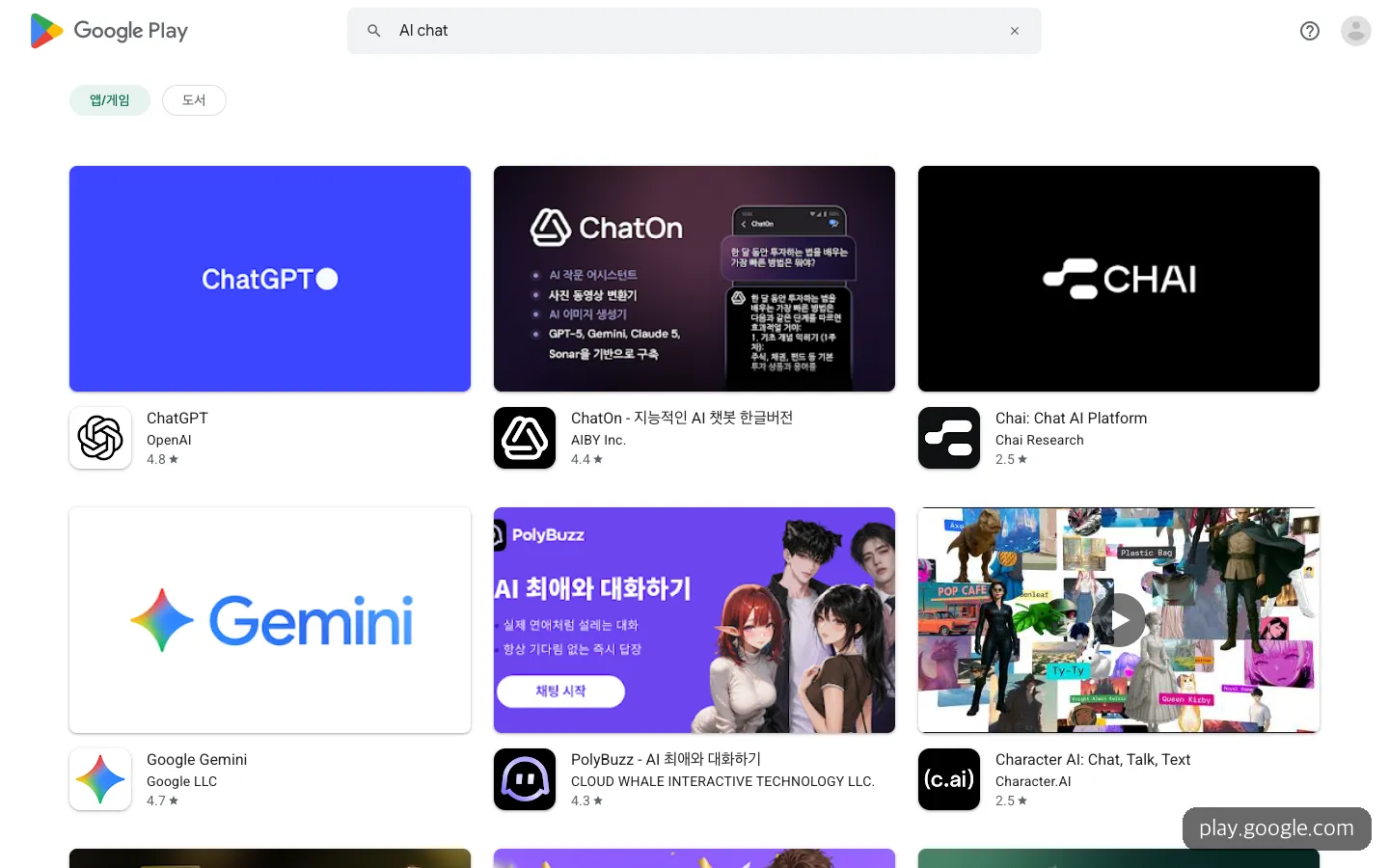
Searching the single phrase ‘AI chat’ returns big-company apps, similarly named chatbot apps, and character chat apps mixed together in one list.
When you search it yourself, three kinds of apps share one screen: apps from big companies such as OpenAI, Google, Meta, and Microsoft; general-purpose chatbot apps you can’t tell apart by name; and character chat apps such as Character AI and Zeta. Ratings range widely, from 2.5 to 4.8.
The problem is that this screen doesn’t show what matters most. The cards list neither download counts nor user counts. From search results alone, you can’t tell which apps are actually being used. It’s even more frustrating on a phone: a large banner leaves room for only about two apps per screen, so scanning through look-alike apps to choose one wasn’t easy.
More apps, but downloads stay flat
Start with supply. According to Appfigures’ count, the app analytics firm, 557,000 new apps were released on Apple’s App Store in 2025. That was 24% more than in 2024, and the first year since 2016 with a meaningful increase. Appfigures pointed to LLMs and AI coding tools such as Cursor and Replit lowering the barrier to entry.
In 2026 the pace picked up. According to a Sensor Tower estimate reported by 9to5Mac (citing The New York Times), new App Store apps in the first half of 2026 numbered about 560,000, nearly matching in six months the roughly 600,000 of all of 2025. The same estimate put App Store downloads at 35.4 billion in 2025, up 3%, and at 17.6 billion in the first half of 2026, up 2%.
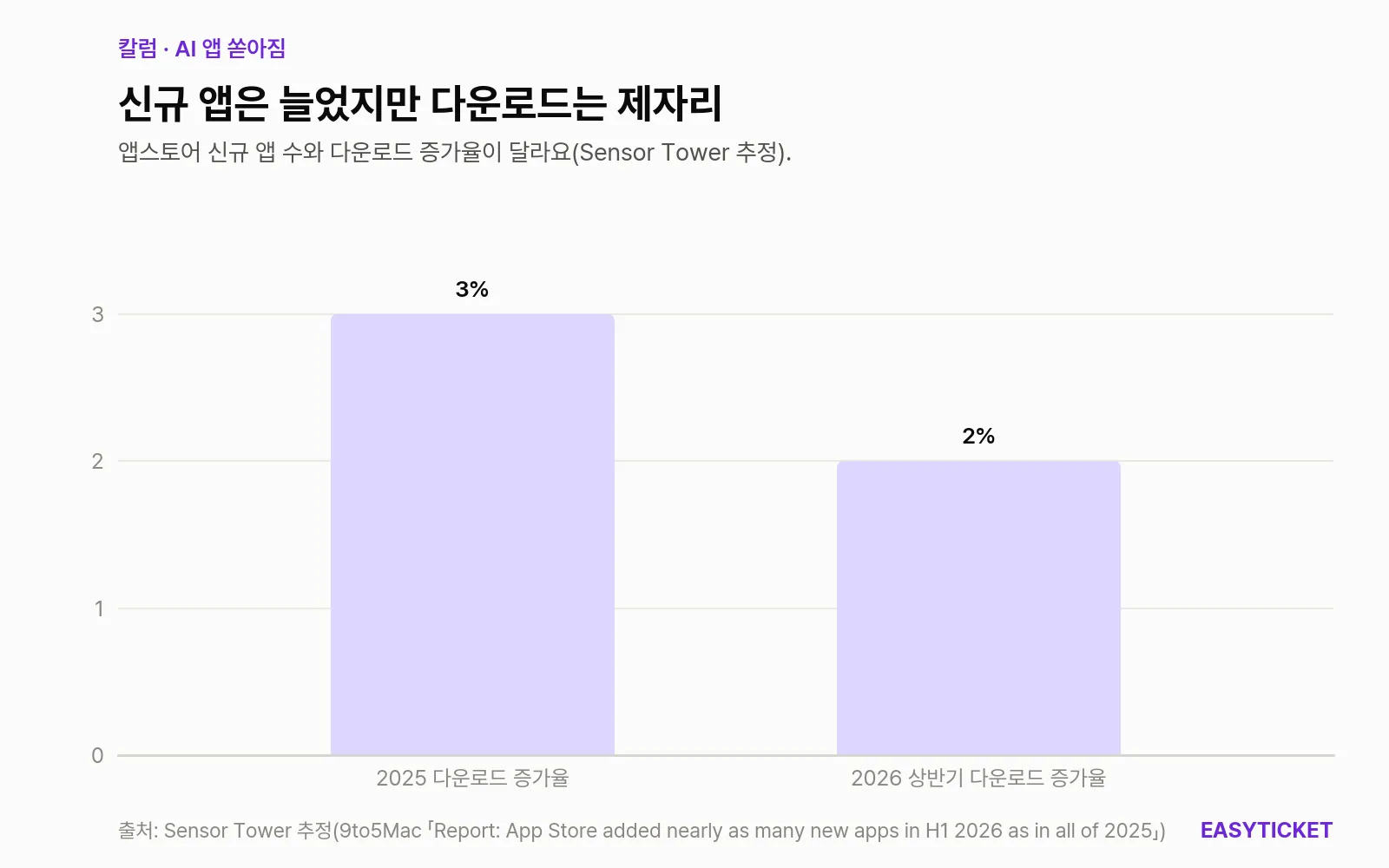
While new apps surged, App Store download growth stayed at 3% and 2%.
In other words, the goods on the shelves have multiplied while the customers have barely changed. The share any single new app can capture has to get thinner. Apple welcomes the trend. In the same report, an Apple spokesperson said 90% of submitted apps are reviewed within 48 hours, and that apps built with vibe coding are held to the same quality, privacy, and security standards.
Three apps split the usage time
On the demand side, things are narrowing. According to Sensor Tower’s State of AI 2026, three apps, ChatGPT, DeepSeek, and Gemini, accounted for nearly 90% of the time spent on AI assistant apps in the first quarter of 2026. ChatGPT reached 1 billion monthly users in May 2026. More than 200,000 apps carry the ‘AI’ label, yet the places where people spend their time can be counted on one hand.
The seventh edition of the generative AI consumer app rankings from venture capital firm a16z, published in October 2026, shows the same picture. Only 11 products newly entered the top 100, the fewest of the seven rankings. Apps pour in, but the leaderboard is hardening.
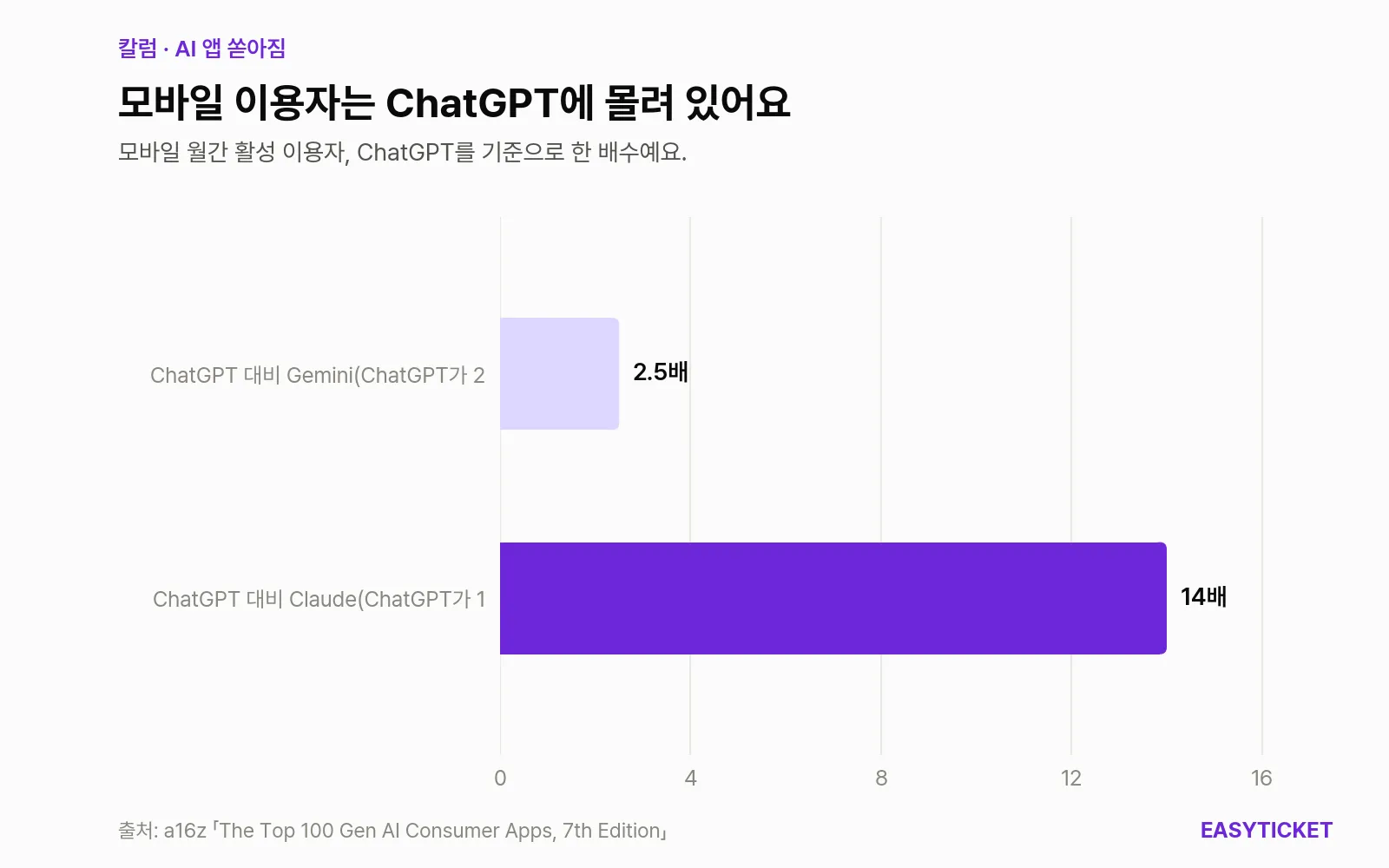
By monthly mobile users, ChatGPT has 2.5 times as many as Gemini and 14 times as many as Claude.
The gaps among the big apps are wide, too. In the same a16z data, ChatGPT had 2.5 times as many monthly mobile users as Gemini and 14 times as many as Claude. Wallets aren’t widening much either. Based on a US card payment panel, only 13% of people who pay for one AI product also pay for another. Most people, in other words, use just one.
Installed, but not for long
The RevenueCat 2026 subscription app report (as covered by TechCrunch) shows how long apps stay in use. RevenueCat makes subscription management tools. Of the subscription apps in the report, 27.1% were AI apps, and the median share of subscribers still subscribed after one year was 21.1% for AI apps and 30.7% for non-AI apps.
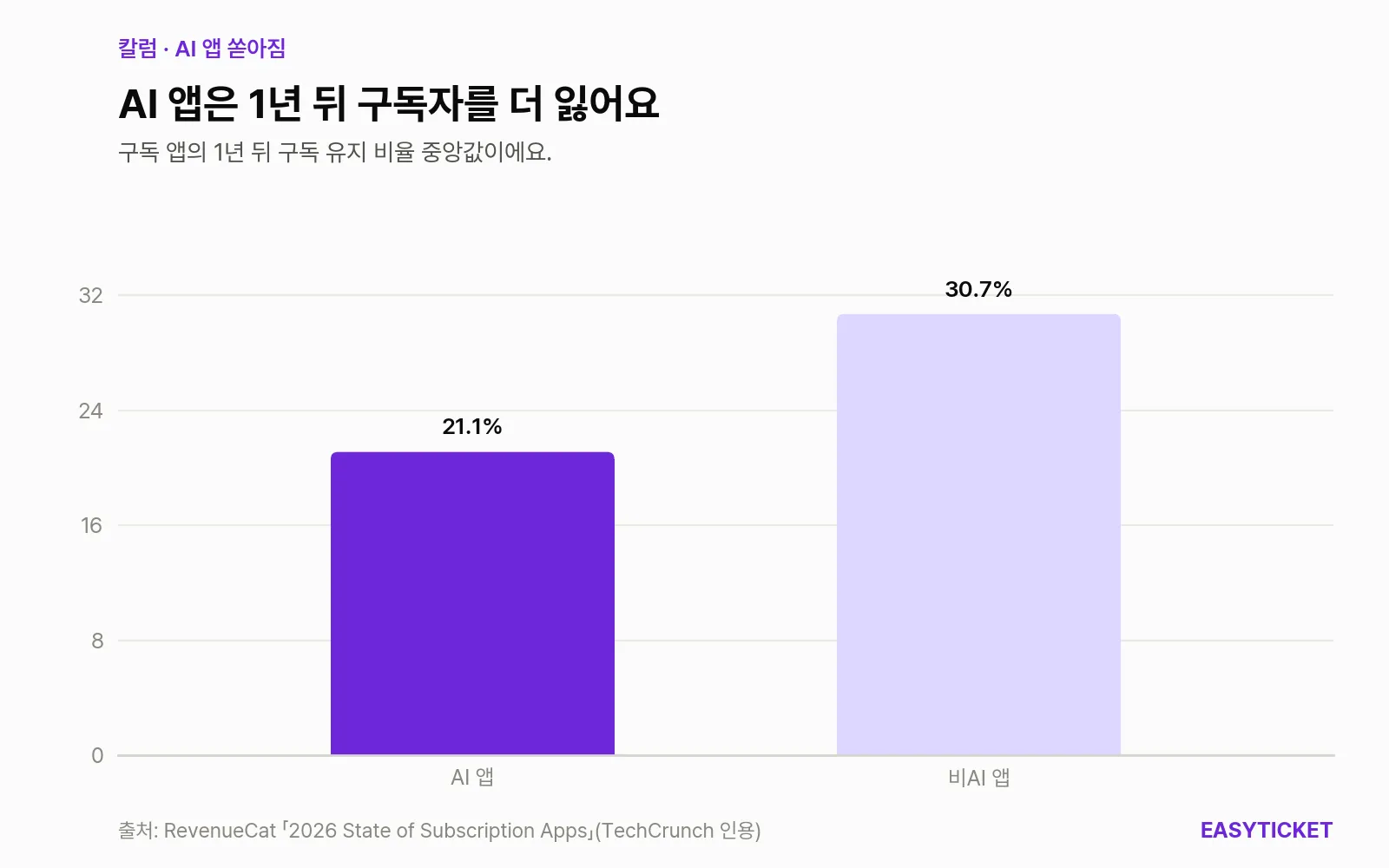
Among subscription apps, only about two in ten subscribers to AI apps are still subscribed a year later.
If ten people paid, one year later two would remain in an AI app and three in other apps. Annual subscriptions were also canceled 30% faster in AI apps, by the median. EasyTicket finds the reason in the previous two sections. There are dozens of apps with similar features, and a free big-name app that works reasonably well is always right next door, so the reason to stay is weak.
Seen another way, AI apps actually sell well
Looking at only one side of the numbers, it’s easy to conclude that ‘AI apps aren’t used,’ but that conclusion is wrong. According to Sensor Tower’s State of Mobile 2026, generative AI app downloads in 2025 reached 3.8 billion, about double the previous year. In-app purchase revenue came to just over $5 billion, about triple, and time spent reached 48 billion hours, about 3.6 times. Considering that downloads across all apps grew just 0.8% that year, this is a category that grows almost alone in a stagnant market.
The same RevenueCat report has items where AI apps come out ahead.
| RevenueCat 2026 report (median) | AI apps | Non-AI apps |
|---|---|---|
| Rate of converting from free trial to paid | 8.5% | 5.6% |
| Amount actually paid per annual subscriber | $30.16 | $21.37 |
| Monthly subscription retention rate | 6.1% | 9.5% |
| Refund rate | 4.2% | 3.5% |
It’s a structure that sells better at first and loses users faster later. So EasyTicket’s conclusion is closer to ‘they aren’t used evenly in proportion to their growth’ than to ‘AI apps aren’t used.’
Let’s also note the limits of the numbers. The RevenueCat figures cover only subscription apps that use RevenueCat, not the whole market. Appfigures and Sensor Tower count new apps differently, so the two shouldn’t be compared directly, and the idea that vibe coding caused the surge is a plausible explanation, not an established fact. The a16z payment figure is based on a US card panel.
How much are AI apps used in Korea?
In Korea, the number of people who have tried generative AI is growing fast. In the Ministry of Science and ICT’s 2025 Internet Usage Survey (50,750 people aged 3 and older), the generative AI experience rate was 44.5%, up 11.2 percentage points from 33.3% a year earlier. Among services used, ChatGPT led overwhelmingly at 41.8%, followed by Gemini at 9.8%, Copilot at 2.2%, and Clova X at 2.0%. The concentration holds in Korea as well.
The reasons given by the other half are interesting. Of the 55.5% who hadn’t tried it, 49.5% answered ‘no interest or need,’ and this answer was most common among teens (68.2%) and people in their 20s (56.0%). People in their 60s and older more often cited ‘not knowing how to use it.’ Paid subscriptions stood at just 7.9%.
Another survey takes a different angle. The Microsoft AI Economy Institute, estimating from usage data for ages 15 to 64, put Korea’s generative AI usage rate in June 2026 at 40.6%. The global average is 18.8%, and Korea rose from 16th to 12th. The populations and definitions differ, so it can’t be set side by side with the Ministry’s figure, but both surveys point the same way: Korea is a fast adopter.
The question left for vibe coders
The cost of building an app has dropped nearly to the floor. In exchange, the odds that an app stays on people’s phones have gotten lower. EasyTicket thinks that an app that is just ‘one more wrapper around what ChatGPT already does’ will have a hard time surviving in today’s market. Apps with the same name show up a dozen times in search results, and users have already settled on one big app.
So a vibe coder who wants to launch an AI app should first design for ‘these people will open it again at this moment,’ rather than for ‘AI is inside.’ Think of a narrow niche that general-purpose chatbots won’t bother to tailor for, such as the repetitive work of a specific profession or preparation for a specific exam. Since the numbers show AI apps win initial payments more easily, there is an opening as long as you create a reason to stay.
There are two things to watch next. One is whether the number of newly entering apps in the next a16z ranking rises again. The other is whether the one-year retention rate of AI subscription apps narrows the gap with non-AI apps. When these two numbers move before the app-count graph does, we can say AI apps have started to be used as much as they’ve multiplied.
Frequently asked questions
Can I publish an app built with vibe coding on the App Store?
Yes. In a July 2026 report, Apple said it applies the same quality, privacy, and security standards to apps built with vibe coding as to any other app. In other words, review looks at whether an app meets the standards, not at how it was made.
Are the similarly named AI chat apps made by the same company?
Mostly no. In Google Play search results, ‘AI Chat,’ ‘AI Chat App,’ and ‘Chat AI’ each have a different developer name. The quickest way to tell them apart is to check the developer listed under the app name before you download.
How many people pay for AI apps?
In the Ministry of Science and ICT’s 2025 survey, the paid generative AI subscription rate in Korea was 7.9%. In the US panel a16z looked at, paid subscribers to ChatGPT, Gemini, and Claude were 4.5% as of August 2026, more than double the 2.1% a year earlier.
Sources 8
- Appfigures, The App Store Just Logged Its Biggest Release Year in Nearly a Decade
- 9to5Mac, Report: App Store added nearly as many new apps in H1 2026 as in all of 2025
- Sensor Tower, State of Mobile 2026
- Sensor Tower, State of AI 2026 보도자료
- TechCrunch, AI-powered apps struggle with long-term retention, new report shows
- a16z, The Top 100 Gen AI Consumer Apps, 7th Edition
- 머니투데이, 국민 10명 중 4.4명 "생성형 AI, 나도 써봤다"
- Microsoft, Global AI Diffusion: Q2 2026 Trends and Insights
AI helped with research and the first draft; the operator tried the subject firsthand, checked and edited this article before publishing. Let us know if you spot a mistake.