
In a survey conducted in the U.S. this September, 89% of retail decision-makers said they are preparing for “AI that buys on your behalf.” In the same survey, just 15% of consumers said they would give an AI their payment details and let it make a purchase. Agentic commerce is a way of shopping in which an AI agent doesn’t stop at finding and comparing products but also completes the payment for you. Companies such as OpenAI, Walmart, and Naver (the Korean search portal) have been testing it one after another since fall 2025.
EasyTicket believes the real face of AI shopping this holiday season is not an assistant that buys for you but a clerk who finds things for you. People ask AI about discounts and gift ideas, then keep the final payment button in their own hands. What supports this view is that surveys from different organizations point in the same direction.
89% and 15%, Two Numbers From the Same Survey
The starting point is the holiday AI shopping survey released on November 4, 2026, by Talkdesk, a customer service software company. In September 2026, the research firm Centiment surveyed 1,048 U.S. adults planning to shop online this holiday season, along with 312 director-level or higher executives at U.S. retail companies (50 or more employees) that use AI.
First, the 89% needs to be read correctly. It combines companies that have already finished optimizing for AI agents with those that are “planning or testing.” It does not mean 89% have opened up payment features. Even so, it clearly shows where the industry’s expectations lie.
The consumer numbers step down like a staircase. 74% said they would use an AI assistant for this season’s shopping, and 49% said they would buy from a brand they had never seen before based on an AI recommendation. But the share willing to hand over payment details and let AI complete a purchase drops sharply to 15%, and when there is no confirmation step before execution, only 10% remain. Three in four plan to use AI, yet only about one in seven would trust it with their wallet.
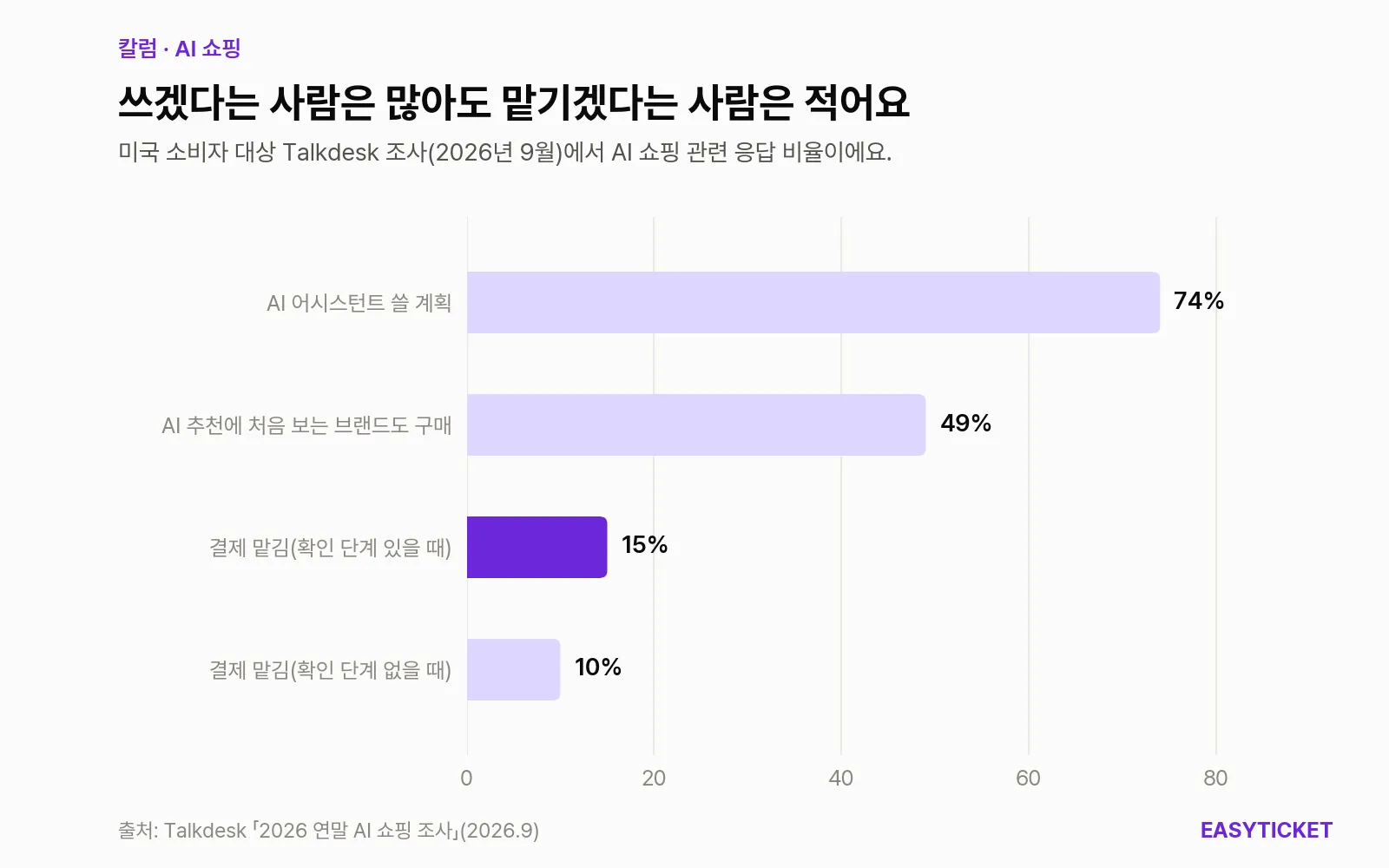
Three in four consumers say they will use AI shopping, but only one or two in ten would let it handle payment.
Michael Klein, Talkdesk’s head of retail product marketing, also said consumers have a “long way to go” before they let AI make purchases for them. He said this is even truer for items that require a lot of thought.
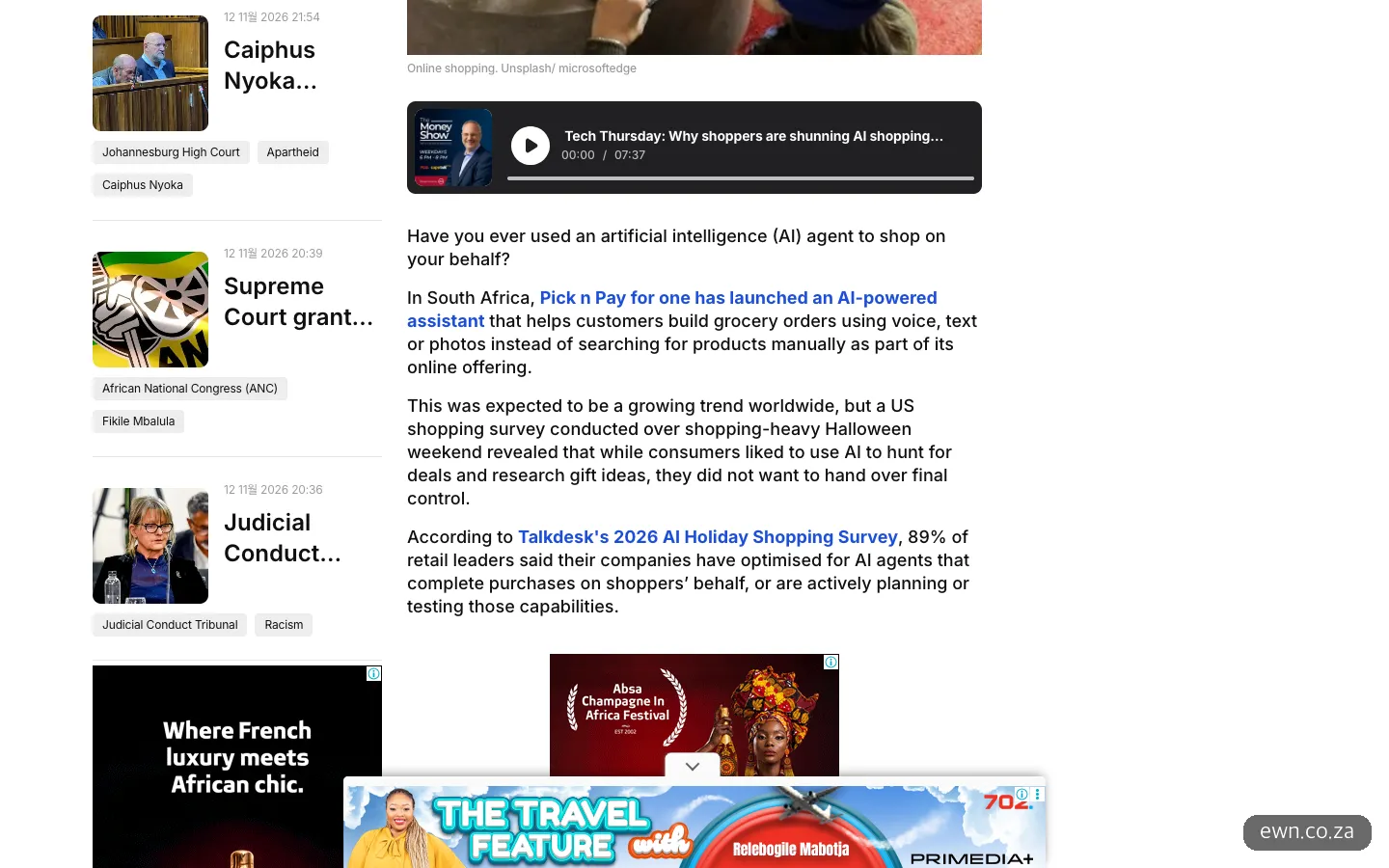
South Africa’s EWN also covered the same survey, summing it up as “use AI to find deals, but don’t hand over the decision.”
The survey drew attention outside the U.S. as well. South African outlet EWN reported these figures alongside news that local retailer Pick n Pay launched an AI grocery assistant in July 2026 that builds a shopping cart from voice, text, or photos. However, the article describes the survey timing as “Halloween weekend,” while Talkdesk’s press release says it was conducted in September. The numbers are best read according to the press release.
”Have Tried” and “Will Hand Over” Are Different Things
A single survey could be a fluke. So we lined up surveys from other organizations. The table below is not meant to compare the numbers across surveys. It is meant to show how wide the gap is between “use” and “hand over” within each survey.
| Survey | Respondents and timing | Use | Hand over |
|---|---|---|---|
| Talkdesk | 1,048 U.S. adults, September 2026 | 74% plan to use an AI assistant this season | 15% would hand over payment (10% with no confirmation step) |
| Visa (conducted by Harris Poll) | 2,065 U.S. adults, May 2026 | 72% have used an AI assistant | 23% trust generative AI to pay on their behalf |
| Gartner | 322 U.S. consumers, January 2026 | 31% want AI to narrow down household goods options | 11% would hand over the purchase decision (highest across categories) |
The questions and definitions differ from survey to survey. Even so, in all three, the “use” group is roughly three to five times the size of the “hand over” group. The Gartner result stands out in particular. Even for items like household goods and personal hygiene products, where a wrong purchase costs little, the share willing to let AI decide the purchase did not exceed 11%.
Companies Are Handing the Pay Button Back to People
Consumers aren’t the only ones hesitating. According to industry outlet MarTech, Daniel Danker, a Walmart vice president, said in March 2026 that purchases completed inside ChatGPT’s “Instant Checkout” converted at one-third the rate of purchases where shoppers clicked through to Walmart’s site and paid there. Although Walmart had listed about 200,000 products, he said the experience was not satisfying, and the company shifted toward its own platform and its own assistant.
OpenAI has moved too. According to a Yonhap News report, OpenAI launched Instant Checkout with Stripe in September 2025, then in March 2026 scaled back standalone checkout inside ChatGPT and put more weight on product discovery. Other cases in the same article follow the same pattern.
- Meta’s AI agent “Muse” asks for user approval right before a purchase.
- In March 2026, Shinhan Card (a Korean card issuer) and Mastercard demonstrated a model in which AI searches and books transportation and the user approves the payment once.
- In February 2026, Naver launched a beta shopping AI agent in its Naver Plus Store, and plans to pilot in-agent payment for some product categories within the year.
Retailers have run into problems themselves. In the Talkdesk survey, 58% of retailers said they had experienced AI errors, and 29% of those said they had lost customers because of it. Inaccurate product recommendations (25%) were cited as a leading problem. If a single wrong recommendation can drive customers away, it’s easy to imagine what a wrong payment would do.
On the Other Hand, AI Shopping Is Already Growing
There are numbers on the other side, too. In its holiday shopping forecast from September 2026, Adobe projected that AI traffic to U.S. retail sites from November 1 through December 31 will rise 130% from a year earlier. On Thanksgiving Day alone, the increase is 159%. The same forecast puts U.S. online holiday sales at a record $275.1 billion (up 6.7% year over year).
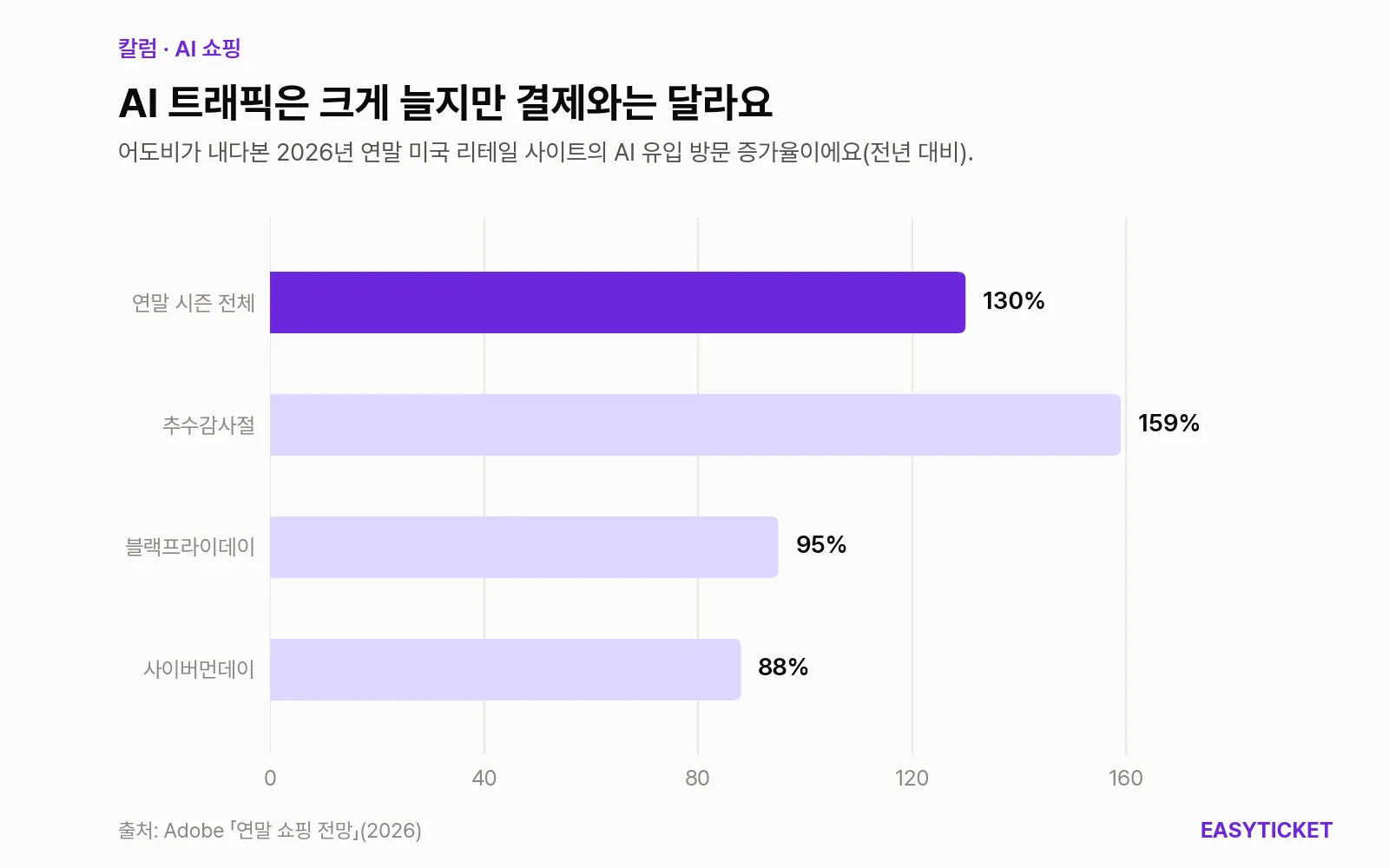
Adobe’s forecast is the growth rate of visits that arrive by clicking a link from AI. It is not a count of completed payments.
Still, it is worth pinning down what that 130% means. In Adobe’s terms, AI traffic means visits to a shop that come from clicking links shown in AI chats or AI browsers. It is not the number of payments completed inside AI. The share of total visits that come from AI has not been disclosed either, and if the starting point is small, the growth rate will naturally look large. On top of that, the forecast was published before the season, so actual results will not be known until early next year.
An Adobe survey of 5,000 consumers in July 2026 paints the same picture. Among people who had shopped with AI, 77% said they felt more confident about their purchases, and 69% said they were less likely to return items. Yonhap also reported that the average daily transaction volume of Naver’s shopping agent in August 2026 was about four times its level at launch in March. It is true that AI shopping is growing. But since it is growing in the area of “finding things for you and opening the door to the store,” it doesn’t conflict with this column’s view.
The Issue Isn’t AI, but Who Is Responsible
The Visa survey has one more interesting number. In the Visa Trust Index, 23% said they trust generative AI to pay on their behalf, but that rose to 61% when Visa processes the payment. Among ages 18 to 34 it was 68%, and among frequent AI users it was 71%. Of course, because this survey comes from a payment company, it should be read with the understanding that the results emphasize trust in its own brand.
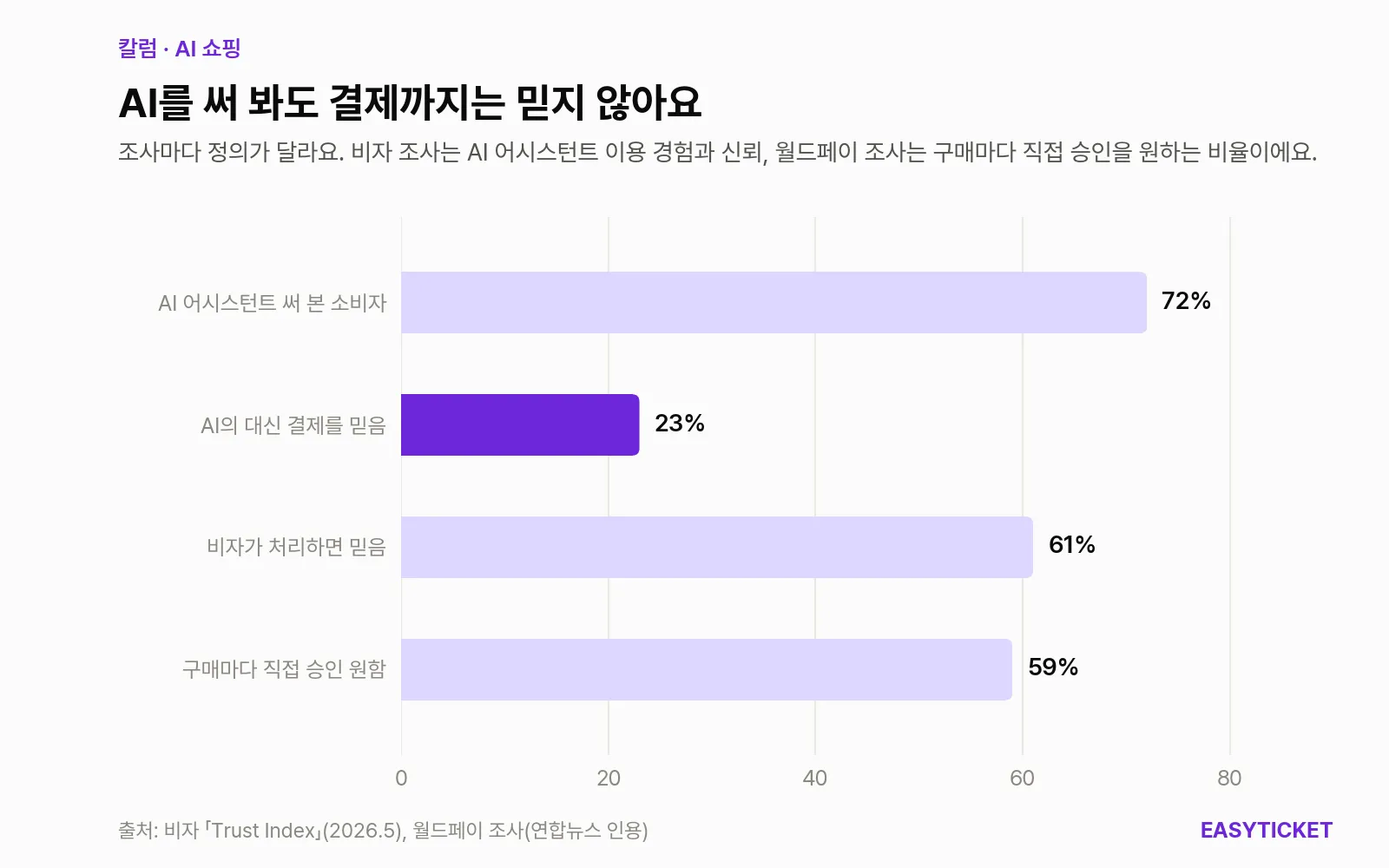
23% trust AI to pay, but that rises to 61% when a familiar payment company handles it (the 59% for Worldpay comes from a separate survey).
What people shy away from seems to be less the technology of AI itself and more the question of “who is responsible if something goes wrong.” In the Worldpay survey cited by Yonhap (8,000 consumers across seven countries), 59% of respondents interested in AI shopping said they want to approve every purchase themselves.
Doubts about the recommendations themselves run deep, too. In the Talkdesk survey, 77% of consumers said they want to know when AI is involved in their shopping, yet 37% of retailers said they do not fully disclose it. Consumers who want stronger AI rules worried about unauthorized collection of personal data (55%), paid product placement (41%), and being charged prices different from other shoppers (41%). In a separate Gartner survey (November to December 2025, 846 U.S. consumers), 54% of those who used AI for a recent purchase said they had to double-check all the information the AI gave them.
The limits of these numbers should be noted as well. The Talkdesk, Visa, and Gartner surveys all target U.S. consumers. We could not find a public survey that directly asks Korean consumers whether they would let AI handle payment. There is no basis for assuming Korea is the same as the U.S.
What Vibe Coders Should Build: One Approval, Not Automated Payment
For anyone trying to build an AI shopping helper or recommendation service, these numbers amount to fairly concrete design guidance. A feature that handles payment fully automatically is hard to build, and few people want it right now. The fact that 15% falls to 10% when the confirmation step is removed means people see the moment of “taking one last look and pressing the button” not as a feature but as a safety mechanism.
If you’re building for the first time, there are three places to put your effort: showing a one-line reason why a product was chosen, labeling products that are ads or affiliate listings, and collecting price and seller on a single screen for approval right before payment. The approach that Meta’s Muse and the Shinhan Card pilot chose was ultimately “one approval” as well. If 54% of consumers double-check AI information, making it easy to double-check is what earns trust first.
There are two numbers to watch. One is the actual AI traffic figures Adobe will release after the holiday season ends, and the other is how Korean consumers respond to the in-agent payment pilot Naver has announced. Both will be early signals of whether “AI that finds” turns into “AI that buys.” Until then, EasyTicket believes the deciding factor for AI shopping services is not payment automation but making people trust the recommendations.
Frequently Asked Questions
Is there AI shopping in Korea where AI pays for you?
As of Yonhap News’s October 2026 report, Naver is running a beta shopping AI agent in its Naver Plus Store and plans to pilot in-agent payment for some product categories within the year. Shinhan Card and Mastercard demonstrated a model in which AI makes the reservation and the user approves once. Services that pay entirely on their own are not yet common.
Can I buy things directly in ChatGPT?
OpenAI launched Instant Checkout, which handles payment inside ChatGPT, in September 2025, but in March 2026 it scaled back standalone checkout and put more weight on product discovery. For now, the main flow is that ChatGPT finds products and the actual payment happens after you move to the seller’s site.
Can I trust AI shopping recommendations?
They are useful for finding and comparing. In the Adobe survey, 77% of people who had shopped with AI said they felt more confident about their purchases. However, in the Gartner survey, more than half of AI users had to double-check the information. It is safer to check the price, the seller, and whether something is labeled as an ad yourself before paying.
Sources 8
- Retailers are betting on AI agents for holiday shopping, but consumers refuse to hand over their wallets (Talkdesk 보도자료, GlobeNewswire)
- Adobe: U.S. Holiday Shopping Season to Hit Record $275.1 Billion Online, Rising 6.7% YoY
- New Visa Research Finds Consumer Trust is Accelerating the Path to Agentic Commerce
- Gartner Survey Finds Consumers Want AI Shopping Help, But Not AI Purchase Decisions
- Consumers Want AI Shopping Help, Not Purchase Decisions (destinationCRM)
- Walmart says ChatGPT checkout converted 3x worse than its own website (MarTech)
- [AI돋보기] AI가 물건 고르고 결제까지…내 카드 맡겨도 될까 (연합뉴스/파이낸셜뉴스)
- Consumers resist giving final control to AI shopping assistants (Eyewitness News)
AI helped with research and the first draft; the operator tried the subject firsthand, checked and edited this article before publishing. Let us know if you spot a mistake.