
Between June 2022 and June 2026, South Korea lost 285,000 jobs held by people ages 15 to 29. Over the same period, the number of employed people in their 50s rose by 230,000. The Bank of Korea and the Stanford Digital Economy Lab, each working from its own country’s data, pointed to the same thing in August 2026. The jobs AI takes first are entry-level positions that used to handle work AI can now do in a person’s place.
Here is how EasyTicket sees it. AI is not erasing whole occupations so much as narrowing the front door to them first. Asking “Will my job disappear?” fits the numbers less well than asking “Who will end up doing the part of my work that beginners used to do?”
Where did the 285,000 lost jobs come from?
The Bank of Korea’s research department published an issue note on August 18, 2026, titled “Is AI Behind the Slump in Youth Employment?” It broke the figure above down by industry. According to SBS Biz and Etoday, 268,000 of the 285,000 lost youth jobs, or 94.0%, came from industries with high AI exposure (the top 3rd and 4th quartiles). Of the 230,000 added workers in their 50s, 173,000 also came from those same high-exposure industries. Within the same industries, youth positions drained out while experienced-worker positions filled in.
The industries with the steepest declines make the picture even clearer.
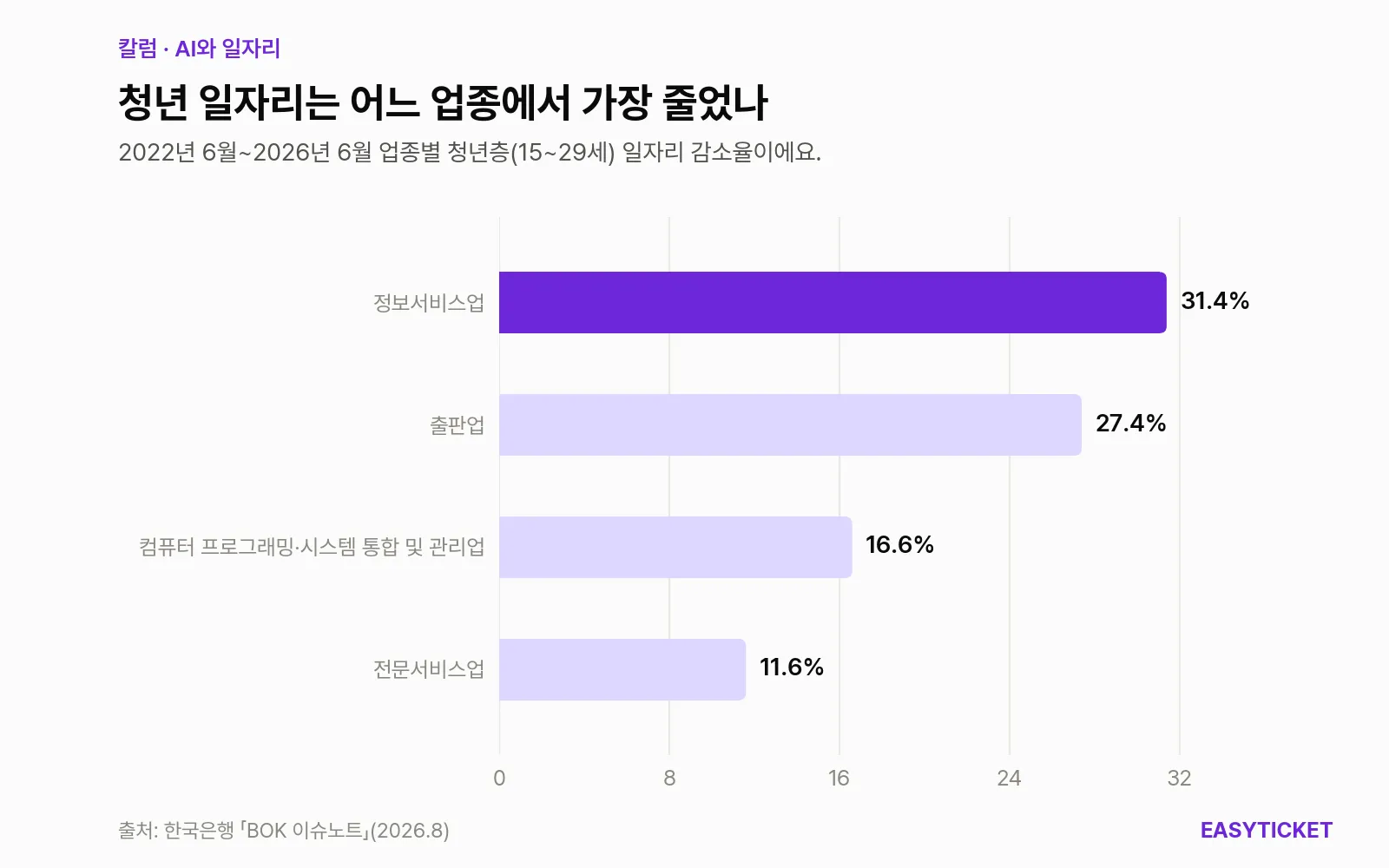
Industries where youth jobs fell the most. The top four all involve working with text and code in front of a screen.
In information services, more than three in ten youth jobs (31.4%) disappeared. Publishing (27.4%), computer programming, systems integration and management (16.6%), and professional services (11.6%) followed. It stands out that the work at the top of the list is done at a screen, handling text and code, not on a factory floor.
The same report found that the youth share of new hires fell by 7.6 percentage points, from 36.9% in 2014 to 2019 to 29.3% in 2024 to 2026.
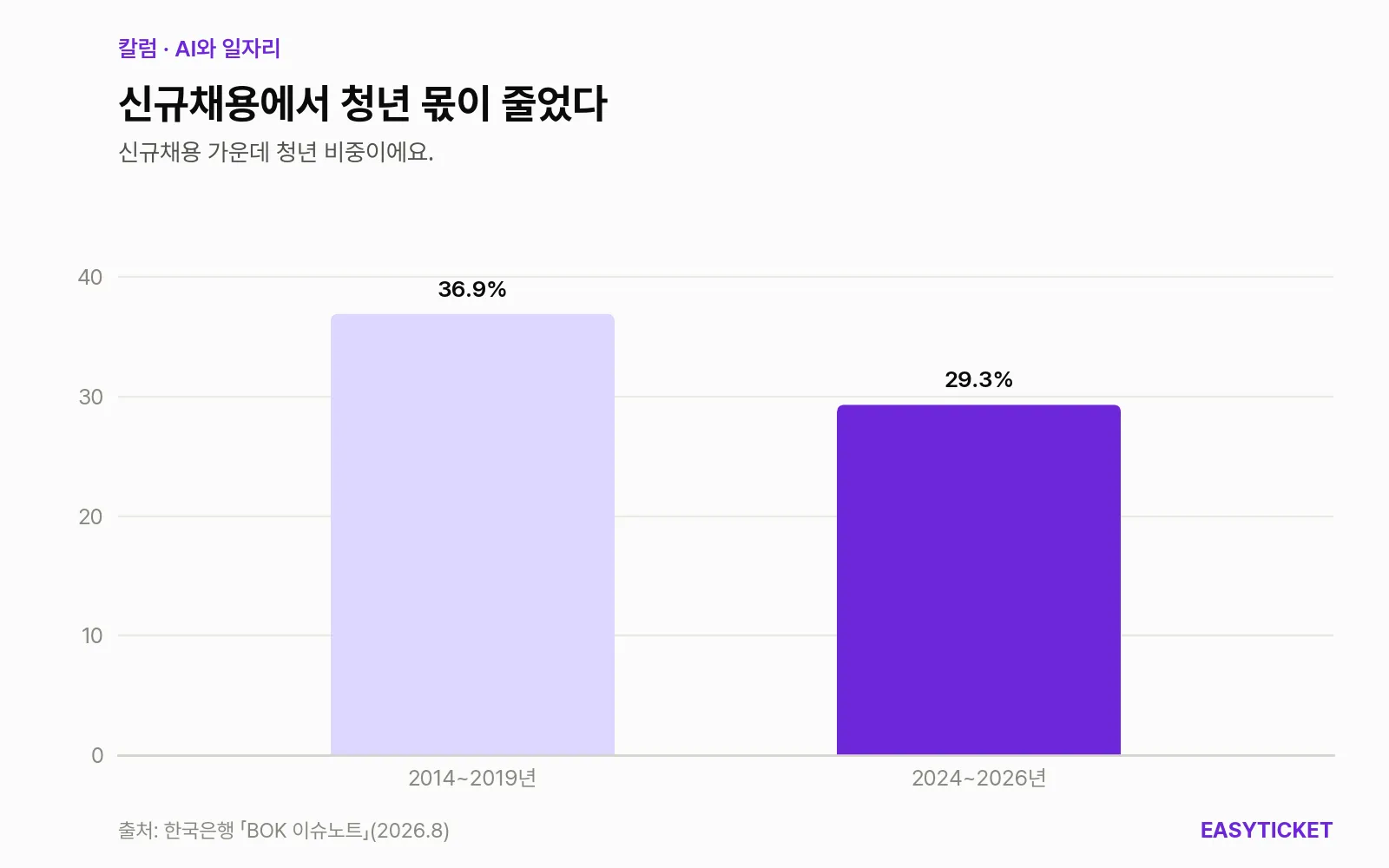
The youth share of new hires. Out of every ten people hired, young workers dropped from nearly four to under three.
Since ChatGPT launched in November 2022, the unemployment rate for young people with a four-year degree or higher has averaged 7.0%, which is 1.6 percentage points higher than for those with a junior college degree or less (5.4%). Earlier waves of automation hit less-educated workers first. This time the order is reversed.
Hiring stopped, not employment
US data points the same way. The Stanford Digital Economy Lab used payroll data from the payroll processor ADP to publish a revised edition of “Canaries in the Coal Mine?” on August 12, 2026.
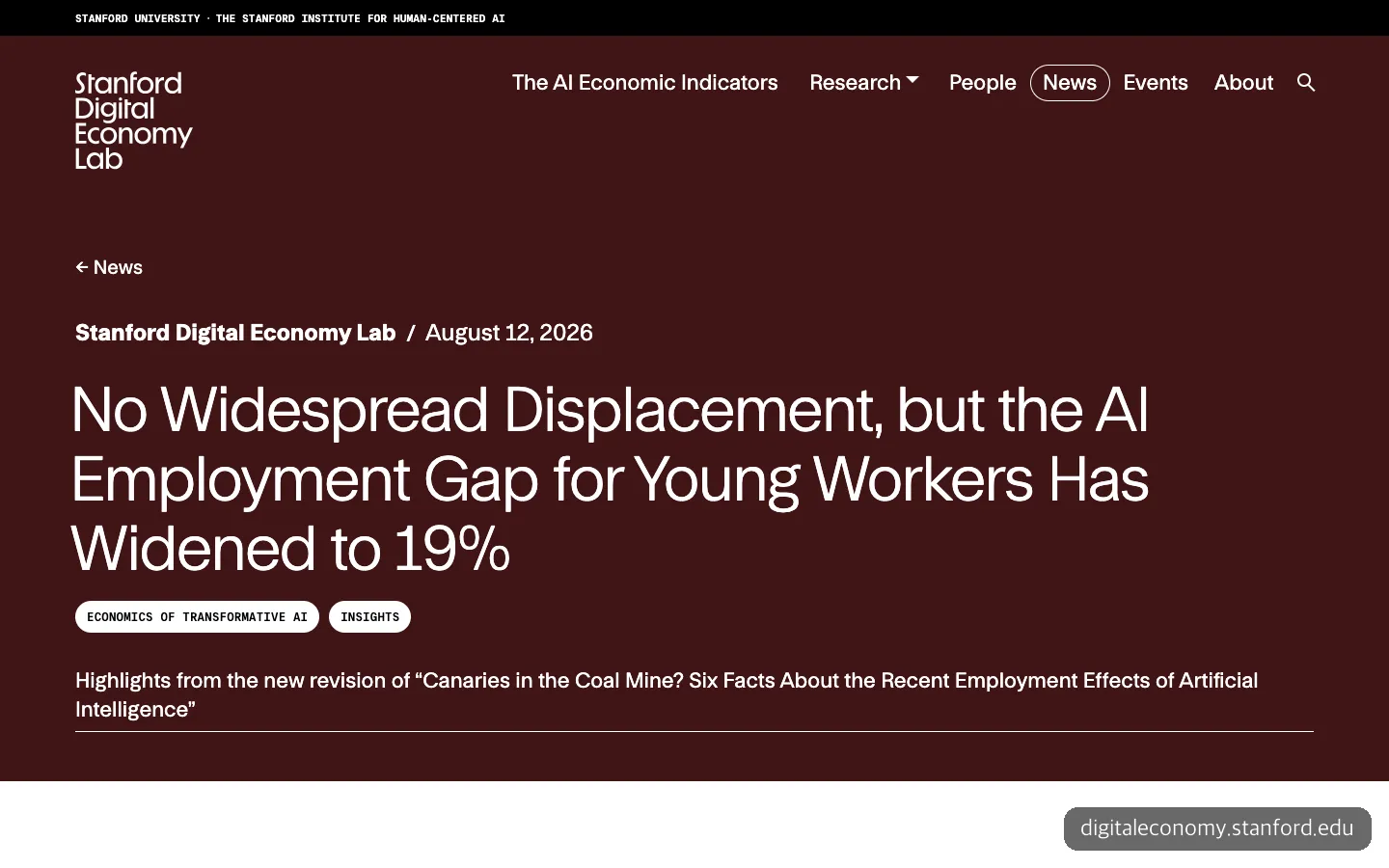
The Stanford Digital Economy Lab’s announcement of its August 2026 revision. The headline itself says both “no large-scale replacement” and “a 19% gap for young workers.”
As of June 2026, employment for ages 22 to 25 in highly AI-exposed occupations is about 19% lower than for the same age group in less exposed occupations. In the July 2025 data the gap was 15%, so it widened over the year. Experienced workers showed no similar gap. From November 2022 to June 2026, employment for ages 22 to 25 in the top two exposure quintiles fell by about 11%, while in the bottom three quintiles it grew by about 10%.
Of the six facts the report highlights, the one that lingers longest concerns hiring. The adjustment happens through reduced hiring of young workers, not through more layoffs. That overlaps with the Bank of Korea’s conclusion. Scenes of people already in their seats being let go are rare. Instead, the number of beginners hired next year quietly shrinks. It is hard for that to become a news headline, so people feel it late.
Some companies have put numbers on it publicly. According to TechRepublic, Salesforce CEO Marc Benioff said on a podcast in the summer of 2025 that the company had cut its customer support staff from about 9,000 to about 5,000, citing AI agents as the reason. He added that some of those workers were moved into sales.
What kind of work will AI replace?
The key words both reports share are “automation” and “augmentation.” The Bank of Korea found that the larger an industry’s share of automation, where AI does the work, the more youth employment fell, while the pattern was not clear in industries with a high share of augmentation, where AI helps people do their work. Stanford likewise wrote that the declines concentrated in automated occupations, while employment in occupations that AI complements stayed flat or grew.
The Stanford revision added one more criterion. Youth employment fell in occupations centered on codified knowledge, which can be taught through textbooks or documents. In occupations centered on tacit knowledge, built through hands-on work and mentoring, employment of experienced workers grew. The first tasks a beginner takes on are usually ones a manual can explain. And a manual is exactly what AI learns best.
The World Economic Forum’s “Future of Jobs Report 2025” (January 2025) offered a similar list at the job-role level. By 2030, the roles with the largest absolute decline are clerical jobs such as cashiers and ticket clerks, and administrative assistants and secretaries. The fastest-declining roles it named include postal service clerks, bank tellers, and data entry clerks. Forty percent of employers said they plan to reduce staff where AI can automate work. The same report also projected that over the same period 170 million jobs will be created and 92 million lost, for a net gain of 78 million. Looking only at the jobs that vanish gives half a picture.
A different view that blames population
Some reports, published in the same country and the same summer, reach a different conclusion. In the summer issue of its “Employment Issue” on August 31, 2026, the Korea Employment Information Service read the hiring slowdown as the result of a shrinking youth population more than of AI replacement.
According to a Ministry of Employment and Labor press release, the number of people newly enrolled in employment insurance has fallen in every occupation since 2023, regardless of AI exposure level. The employment index for those under 30 (2022 = 100) in 2025 was 86.6 for the high-exposure group and 92.5 for the low-exposure group. The high-exposure group did fall further, but the institute judged that the decline began before ChatGPT’s release. Of 2,297 establishments surveyed, 28.6% had adopted AI, and the main purpose was reducing repetitive work, not cutting headcount. Even so, this report separately noted a concern, from its survey of current employees, that the junior “skill ladder” could weaken.
There is a reason the two Korean sources diverge. They look through different windows, so the numbers come out differently.
| Bank of Korea issue note | Korea Employment Information Service “Employment Issue,” summer issue | |
|---|---|---|
| Published | August 18, 2026 | August 31, 2026 |
| Data examined | Employed people by industry | Employment insurance data, regional employment survey |
| Key figure | 94.0% of lost youth jobs came from high AI-exposure industries | Employment index for those under 30 (2025): 86.6 for high-exposure, 92.5 for low-exposure |
| Interpretation of cause | AI is an accelerant that sped up other changes | Youth population decline, more than AI replacement |
The numbers in the table should be read only within each report. The standards differ, so they cannot be subtracted from or divided by one another. And the Bank of Korea itself saw AI less as a direct cause than as an “accelerant” that sped up other changes, such as the normalization of overhiring after the pandemic, fewer large-company open recruitment rounds alongside a preference for experienced hires, and weaker in-house training.
There are cautious voices abroad as well. According to Fortune, Yale’s Budget Lab said in a February 2026 analysis that, for the economy as a whole, AI looks closer to stable than to hugely disruptive, and co-author Martha Gimbel said some layoffs blamed on AI may be “AI washing.” The Stanford researchers also stated plainly that their results are “descriptive patterns, not causal estimates.”
Still, EasyTicket does not withdraw the phrase “jobs AI will take” for one reason. Setting the debate over causes aside, the same shape shows up in both Korean and US data. In work with high exposure, it is beginners rather than experienced workers who are dropping out, and at the hiring stage rather than through layoffs. No source says “mass unemployment across all occupations,” but several sources say together that “first seats are shrinking.”
What these numbers mean for vibe coders
For people who do vibe coding, this story is not someone else’s business. In the Bank of Korea data, computer programming ranks third in rate of decline. The Anthropic Economic Index, released by Anthropic in February 2025, analyzed about one million Claude conversations, and the field with the most queries was computing and mathematics (37.2%).
In the same analysis, 57% of tasks were classified as augmentation and 43% as automation. That means the pattern of people working back and forth with AI to build something is still slightly more common. But this figure covers only Free and Pro user conversations, and it has the limitation that it cannot confirm whether the use was for work.
The judgment that follows is simple. If all you do is take code from AI and paste it in, you are standing on the “codified knowledge” side that Stanford described. By contrast, choosing what to build, seeing where users actually get stuck, and reading the response after launch to decide the next move are closer to tacit knowledge, which is hard to teach through documents. For someone starting out in an era when entry-level seats are shrinking, it makes more sense to ship something small yourself and collect reactions than to wait for a company to teach you. Companies are handing out fewer rungs of the “career ladder” the Bank of Korea talked about, so you have to build the first step yourself.
Numbers to watch next
The first is whether Stanford’s gap for ages 22 to 25 widens beyond 19%. The lab publishes separate data updated monthly, so the direction can be checked as soon as the next figure comes out. The second is whether the youth share of new hires in Korea (29.3% for 2024 to 2026) bottoms out. The third is whether, as the 28.6% AI adoption rate in the Employment Information Service survey rises, the stated purpose of adoption remains “reducing repetitive work.” The moment that purpose shifts toward “headcount reduction,” even today’s cautious interpretation would have to be rewritten.
Frequently asked questions
Does high AI exposure mean the occupation will disappear?
No. Exposure measures how far AI can take over or assist with the tasks of an occupation. Both Stanford and the Bank of Korea found that employment trends split not by exposure itself but by whether AI “replaces” the work (automation) or “helps” with it (augmentation).
Why did only young people’s jobs shrink while those of people in their 50s grew?
The two reports share an interpretation: companies cut beginner hiring and hired experienced workers rather than pushing people out. AI catches up quickly on work that can be learned from a manual, but judgment built up on the job still remains the territory of experienced workers.
Is it too late to prepare to be a developer?
It is true that youth jobs in programming fell by 16.6% in the Bank of Korea data. But within the same trend, employment in work that uses AI as a complementary tool stayed flat or grew. If you shift the weight from the hands that type code toward deciding what to build and taking responsibility for the result, the door may have narrowed, but it has not closed.
Sources 8
- SBS Biz: AI 확산에 청년 일자리 28.5만개 '뚝'…50대는 오히려 늘었다 (2026-08-18)
- 이투데이: 사라진 청년 일자리 94%가 'AI 고노출 업종'⋯고학력자 충격 더 컸다 (2026-08-18)
- 고용노동부 보도자료: 한국고용정보원 『고용이슈』 여름호 발간 (2026-08-31)
- Stanford Digital Economy Lab: No Widespread Displacement, but the AI Employment Gap for Young Workers Has Widened to 19% (2026-08-12)
- Fortune: Yale Budget Lab AI labor market / AI washing (2026-02-02)
- World Economic Forum: Future of Jobs Report 2025
- Anthropic: The Anthropic Economic Index (2025-02-10)
- TechRepublic: Salesforce 'Needs Less Heads,' So It Cut 4,000 Jobs, As AI Takes Over
AI helped with research and the first draft; the operator tried the subject firsthand, checked and edited this article before publishing. Let us know if you spot a mistake.