
On a morning subway commute, the phone screen is dark, but “The Meaning of Document Comprehension” is playing in the earbuds. NCS Modular (NCS 모듈형) is an app for preparing for the written exams at Korean public corporations, built by the EasyTicket operator through vibe coding. It lets you listen to summaries of all 10 NCS vocational basic competency areas as audio (text-to-speech, or TTS) while working through more than 1,000 practice questions. It launched first on the App Store on July 10, 2026, and is now also available on Google Play. Through October 31, 1,948 people newly downloaded it across the two stores, and among those who opened the app, each person spent an average of 46 minutes in it. For the developer, this is the first app made after becoming convinced that “I can keep shipping apps with vibe coding,” and of all the apps released so far, it is the one people use the longest and the one with the most users.
What kind of app is NCS Modular?
The “modular” type of NCS exam asks whether you know the concepts that appear in the vocational basic competency guidebooks. The NCS Modular app reorganizes those concepts into summaries for 10 areas (communication, numeracy, problem solving, self-development, resource management, interpersonal skills, information, technology, and organizational understanding, plus professional ethics) and 34 subareas, then ties them into a flow of reading, listening, and solving.
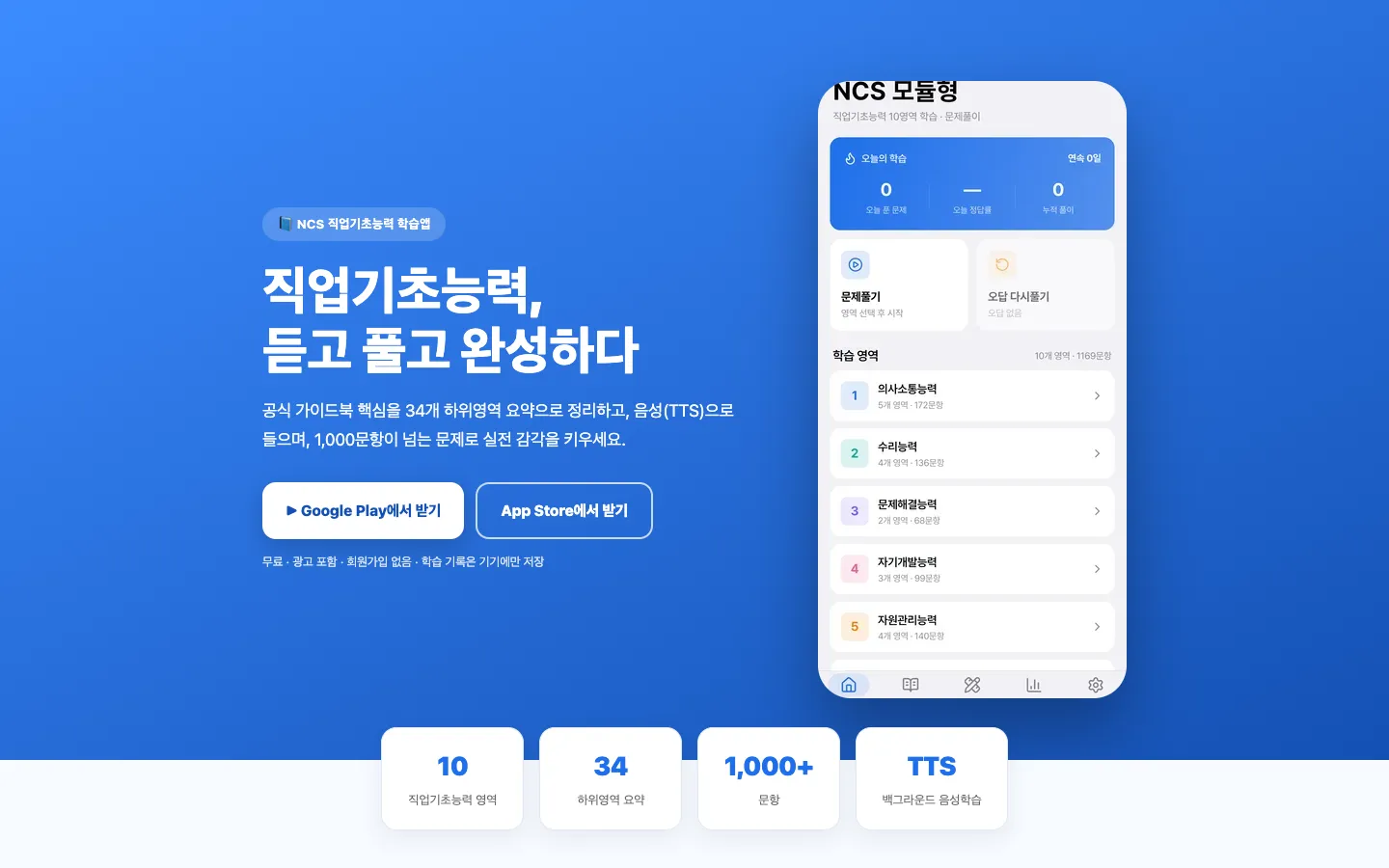
The first screen of the NCS Modular intro page. It leads with 10 areas, 34 subareas, more than 1,000 questions, and audio listening.
As of November 2026, the app includes the following features.
- Audio listening: Playback continues when you turn off the screen or use other apps, and you can change the speed.
- Practice questions: Choose an area and the number of questions, and you get a new mix each time, with the answer and explanation shown right after you solve each one.
- Wrong-answer notebook: Questions you miss are collected automatically and drop off when you answer them correctly later.
- Statistics: It shows your accuracy and time spent by area and by difficulty, and points out your weak areas.
The app is free and supported by ads. There is no sign-up, and study records are stored only on the device. The intro page says “more than 1,000 questions,” while the app’s home screen shows 1,169.
Why revive the lost first app first?
The story begins before the AI era. When the developer was preparing for a public corporation written exam, he felt there should be an app for practicing a little each day at estimating data interpretation answers by instinct, without calculating. So he built “NCS Vitamin Data Interpretation” (NCS 비타민 자료해석) himself. He ran it for a while, but could not keep up with updates, and it came down from the stores.
When the developer, who had been trying out various things with AI, returned to app development, this app was the first task he chose. Rather than a new idea, reviving an app he had already built once through vibe coding was a better way to test whether it really works. The result was the relaunch of NCS Vitamin. According to the App Store version history, after version 1.0 came out on June 24, three small fixes were uploaded through July 5.
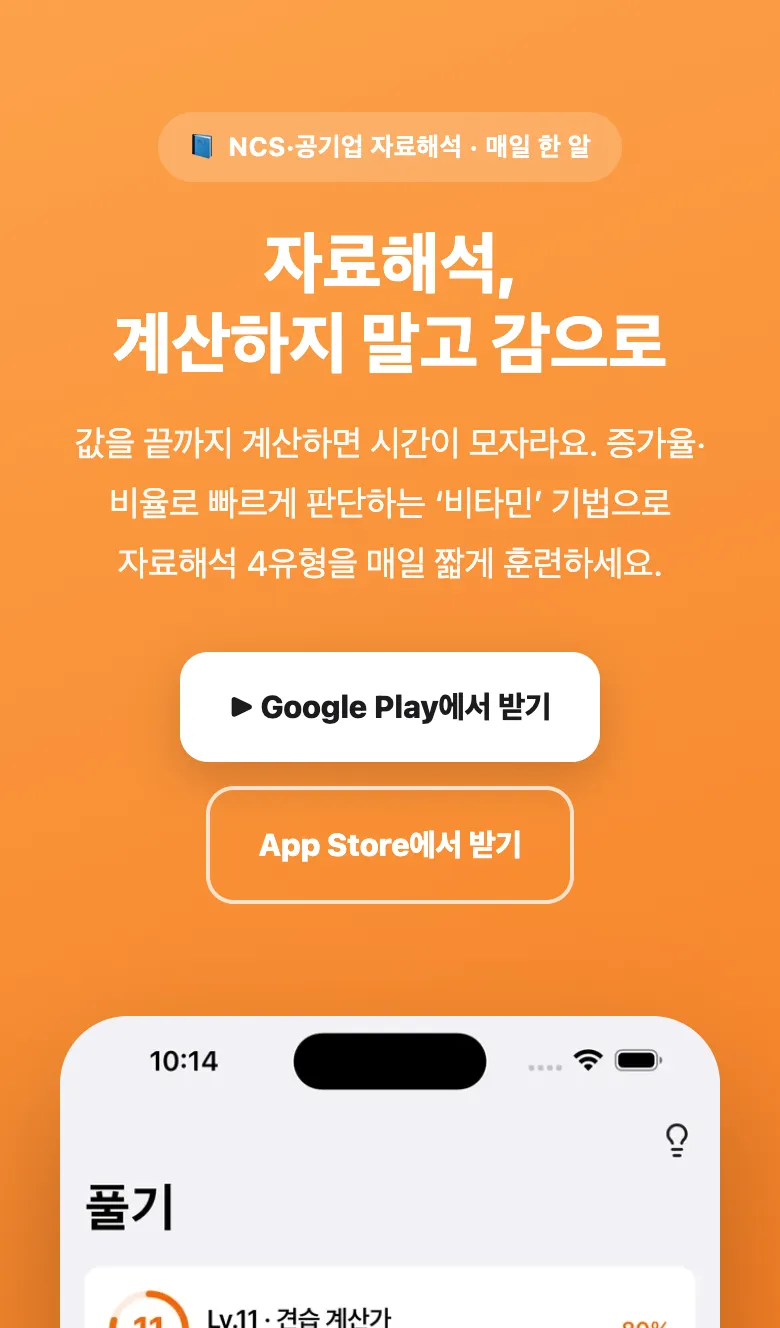
NCS Vitamin, the app revived first. The intro page uses the same layout as NCS Modular, with only the color changed.
This is where his conviction came from. An app that had been removed because he couldn’t keep updating it was back on the store, and within a few days he could fix what needed fixing and push it out right away. He judged that he could build the next app the same way, and the next topic he picked was the modular type.
The second app, out in two weeks
About two weeks separate NCS Vitamin 1.0 and NCS Modular 1.0. It could move fast because he carried over the whole framework. Both apps share the same structure: use it right away without signing up, keep records only on the device, and watching a rewarded ad once removes ads for 3 hours. The intro page uses the same layout too, with the color switched to blue.
What he decided anew was not “what to teach” but “how to teach it.” The developer sees the modular type this way: an area that is too much of a waste to spend lots of time on, yet too unsettling to skip. If it is not a subject to sit down at a desk and grind through, he reasoned, the better fit is to let it wash over your ears while you travel and check it with questions in spare moments. That is why he put audio listening at the center of the app, not as one item on a feature list.
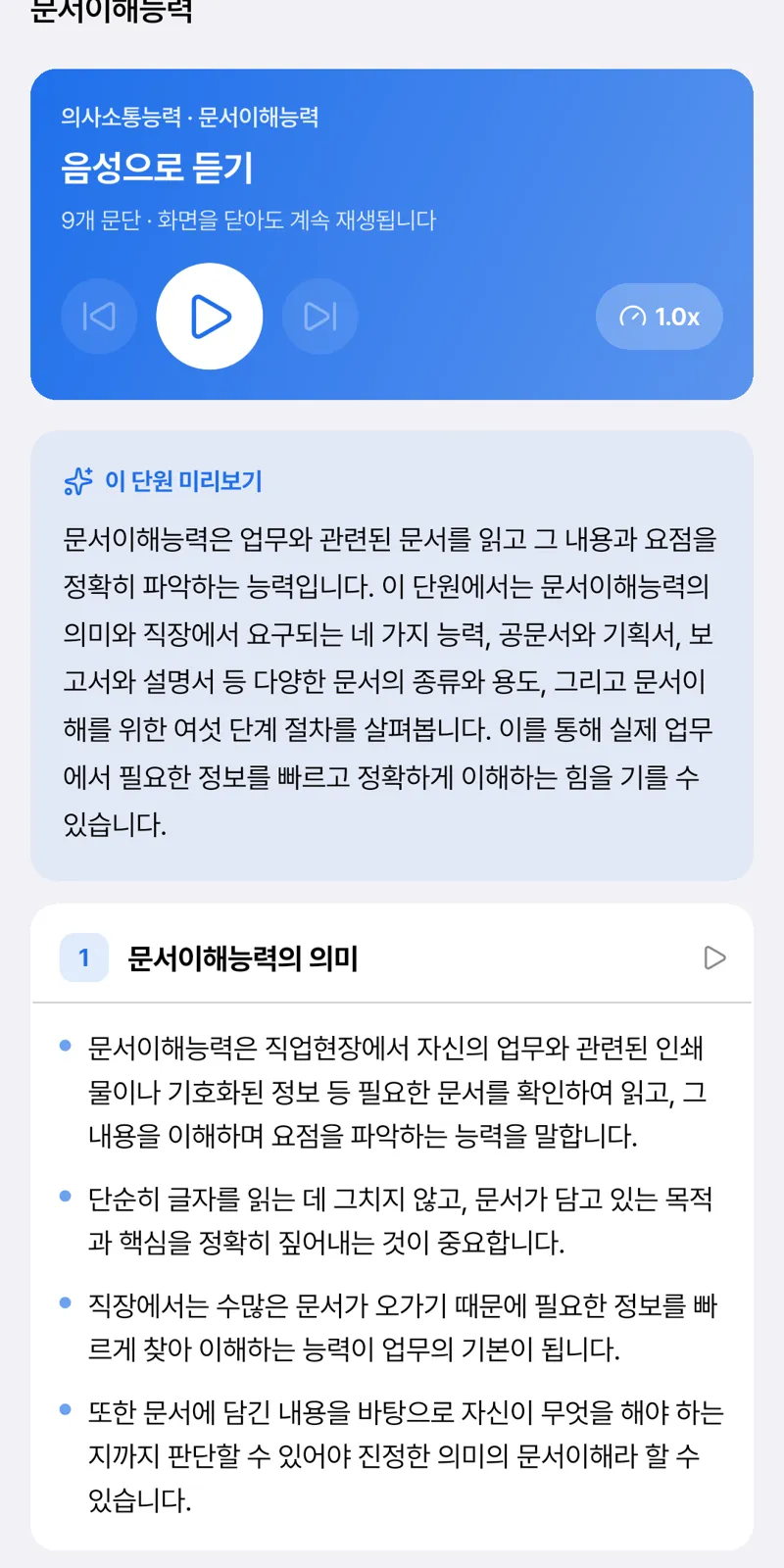
Open a chapter and audio listening sits at the very top. It keeps playing even after you close the screen.
The key is background playback. Even with a listening feature, if it stops the moment the screen turns off, its usefulness on the subway is cut in half. That is why he made it keep going when the screen is off, when you switch to another app, and on the lock screen. Speed control went in for the same reason. What he left out is just as clear. He did not add accounts or syncing across devices. He chose to remove the sign-up step so that people can start listening right away.
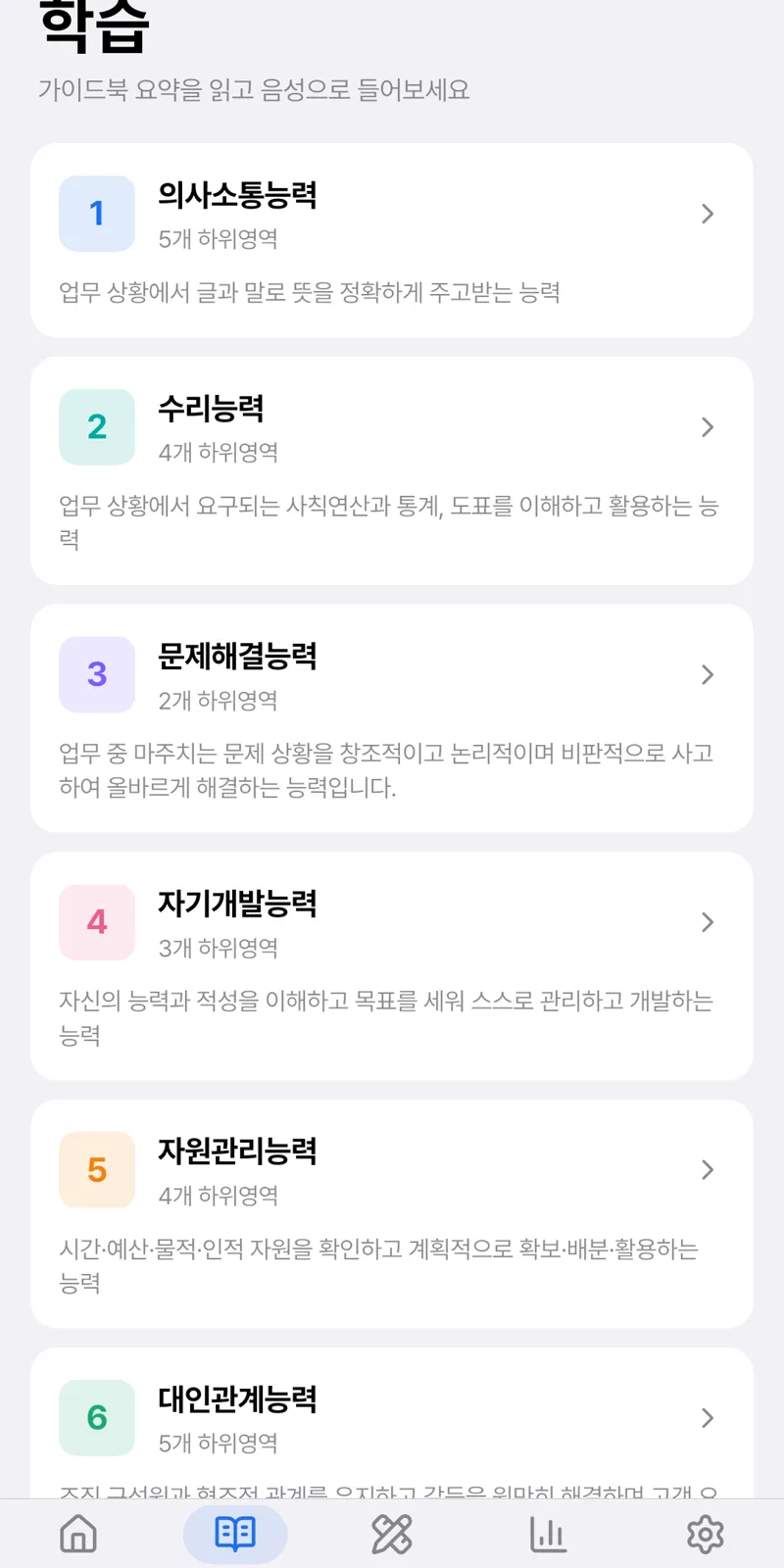
The study tab. The 10 areas are divided into subareas, where you read and listen to summaries.
Four months after launch, how many people downloaded it?
From July 10 to October 31, 1,948 people newly downloaded the app across the two stores. That breaks down into 1,211 first-time downloads on the App Store and 737 new installs on Google Play. The Google Play figure runs only through October 26, so the last five days are missing. The 125 re-downloads by people who deleted the app and got it again from the App Store are counted separately from this number.
By month, the trend splits in two. July was 215 on the App Store alone, August was the peak at 635, followed by 589 in September and 509 in October. The App Store peaked at 488 in August and fell to 294 in September and 214 in October. Google Play went the other way. Installs appear from August 6, and rose from 147 in August to 295 each in September and October, so from September the two stores were nearly half and half.
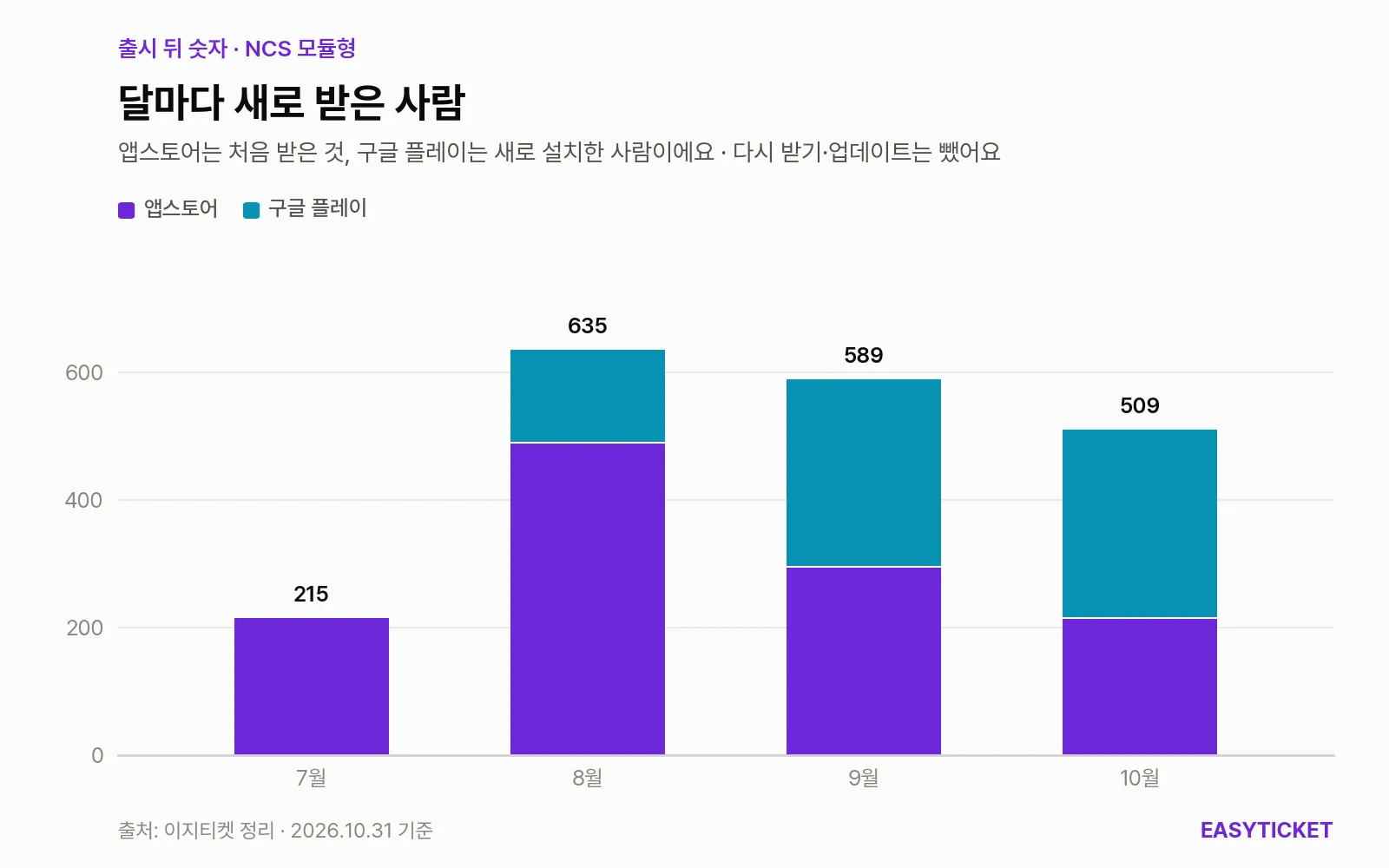
New downloads by month. From September, Google Play filled the space left by the App Store’s decline.
What to read from the chart is “it held up” more than “it dropped.” Without advertising, more than 500 people newly downloaded the app every month for four months straight. All 1,211 App Store downloads came from Korean accounts, and 128 of them were on iPad. That suggests some people study by propping up a tablet and listening. On Google Play too, 724 of the 737 were from Korea.
The people who deleted it also deserve a straight look. On Google Play, 192 people had uninstalled it through October 26, and as of that day the app was installed on 598 devices. That means roughly seven in ten of the people who downloaded it kept the app. The problem is that deletions rose each month: 23 in August, 69 in September, and 100 in October. In October, that equals one third of the 295 new installs. Store numbers alone cannot tell us why people deleted it, but it is worth keeping in mind that an app you can try right away without signing up is just as easy to delete when it isn’t a fit.
Of those who downloaded, how many stay and use it?
In-app usage numbers are captured properly starting around August 15, 2026. Numbers before that come out lower than the real figures, so we look only at the period after.
From August 15 to October 31, 1,805 people opened the app at least once. Each person opened it an average of 4.6 times and used the app for an average of 46 minutes. That works out to a little over 10 minutes per open. That is hard to reach in an app where you solve a few questions and close it, and it matches the way people play one chapter through to the end. On top of that, this time counts only when the app screen was on. Time spent listening with the screen off and the phone in a pocket is not included, so it is natural to think that the time people actually spent studying by ear is longer. The numbers also show why the developer felt this was “the app people use the longest.”
The number of people who opened the app each month was 495 in August (from the 15th), 834 in September, and 866 in October. New downloads began to dip slightly from September, yet the number of people opening the app actually grew. Of the 866 who opened it in October, 636 were opening it for the first time, so about 230 were people who had used it before and came back. That is more than the 170 in September.
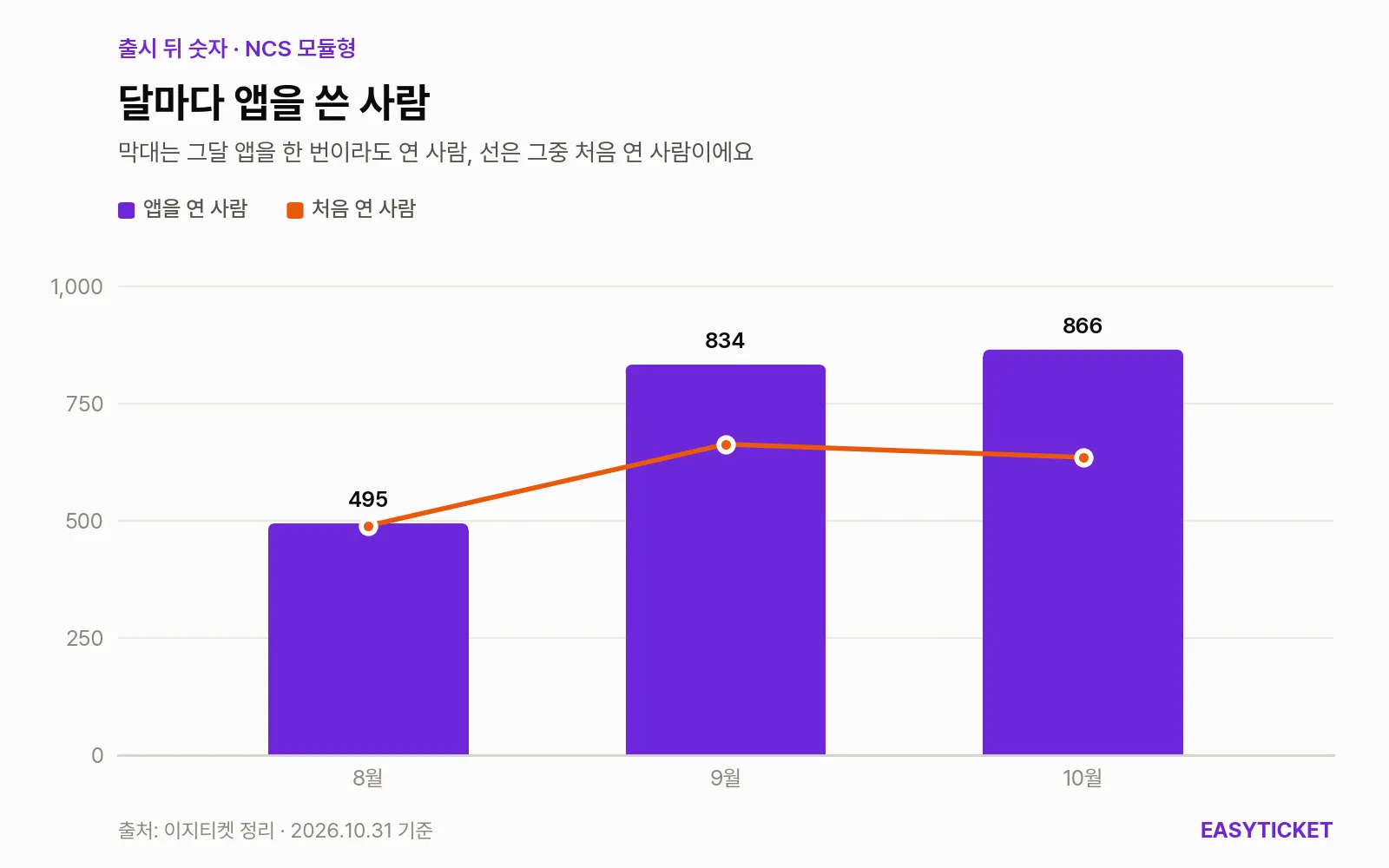
People who opened the app each month (bars) and, among them, first-time openers (line). August starts on the 15th.
As of October 31, 797 people had opened the app in the previous 28 days, 252 in the previous 7 days, and 63 on that single day. The number who come in every day is still small. Instead, there is a thick base of people who pull it out once or twice a week, which resembles the nature of modular-type study: “too much of a waste to spend time on, but awkward to skip.”
What changed after launch, and how it differs from a question bank app
There were two main updates after launch. In version 1.2.5 on August 15, he added an in-app purchase (3,300 KRW) that removes ads permanently, and in version 1.2.6 on October 8, he fixed an ad-related bug. His view was that if ads bother people who mainly listen, there should be a way to be done with them in one step, not only the 3-hour free removal.
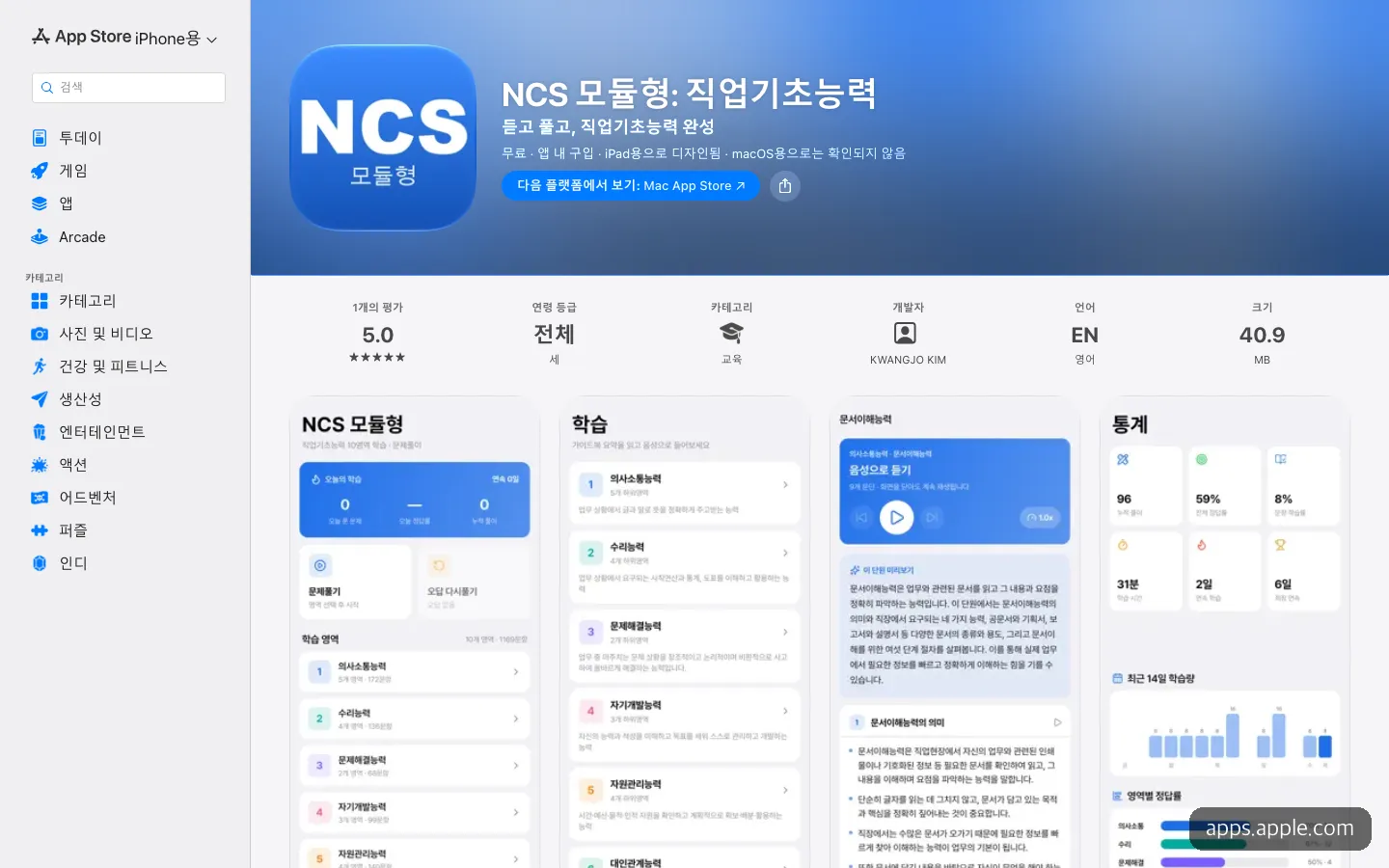
The NCS Modular App Store page. The audio listening screen is the third screenshot.
When you search the App Store for “NCS 직업기초능력” (NCS vocational basic competencies), another app appears alongside it. It is “NCS 직업기초능력 - 공기업 채용 필기 문제은행” (NCS Vocational Basic Competencies: Public Corporation Written Exam Question Bank), which released version 1.0 on August 17, 2026. Placed side by side as of the App Store on November 1, 2026, they look like this.
| NCS Modular | NCS Vocational Basic Competencies Question Bank | |
|---|---|---|
| Price | Free, ad removal 3,300 KRW | Free, Premium 4,900 KRW per month or 24,900 KRW lifetime |
| Questions | More than 1,000 | More than 4,600, 335 lessons |
| Notable features | Background audio listening, speed control | Spaced repetition (FSRS), 60-question 60-minute mock exam |
| Records | Stored on the device only, no sign-up | Sync across devices |
| Rating (number of ratings) | 5.0 (1) | 5.0 (14) |
| App size | 40.9MB | 95.6MB |
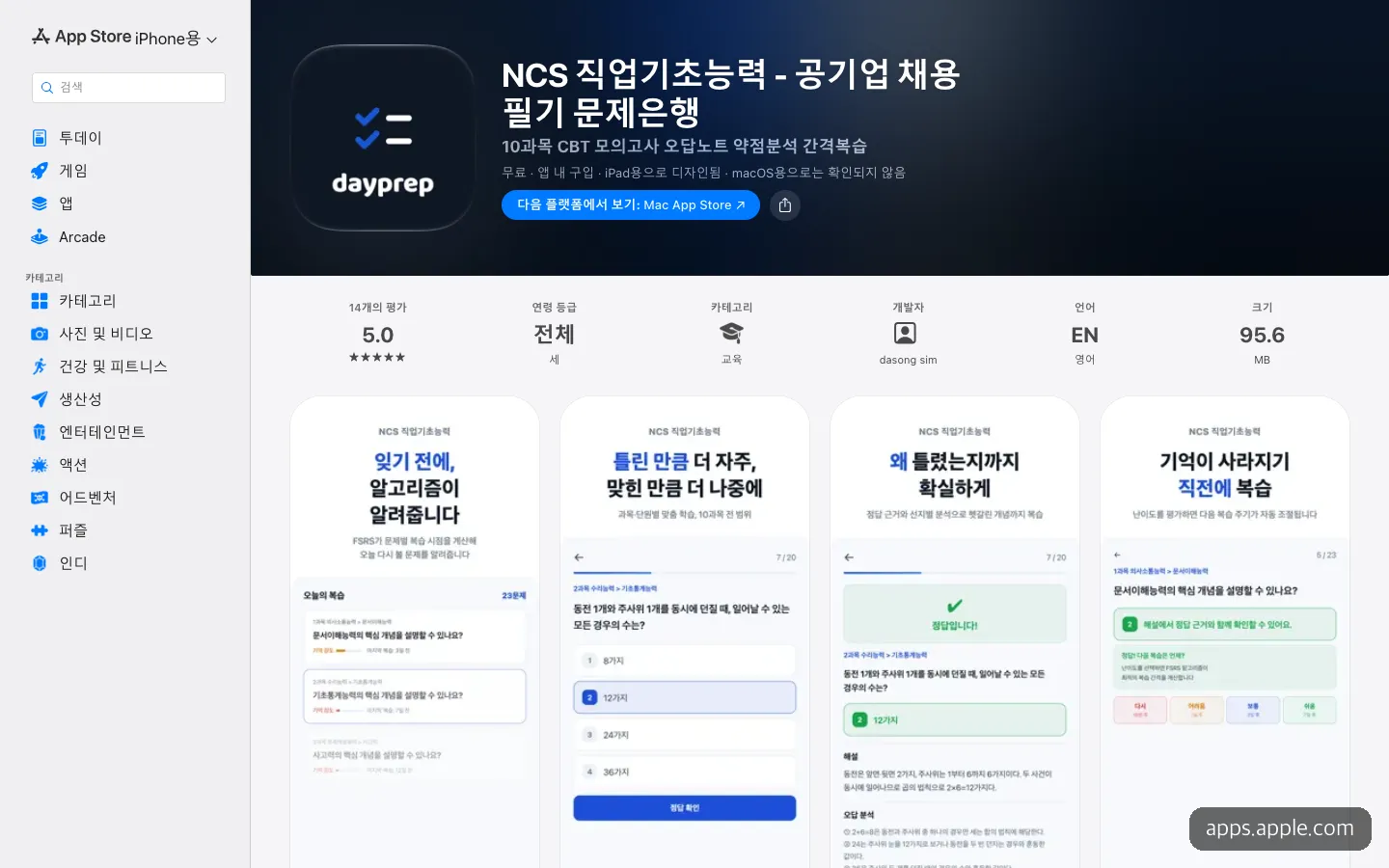
The question bank app that appears for the same search term. It leads with review intervals, explanations, and wrong-answer analysis.
The question bank app is ahead on number of questions, mock exams, and syncing. If you want to solve a lot of questions at a desk, timing yourself as in the real exam, that one is the better fit. What sets NCS Modular apart, going by the store pages, is that it has a listening feature and that you can use it the moment you open it, with no sign-up. They are closer to two apps for different situations than to competitors.
Four things to fix next
1. Align with the vocational common competency overhaul. In a press release on April 28, 2026, the Ministry of Employment and Labor announced that it would rename “vocational basic competencies” (직업기초능력) as “vocational common competencies” (직업공통능력) and restructure the 10 areas and 34 subcompetencies into 7 areas and 21 subcompetencies. AI utilization, digital responsibility, and occupational safety and health awareness are newly added, and the learner workbook is due out within the year. Herald Business (헤럴드경제), a Korean business daily, described it as the first full overhaul in 20 years. When it will be reflected in public corporation written exams has not yet been announced, but the current app is built on the old 10-area system, so it makes sense to start with chapters that group the new areas separately.
2. Let people meet listening before they delete. Deletions on Google Play rose to 100 in October. Meanwhile, people who stay use the app for a little over 10 minutes at a time. The charm of this app is in the listening, but if first-time users go straight to solving questions and leave, they walk away without tasting it. A flow that steers people to play one chapter right on first launch is the first candidate for reducing deletions.
3. Build up ratings and fix the store language label. The App Store rating is 5.0, but there is only 1 rating, versus 14 for the comparison app. With more than 200 returning users a month, asking for a rating at a satisfying moment, such as after someone has finished listening to a few chapters, could build up the count. Also, all text inside the app is in Korean, yet the App Store language field shows only “EN,” which is something that can be fixed right away.
4. A taste of listening on the intro page. Visitors stay on the app intro page for an average of 9 seconds (July 10 to October 31), and people who arrived by clicking a link on a Naver Cafe (a community forum on Korea’s largest portal) stand out. For now there are only store buttons, so if people could listen to one chapter right on the page, public corporation exam candidates could experience the core of the app before installing.
From the NCS Modular intro page, you can go straight to either store. If you have been putting off the modular type, starting with one chapter during one subway stop on tomorrow’s commute is exactly the use this app was made for.
Frequently asked questions
Is NCS Modular free?
Yes, you can download and use it for free, and it is supported by ads. Watching a rewarded ad once removes ads for 3 hours, and the in-app purchase that removes ads permanently costs 3,300 KRW (as of the App Store in November 2026).
Can I use it on both iPhone and Android?
It is available on both the App Store and Google Play. You can also download it on iPad, and the intro page links directly to each store.
What happens to my study records if I change phones?
There is no sign-up, and study records are stored only on the device. A feature for moving records through an account is not described, so it is safer to assume that you will start from scratch when you switch devices.
Can I practice data interpretation in this app too?
No. Data interpretation is handled by NCS Vitamin, the sibling app revived first. It is built for short daily practice at making quick judgments with growth rates and ratios, so you can use it alongside Modular.
Sources 7
AI helped with research and the first draft; the operator tried the subject firsthand, checked and edited this article before publishing. Let us know if you spot a mistake.