
There was an Instagram reel in which someone spread a map of the whole country on the floor, threw a pen, and left right away for wherever the tip landed. The EasyTicket operator said the first thing that came to mind wasn’t “that’s fun” but “that takes way too much gear.” The app that came out of that thought is P들의 여행 (Ptrip), which the EasyTicket operator built directly through vibe coding. Ptrip is a free travel app where you throw a dart at a map or globe on your phone to pick a destination, and AI fills in the itinerary for that place. It launched on the App Store and Google Play on June 9, 2026.
From launch through October 31, 2026, 1,347 people downloaded it for the first time on the App Store alone. Yet it earns almost nothing. This article covers both stories: how it was made, and why it doesn’t make money.
What kind of app is Ptrip?
At first it was an app with just a dart. Now it’s closer to an itinerary app that runs from choosing a destination, to planning the trip, to splitting costs after you get back. As of November 1, 2026, the flow that the Ptrip intro page presents goes like this:
- Decide: Globe dart, finding places within your budget, and the cheapest flight date in the next six months
- Plan: An AI itinerary that factors in arrival time, lodging, and the return flight, plus travel companions you invite by link, QR code, or code
- Go: A one-line expense log with cost splitting, and 14 minigames
- Keep and share: A globe of cities you’ve visited, a 20-question travel personality test (16 types), and a look at itineraries other people have made public
There’s no sign-up. Flights and lodging are booked on partner pages, and nothing is paid inside the app. The latest App Store version is 2.81.0 (September 18), and the app is 142.6MB.

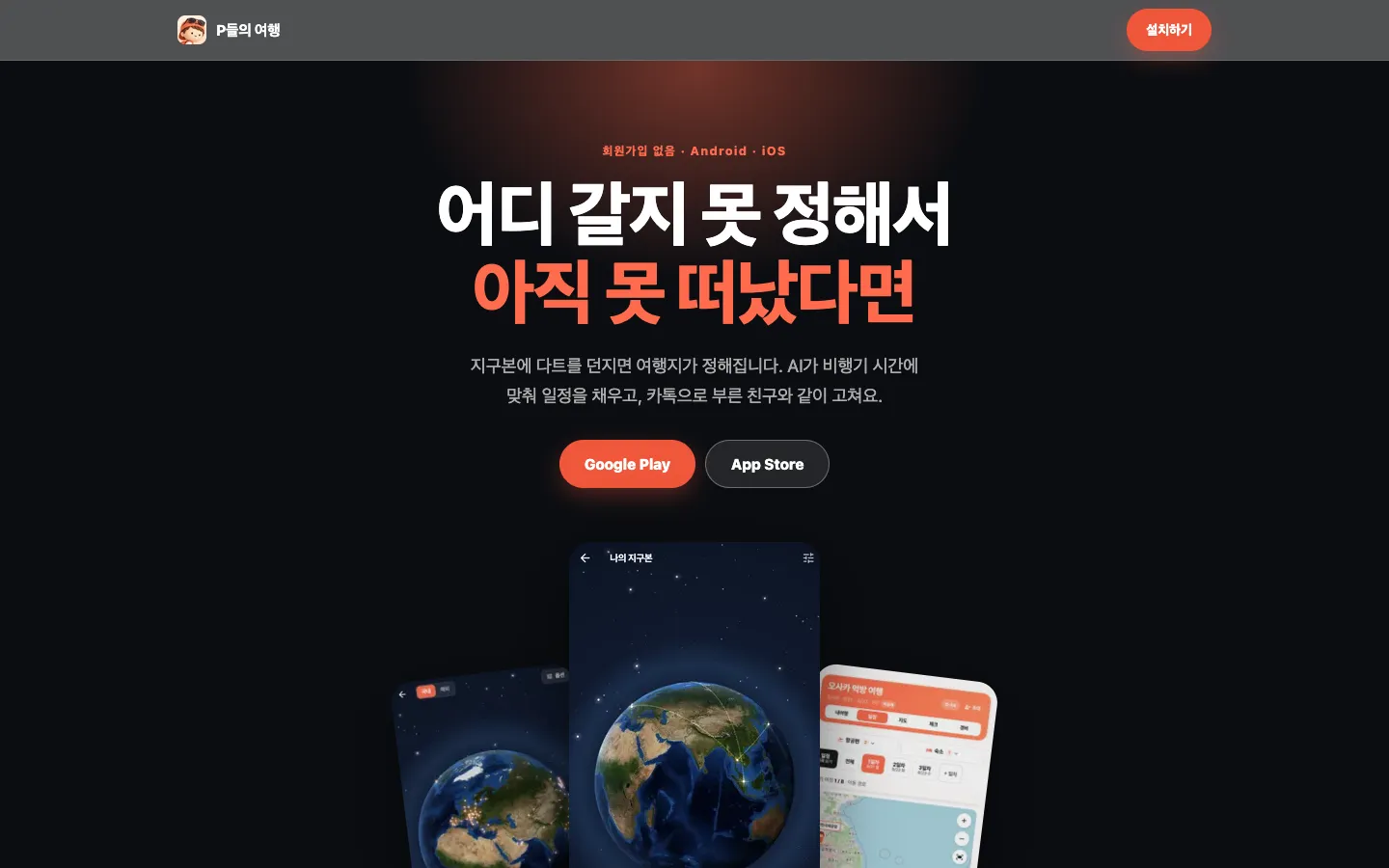
The current intro page puts the globe and AI itinerary ahead of the dart.
Why a dart instead of a pen, and why an app?
The impromptu trip in the reel looks fun, but to copy it you need a paper map, a pen, and floor space to unfold it. The developer figured that moving all this onto a phone would make an impromptu travel app for Ps (the P in MBTI, the type that dislikes planning). The picture was someone who hates planning throwing one dart on Friday night and leaving the next morning. The headline line in the first store listing was also about throwing a dart on Friday night and setting off on Saturday morning.
The money plan was set from the start too. Once a destination is chosen, the app would recommend nearby sights and lodging, and attach an affiliate commission to the lodging booking links.
The first version (1.0.0), released on June 9, 2026, carried this idea over as it was. Pulling back and releasing a dart on a map of the whole country picked a destination at the city, county, or district level (adjusted so it wouldn’t land in the sea or deep in the mountains). It showed sights, restaurants, and public transit routes within a radius of 1, 5, 10, or 30 km. Tourism information came from Korea Tourism Organization open data, and the developer also added a roulette, ladder game, and lot drawing for friends deciding who pays for a meal. There were no ads, and records stayed on the phone only, with no sign-up.
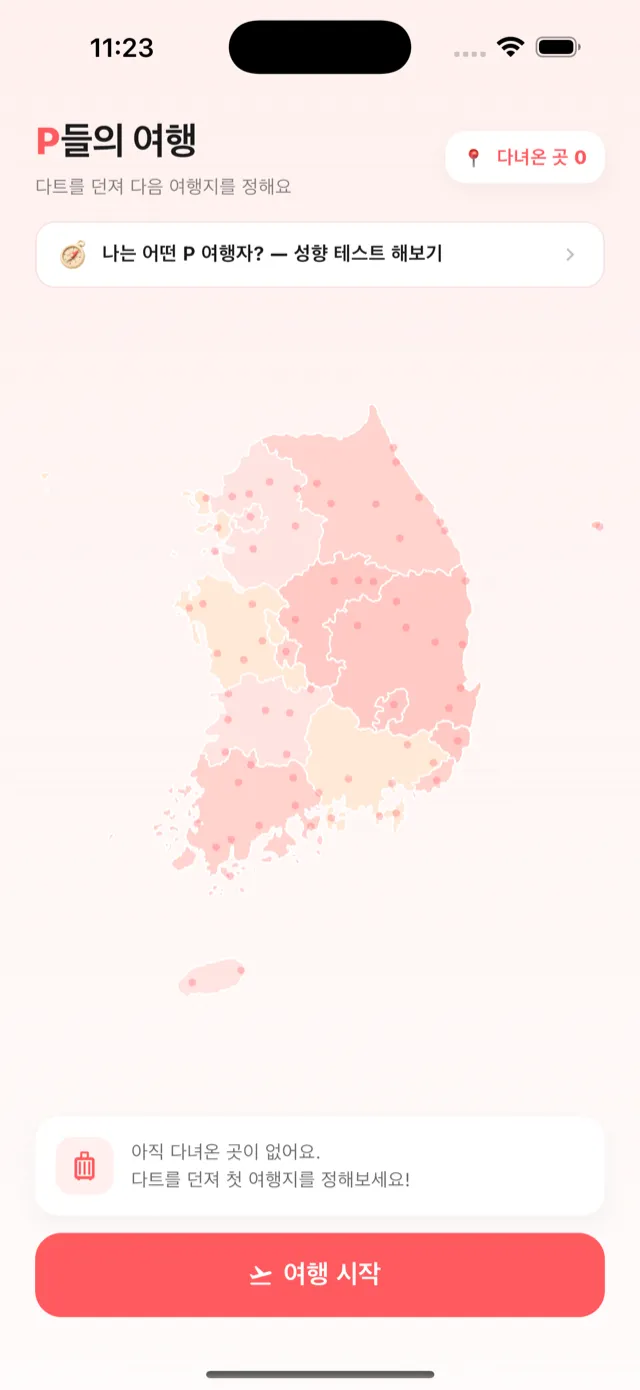
The first version’s home screen. One nationwide map and a start-trip button were all there was.
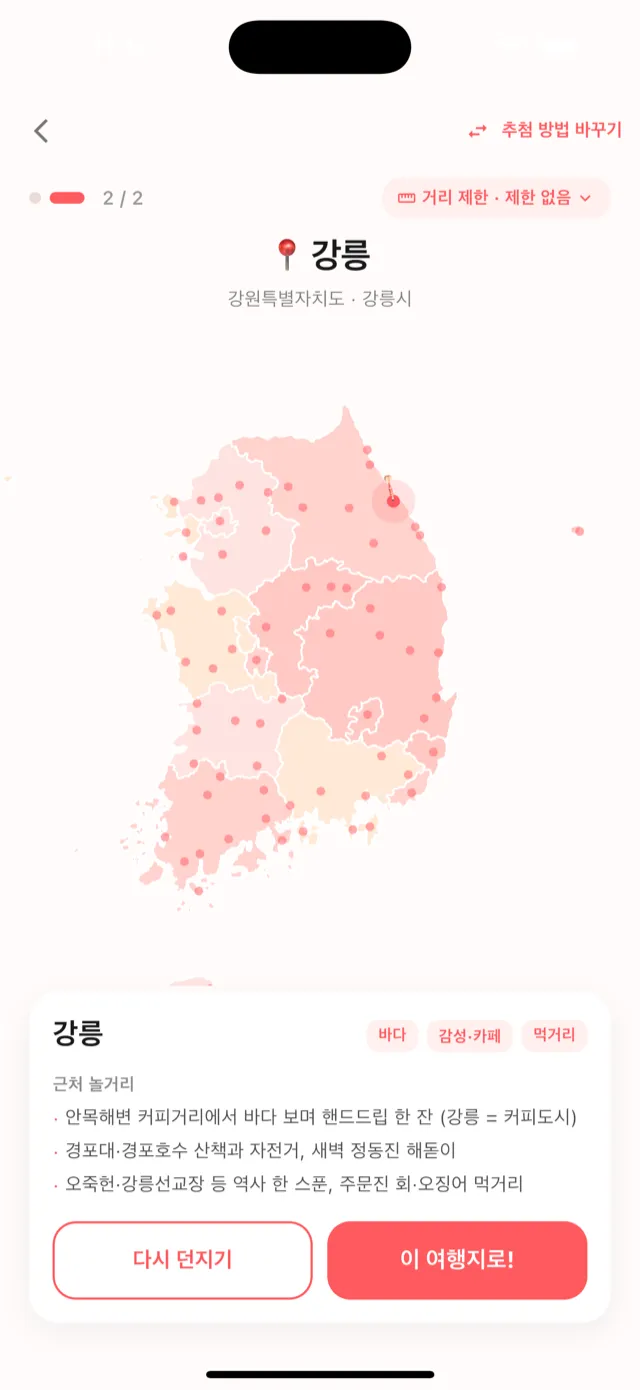
The first version’s result screen. It showed the district the dart hit and things to do nearby.
From a drawing app to an itinerary app
In the developer’s words, the first version was “crude.” Still, as people kept downloading it, the developer made two major overhauls.
The first came on July 18 to 21. It added a travel expense log, cost splitting that finishes in the fewest transfers, a split-the-bill calculator, a checklist, and image sharing to KakaoTalk. Minigames (such as a 10-second stopwatch challenge and a reaction-speed test), penalty records, 1,080 lodging listings, and the travel personality test were added then too. When this update went up, Google Play labeled the app as “contains ads.” The developer had never put in ads. A component built into the app had automatically added an advertising ID permission. The developer removed the permission and uploaded again.
The second (August 18 to September 8) changed the direction itself. The dart became just one of several ways to pick a destination (random, budget, lowest fare), and the developer decided to rebuild the app as one where you plan an itinerary with friends afterward. With overseas destinations added, the dart now gets thrown at a 3D globe, covered with the real Earth texture the developer had used in another game. For the build, the developer gave an AI coding agent numbered feedback several times a day and checked each fix right away on a web screen.
Three areas took the longest.
- The globe. Blurry rendering, crosshairs on the background stars, and a bug where picking a dart didn’t change it right away took dozens of rounds to fix. At one point the whole way of throwing the dart changed, so the developer rolled it back, saying “the original dart system was the best.”
- Zigzag routes in the AI itinerary. Day 1 came out empty, days from the second one didn’t start at the lodging, and routes doubled back on themselves. The cause was somewhere unexpected. The Jeju data was split into “Jeju (East)” and “Jeju (West),” which didn’t match “Jeju Island,” so no candidate places were reaching the AI at all. The developer merged the two regions and also removed personality phrases like “leave the schedule open,” which clashed with the “pack it tightly” rule.
- Keeping the AI from making things up. The developer researched and stored attractions, restaurants, cafes, and activities for every destination you can pick in the app ahead of time, and had the AI only fit routes and tastes within that data.
For the AI model, the developer compared the per-run cost of Claude, GPT, and Gemini and picked Gemini as the default. Generating one itinerary was calculated to cost about 31 to 37 won, which is why the AI itinerary is limited to five per day, with a short ad shown after the first one.
How many downloads after launch?
From launch on June 9 through October 31, 2026, 1,567 people newly downloaded the app across both stores (1,347 on the App Store and 220 on Google Play). The App Store figure counts only first-time downloads per account, so the 113 re-downloads after deleting aren’t included. The Google Play figure runs through October 26. True to an app launched without ads, almost all downloaders were in Korea (all 1,347 on the App Store, 215 on Google Play). On the App Store, 1,316 were on iPhone and 29 were on iPad.
By month, the numbers differ a bit from the developer’s impression. The developer felt downloads kept growing. The cumulative total did keep rising, but July had the most new downloads in a single month. June (three weeks) had 23, July 556, August 507, September 322, and October 159. On July 11, 46 people downloaded it on the App Store in a single day, the first big jump, and about 20 a day continued for more than a month after that. Google Play went the other way, with September (92) as its biggest month. During September 14 to 21, when people flooded to the intro page from Threads, downloads rose on both stores. On September 20 alone, 20 people downloaded it on the App Store and 15 on Google Play.
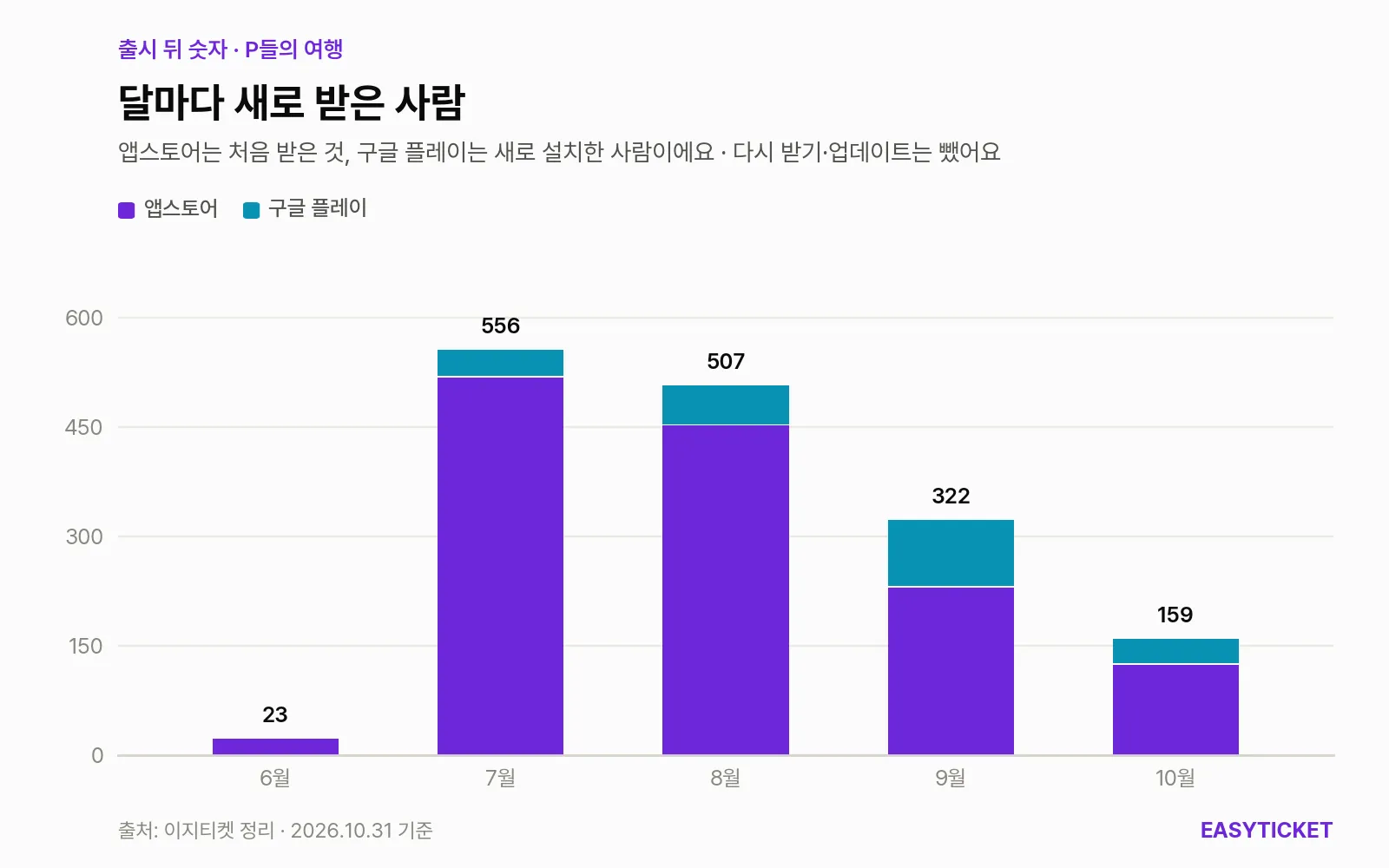
New downloads per month. July was the highest, and October was less than a third of it.
Quite a few people also deleted it. Of the 220 who installed it from Google Play, 104 deleted it, and as of October 26 the number of Android devices with the app installed is 123. Roughly one in two stayed. Deletions peaked at 43 in September, the month with the most installs. For someone who downloaded it just to throw a dart once, a 142.6MB itinerary app can feel heavy. The App Store doesn’t report deletions separately, but re-downloads after deleting rose to 43 in September and 37 in October, up from earlier months. On September 18, when the 2.81.0 update came out, 9 people re-downloaded it in a single day.
Usage inside the app can only be counted properly from September, so the usage story below sticks to September and October figures. In September, 437 people opened the app at least once, and in October, 310. Of those 310 in October, 92 had already opened the app before. As of October 31, 261 people had opened the app in the last 28 days, 70 in the last 7 days, and 9 that day. Against the 1,567 new downloads, that makes about one in six people who open it at least once a month.

People who opened the app at least once in September and October (bars) and people who opened it for the first time that month (line). In October, returning users made up a bigger share.
Those who stay don’t just pop in and leave. Through October 31, each person who opened the app opened it about three times on average and stayed about 11 minutes. The most-opened screen was Travel Talk (421 people), where users post trip stories, followed by the 20-question travel personality test (309) and the dart (298). Of the 309 who started the personality test, 246 saw their results. By contrast, 52 people visited the lowest-fare flight search and 18 visited the companion screen. The screens closest to affiliate income drew the fewest people, and that connects directly to the next section.
The developer points to a hidden entrance elsewhere: the web version, Random Dart Throw, posted on the EasyTicket site. You can throw a dart at the globe without installing the app, and a link to the original app sits on the result card and at the bottom of the page. The developer believes this web app is why downloads kept coming in steadily. The most visitors to the app’s intro page came through Naver mobile search and Threads links (June 9 to October 31).
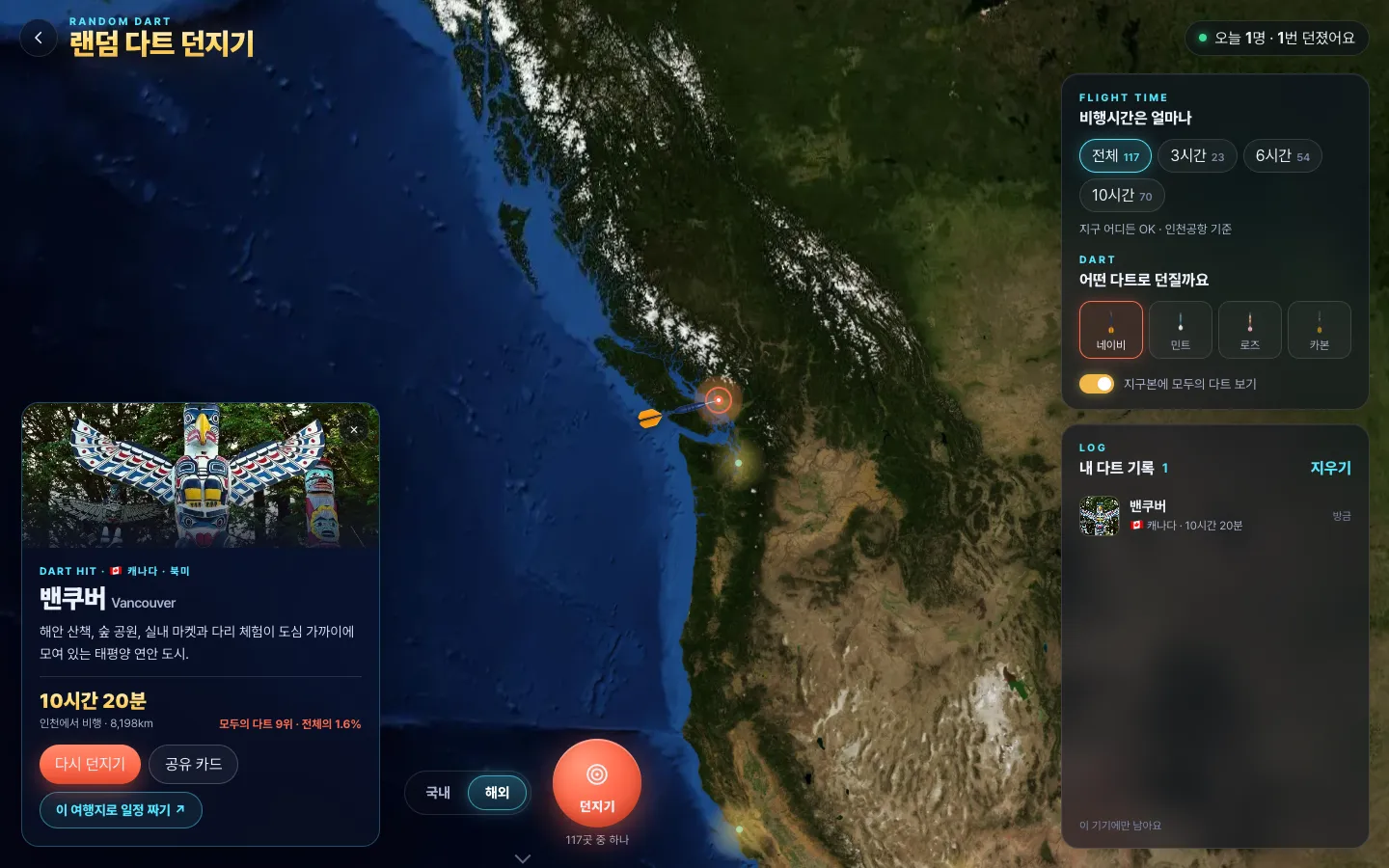
Below the web dart’s result card is a “Plan an itinerary for this destination” button that leads to the app.
Throwing one myself, it works well as an entrance. The dart flew off and zoomed in on the North American west coast, then came up with Vancouver (10 hours 20 minutes from Incheon), with the plan-an-itinerary button right below. On a phone, the options and history fold into buttons, leaving only the globe and a large throw button, which made it easier to use with a thumb. There were some shortcomings. The globe takes about 5 seconds to fully load, and on a computer, clicking the “Throw” button only made the globe turn slightly. Pressing the space bar was what actually threw the dart. The “how many today” label at the top of the phone screen was cut off. And people who came over from the web dart and downloaded the app aren’t counted separately, so “the web app drove downloads” is still just the developer’s impression.
Why doesn’t it make money even as downloads grow?
The developer’s conclusion is short: even with more people, income doesn’t seem likely to grow. There are three reasons.
First, not many people use it. 261 people opened the app in the last 28 days, and there are a great many travel apps built with vibe coding. Second, a trip starts with choosing a destination, and in most cases that’s already done before the app is opened. The third is the decisive one. Once people settle on a destination, they search the internet for lodging and flights by reviews and lowest prices, and book right on the platform that showed them. The two places that generate affiliate income (lodging and flights) have no reason to go through this app. The fact that only 52 people opened the flight search screen says the same thing.
Outside figures point the same way. In SiteMinder’s 2026 traveler report, which surveyed about 12,000 travelers in 14 countries, 26% of people start their hotel search on a booking platform, up from 18% a year earlier. Those starting on a search engine fell from 36% to 21%. That means finding lodging increasingly starts and ends inside big booking apps.
Big platforms already hold the same ground. When MyRealTrip launched a ChatGPT-based AI trip planner in February 2023, it made the itineraries link straight to its own product pages. NOL Universe said in June 2026 that it would merge its travel and leisure services into NOL and grow it into an “AI travel agency” (reported by CEO Score Daily). In a trend where AI itineraries and booking are bundled in one app, a small app that hands booking off to someone else’s page has little room to collect commissions.
On August 22, while still building, the developer had worked out in advance the profit and loss of adding a community and accounts. Even assuming 1,000 monthly users, affiliate income would be around 9,000 won a month, banner ads 18,000 won, and AI itinerary ads 6,000 won, for a total profit of barely 20,000 won in the black. The current number of monthly users is just over a quarter of that assumption. On September 7, the developer also weighed switching the AI itinerary to per-use payment or a subscription, but in the end decided to keep the ads. The number of downloads and the path to making money were different problems from the start.
Ptrip among similar apps
Putting an app that started from the same “random destination draw” next to a leading itinerary-planning app looks like this (App Store, November 1, 2026).
| P들의 여행 (Ptrip) | 떠나가챠 (Tteonagacha) | Triple | |
|---|---|---|---|
| Starting point | Globe dart draw | Two-step draw: province, then city/county/district | Trip planning and booking |
| Scope | Domestic and overseas | Domestic | Domestic and overseas |
| AI itinerary, companions | Yes | No (nearby tourism info, map of places visited) | Yes |
| Devices, size | iPhone and Android, 142.6MB | iPhone only, 46.7MB | iPhone and Android |
| Rating | 5.0 (4 ratings) | None shown | 4.8 (about 27,000) |
| Notes | Free, no in-app purchases | Free, has ads | Service ends Nov. 3, users directed to NOL |
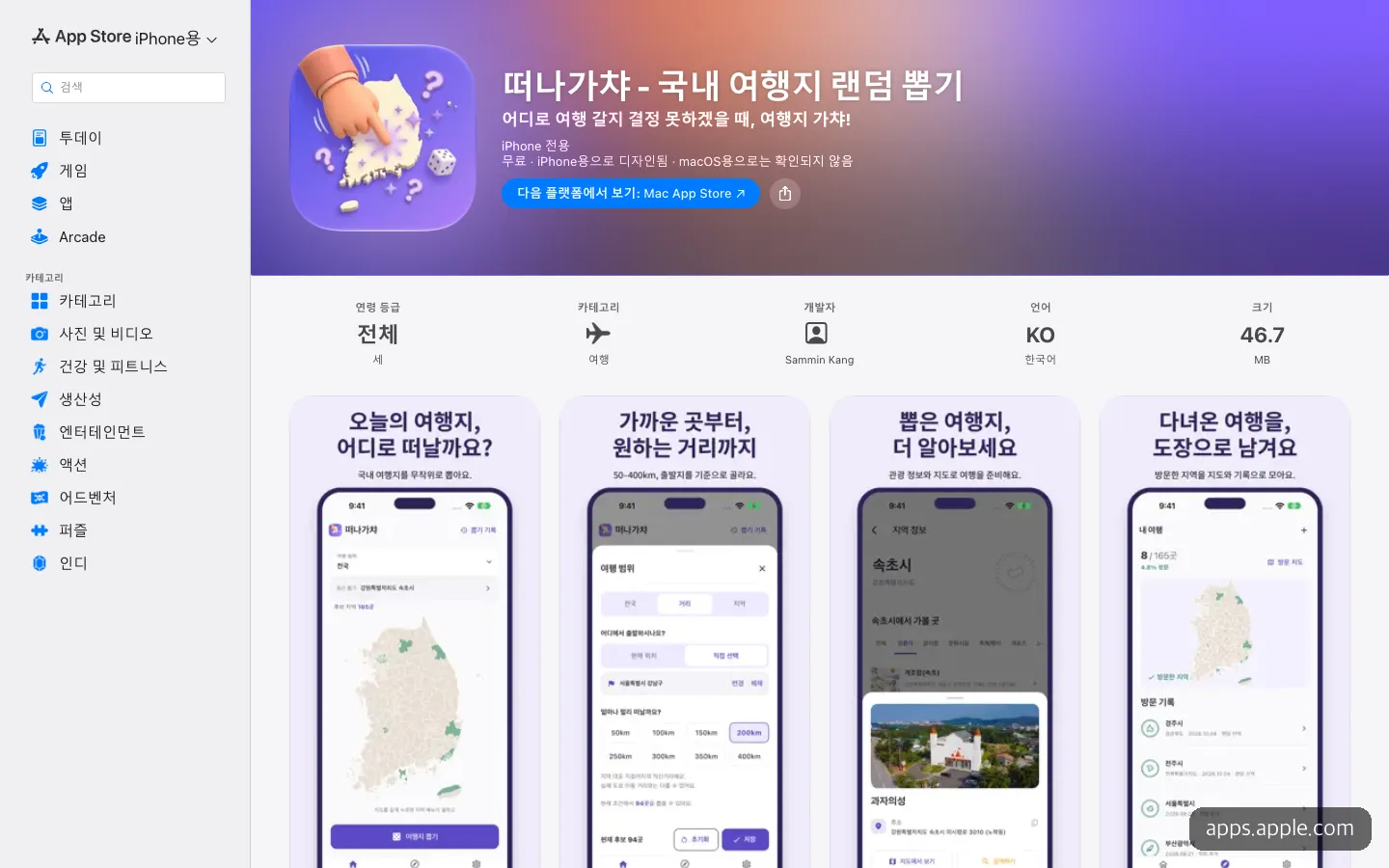
Tteonagacha, which started from the same “random destination draw,” is a light app focused on domestic draws.
Tteonagacha stays small and light, focused on the draw alone, while Ptrip took on what comes after the draw, from itinerary to companions to cost splitting. If you just want to quickly pick a weekend day-trip spot, a light draw app fits. When you want to plan with friends and settle the money in one app, Ptrip becomes more useful. One weakness is that it has only 4 ratings. It’s an app that more than 1,300 people downloaded for the first time on the App Store alone, yet it has almost no reviews, so someone seeing it for the first time in the store has little reason to trust it. Being about three times the size of Tteonagacha is also a burden for first-time downloaders.
What to improve next
The developer plans to keep maintaining the app, since some people actually use it for the itinerary and its other features. Looking at the numbers and my own testing, there are four places to work on.
- Make money where people stay. The screens users opened most were Travel Talk, the personality test, and the dart, while flight search reached only 52 people. Rather than relying on affiliate links, it fits the structure better to look for income in the features where people stay, like the AI itinerary ads already in place.
- Make the path from the web dart countable. The developer calls it the best entrance, but right now it’s only an impression. Counting people who came from the web dart and downloaded the app would make it easier to decide where to focus. The problem of the throw button not working well on computers is worth fixing at the same time.
- Ask remaining users for reviews. On Google Play, nearly half of those who installed it deleted it, but those who stay spend about 11 minutes each time they open it. Asking for a rating at a moment when the trip feels wrapped up, such as after finishing a cost split, could collect words from satisfied users for a store page with only 4 ratings.
- A first screen for people arriving from search. The biggest path among people who found the app’s intro page was Naver mobile search. The next step is to polish the intro copy and store keywords so phone users who arrive searching for “impromptu trip” or “travel destination recommendations” can download right from the first screen.
Building a travel app with vibe coding has become easy. So before trying to gather downloads, it makes more sense to work out where those people spend their money.
Frequently asked questions
Is Ptrip free?
Yes, it’s free. You can use the AI itinerary up to five times a day, with a short ad after the first one. Flights and lodging are booked on partner pages, and users pay nothing extra.
Do I have to sign up?
No. You use it without signing up, and you invite companions by link, QR code, or code.
Can I just throw the dart without installing the app?
On the EasyTicket site’s Random Dart Throw, you can draw one of 117 overseas and 99 domestic destinations. Records stay on that device only.
Sources 8
AI helped with research and the first draft; the operator tried the subject firsthand, checked and edited this article before publishing. Let us know if you spot a mistake.