
In late March 2025, open your social feed and your friends’ profile pictures had all turned into Ghibli-style drawings. A few months later, a quiz asking “Are you Teto or Egen?” took their place. An ○○-like is what people call the phenomenon in which, after one service or piece of content goes viral, apps, websites and videos with nearly the same format and feel appear one after another within days. In 2026, AI tools have made that line longer and faster than ever.
Here is how EasyTicket sees it. A flood of same-feeling content is not something AI invented. It was already happening. When the cost of making things dropped to nearly zero, only the speed and volume changed. And in that flood, the share left for those who build after the hit keeps shrinking.
From Ghibli to Teto, when the feed turns one color
It always starts the same way. OpenAI released GPT-4o image generation on March 25, 2025, and as Axios reported, once restrictions on specific art styles were lifted, Ghibli-style portraits covered feeds within a day or two. Conversion apps and videos built around that style followed.
The Teto-Egen test took the same path. Open the Korean App Store listing for an app called “Egen Guy? Teto Girl?” and the description leads with “The Teto-Egen psychology test that went viral in 2025” and “No more MBTI!” The trend’s name is the app’s identity. In the “You Might Also Like” row on the same page were an app that claims to tell you whether your face is Teto-type or Egen-type, an AI face analyzer and an AI ideal-type tournament, all lined up side by side. The screen alone can’t tell you who copied whom. But it is clear that apps built on the same idea are numerous enough to fill a row. The app itself had only two ratings.
Video moves even faster. Video editing service Kapwing watched the first 500 Shorts on a brand-new YouTube account with no watch history. Of those, 104 (21%) were so-called AI slop churned out with AI, and 165 (33%) were brain rot, content with no context and only stimulation left (as of October 2025). That means one in five Shorts a newcomer sees is a near-identical AI video.
It happened with Flappy Bird too
If this scene feels familiar, there is a reason. It happened in February 2014, right after Flappy Bird was pulled from the App Store. According to MacRumors, citing a Guardian tally, of about 293 new iOS games released in the 24 hours starting February 26, 95 were Flappy Bird clones or heavily influenced by it.
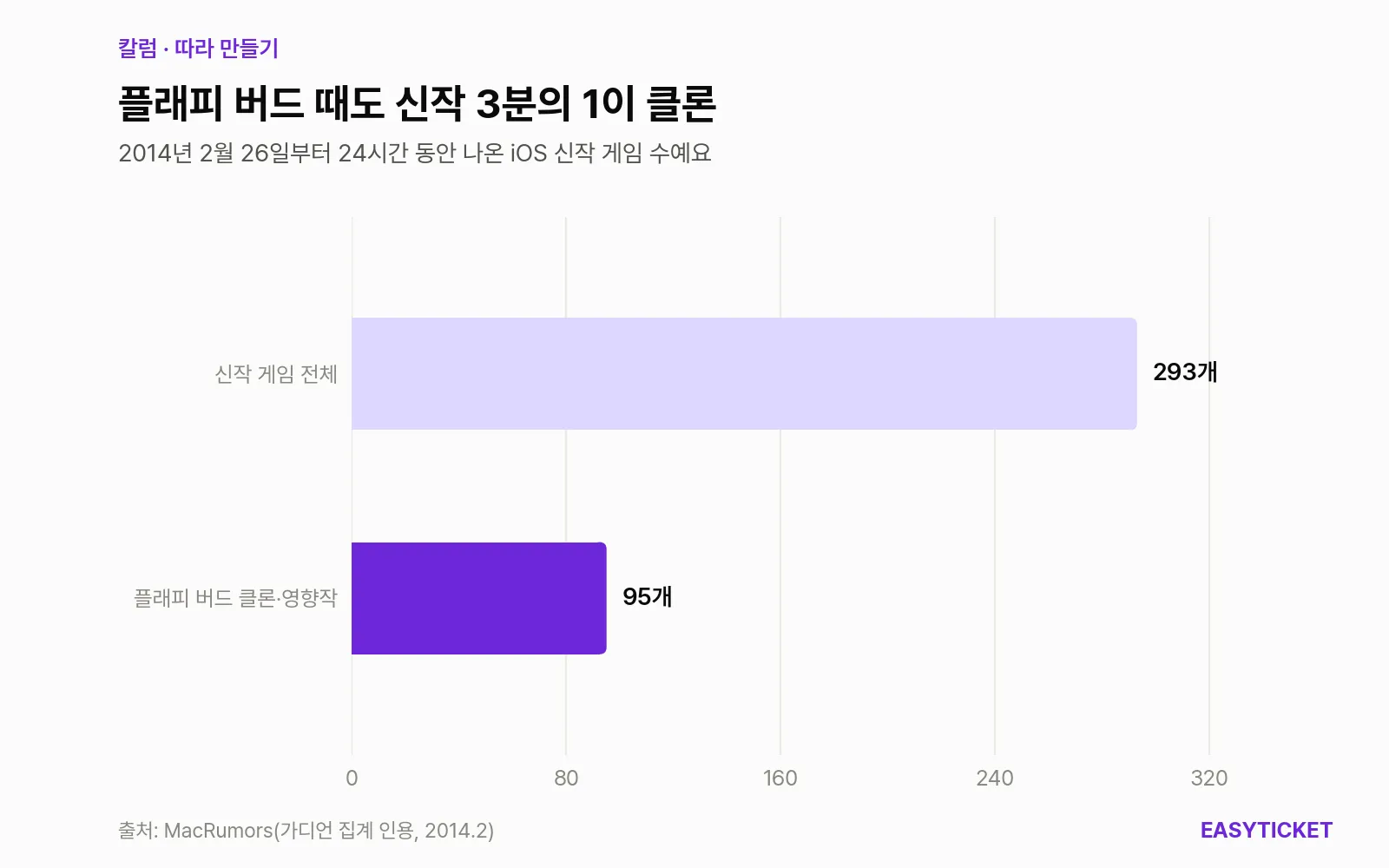
About a third of the new iOS games released in the single day after Flappy Bird was pulled looked like the same game.
Then came Wordle in January 2022. Apps copying the free, browser-only word game piled into the App Store, and one of them charged $30 a month. According to Macworld, Apple took down several Wordle clones in the wake of this, and every one of them had passed review once. There was no AI then. The format was simply simple enough for a person to copy in a day or two.
| Trend | When | Original’s format | What followed | Aftermath |
|---|---|---|---|---|
| Flappy Bird | February 2014 | A simple game where you tap the screen | About a third of one day’s new iOS games were clones or influenced by it | The original had already been pulled from the store |
| Wordle | January 2022 | A free word game played in the browser | Even clones charging $30 a month appeared | Apple removed several clones (all had passed review once) |
| Ghibli style and Teto-Egen | 2025 | One art style, or a few questions and a result card | Conversion and test apps filled the recommendation rows | An app with two ratings sat in the same row |
In all three cases, the original’s format was simple. What changed is that the hands doing the copying went from people to AI tools.
When the cost of making drops to near zero
What changed is speed and scale. App releases that had been shrinking or flat for years suddenly started to grow. App analytics firm Appfigures estimated about 557,000 new apps on Apple’s App Store in 2025. That is 24% more than in 2024 (448,000), and 2023 (424,000) was the lowest level since 2012. Google Play is not included.
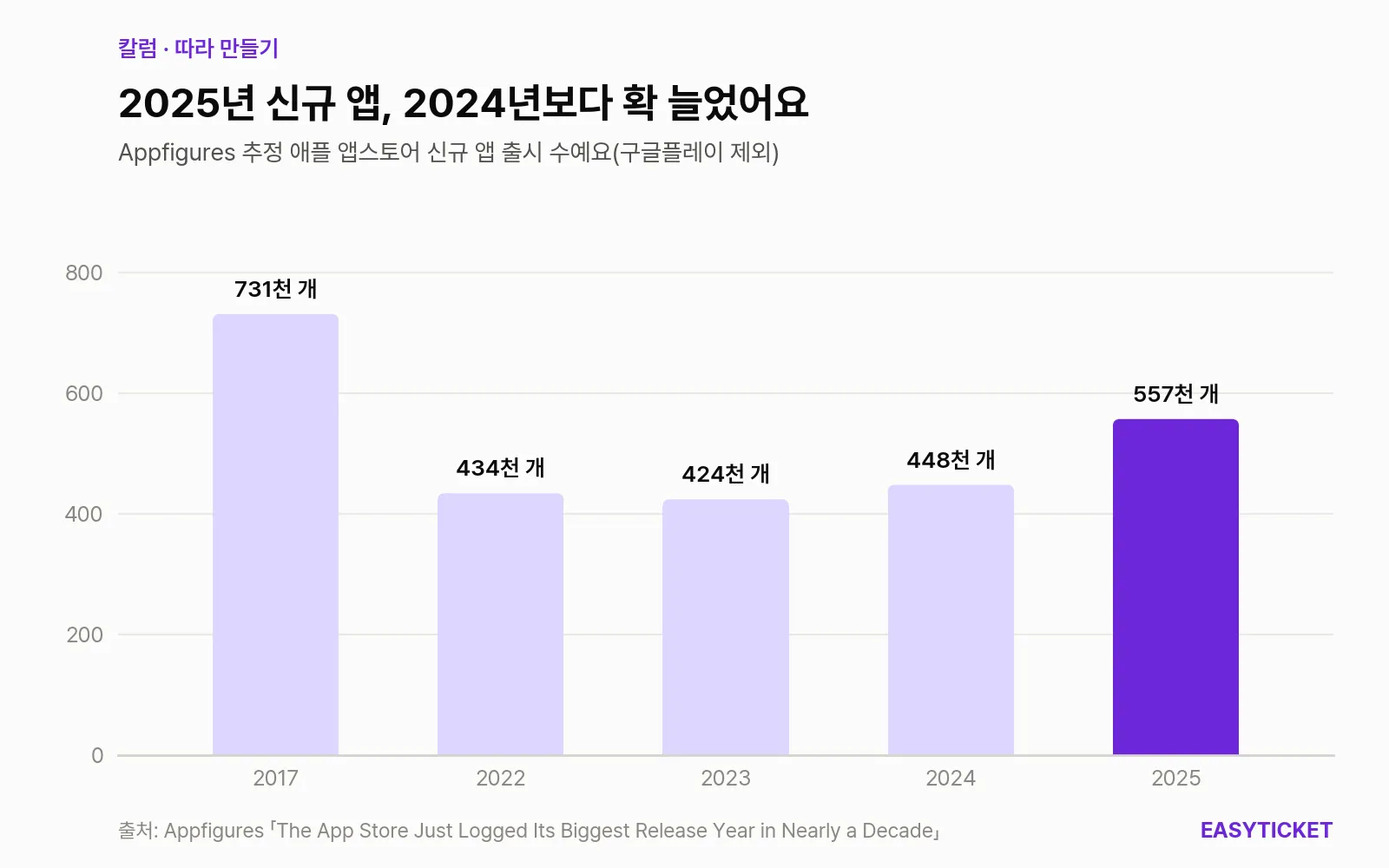
New App Store releases, flat or falling for years, jumped sharply again in 2025.
Appfigures believes AI-built apps are coming in. But it did not count how many such apps there are, and it added that they lack competitiveness in features and experience. That vibe coding is the cause is still circumstantial. Even so, it is hard to dismiss that the surge overlaps with the period when tools like Claude Code and Cursor made it possible to ship a test app in a day.
The problem is the pie those added apps have to share. According to 9to5Mac, which reported Sensor Tower’s estimates, new apps in 2025 grew 30% to about 600,000, but downloads grew only 3%, to 35.4 billion. In the first half of 2026, new apps reached about 560,000, roughly double the same period a year earlier, yet downloads grew just 2%.
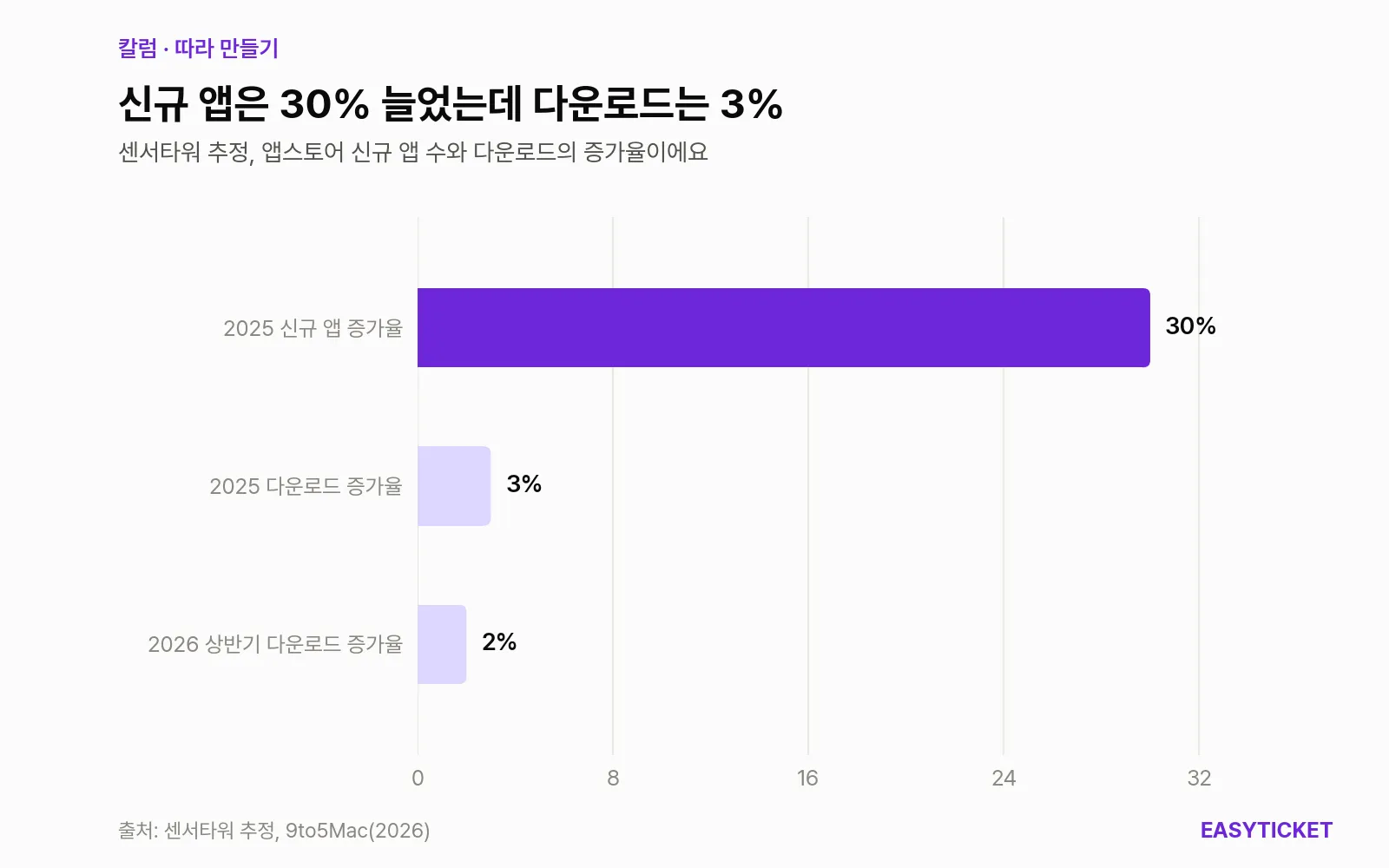
New apps have grown sharply, but the number of downloads people make has barely moved.
Put simply, people’s phones and time stay the same while the number of apps competing for that space has doubled. For an ○○-like app riding the same trend, it is worse. Because the apps are indistinguishable, they fight over a single slot, both in name searches and in recommendation rows.
Why do same-feeling ideas flood in?
The reasons come down to three. First, the idea is already proven. If hundreds of thousands of people have shared it, that looks like proof of demand. Second, the format is simple. Twelve questions and a result card, or one photo and one art style. That is small enough that a single line to a vibe coding tool, “make me a Teto-Egen test,” produces the skeleton. Third, the name is the search term. Put the buzzword in the app name and it matches exactly what people type.
When all three overlap, the outcome is predictable. Everyone builds the same idea on the same day with the same tools, gives it the same name and lines up in the same row. The feed turns one color not because anyone is lazy, but because this calculation works out the same way for everyone.
The stores don’t welcome this either. Apple’s App Review Guidelines treat copycats separately in 4.1, and the spam clause in 4.3 says that opportunistically making variations of a popular app harms search and discovery. It also says that already saturated categories such as fortune telling, wallpapers and simple timers won’t be accepted unless they offer a meaningfully different experience.
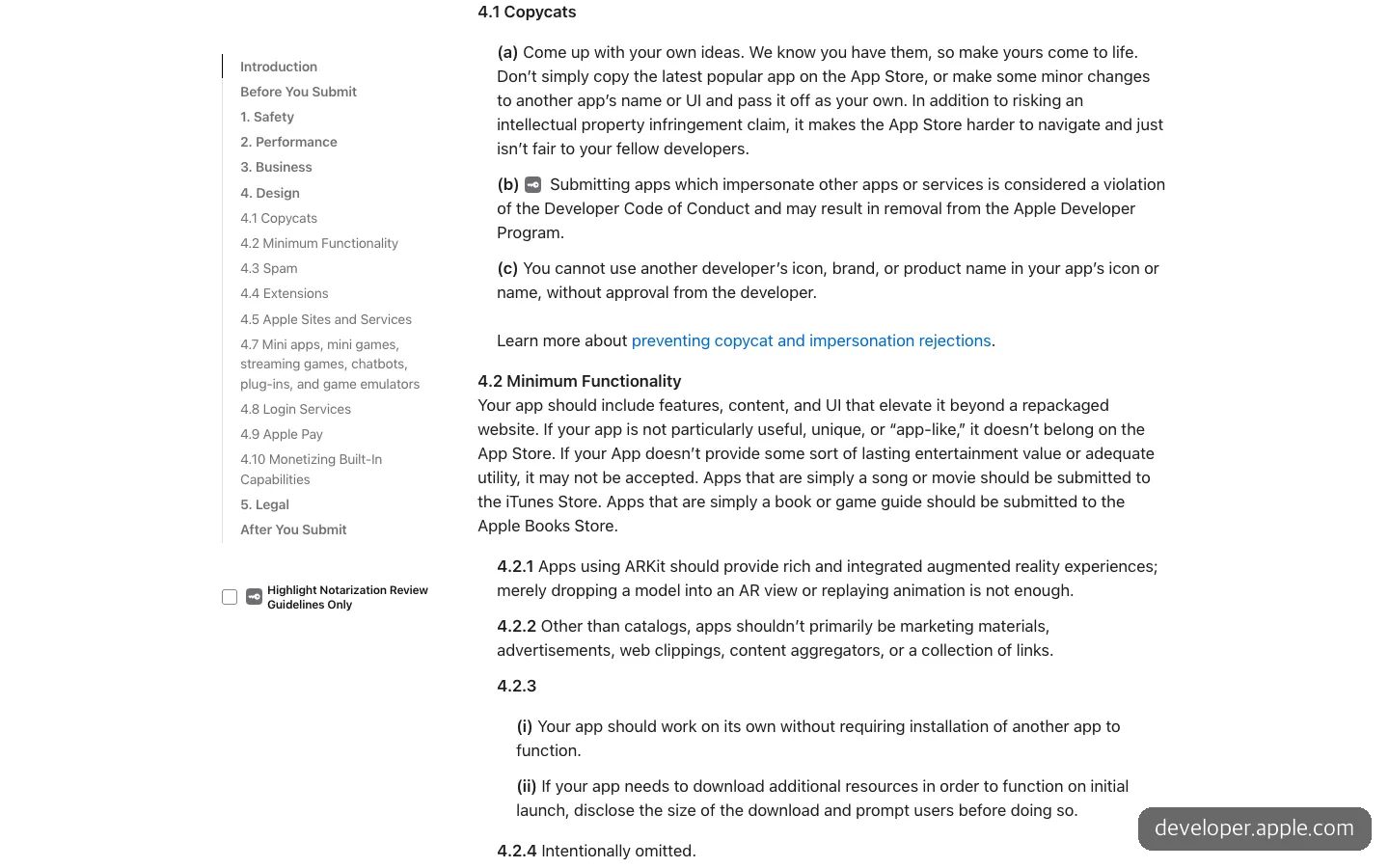
Apple’s App Review Guidelines 4.1 say apps that copy popular apps, or only slightly change the name and UI, won’t be accepted.
Another view: the use of imitation and the limits of these numbers
There is no need to see ○○-likes only in a bad light. Trends have always spread through imitation. Ghibli-style profile pictures spread because everyone tried it once with their own photo, and you can’t fault that fun itself. Some also argue that a free version modeled on an expensive tool widens users’ options.
Nor are originals buried. On January 31, 2022, right in the period when Wordle clones were everywhere, The New York Times bought it for a price in the low seven figures. The copycat apps were taken down, and the original was recognized for its value. In some cases, the bigger the flood, the clearer the original stands out.
Let’s also be clear about the limits of the numbers. Kapwing’s 21% is based on a new account with no watch history, so it is not the share across all of YouTube. Appfigures and Sensor Tower count differently, so even for the same year 2025 they split into 557,000 and about 600,000. Attributing the rise in releases to AI is only those two companies’ interpretation, and there is still no figure that counts vibe-coded apps separately. The stores’ line of defense is also loose. With Flappy Bird and with Wordle, clones were taken down only after passing review.
The question left for vibe coders
The cost of making dropping to near zero means that what you build in a day, others can build in a day too. If you ship an ○○-like the day after a trend appears, you stand on the same starting line as dozens of people who had the same thought that day. And the download pie is growing just 2 to 3% a year.
So EasyTicket thinks that if you are going to build on a trend, you should compete on angle, not speed. Even within the same Teto-Egen idea, you need a difference that a mere name change can’t explain, such as questions tailored to one occupation or one situation, or a design where there is one more thing to do after you get your result. If that is hard, it is better to treat the trend as a practice problem. Copy it in a day to get your hands warmed up, and put your own idea in the store.
There are two things to watch next. One is whether releases in the second half of 2026 keep growing at the double pace of the first half. The other is whether Apple and Google enforce clauses like 4.1 and 4.3 more strictly in response. If both happen, the room to establish yourself as an ○○-like will get even narrower.
The next time a trend covers your feed, it is enough to ask yourself once before you copy it: “If I removed the name, would people still recognize this as mine?”
Frequently asked questions
Is it a problem to publish an ○○-like app?
Building on the same trend alone won’t get you blocked. But Apple’s review guidelines say they won’t accept apps that copy a popular app outright or change only its name and UI, or apps that use another developer’s icon, brand or product name without permission. If you borrow the original’s name or look, you can be rejected or removed later.
What does AI slop mean?
It is a derogatory term for shallow, similar-looking content churned out quickly with AI. In Kapwing’s survey (as of October 2025), 21% of the 500 Shorts shown on a new YouTube account fell into this category.
Can you make money from an app that follows a trend?
You might for a short time, but it is hard to last. An app charging money by imitating Wordle was removed from the App Store in January 2022 along with other clones. Now that new apps have doubled while downloads grew only 2%, it has also become harder to stand out among similar apps.
Sources 8
- Apple – App Review Guidelines
- Appfigures – The App Store Just Logged Its Biggest Release Year in Nearly a Decade
- 9to5Mac – Report: App Store added nearly as many new apps in H1 2026 as in all of 2025
- MacRumors – Flappy Bird Clones Make Up One-Third of Newly Released iOS Games
- Macworld – Wordle copycats removed from the App Store
- NPR – The New York Times buys Wordle
- Axios – New ChatGPT update spurs flood of Ghibli-style portraits
- The Decoder – One in five YouTube Shorts shown to new users is AI-generated slop, study finds
AI helped with research and the first draft; the operator tried the subject firsthand, checked and edited this article before publishing. Let us know if you spot a mistake.