
In September 2026, a phone call came into Fideuram, a subsidiary of Italy’s Intesa Sanpaolo, in the voice of a well-known law firm attorney. The voice was an AI clone, and according to a Hankyung (The Korea Economic Daily) report, the scam drained 95 million euros (about 142.7 billion won). Stanford’s AI100 is a long-running study launched in 2014, in which an expert panel assesses the state of AI every five years. Its third report, published on November 10, 2026, concluded that AI-generated images, audio and video have effectively ended the century-old assumption that a photo can be trusted.
EasyTicket sees the thing that broke in that sentence as a habit more than a technology. The habit of believing whatever we see and hear is no longer safe in a world where faking has become this easy. So the answer lies less in smarter detectors and more in an order of operations: verify, then believe.
16 Times in Two Years: Fakes Go Mainstream
The AI100 report runs 127 pages and is titled “AI Goes Mainstream.” It was written by a 12-member panel chaired by Professor Michael Wooldridge of the University of Oxford, and it contains a dedicated section called “The End of Photographic Truth.” Stanford HAI’s report overview notes that cloned voices are already used in fraud and synthetic media has been used in elections, and it expects the fallout to spread to journalism, law and democratic institutions.
The numbers make the speed tangible. In its February 5, 2026 announcement, the UK government estimated that about 8 million deepfakes were shared in 2025. In 2023 the figure was 500,000, so that is a 16-fold increase in two years.
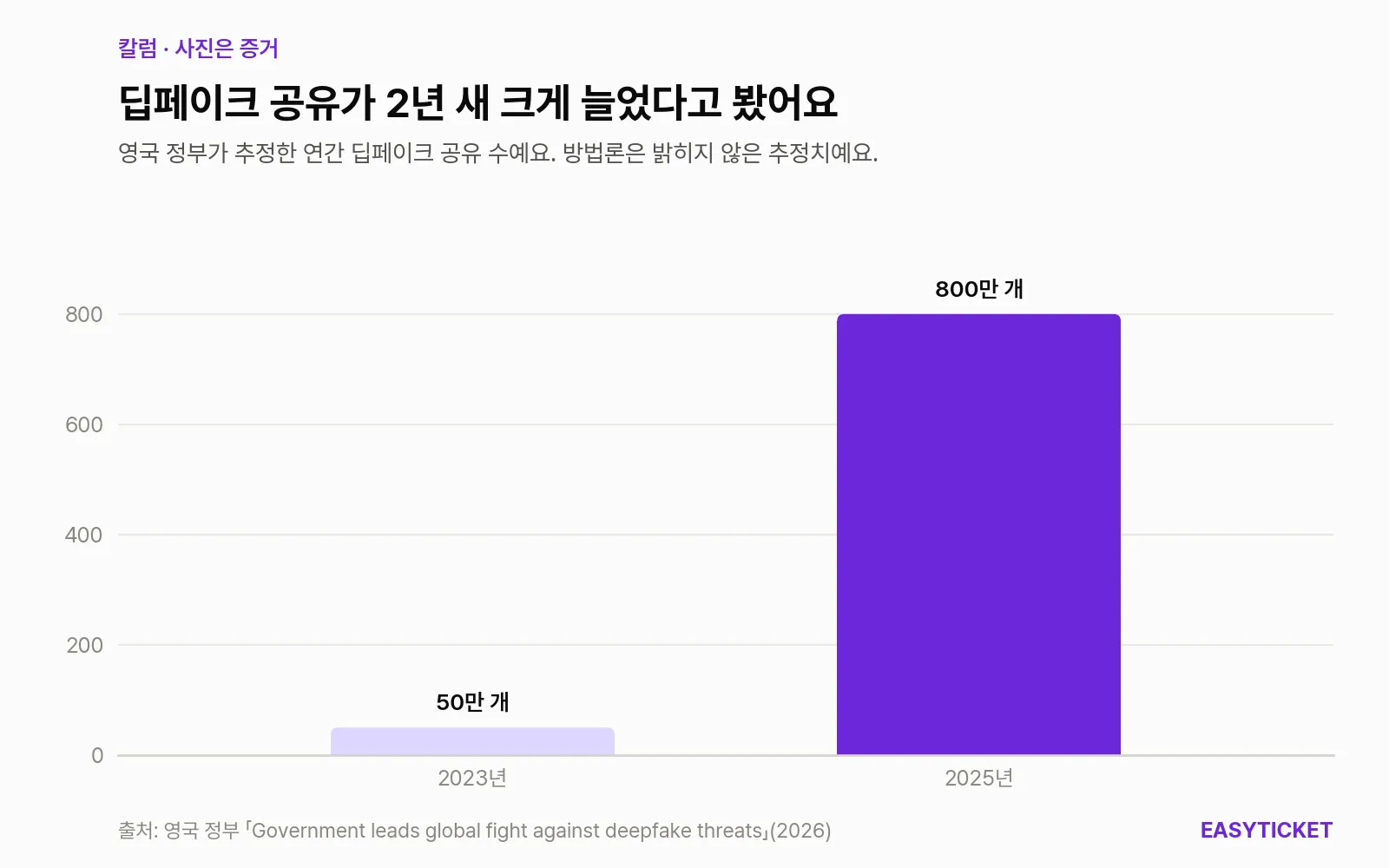
The UK government’s estimate of deepfakes shared per year. It grew 16-fold in two years.
Nor are the people spreading fakes limited to anonymous accounts. In January 2026, the White House’s official X account posted a photo of an activist arrested at a Minnesota protest, altered to show her crying. The original was an expressionless photo first posted by the Secretary of Homeland Security (head of the Department of Homeland Security). According to CBS, the White House acknowledged altering the photo and replied, “The memes will continue.” Even a photo posted by a government account now has to be checked against the original.
Eyes That Can’t Find the Fake, Even When Told to Look
“If you look closely, you can tell” is no longer something we can lean on. In February 2025, the biometric authentication company iProov showed 2,000 consumers in the UK and US a mix of real and deepfake images and videos. Even though they knew they were looking for deepfakes, only 0.1% identified every one correctly. That is about one in 1,000 people. They also caught fake videos 36% less often than fake images, which means we are more easily convinced by moving pictures.
Voices are harder still. In the Fideuram case, the criminals first sent a message impersonating the parent company’s CEO, then called using the cloned attorney’s voice. The message and the voice vouched for each other, so it would have been hard to doubt either one separately. If both eyes and ears can be fooled, the basis for judgment has to be the route rather than the content. The question becomes whether this request arrived the way such requests normally do.
Convincing Fakes Reach the Courtroom
The courtroom is where “evidence” carries the most weight. The same Hankyung article also reported the results of a National Court Administration (the administrative body of Korea’s judiciary) survey of 360 judges. About 8 in 10 said they had encountered AI-fabricated case law in trials.
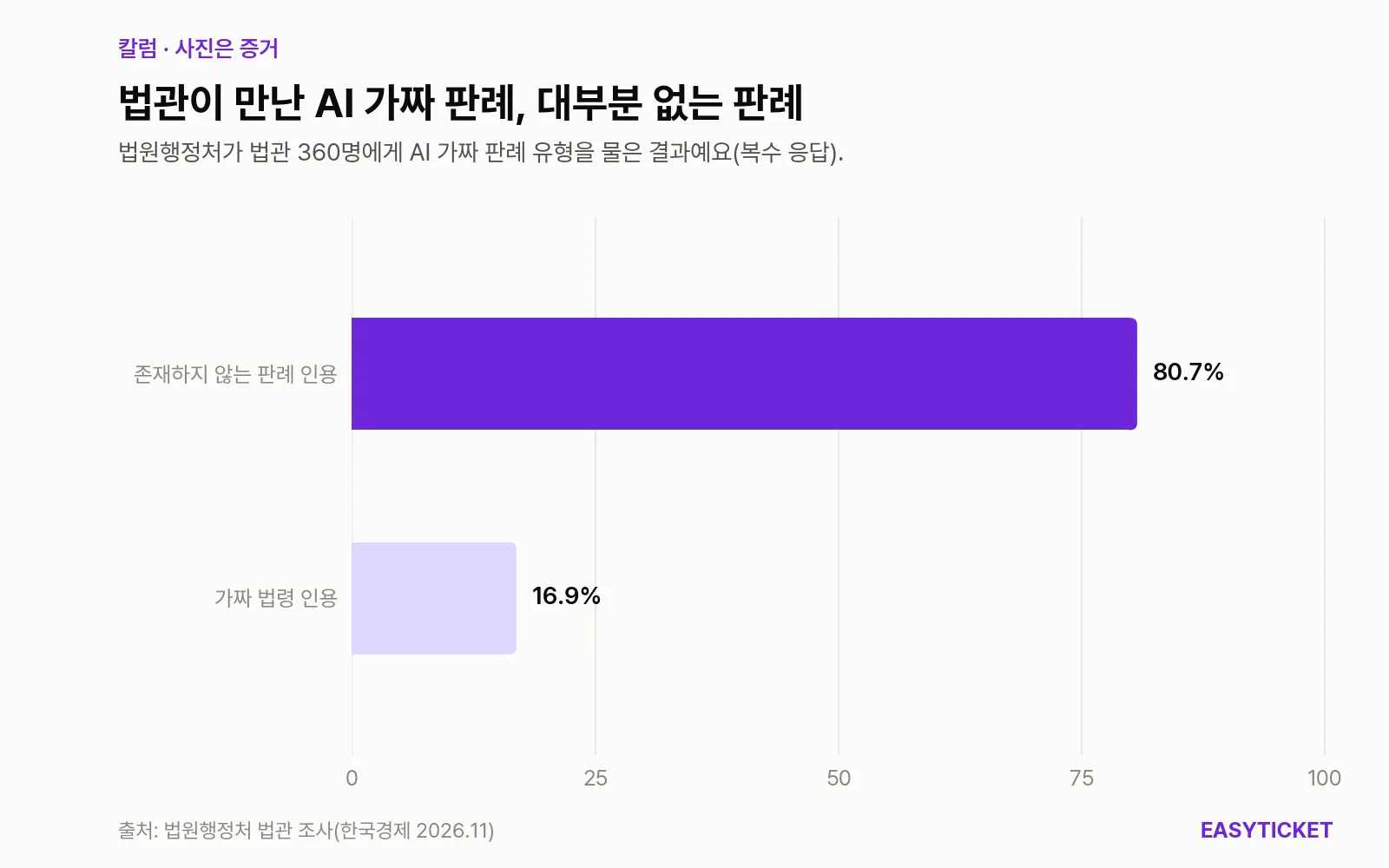
Most of the AI-fabricated material judges met in trials was precedent that does not exist (multiple responses allowed).
As the chart shows, most cases (80.7%) cited precedents that do not exist at all. This is text, not photos or voices, but the root of the problem is the same: the habit of assuming that if the form looks right, the content must be real. The old practice of trusting anything with a proper case number and sentence structure is being shaken in the same way that trust in images has collapsed.
Even So, Video Still Carries Weight
There is evidence on the other side, too. A study called “The Liar’s Dividend” tested through experiments the worry that someone can escape accountability by claiming real evidence is an “AI fake.” Published in the journal American Political Science Review (2024), it ran five preregistered experiments with more than 15,000 American adults. Politicians did benefit when they claimed a real scandal was “misinformation,” but the effect appeared mainly with text-based reports. Video evidence was not easily dismissed. In other words, people still do not turn their backs on video very readily.
The numbers this column relies on have their limits as well.
| Figure | Who and when | What to watch for when reading it |
|---|---|---|
| About 8 million deepfakes (2025) | UK government, announced February 2026 | An estimate with no disclosed methodology. Hankyung described it as “sexual deepfakes,” but the government’s original text refers only to deepfakes overall |
| 0.1% identified every one | iProov, February 2025, 2,000 people in the UK and US | A figure from a lab-like setup run by a company that sells deepfake detection. It may differ from glancing at a real feed |
| 80.7% citing nonexistent precedents | National Court Administration, 360 judges | Multiple responses allowed, and the figure comes via Hankyung’s reporting |
There is one limit beyond the numbers. Photo manipulation existed before AI. What has changed is that anyone can now do it in a few seconds.
That is why EasyTicket thinks going as far as “nothing can be trusted anymore” is too much. Trust has not disappeared. There is simply one more step to take before believing.
How Do You Check Whether an AI Photo Is Real?
The technical answer is a provenance record. C2PA is a standard that stores in the file itself which device took a photo and what edits it went through, and the record it leaves is called Content Credentials. In September 2025, Google said it would attach this record to JPEG photos taken with the default camera on the Pixel 10, and that Google Photos would apply it to both AI edits and ordinary edits.
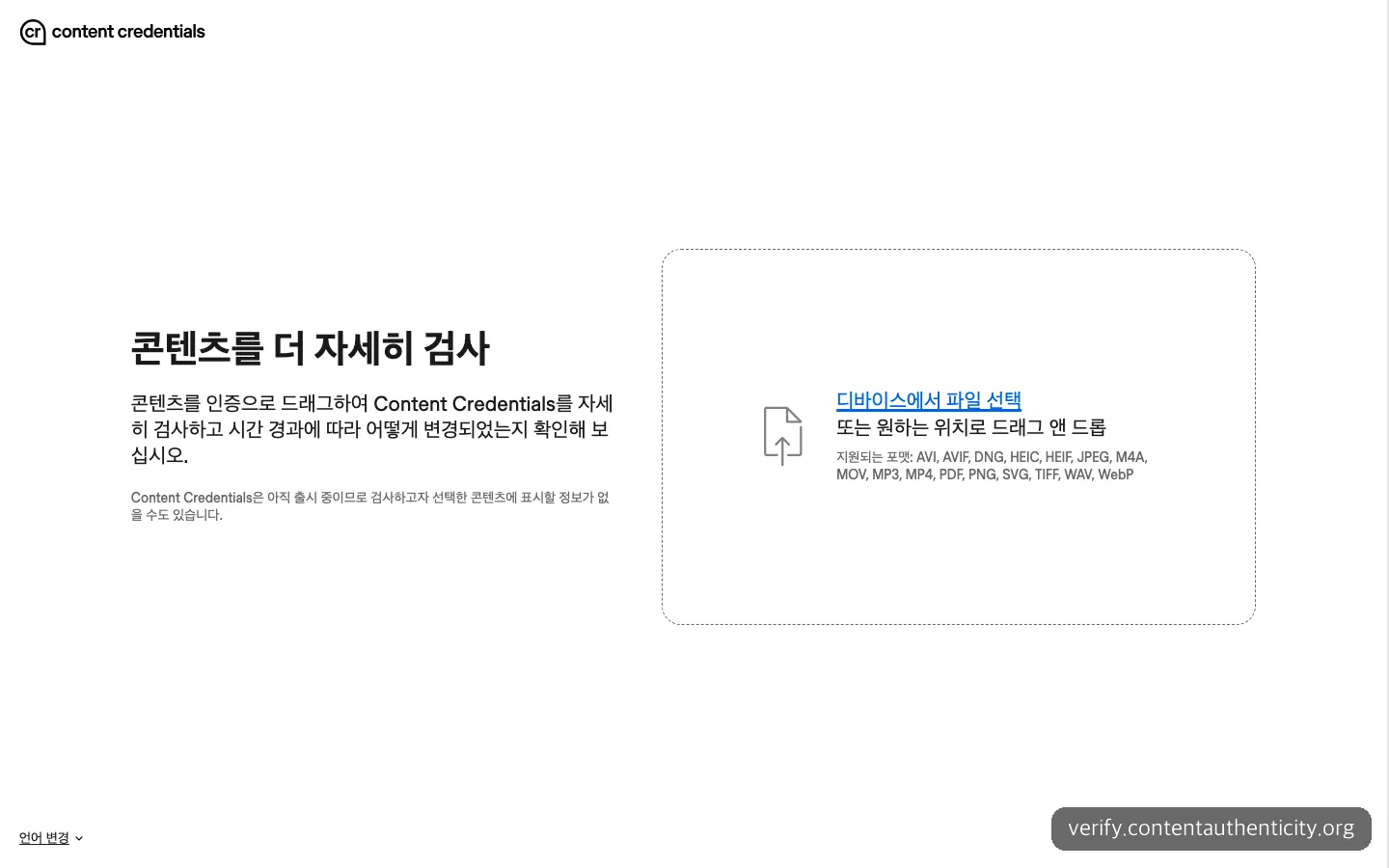
A verification page that shows a file’s C2PA history when you upload it. A notice at the lower left says there may be no information.
The Content Credentials verification page, which reads these records, opens without a login, and the interface appears in Korean when you visit. You can upload anything from photos such as JPEG and PNG to MP4 video and WAV or MP3 audio. The catch is the notice at the lower left of the screen. It says that because adoption is still underway, there may be no information to display. A missing record does not mean a fake. On devices or apps that do not support records, or in files that have been re-saved, the record may never have been there at all. In the end, this tool is useful for showing that something is real, but only half useful for sorting out fakes.
So in daily life, the order of steps comes before any tool. If a voice or video asks for money or personal information, don’t respond on that channel. Call back on a number you already know. In the Fideuram case, too, every check ended up happening inside the same channels, the message and the phone call.
A New Assignment for the People Who Build
If you are building a service that creates images or voices with AI, this problem is not only the receiver’s concern. Korea’s AI Basic Act, which took effect on January 22, 2026, requires watermarks on generative AI outputs and clear labeling, recognizable by anyone, on content such as deepfakes whose authenticity is hard to judge. The obligation falls on AI businesses, not on ordinary users. Fines are imposed after the grace period ends.
If you whip up an image-generation web app through vibe coding and release it, you stand on the side of those who put it out, not the side of users. Exactly where the law’s definition of a “business” ends needs to be examined separately, but building an “AI-generated image” label in from the start takes little effort. EasyTicket believes that, however the law ends up being interpreted, making this label the default is the right call. It is much easier to include it from the beginning than to add it later.
There are three things to watch from here. First, whether the deepfake detection evaluation standards the UK government said it would build with Microsoft and others actually appear. Second, how well the labeling obligation is followed once the AI Basic Act’s grace period ends. Third, whether social media platforms keep the provenance records of uploaded photos rather than stripping them out. The HAI overview points out that high-level summits so far have produced only declarations of principle, with no binding commitments. Until rules catch up, the habit of verifying before believing is the nearest line of defense.
Frequently Asked Questions
If I post an AI-made image on social media, am I legally required to label it?
Under Korea’s AI Basic Act (in effect since January 22, 2026), the labeling and watermark obligations fall on AI businesses, not on ordinary users who simply use a tool and post the result. Still, if an image looks like a real person or event, noting that it is an “AI-generated image” reduces misunderstanding.
What should I do if I get a call in a family member’s voice asking me to send money?
The surest approach is not to answer on that call, but to hang up and call back directly on a number you already know. Agreeing in advance on a verification question that only your family knows is another option.
Where can I read the AI100 report?
You can download it as a PDF from the Stanford AI100 website. It is a 127-page English-language report, and Stanford HAI’s overview offers a short summary if you only want the essentials.
Sources 8
- The World Has Changed: Insights From The New AI100 Report (Stanford HAI)
- "눈으로 봐도 못 믿겠다"…정부도 AI 조작사진 발표 (한국경제)
- Government leads global fight against deepfake threats (GOV.UK)
- White House posts an altered photo of Minnesota protester's arrest (CBS News)
- iProov Study Reveals Deepfake Blindspot (Business Wire)
- The Liar's Dividend: Can Politicians Claim Misinformation to Evade Accountability? (American Political Science Review)
- How Pixel and Android are bringing a new level of trust to your images with C2PA (Google)
- AI기본법 내일부터 시행…생성형 AI 결과물 '워터마크' 부착해야 (뉴시스)
AI helped with research and the first draft; the operator tried the subject firsthand, checked and edited this article before publishing. Let us know if you spot a mistake.