
The post titled “HackerTube, but for books” hit the Hacker News front page a few days after Karpathy released HackerTube. As of November 6, 2026, it had earned 1,860 points and 307 comments. HackerBooks is a free website that gathers more than 15,000 books mentioned in Hacker News comments from 2007 to 2026 and ranks them by how many different people recommended each one. A Hacker News user, roansh, posted it to the Show HN board in early November 2026 and said Claude wrote most of the code.
A site cloned from someone else’s project in three days drew a reaction close to the original’s, which makes it a textbook case of what goes viral in the vibe coding era. But after using it myself, I think the site took off for a reason other than “it was built fast.”
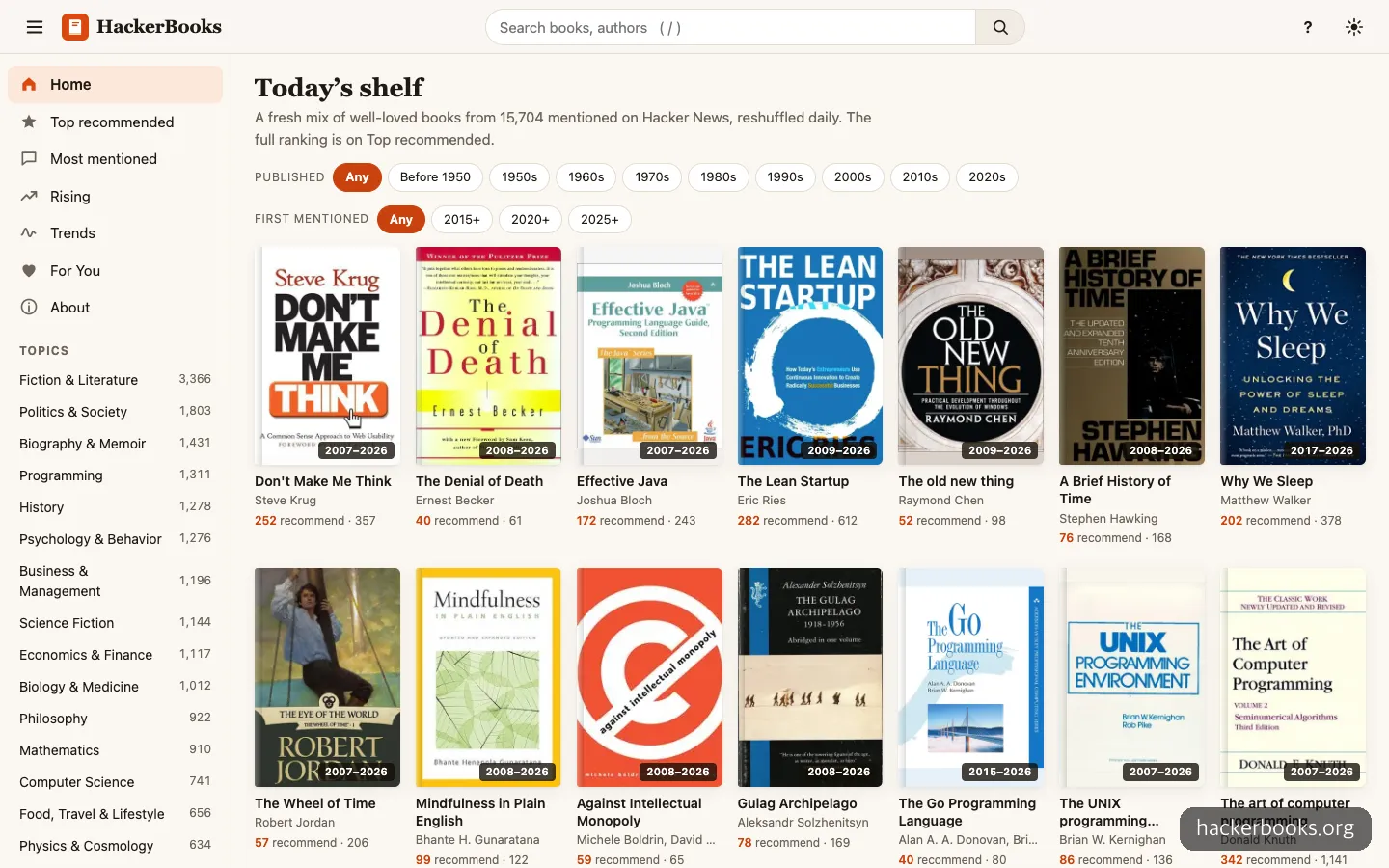
Today’s shelf on the home page. Each book shows the number of people who recommended it next to the number of people who mentioned it.
Same Format as the Original, Different Subject
The original HackerTube is a site Andrej Karpathy published on his blog on October 31, 2026. It pulls 6,454 YouTube videos from about 40,000 Hacker News comments and sorts them into 150 topics. According to Karpathy’s blog post, he built it in about two hours with the Claude Code desktop app, and the only things he did by hand were getting a YouTube API key, setting up a server, and buying a domain. One detail stands out: he also opened up a data export so that others could build similar sites with their own agents.
HackerBooks is the first and biggest answer to that invitation. Open the two sites side by side and they even look alike.
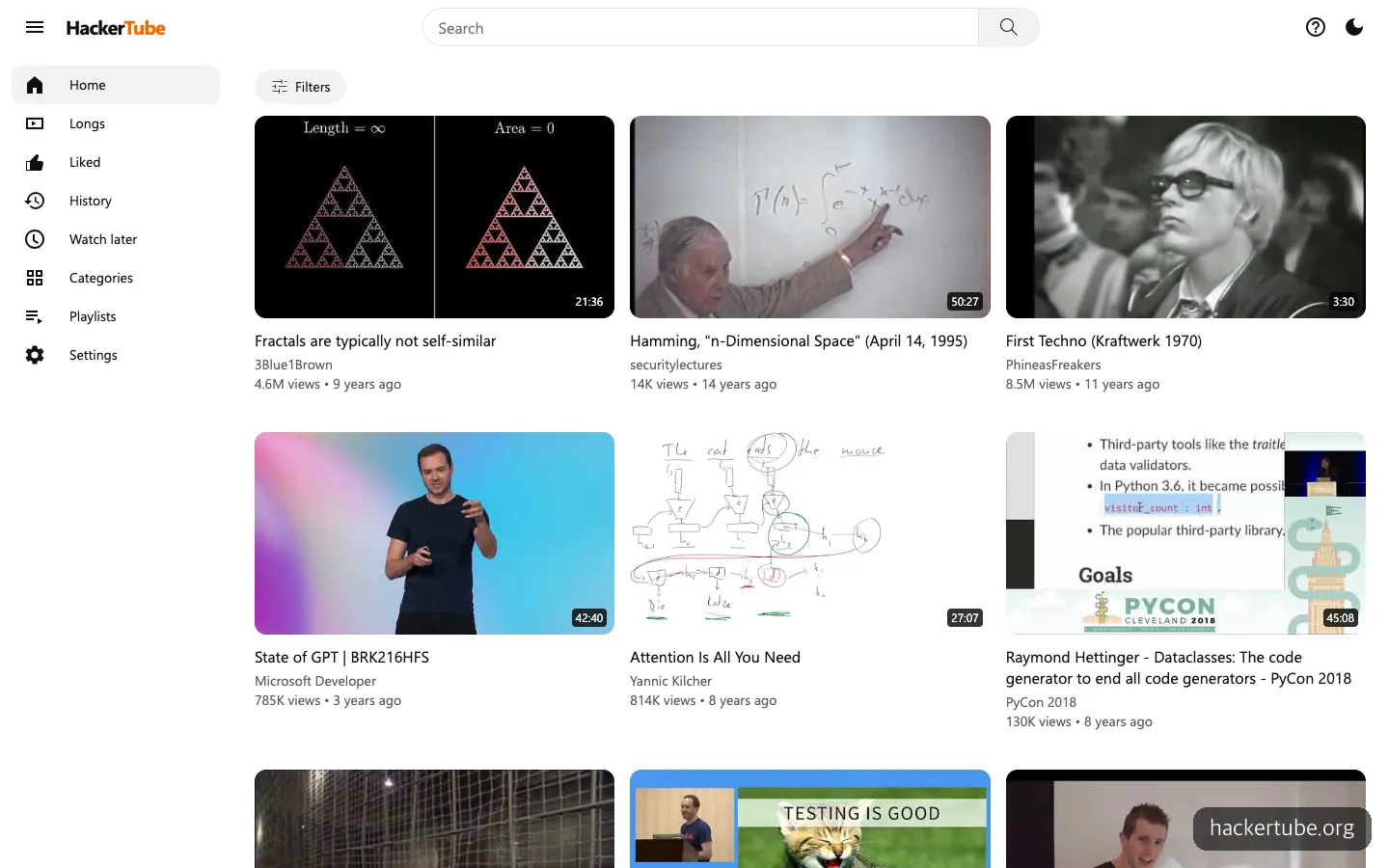
The original HackerTube. HackerBooks inherited its layout of a sidebar, a search bar on top, and a card grid.
| HackerTube (original) | HackerBooks | |
|---|---|---|
| Creator | Andrej Karpathy | Hacker News user roansh |
| What it collects | 6,454 YouTube videos | 15,704 books (as of November 4) |
| Period | 2007 to 2026 | 2007 to 2026 |
| Categories | 150 topics | 32 topics |
| Ranking basis | Mentions in Hacker News comments | Number of people who recommended (split into recommend, neutral, criticize) |
| Menus | Longs, Liked, History, Watch later, etc. | Top recommended, Rising, Trends, For You, etc. |
| Hacker News response (November 6) | 2,882 points, 640 comments | 1,860 points, 307 comments |
The one row that really differs is “Ranking basis.” A video that gets mentioned a lot is usually worth watching, but books are a different story. A book brought up to praise it and a book brought up to trash it each count as one mention. That is why HackerBooks kept the original’s format and changed only this part.
How Was HackerBooks Built?
The creator described the process in fair detail on the About page and in the Hacker News comments. Here is the sequence.
- Extract candidate book titles from the public Hacker News data dump using regular expressions and light natural language processing.
- Match the candidates against book records in Open Library. Only titles easily confused with common words, such as Dune, Influence, and Range, were sent to a small language model for separate review.
- Count mentions of each book across all comments.
- Claude Sonnet 5.5 labels every mention as recommend, neutral, criticize, or not about the book.
- A larger model, Claude Opus 5.5, rechecked 400 of those labels and agreed with 85% of them.
In the comments, roansh said the site itself was built with Claude Code and deployed to Cloudflare using plain JavaScript and static JSON files. Data processing ran on Python and DuckDB. roansh wrote that Claude wrote nearly all of the data processing and site code, while they set the direction, made decisions, and bought the domain. They even admitted that Claude drafted the Show HN intro post and they edited it slightly.
HackerBooks has not disclosed how long it took to build. The “two hours” figure belongs to Karpathy’s HackerTube, so it should not be mixed up with this project.
Why 1,860 Points
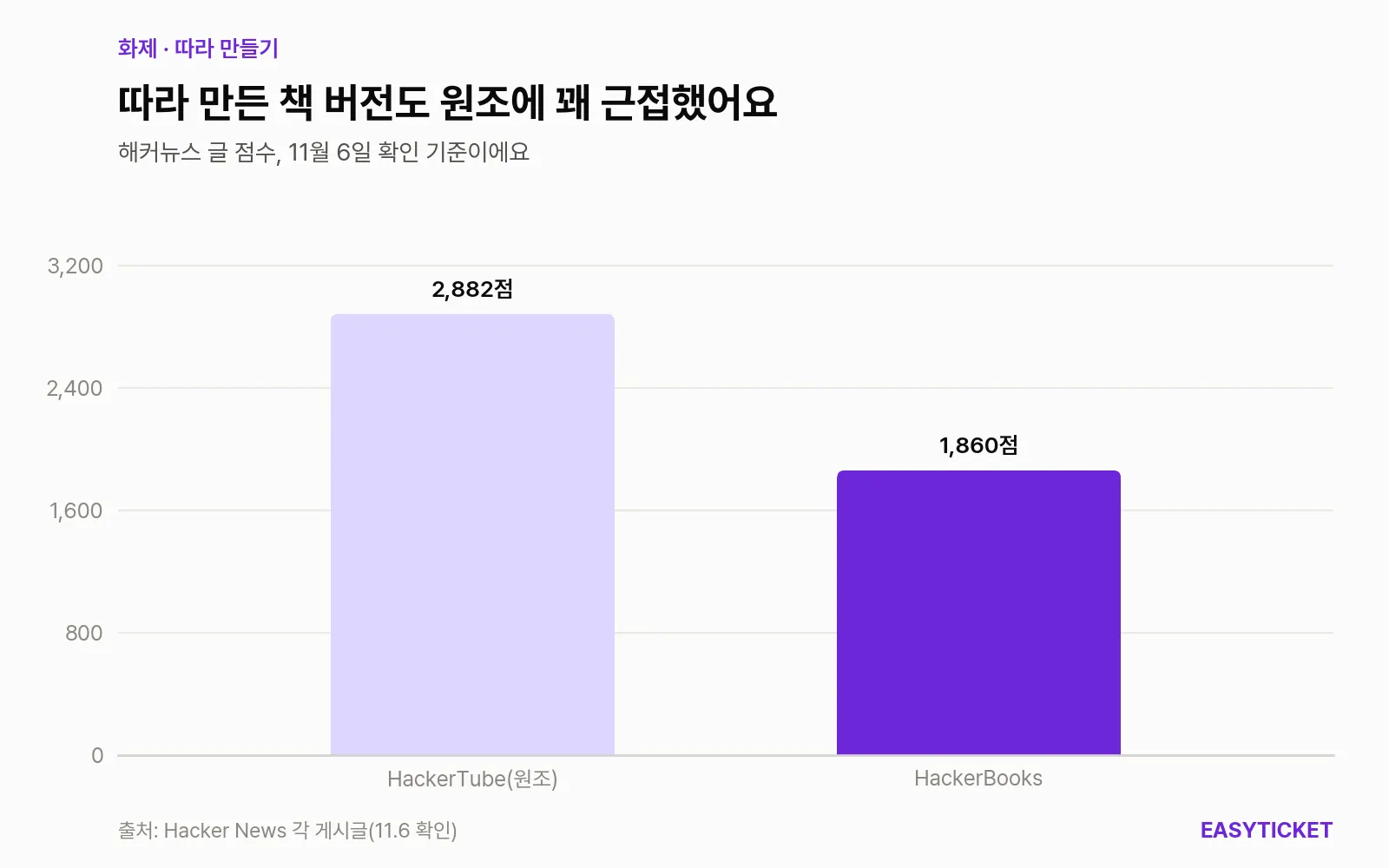
Hacker News post scores compared. The book version of the copy reached nearly two-thirds of the original’s score.
In points, that is about two-thirds of the original, and the comment count is about half. For a cloned site, that is an unusually strong reception.
Start with the reasons the sources confirm. There are three. The first is timing. With the original at the center of the conversation, the one-line pitch “the same thing, for books” landed immediately. Karpathy himself left a “Love it!” comment on the HackerBooks post. The second is speed. Hacker News users praised how fast the site is, and one comment said the static files let it withstand the wave of visitors from Hacker News. The third is how quickly it spread to media in other countries. The Japanese tech outlet GIGAZINE covered it on November 2, and GeekNews, a Korean developer community, featured it the same day.
EasyTicket’s view goes a step further. What lifted this site was its subject matter more than its build speed. For Hacker News readers, “the books Hacker News has recommended for 19 years” is their own story. There is a small thrill in seeing a comment you once wrote counted as a vote in the ranking, which is also why the comment section filled with “why is this book missing?” and “this ranking looks off.” Books were closer to this community’s identity than videos were.
Using It, the Numbers Always Came in Pairs
You can use it right away without logging in. On desktop, a menu and 32 topics sit on the left. Fiction & Literature is the largest topic with 3,366 books, followed by Programming with 1,311. The first fun discovery was that, on a developer community’s site, fiction outnumbers programming books by more than two to one.
Click Top recommended and the number one book is How to Win Friends and Influence People. 611 people recommended it and 915 mentioned it. Second is Gödel, Escher, Bach, third is Thinking, Fast and Slow, followed by Designing Data-Intensive Applications, The Mythical Man-Month, Code Complete, and Snow Crash. It is a mix of self-help, programming classics, and science fiction, which makes for a very Hacker News ranking.
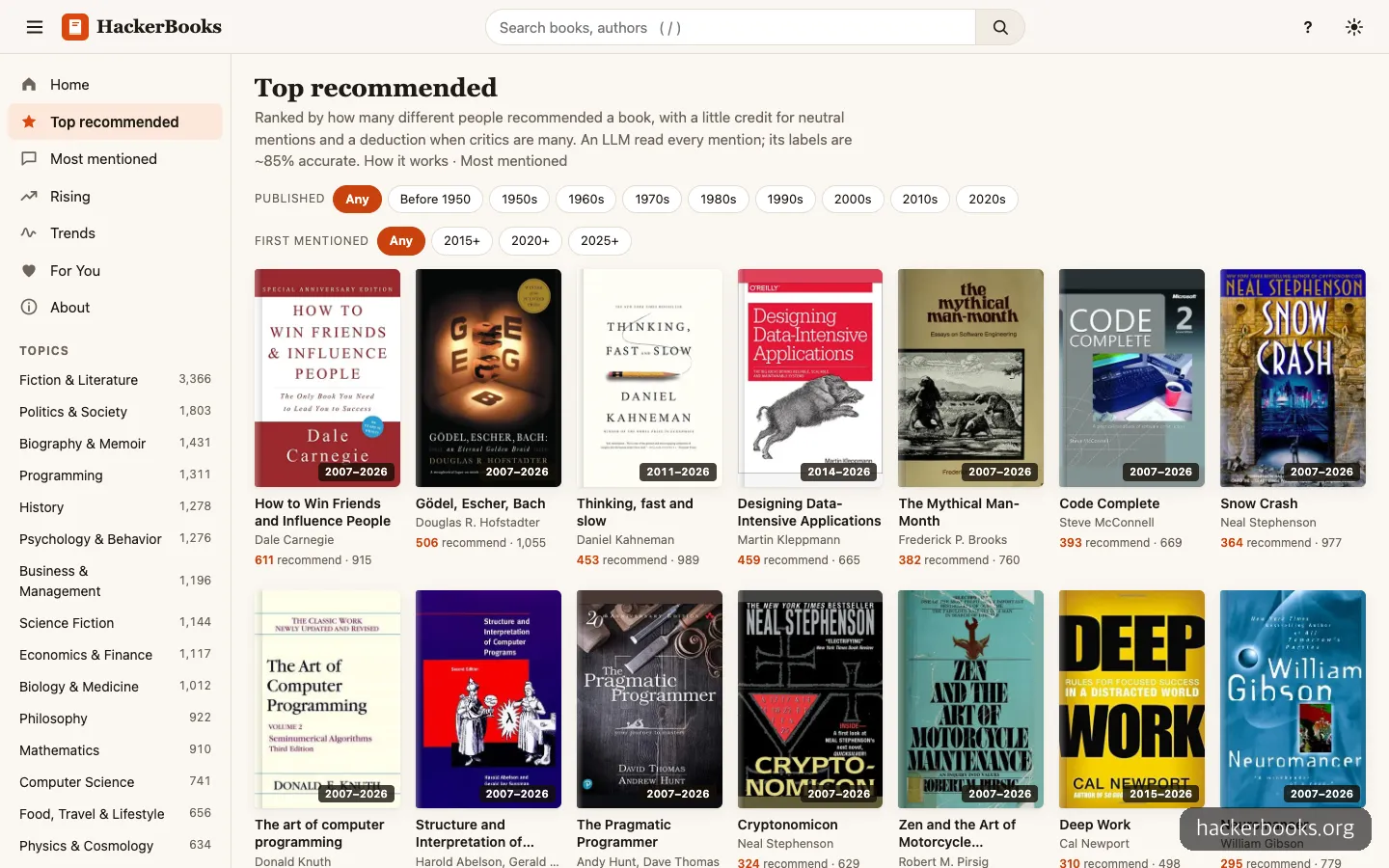
The Top recommended ranking. The note at the top says an LLM read every mention and that label accuracy is about 85%.
The character of the site shows only when you click into a single book. The Snow Crash detail page has four numbers: 364 people recommended it, 977 commenters brought the book up, there are 1,284 mentions, and the first and last mention years are 2007 and 2026. The bar below shows 37% recommend, 56% neutral, and 7% criticize. In other words, the book came up 1,284 times on Hacker News, but only a little over a third of those were along the lines of “you should read this.”
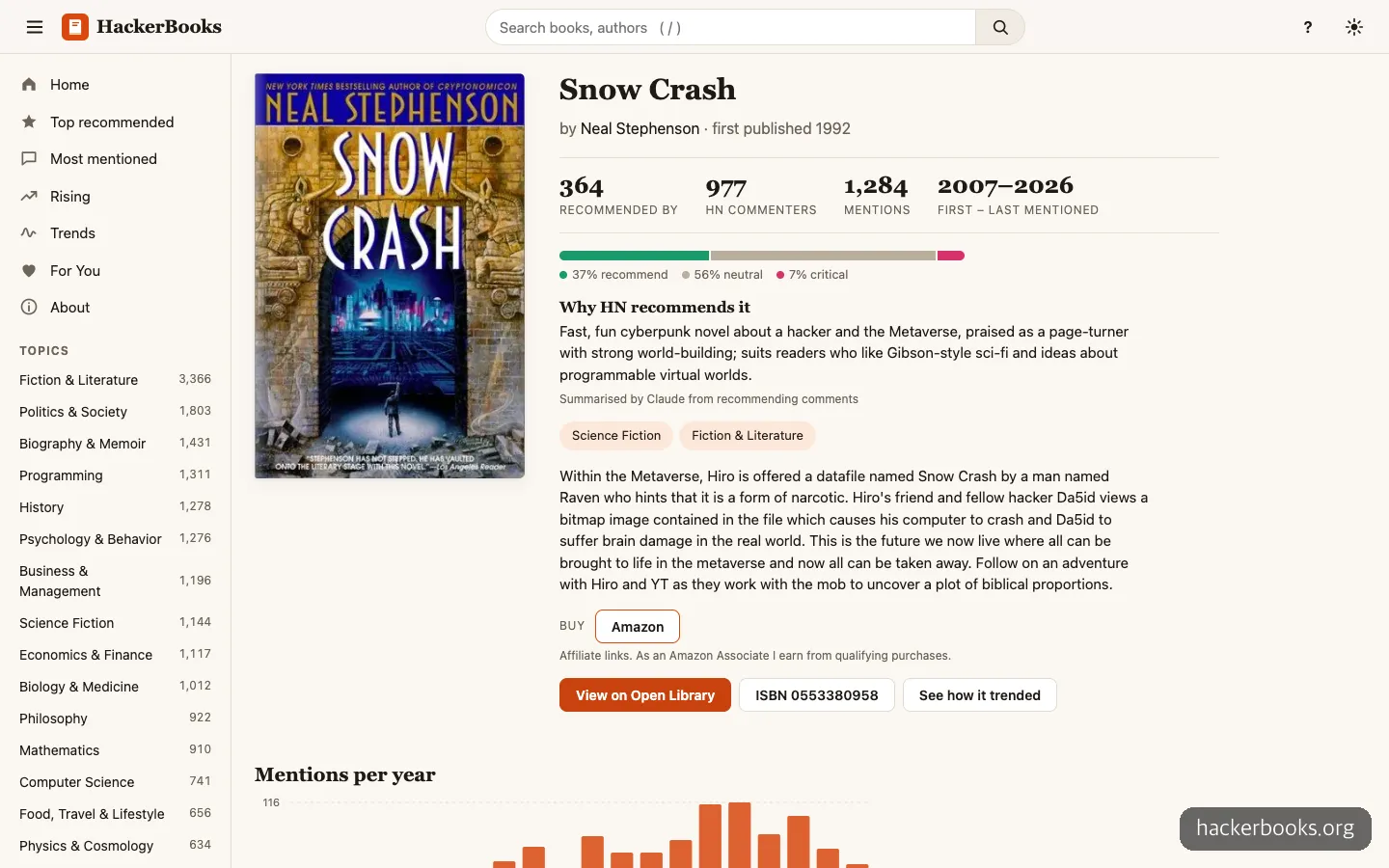
Snow Crash detail. 364 people recommended it, but there are 1,284 mentions, and the recommend share is only 37%.
Further down the detail page are “Why HN recommends it,” a summary of recommending comments written by Claude, a bar chart of mentions by year, and actual comment excerpts. Each excerpt carries the author, date, and label, plus a link to the original thread, so you can open it and check whether the label fits. In GeekNews reactions, someone asked for links to the original comments, and the detail page now includes thread links.
The place I stayed longest was the Trends page. It draws lines showing how the top 10 books rose and fell each year from 2008 to 2026. In 2026 the number one book is Neuromancer, and books that stayed in the top 50 every year for more than 17 years are collected separately as “Evergreens.”
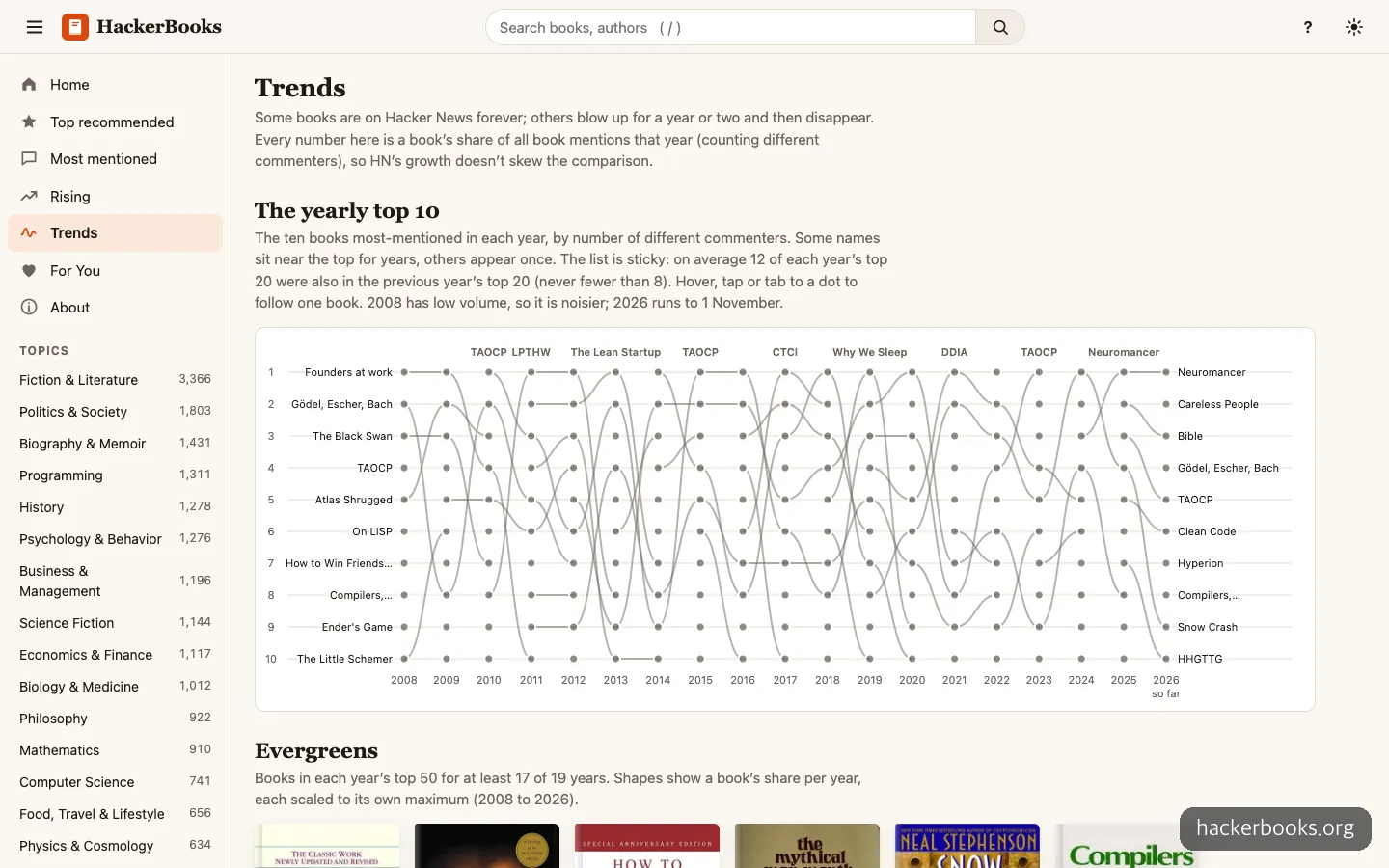
The yearly top 10 on the Trends page. Lines trace what Hacker News read each year.
Pages opened within one to two seconds each time, so there was never a frustrating moment. If you are a developer looking for your next read, it works better to pick a single topic you care about and look at the recommendation share than to start with Top recommended. The overall ranking is dominated by old classics, so there is less to discover.
The Gap Between “Recommended” and “Mentioned”
The creator stated the limits from the start. The Show HN post says “It counts mentions, so it’s not perfect,” and the first paragraph of the About page states flatly that “Mentions are not endorsements.” The 85% label accuracy is not hidden either. Put another way, roughly one in seven mentions may carry the wrong label.
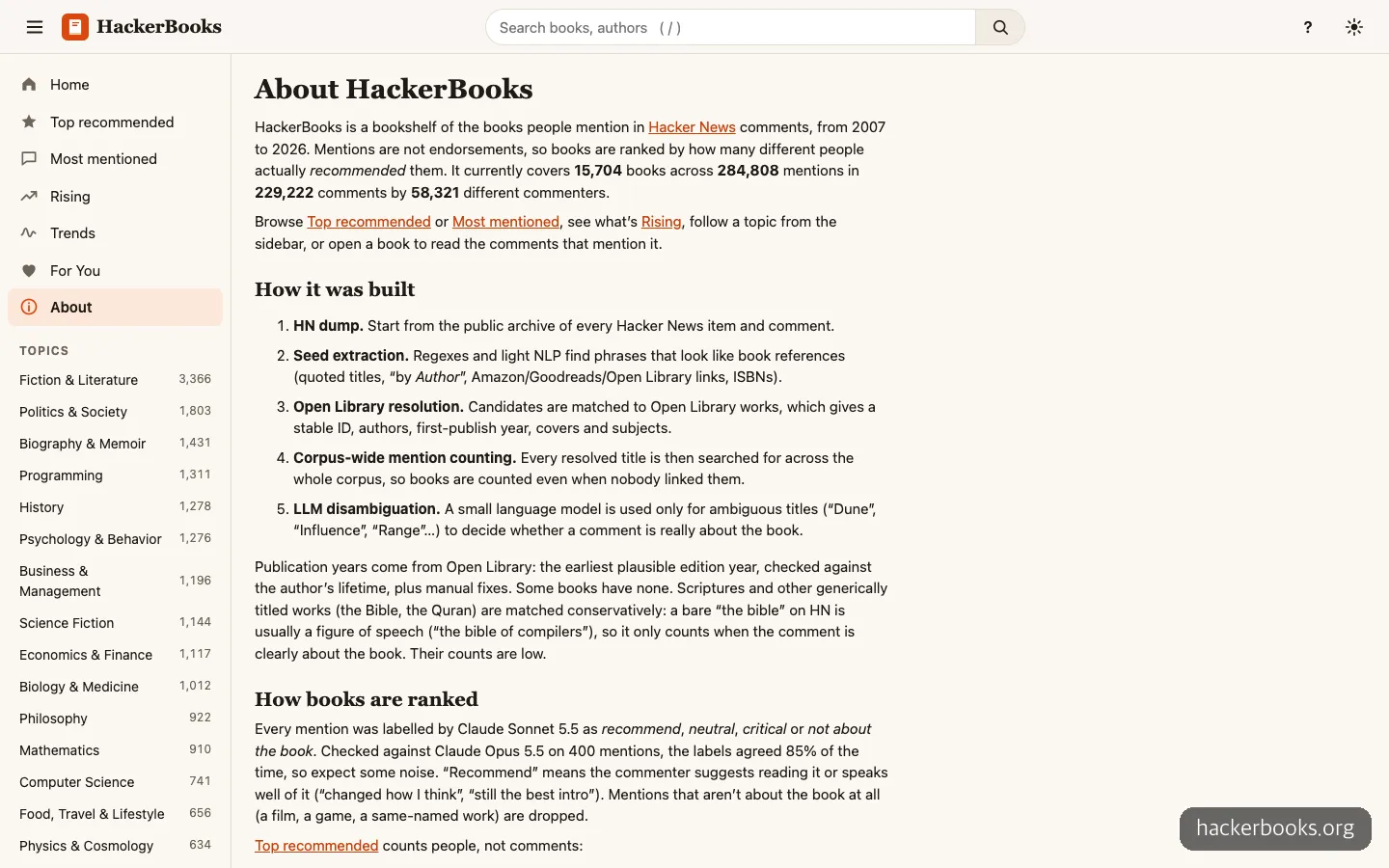
The About page. Alongside the line that mentions are not endorsements, it explains the labeling method and admits the data has noise.
In fact, Hacker News commenters raised points like these.
- Sarcastic comments get counted as recommendations.
- Some books are linked to the wrong author, and lesser-known books are missing.
- Mein Kampf was marked “recommended.” After this was pointed out, the creator changed the wording to “mentioned by.”
GIGAZINE pointed out data errors, such as the fantasy novel Mistborn appearing to have a first publication year of 2001. On the Trends page I looked at myself, “Bible” appeared in the 2026 top 10, even though the About page says titles that overlap with common words are matched conservatively. Many of those mentions were probably figurative rather than earnest calls to read the Bible, so it is questionable whether this ranking reflects “recommendations.”
The numbers themselves also shift over time. The original Show HN post said about 16,500 books, and the GeekNews post said 16,543, but the About page updated on November 4 says 15,704. The drop seems to come from fixing the matching, but the site does not explain why.
User requests are also still open. People asked for a filter that screens out fiction and for links to libraries or DRM-free ebooks, and on GeekNews some said the For You recommendations are weak. The only purchase button is a single Amazon affiliate link, which is of limited use to Korean readers.
Similar Sites Existed Before
The idea of “books Hacker News recommended” is not new in itself. In 2020, GeekNews featured hackernewsbooks.com, a newsletter that emailed only Hacker News book recommendations. According to the HackerBooks comments, that site was in use for several years and disappeared a few months ago. Comments on both Hacker News and GeekNews also said a similar site existed in 2021.
After HackerBooks, sites in the same format kept coming. Comments mentioned hackerfilms, a movie version, and trustmebro.reviews, which collects books recommended on Reddit. Who made either of them has not been disclosed.
The same idea has come around again every few years, but this time the result was different. Where earlier sites stopped at counting mentions, HackerBooks used a language model to sort the nature of hundreds of thousands of mentions one by one. Work that was daunting for a person alone has become a question of model call costs. Anyone can copy the quick build with Claude. What is hard to copy is the decision to show recommendations and mentions separately, and the attitude of stating the 85% limitation close to the front page.
Frequently Asked Questions
Is HackerBooks free?
Yes, it is free. You can use it without signing up or logging in. According to the About page, it does not track users, and the For You recommendations are calculated inside your browser. It says running costs are covered by Amazon affiliate commissions.
Is it an official site made by Hacker News?
No. The About page says it has no connection to Y Combinator or Hacker News. It is a personal project that uses Hacker News public data.
Can I build a site like this too?
Karpathy, who made the original, opened the data export from the start with exactly that in mind. HackerBooks also lets you download per-book data as CSV. Both examples were built with Claude Code, so what remains is deciding “which subject from which community to collect.”
Is there a Korean community version?
Not in the range I checked for this article. So far, the versions that have appeared are Hacker News videos, books, and movies, plus a Reddit books version. If someone builds the same thing from GeekNews or Korean developer community comments, the contest will be decided by separating recommendations from mentions, as in this case.
Sources 5
AI helped with research and the first draft; the operator tried the subject firsthand, checked and edited this article before publishing. Let us know if you spot a mistake.