
You hand a feature to an AI coding tool, then open a fresh session the next day to keep going. But today’s AI doesn’t know the rules you set yesterday, so it writes plausible but wrong code all over again. Elephant-Goldfish Model (EGM) is an Apache 2.0 open-source plugin that Google engineers released on October 22, 2026. It makes the AI write a design doc before it writes code, then has a reviewer AI that knows nothing about the earlier conversation read only that doc and look for gaps. You attach it to Claude Code, Codex, or Google Antigravity, and, as the name suggests, an elephant and a goldfish split the work.
The elephant writes, the goldfish reads
The name is the explanation. The elephant is the side that remembers the project context for a long time. The coding agent you’re chatting with plays this role and writes the first draft of the design doc. The goldfish is the side with a short memory. A newly launched review subagent reads only the draft and the sources it references, with no prior conversation, and points out unstated assumptions and blind spots. What to give up, what to choose, and whether to approve the design are decisions a person makes before implementation.
Why use a reviewer with no memory? The Google Open Source Blog points out that AI has made coding faster, but sloppy output, bugs, and context lost between sessions have gotten faster too. An AI that knows the whole conversation mentally fills in whatever the design doc leaves out. The doc has to make sense even to a goldfish that knows nothing, and the bet is that tomorrow’s fresh session will then produce the same code. The blog states the goal as having the AI produce the intended code correctly on its first try.
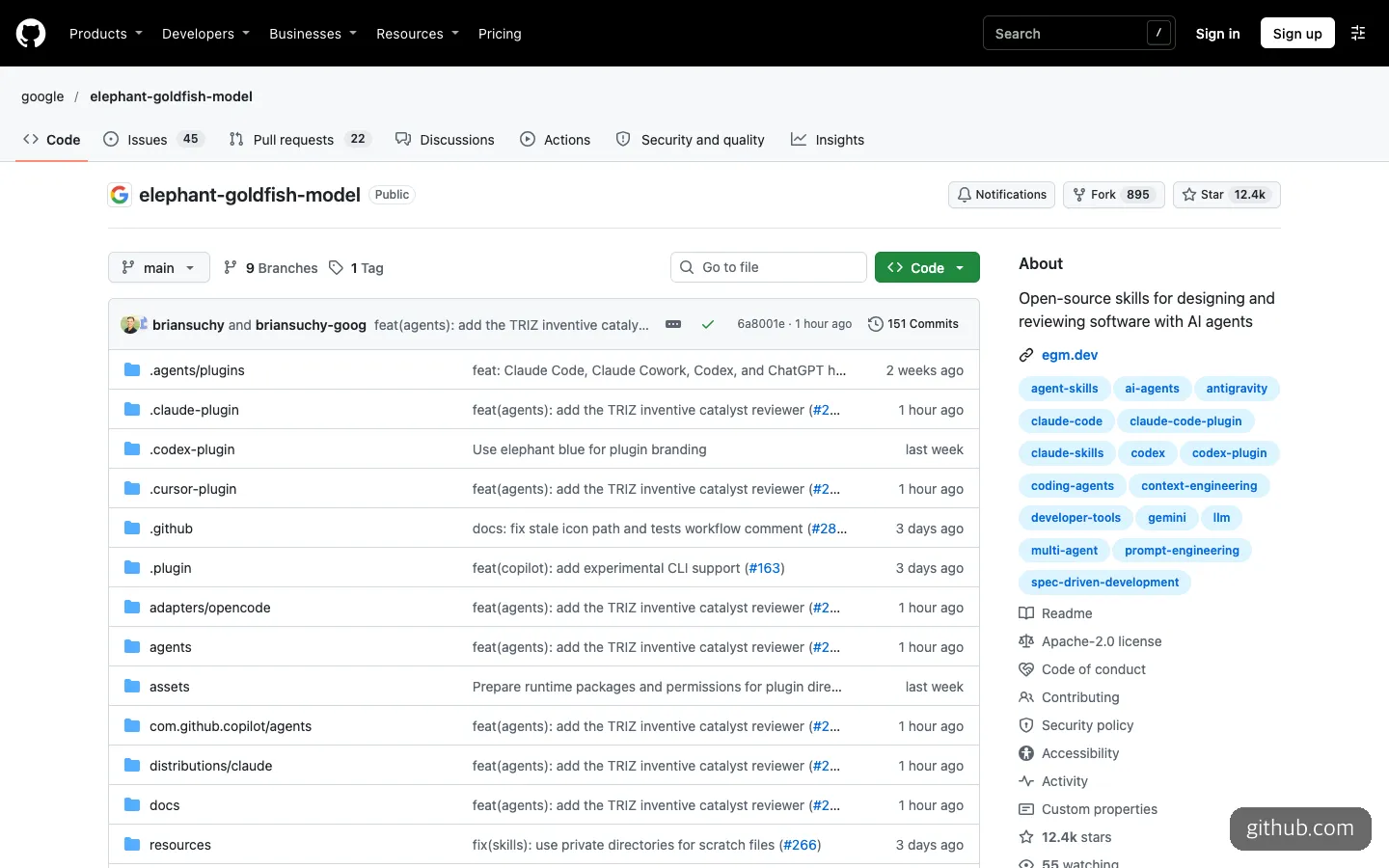
The EGM repository home page. The Apache-2.0 license and a link to the official site appear on the right.
As of November 6, 2026, the official repository has 12.4k stars and 895 forks. According to the blog, thousands of Google employees use this plugin every day to ship real production code. Still, the repository carries a line saying it is “not an officially supported Google product.” It’s closer to a method used internally and then made public than to a product the company stands behind. The approach was first put forward by Dave Rensin, a co-author of the blog post.
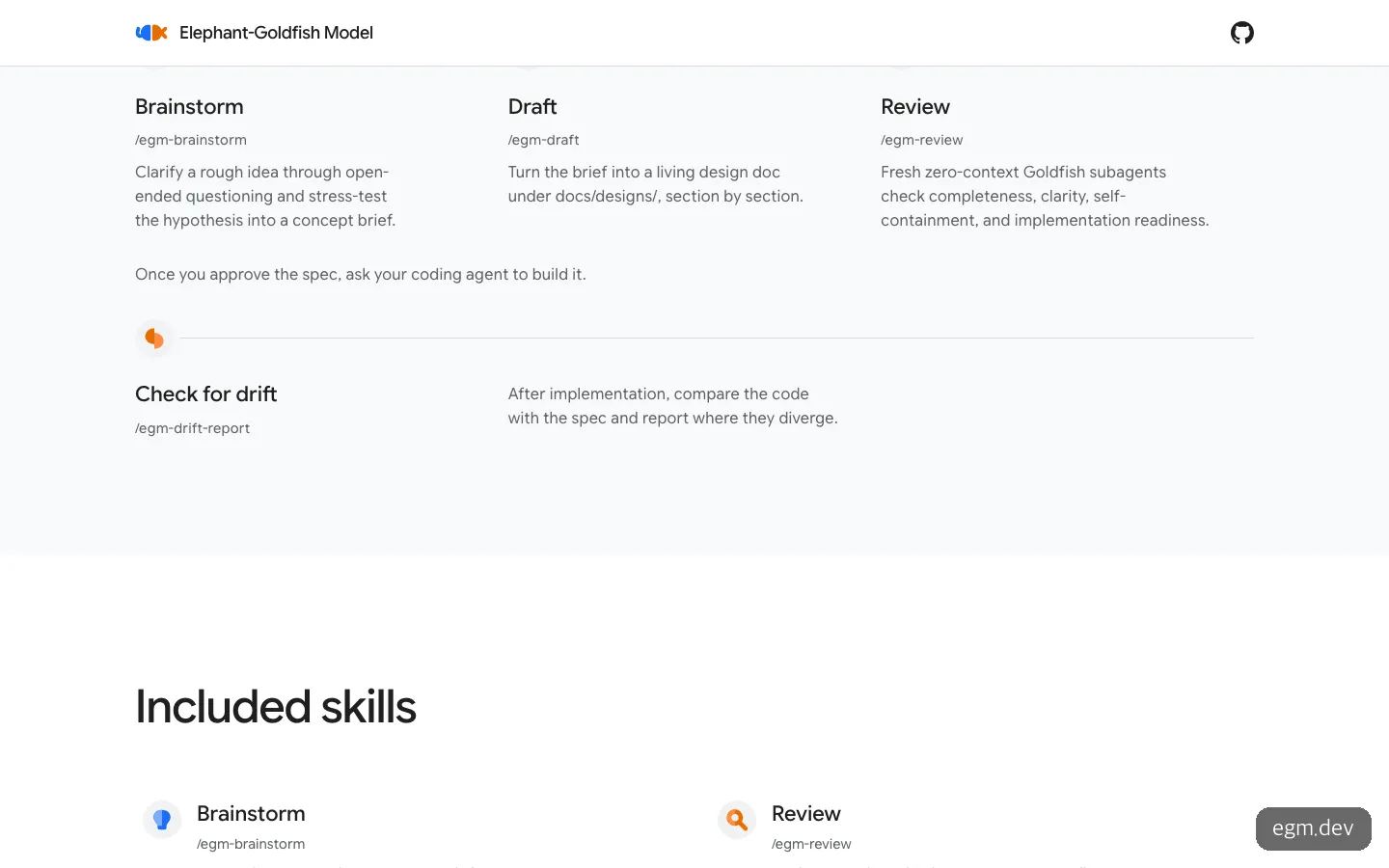
The flow runs from brainstorming to a draft to review. Only after approval do you hand off implementation, and when it’s done you check whether the design and the code have drifted apart.
One thing worth noting is that EGM doesn’t write the code itself. In the flow diagram on the official site, egm.dev, the step after approving the design doc reads “tell your coding agent to build it.” EGM handles design, review, and the comparison after implementation. The building is left to the AI you already use.
When is EGM worth using?
The README’s rule is simple. If a feature needs design decisions before implementation, use it. If it’s a small, clear bug fix, work the way you normally do. EasyTicket added a few vibe coder scenarios on top of that.
It fits well in these cases.
- Features that take several days to build. For work that spans many sessions, such as payments, membership tiers, or reservations, the design doc acts as the memory you hand to an AI that starts fresh each time. Design docs pile up in the project’s
docs/designs/folder, and an index file is created along with them. - When the AI keeps building something different. The core of the goldfish review is “can this be implemented when read without context?”, so it exposes the vague spots ahead of time.
- When you want to tidy up a project that’s already running.
/egm-bootstrapcreates or fixes docs from existing code, and/egm-drift-reportcompares the docs with the current code to show where they’ve diverged.
On the other hand, if you use it to change one button color or fix one typo, writing the design doc and getting it reviewed takes longer than the fix. The getting-started doc also recommends skipping the process for simple bug fixes. If it’s a toy web app you’ll build in a day and throw away, just tell the AI what to do. There’s no tomorrow in which you’d reopen the design doc.
How do you use the EGM plugin?
All you need is one coding agent that can launch a new subagent. Claude Code, Codex, and the Antigravity CLI qualify, and in an environment that can’t launch subagents, EGM stops at the review step. It doesn’t require a separate API key or a GPU.
Installation is the two commands listed in the README. For Claude Code, it looks like this.
claude plugin marketplace add google/elephant-goldfish-model
claude plugin install egm@egm
For Codex, you use this.
codex plugin marketplace add google/elephant-goldfish-model
codex plugin add egm@egm
After installing, you need to open a new session for the commands to be picked up. The docs also say that installing only some of the features won’t work. The plugin reads reviewer instructions and document standards at run time, so you have to install the whole plugin.
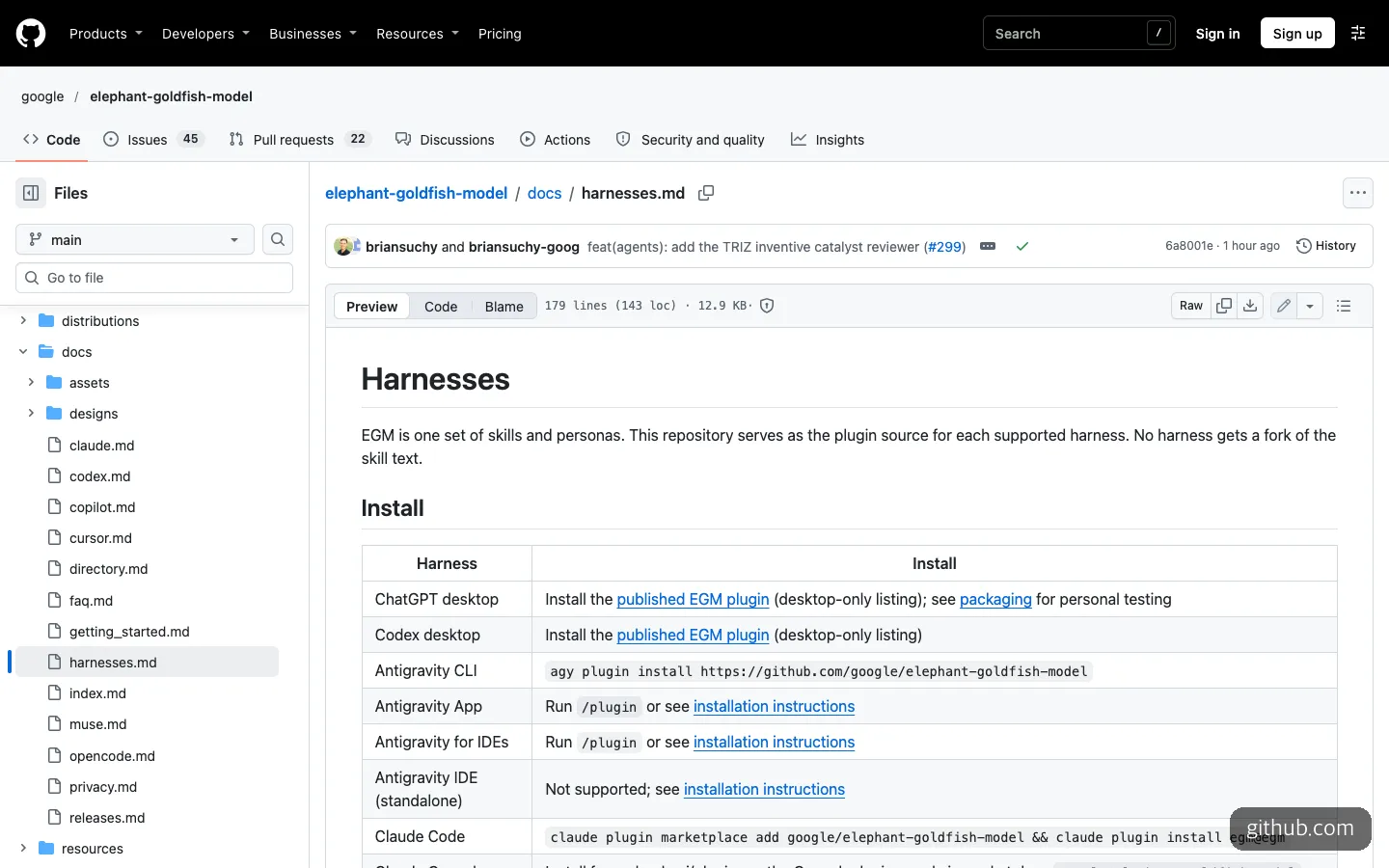
The per-tool install table. It notes that the standalone Antigravity IDE is not supported.
If terminal commands are unfamiliar, you can hand the whole job to the AI. The request that egm.dev suggests is this one line.
Install https://github.com/google/elephant-goldfish-modelOnce it’s installed, the flow follows the egm.dev diagram. In Claude Code and Antigravity, you put the egm: prefix in front of each command, and in Codex you pick from the skill list.
| Step | Command | What it does |
|---|---|---|
| 1 | /egm:egm-brainstorm | Refines a vague idea through questions into a concept brief |
| 2 | /egm:egm-draft | Turns the brief into a design doc under docs/designs/ |
| 3 | /egm:egm-review <draft path> | Memoryless reviewers go through the design doc in stages |
| 4 | /egm:egm-resolve | Works through the issues raised in the review one by one |
| 5 | After approval, ask for implementation as usual | The coding agent implements according to the design doc |
| 6 | /egm:egm-drift-report | Reports where the design doc and the current code have diverged |
A first request like this is enough: “Use /egm:egm-brainstorm to organize ideas for adding a notification scheduling feature to our app. Don’t write any code yet.” That last sentence matters. Coding agents try to start writing code the moment they get a chance.
Try it by hand before installing
If you hesitate to install right away, the getting-started doc points to another route. It says to understand the method before the tool. You copy and paste the prompts in order, do it by hand once or twice, and bring in the framework when that repetition gets tedious. The doc says this manual method costs nothing but time and requires nothing to be installed.
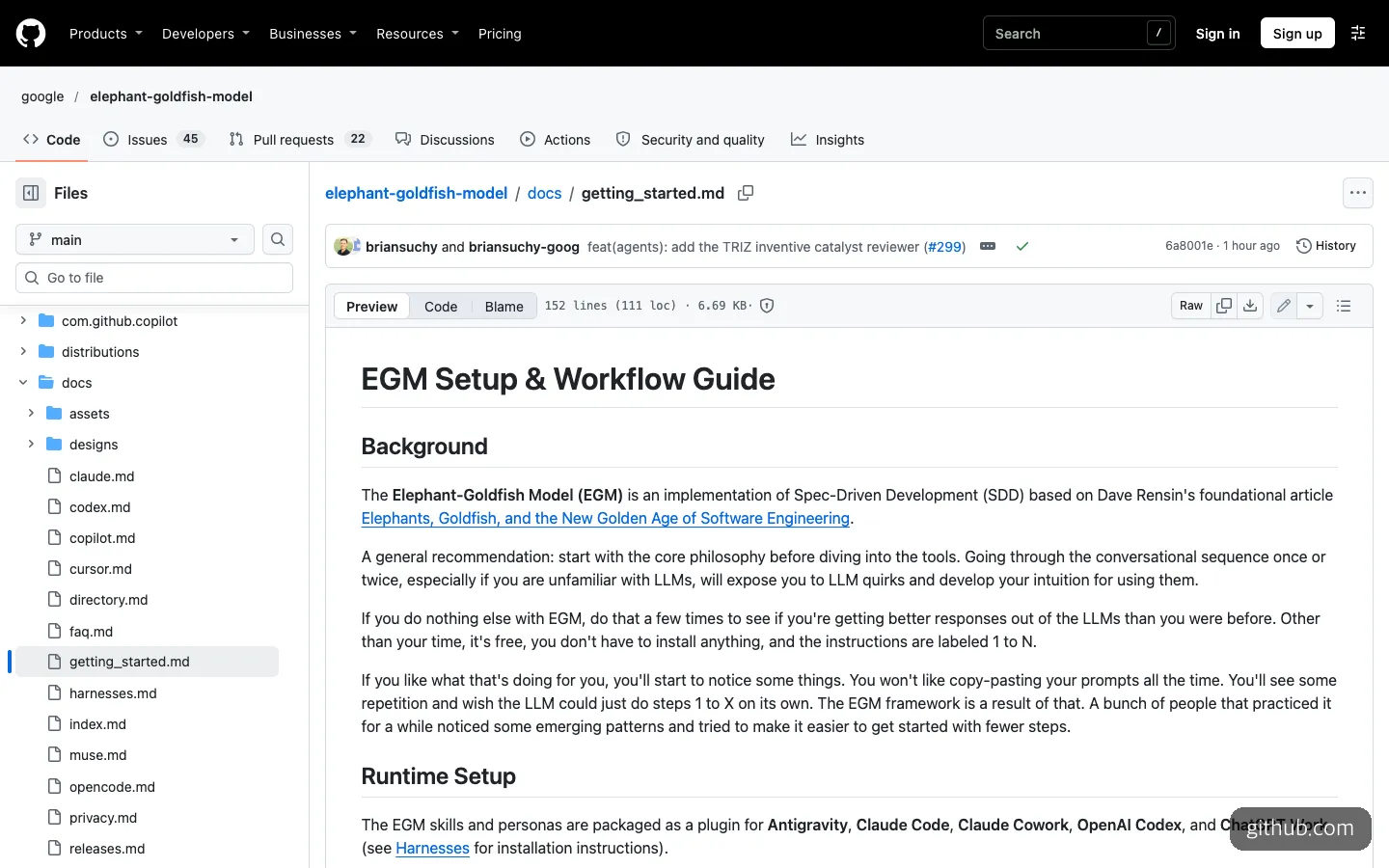
The getting-started doc recommends following the method by hand before installing the tool.
EasyTicket recommends this order for vibe coders. We didn’t install or run it this time. All we did was read the repository, the official site, and the docs, and even from that we spotted some drawbacks. There’s no demo or trial version, so there’s no way to see on screen what review results look like. The official site and docs are English only. Rather than installing it without knowing whether it fits your project, you’ll get lost less by getting a taste another way: use one new chat window as your goldfish, paste in only the design doc, and ask, “Can you implement this from this alone, and where is it ambiguous?” The getting-started doc is only 152 lines, so it isn’t a heavy read either.
How is it different from Superpowers and Spec Kit?
EGM isn’t the first tool to say “design first, then code.” Here it is side by side with the two tools vibe coders are most likely to compare it to (star counts as of November 6, 2026).
| EGM | Superpowers | GitHub Spec Kit | |
|---|---|---|---|
| Made by | Google engineers (not an officially supported product) | An individual developer’s repository (obra) | GitHub |
| License | Apache 2.0 | MIT | MIT |
| Focus | Design doc review, memoryless reviewers | After planning, runs each task with a fresh subagent, two-stage code review | Spec-driven development running from spec to plan to tasks to implementation |
| Does it implement too? | No (leaves it to your usual agent) | Yes | Yes (/speckit-implement) |
| Install | Two plugin commands | /plugin install superpowers@claude-plugins-official | uv tool install specify-cli (requires Python 3.11 or later and uv) |
| GitHub stars | 12.4k | 313k | 147.9k |
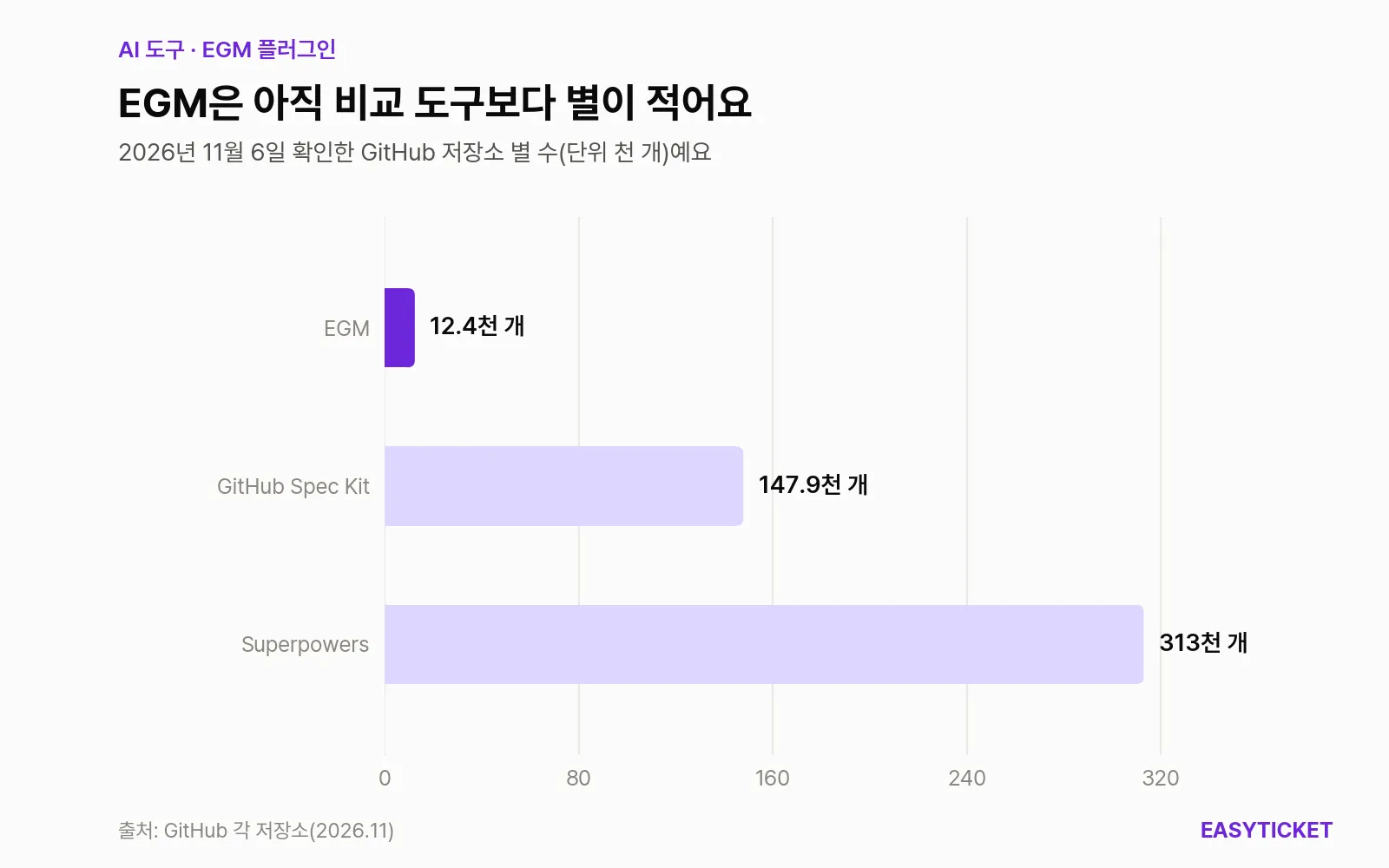
GitHub star counts for the three tools as of November 6, 2026
As the chart shows, EGM has been public for just over two weeks, and its stars are about one twenty-fifth of Superpowers’. Fewer users also means fewer examples to look up when you get stuck. The difference lies in the weight given to review. Superpowers and Spec Kit carry you through one flow from planning to implementation, while EGM concentrates its effort on verifying the design doc before implementation. If Superpowers is already working well for you, there’s little reason to switch. If instead you’re struggling because the AI keeps building something other than what you intended, EGM, which inspects the design doc itself, is closer to the root of the problem.
Still version 0.1: what to know before you use it
The first official release, v0.1.0, came out on October 27, 2026, and the release notes themselves say it is “not at a stage where you can call it stable.” The repository changes several times a day, so the commands and steps in this article may soon be out of date.
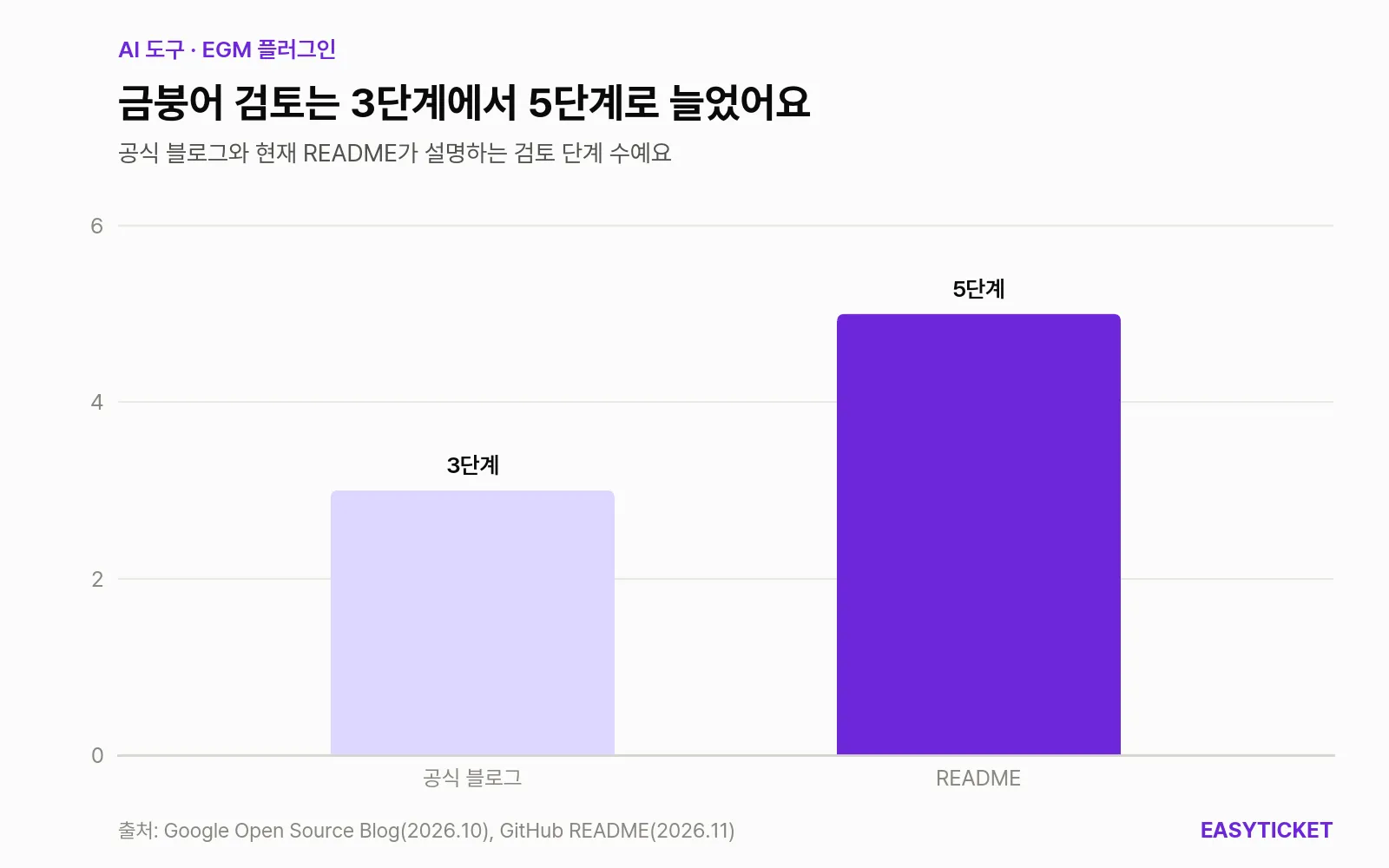
The goldfish review that had three stages at launch now has five in the current docs.
In fact, on launch day the blog described review in three stages: comprehension check, adversarial review, and implementation readiness check. The current README says five stages. The review procedure itself changed within about two weeks.
Here are a few other things to know.
- The goldfish may not be a perfectly blank slate. Claude Code is set up to keep the project settings file (CLAUDE.md) from being passed to reviewers, but there is a report that AGENTS.md ended up in the reviewer context on Codex CLI 0.166.0, and no reliable way to exclude it has been confirmed yet.
- The many issues raised are intentional. The getting-started doc says the goldfish review is built to pour out plenty of feedback, so a person has to filter it. Docs created with bootstrap also need to be reread by a person. The README states plainly that review doesn’t replace tests or human judgment.
- Usage comes out of your own plan. The plugin is free, but it launches several reviewer subagents, so it uses that much of your Claude or Codex plan’s usage. The official docs give no figures for how many tokens it takes.
- Claude Code shows one harmless warning. The docs say it’s normal if “default agents folder ignored” appears in the
/pluginerror list.
Frequently asked questions
Is EGM free?
The plugin itself is Apache 2.0 open source, so it’s free and can be used in commercial projects. However, because review launches several subagents, you’ll still use up usage on the host tool, such as Claude Code or Codex.
Does it work in Cursor or GitHub Copilot?
The repository’s docs folder has guide files for Cursor, Copilot, and OpenCode, but the README gives install commands only for Antigravity, Claude Code, and Codex. Copilot is listed as experimental support, so it’s safest to check each guide file for the level of support.
Can I use it without knowing much about code?
It’s actually a good fit for that kind of person. What EGM handles is the design doc, not code, so a person’s job is to read the reviewer’s points and decide what to choose. Documents and output may come out in English, though, so it helps to ask the agent separately to write the design doc in Korean if that’s easier for you to read.
I heard the official blog says it’s Antigravity only?
At launch it was built for Antigravity, and other environments were said to be coming soon. As of November 6, 2026, install instructions are available for Claude Code, Claude Cowork, and Codex as well. Before you ask for your next feature, try adding one line: “Organize it with /egm:egm-brainstorm, and don’t write any code yet.” You’ll quickly see whether this method suits your work.
Sources 8
- GitHub - google/elephant-goldfish-model
- Introducing the Elephant-Goldfish Model plugin (Google Open Source Blog)
- Elephant-Goldfish Model (egm.dev)
- getting_started.md · google/elephant-goldfish-model
- harnesses.md · google/elephant-goldfish-model
- Releases · google/elephant-goldfish-model
- GitHub - github/spec-kit
- GitHub - obra/superpowers
AI helped with research and the first draft; the operator tried the subject firsthand, checked and edited this article before publishing. Let us know if you spot a mistake.