
A short gameplay clip posted on X on October 23 passed 3.67 million views. It showed the poster’s own university campus collapsing on a 3D map. SMASH University (SMASH 대학교) is a free web game made by Hong Cheol-min, a senior in the School of Software at Chung-Ang University, during exam season in October 2026 using the AI coding tool Claude Code. Players destroy real university campus buildings with tools like bombs, bats, and nukes, and the points they earn pile up under their school’s name. Yonhap News reported on October 29 that the game passed 1 million cumulative visits less than two weeks after launch.
Below, we look at why a game that began as a joke spread this far, and whether its sister game, SMASH Company, which runs on the same engine, is worth a try.
What Kind of Game Is SMASH University?
SMASH University needs no installation and no sign-up. You play right in a phone or computer browser. Type in a school name (typing just the initial consonants works too), and that campus appears in 3D. Pick a weapon from the tool panel at the bottom, smash the buildings, and you’re done. As of November 12, 2026, the official site lists seven tools: bomb, baseball bat, laser, meteor, earthquake, nuke, and a Pepero (a popular chocolate-covered stick snack) javelin added on November 9.
Buildings and roads come from OpenStreetMap, terrain elevation from AWS elevation data, and aerial photos from VWorld, run by South Korea’s Ministry of Land, Infrastructure and Transport. So the library and student union you walk past every day stand there with name tags intact. The surfaces are blocky textures rather than real photos, and the site states that this is an unofficial fan game unaffiliated with any school, so it uses no school logos or emblems.
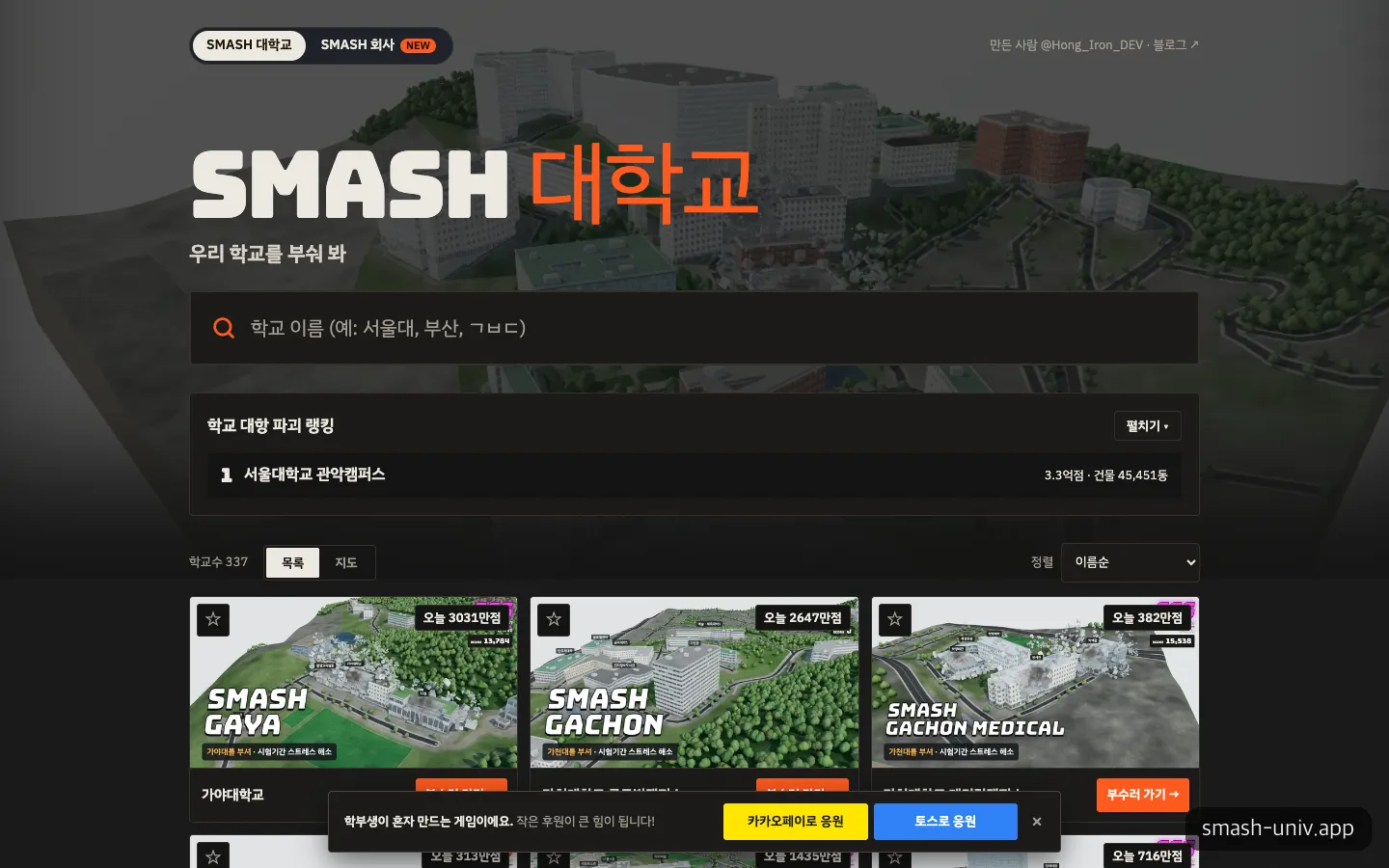
The home screen runs in this order: school search bar, school-vs-school ranking, 3D campus cards.
The layout of the home screen says a lot about the game’s character. The search bar sits at the very top, and right below it is the “School vs. School Destruction Ranking.” Each school card carries a “Today: ○○ points” tag, and the sort options even include “Most destroyed today.” It feels less like a game you play alone and more like one you log into to raise your school’s score.
Two Weeks That Grew a Two-Hour Prototype
It started with a self-mocking joke that went around campuses during exam season: “I wish the school would just disappear.” According to an interview with Yonhap News, he had only three exams that semester and so had some spare time, and building the first prototype with Claude Code took about two hours. Over the next few days he adapted it to phone screens and added weapons, while connecting map and satellite imagery data to expand the list of supported universities.
The site’s announcements show how fast things moved. On October 24, 39 campuses were added, bringing the total to 144. On October 25 came a major graphics update, on October 26 an Instagram account opened, and on November 1, 140 more campuses brought the total to 337. For a little over two weeks, something changed roughly every other day.
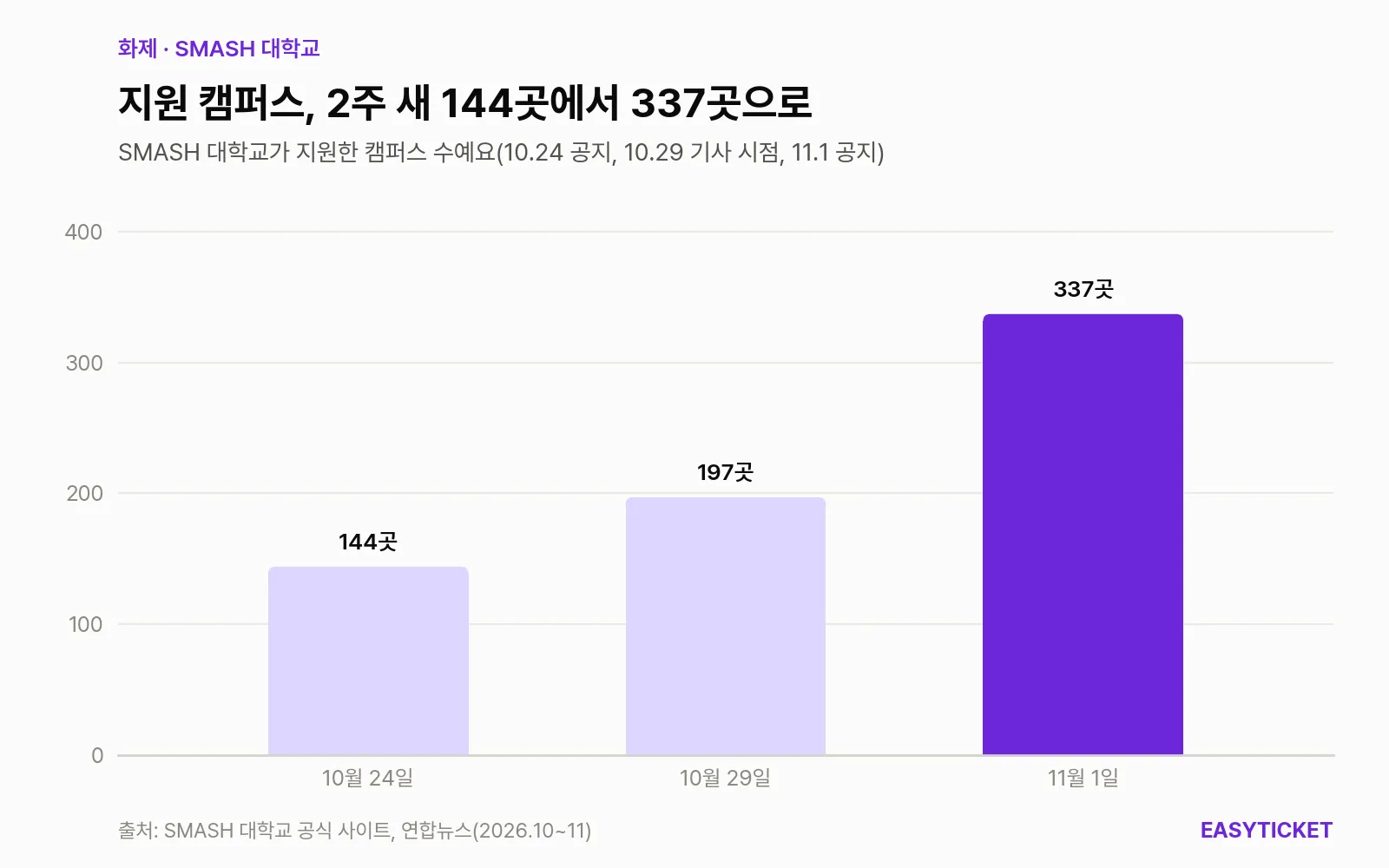
Supported campuses more than doubled in under ten days.
One decision deserves attention. The developer said that, because threats against schools targeting minors are a social problem in Korea, he left out elementary, middle, and high schools from the planning stage. No one gets hurt in the game, either. The creator recognized how risky the premise of “smashing a school” was and drew the line first. That line is also where the game parts ways most sharply with the similar games covered below.
Why It Took Off: Three Reasons From the Article, Plus One More
Yonhap News cited three reasons for the spread: relief from exam and assignment stress, a “school pride battle” sparked by school-vs-school rankings, and social media sharing. In the same article, Professor Lim Myung-ho of Dankook University’s Department of Psychology interpreted the game as anxiety about studies and job hunting projected onto the familiar space of a school, and added that getting too absorbed in it deserves caution.
The numbers show how heated the ranking race got. As of the afternoon of October 28, Seoul National University’s Gwanak Campus had a cumulative destruction score of 48.7 billion points, more than triple that of second-place Yonsei University’s Sinchon Campus (14.8 billion). It is also interesting that Kangwon National University’s Chuncheon Campus reached third place. It suggests that rank depends less on school size than on who is more eager to defend (or smash) their school.
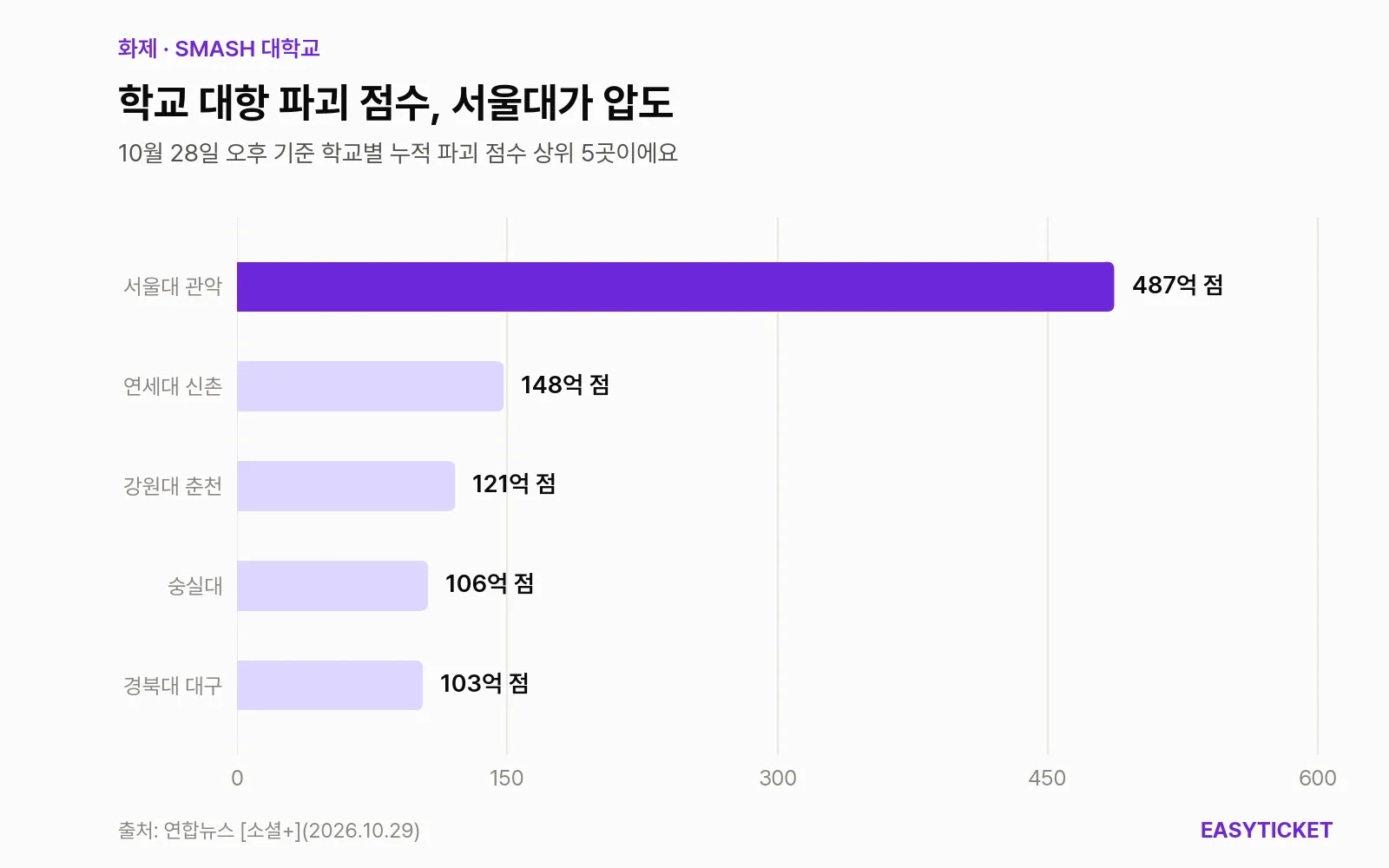
The top five schools by cumulative destruction score as of the afternoon of Oct. 28. Seoul National University was more than triple the runner-up.
EasyTicket would like to add one more reason: the whole thing runs on a single link. There is no app to install and no account to create, so if you drop the address into a school group chat, the person who receives it is smashing their own school within 10 seconds. Because points accumulate under a school’s name rather than an individual’s, “What rank is our school now?” comes up on its own, and every destruction scene becomes a short video as is. Stress relief, belonging, and a screen worth sharing are all packed into a single round. We think the design, more than the technology, is what took a two-hour prototype to 1 million visits.
Trying a Round of Sister Game SMASH Company
SMASH Company is a sister game that takes the university version’s engine as is and lets you smash real buildings in business districts such as Pangyo, Gangnam, Yeouido, and Gwanghwamun. Its tagline is “Smash your company.” As of November 12, its list shows 69 business districts from Seoul to Jeju, and it states that it uses no company logos and will take a listing down if a company asks. The university version’s game screen would not open this time, so I played one full round on the company version, which uses the same engine.
First place in the business-district ranking went to Yeouido’s financial district. That matches what an Asia Economy column wrote, that “Yeouido, with its many securities firms, scored highest,” which got a laugh. When you enter Yeouido, after about a six-second wait, buildings tagged with names such as Parc.1 Tower 1, Hana Securities Building, and Hanwha General Insurance Building rise over satellite-textured terrain.
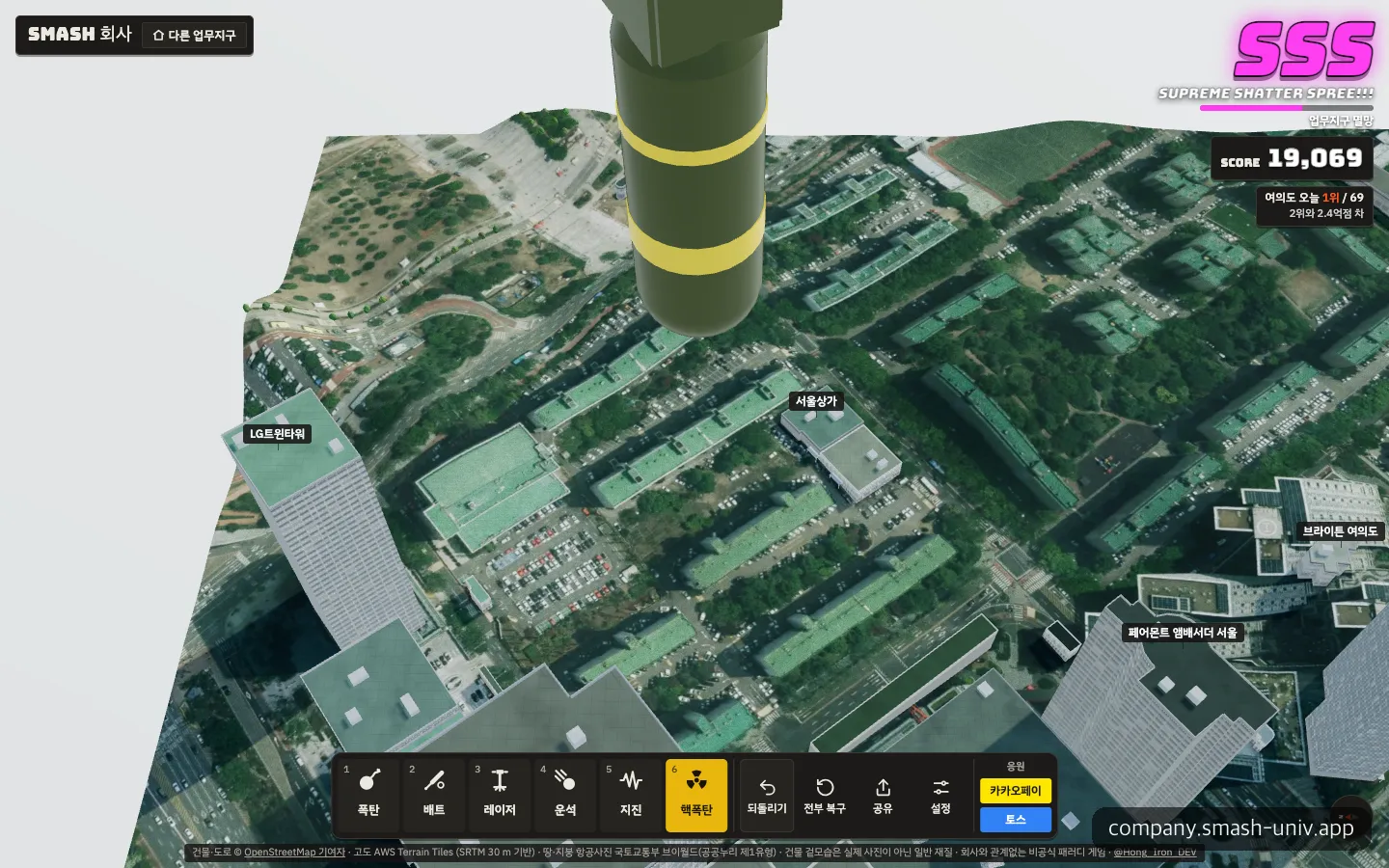
I picked the nuke and clicked a building, and an SSS grade appeared right away.
When I clicked Parc.1 Tower 1 once with the default bomb, all I got was a small hole and a red circle, and the score didn’t go up right away. Switching to the nuke changed the mood. A huge warhead descended from the top of the screen, and a score of 19,069 and an SSS grade (SUPREME SHATTER SPREE) followed immediately.
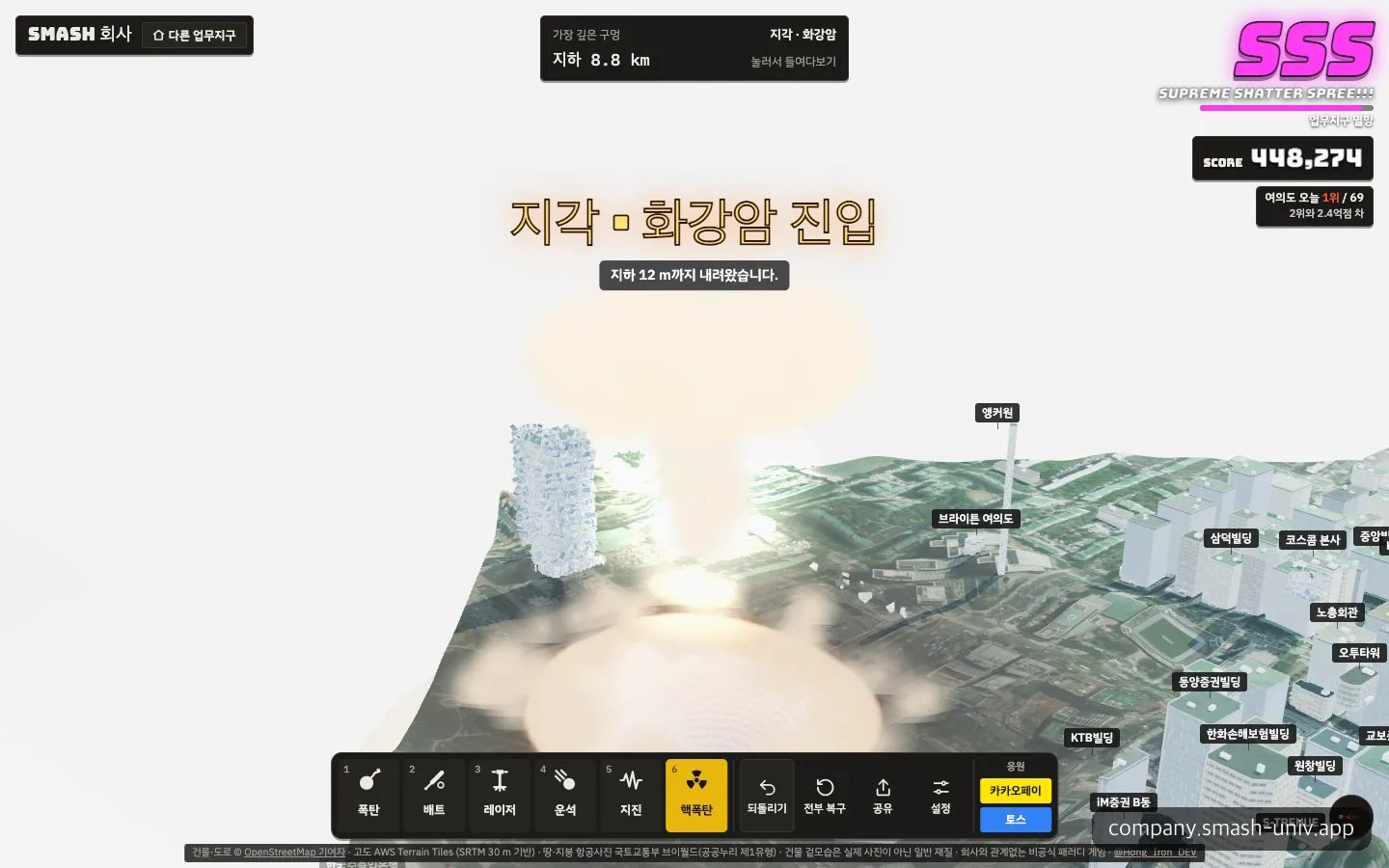
A few seconds later, a mushroom cloud rises, the score jumps into the 440,000s, and a depth message appears.
After about five seconds, a mushroom cloud rises, the building scatters into debris, and the score climbs to 448,274. A message such as “Entered crust and granite, reached 12 m underground” is a small pleasure too. The top grade came in under a minute, so the reward is very quick. It fits a five-minute break, and playing it yourself makes it obvious that this short burst of satisfaction is what turns into a clip worth sharing. Nothing in the game depicts people getting hurt, and a line reading “Unofficial parody game unaffiliated with any company” stays on screen at the bottom.
How Do the Similar Games Differ?
After SMASH University took off, games with the same idea appeared in Korea and abroad. Even a comparison of just their home screens shows quite different characters.
| Item | SMASH University | SMASH Company | Campus Crusher | School Smashing (학교 부수기) |
|---|---|---|---|---|
| Targets | 337 Korean university campuses | 69 business districts | 2,242 campuses in the U.S., Canada, the U.K., the Netherlands, and Mexico | About 12,000 elementary, middle, and high schools and universities |
| Relationship to the original | The original | Sister game by the same developer | States directly that it was “inspired by SMASH University” | No relationship shown on the page |
| Includes elementary, middle, and high schools | Deliberately excluded | Not applicable | Mostly universities | Included |
| Ranking | School vs. school | Business district vs. business district | School vs. school (over 51,000 participants) | Has a ranking screen |
Based on each site’s home screen as of November 12, 2026
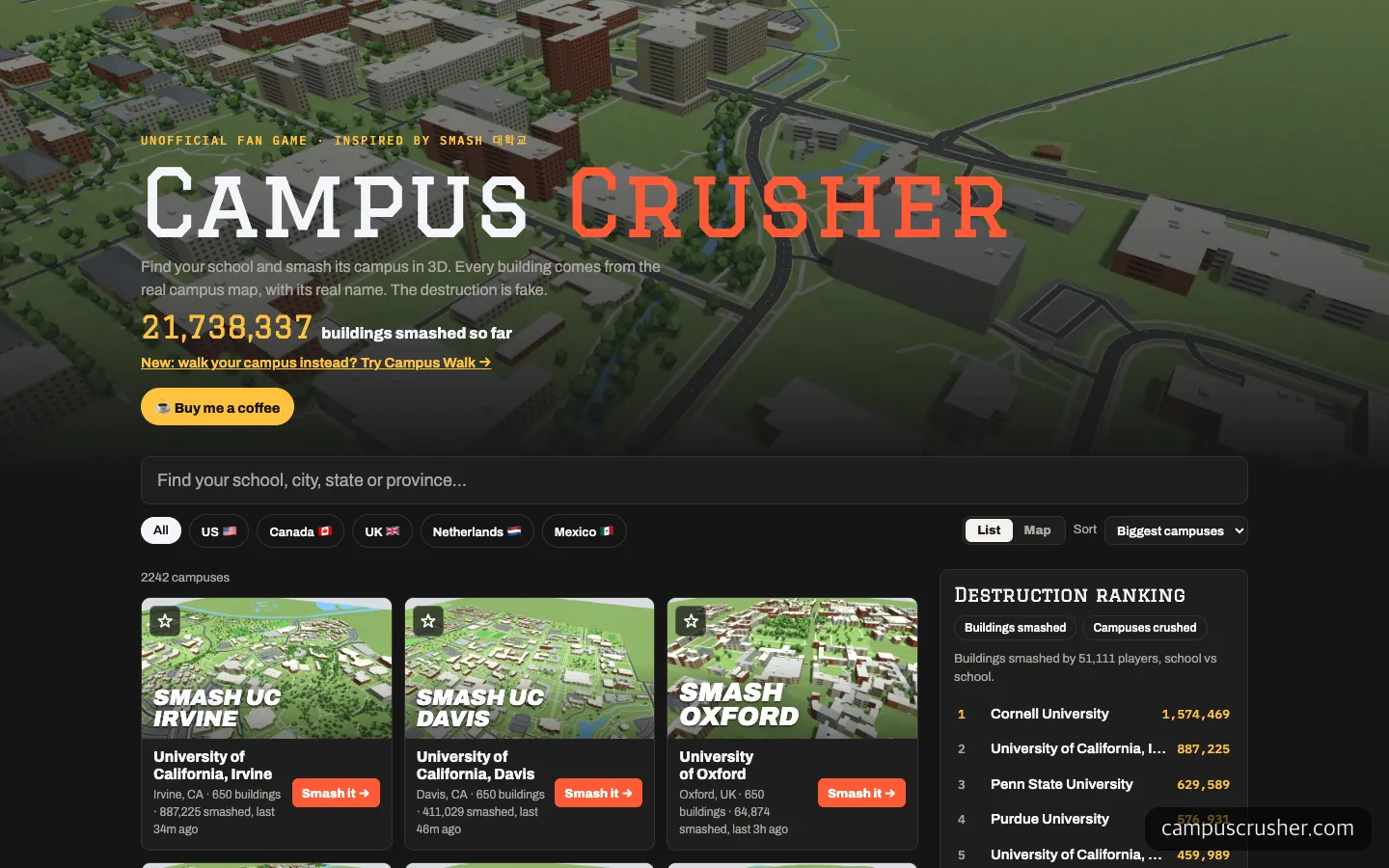
The overseas version, Campus Crusher, says in its first line that it was inspired by SMASH University.
Campus Crusher is an English-language version made by an anonymous solo developer, and its first line names the original in Korean as is. The number of buildings destroyed has passed 21.73 million, and Cornell University is first in the ranking. A Korean college student’s exam-season joke has crossed the ocean, just like that.
School Smashing has a similar setup, but its list mixes in elementary, middle, and high schools. On its home screen it shows 372,000 rounds played and 7.17 million buildings destroyed. The page doesn’t say how it relates to the original. Since it crosses the line the original deliberately drew, households with children will find the original the more comfortable choice.
The Letdowns, and the Questions That Remain
First, the ranking. Half the fun of this game is school-vs-school scores, but according to the site’s notice, score tallying had stopped because of a ranking server connection problem. On the SMASH Company side as well, it says visits that began piling up on October 23 exceeded the free limit of the ranking server, so the game still works but scores don’t accumulate. It shows that when a game made by one student gets 1 million visits, server costs are the first wall. That is also why the homepage has a donation option.
That donation bar is the second letdown. When I opened SMASH Company’s home screen on a phone, a KakaoPay and Toss donation bar covered much of the bottom of the screen, making the list hard to see. You can close it with the ×, but it is a rather irritating spot for first-time visitors.
The last is the uneven feel of the tools. The nuke is spectacular, but the default bomb has a weak one-hit effect, so someone who arrives and only clicks the default tool might leave thinking “Is that it?” When you get in, we recommend picking the nuke or the meteor from the tool panel first.
Frequently Asked Questions
Can I play on a phone?
Yes. The official site describes it as a game you play right in a phone browser. You don’t need to install an app, and you can close the donation bar at the bottom of the home screen with the ×.
I raised my score, but the ranking didn’t change. Is it broken?
The game itself is fine. As of November 12, the site carries a notice that score tallying has stopped because of a ranking server problem. You can still smash things as usual. The ranking also has a cap so that no single person can run up an excessive score, and the “Today” ranking resets at midnight every day.
Can I make a game like this with Claude Code too?
A prototype is closer than you might think. The developer built the first version in two hours, and the public repository shows a setup that strings together free services, with GitHub Pages for hosting and Supabase for the ranking. You will need to think separately about server limits and costs once crowds arrive, though. That is exactly what happened to SMASH.
If you and your friends go to the same school, it’s enough to drop one address into your group chat right after midnight, when today’s ranking resets.
Sources 7
AI helped with research and the first draft; the operator tried the subject firsthand, checked and edited this article before publishing. Let us know if you spot a mistake.