
Scroll through the vibe coding posts that spread best on Instagram, and Chiikawa stands out by a wide margin. Videos of Chiikawa waving from the corner of a coding screen and desktop apps dressed in Chiikawa skins draw the most reactions. The Chiikawa Codex pet is a fan creation: users take the “pets” feature that OpenAI added to its coding app Codex in May 2026, dress it up as Chiikawa, a character by the manga artist Nagano, and pass it around.
Chiikawa was also the first idea that came to mind for EasyTicket, a channel that had only just opened. But we didn’t build it, because copyright got in the way. This column examines, with evidence, the question that stopped us: “Is it okay to build something with Chiikawa and post it or sell it?” To give the conclusion first, here is how EasyTicket sees it. Using it alone on your own computer is one thing, and showing it to others is another. The moment money changes hands, the risk goes up another step. And the single line “unofficial fan work” does not stand in for permission at any of those stages.
Chiikawa in the Corner of Every Feed
It started with one feature. According to gihyo.jp, on May 1, 2026 (US time), OpenAI unveiled “Codex pets,” animated companions in the Codex app that show the status of your work. There are 8 default pets, and the hatch-pet skill lets you create your own pet with AI. The output is just one image (a sprite sheet) and one short config file, so it is easy to move and share. Asia Economy reported in early May that more than 600 characters had already been uploaded to a single pet-sharing site.
Chiikawa sits at the front of that wave. Open the Chiikawa pet on Petdex and a pixel-art Chiikawa starts moving right away, and installation takes a single command. As of November 2026, the page says it has been installed 458 times, and further down the same page a string of Chiikawa-family pets follows, including Hachiware. Each pet has 9 states, such as idle, running, waving, failed and review, so it is genuinely useful for people who work with coding agents. It is cute, useful and easy to install, which makes it a natural fit for spreading through a single video. It is no surprise that anyone aiming for virality looks its way.
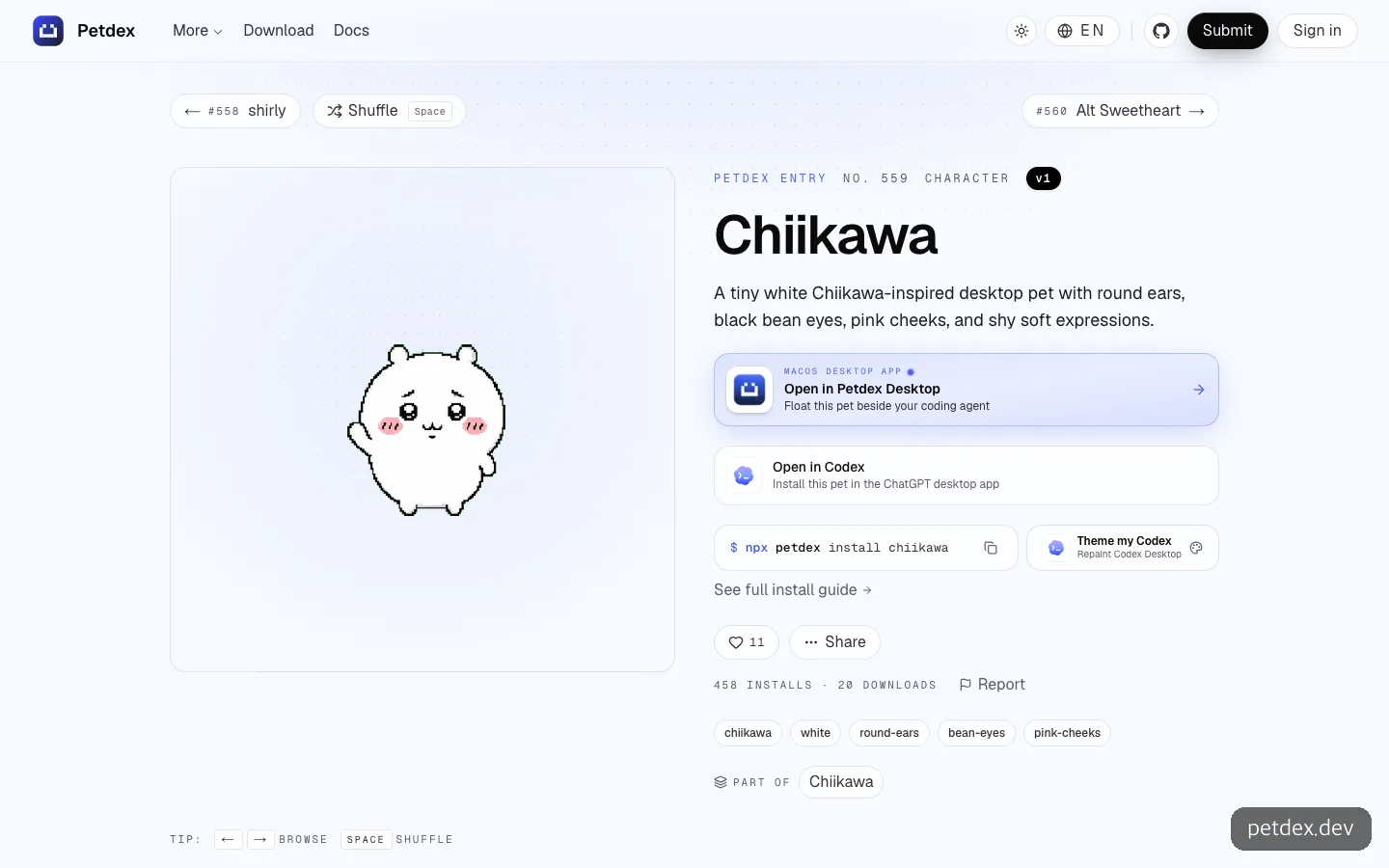
The pixel-art Chiikawa pet installs with a single command and shows 458 installs so far.
What “Unofficial Fan Work” Doesn’t Do for You
A look at how others are releasing these gives a sense of the landscape. I opened three places that distribute Chiikawa pets and apps. All three say the work is fan-made, but the strength of the disclaimer varies.
| Where it’s distributed | How it spreads | Money | Notice shown on screen |
|---|---|---|---|
| GitHub Chiikawa pixel pet repository (by a Korean developer) | One-line install command, 11 characters in one bundle | Free | Unofficial fan creation, rights belong to Nagano and other rights holders, no commercial use or redistribution, will be deleted immediately on request |
| Petdex | One-line install command | Free | Fan art uploaded by users, the site claims no rights to the original IP, report page available |
| itch.io “Desktop Chiikawa” | Windows program you download and run (about 91MB) | “Name your own price” (download free or pay what you like) | Only the wording “fan-made” and “Inspired by” |
One column in the table has a gap: evidence that the rights holder gave permission. None of the three places has such a statement, and as of November 2026 there is also no confirmation that the Chiikawa rights holder has issued an official guideline allowing derivative works.
The notice on the GitHub repository is among the most conscientious. The problem is that the repository that says “no redistribution” is itself distributing 11 characters with a single install command. You can forbid others from redistributing, but that wording does not give you permission to distribute it yourself. Petdex’s disclaimer is likewise a statement that “the site claims no rights,” which is separate from the original rights holder’s permission. The same goes for attaching an open-source license such as MIT to the code. That license covers the code you wrote and does not free up the character art.
The itch.io case is a little more delicate. The description says “Free Forever,” yet the download button on the same screen is set up so you can pay if you want to. It sits somewhere between free and for sale. However, you have to download the program to see it work, so I did not run it and checked only the page description and screenshots.
Is It Illegal to Build With Chiikawa and Distribute or Sell It?
There is no one-line answer. The criteria that decide it are fairly clear, though: how far you made it public, and whether money changed hands.
In September 2026 in Japan, a fan figure of a Chiikawa movie character made with a 3D printer became a controversy on social media. The maker said they were neither selling nor giving it away. In an interview with Bengoshi.com News, attorney Rio Saito saw making it in three dimensions as itself an “adaptation” that alters the original work. Her view was that enjoying it alone at home may be permitted, but taking a photo and posting it on social media raises reproduction and public transmission issues that must be examined separately. She added that being non-profit, or being common among fans, does not automatically make something legal. This is based on Japanese law, but it is a framework that people planning to post Chiikawa pet videos on Instagram can borrow as is. Aiming for virality ultimately means assuming it will be made public.
Korean courts have addressed the sales side clearly. According to the Korea Copyright Commission’s precedent materials, Seoul Central District Court Case No. 2025Gadan84830 (decided February 6, 2026) awarded damages for displaying products that carried images copied from an animation character without permission and selling them online. The summary gives no character name or amount, so we can’t tell whether it was a Chiikawa case. Still, the structure of “putting character art in without permission and selling it” is no different from a paid character app. The Seoul Southern District Court also treated a 2022 case of listing and selling key rings and figures that copied character designs without permission as copyright infringement of the economic rights.
Saying the AI made it for you is no shield either. The Ministry of Culture, Sports and Tourism and the Korea Copyright Commission’s guide for preventing copyright disputes over generative AI outputs (July 2025), as summarized by Law Times, a Korean legal newspaper, says that whether an AI output infringes is also judged by whether the creator worked from the original (access) and how similar the output is (substantial similarity). It held that responsibility for infringing outputs generally lies with the user who entered the prompt, and advised more careful review for public and commercial uses such as advertising and sales than for personal use. If you typed “make it look like Chiikawa” into hatch-pet, responsibility for the result falls on the person who typed it.
Laying the three sources out by stage gives this breakdown.
| Stage | Example | Weight the sources give |
|---|---|---|
| Using it alone | Showing a Chiikawa pet only on your own computer | May be allowed as private use (Japanese attorney’s view) |
| Free release | Uploading to GitHub or a pet-sharing site, posting a video of it in use on Instagram | Reproduction and public transmission must be examined separately, and non-profit is not automatically legal |
| Taking money | Paid app, donation button, pay-what-you-want | Korean precedent awarded damages for selling unauthorized character goods |
On physical goods, enforcement is already a reality. According to Focus Taiwan, Taiwanese police announced on October 22 that they had caught a container brought into Kaohsiung in July 2026 and declared as “daily necessities.” Among the seized goods suspected of infringing intellectual property rights, Chiikawa chopstick rests alone numbered 534.
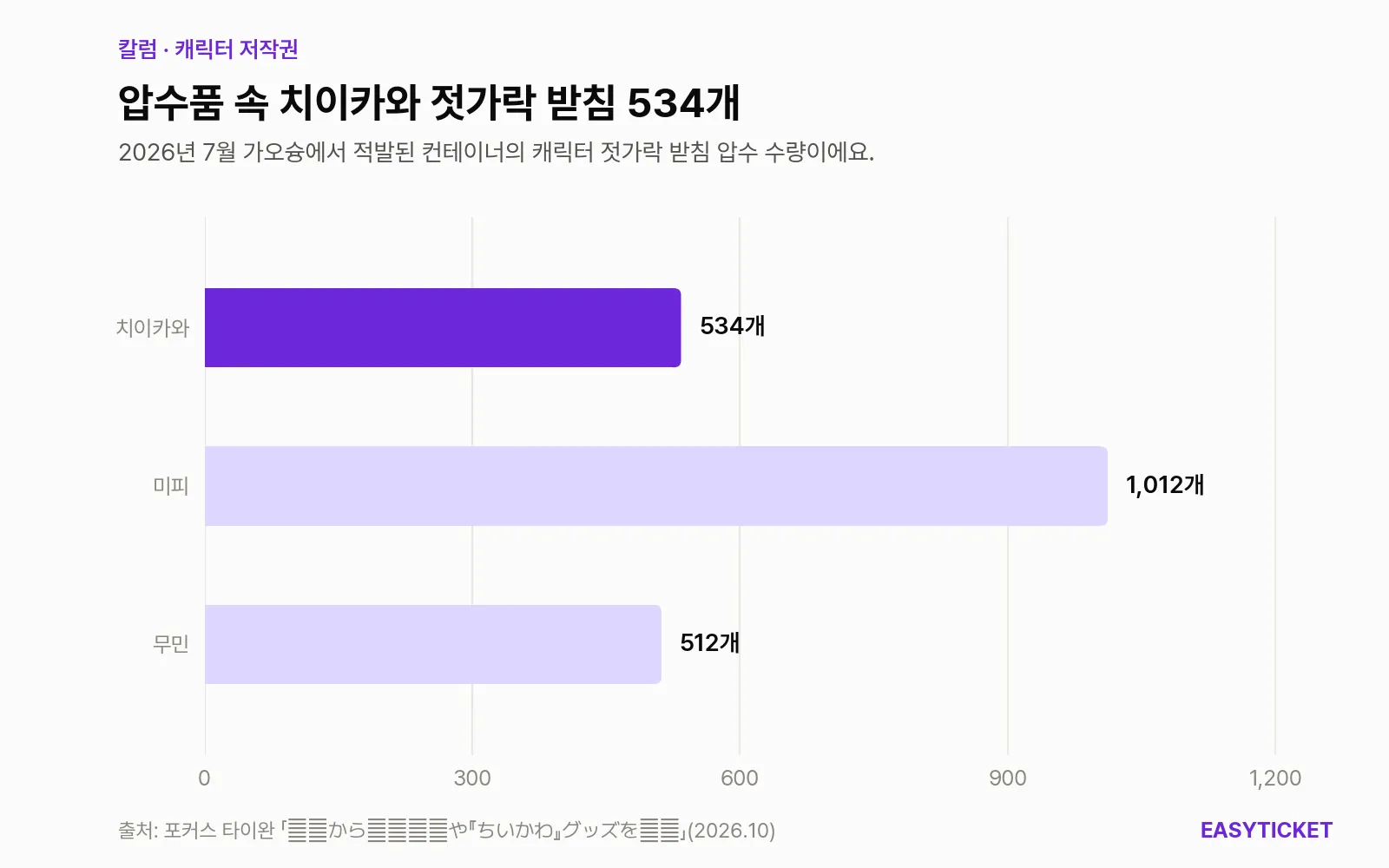
The number of character chopstick rests Taiwanese police seized on suspicion of intellectual property infringement.
In the chart, Chiikawa sits alongside Miffy and Moomin. That means it is treated as a character that sells, and the better a character sells, the more reason its rights holder has to protect it.
A Different View: Between Tolerance and Promotion
There is a clear opposing view. Fan works are a channel that spreads awareness of the original, and rights holders know that effect, so the view goes that they have looked the other way until now. As of November 2026, no official warning or lawsuit from the Chiikawa rights holder aimed at fan apps or Codex pets has been confirmed. The fact that pets installed hundreds of times remain available for download also seems to support this view. That is why you may wonder whether you’re being overly cautious while everyone else posts.
Still, tolerance is not permission. The rights holder’s silence now is just a state that can change at any time, and they have not handed their rights to anyone. The difference shows clearly in comparison with an IP that has stated its rules. In November 2025, Capcom released a derivative-work guideline that allows individual non-profit activity and recognizes hobby-scale for-profit activity, such as sales at doujin (self-published fan) events, as an exception. In return, it attached conditions: state that the work is derivative, and add the creator’s own creativity. For an IP with such a document, fans have a line to lean on, and for an IP without one, fans can only guess where the line is. Chiikawa is currently in the latter group.
The evidence this column relies on also has limits. For both Korean cases, the summaries alone don’t tell us which character was involved or how much the damages were. The Taiwan case involved counterfeit physical goods, so it can’t carry the same weight as a free digital pet. The Japanese attorney’s view is based on Japanese law, and it also remains true that laws differ by country. This is a piece that offers a framework for judgment and is not legal advice, so if money is at stake in your project, it is best not to skip the step of asking a professional.
Why We Chose Not to Build It, and the Paths That Remain
With all the evidence on the table, EasyTicket’s decision not to build a Chiikawa app was not excessive worry. Posting to the channel assumes making it public from the start, which means starting at the second row of the table. And if it got a good response and we added a paid version or a donation button, we would move into the third row. It is not a welcome conclusion. Leaning on a character people already love is the fastest way to grow a channel.
That doesn’t mean the road is blocked. The first path is making your own character. The Codex pet feature was opened up so that people could make their own pets with hatch-pet, and the result is entirely yours. If you plan to grow a channel over the long term, this is the right path. No matter how widely a Chiikawa pet spreads, it is remembered as Nagano’s character, but the more your own character spreads, the more it becomes the face of your channel.
The second is choosing an IP that has rules. If it is a company like Capcom that has issued guidelines, you can read the conditions and build within them. The points to check are whether it is non-profit, whether you stated it is a derivative work, and whether your own creativity went into it.
Third, if you still want to make something with Chiikawa, stopping at the level of using it alone is the safest. If you do release it, you should at least remove any structure where money changes hands. That applies not only to paid sales but also to donation buttons and pay-what-you-want.
What to Watch Next
The first is whether the Chiikawa rights holder will issue standards for derivative works. If they draw a line the way Capcom did, fan developers would have something to lean on, and this column’s answer could change then. The second is how the report pages on pet-sharing sites such as Petdex actually work. If cases appear of pets being taken down at a rights holder’s request, the “tolerance” view will lose strength. The third is whether the government guide on AI outputs becomes more specific about how far it treats a “similar character” as infringing.
You can make a viral hit with a borrowed character, but a channel lasts only with a character of your own.
Frequently Asked Questions
If only the people who want to pay do so, like “Name your own price,” isn’t that still not a sale?
Even if people can get it free, you have opened a channel for money to flow, so it is hard to call it purely non-profit. The Ministry of Culture, Sports and Tourism guide also says commercial uses such as sales call for more careful review. If you are worried, it is safer not to have any payment channel at all.
Is it okay if I redraw it slightly differently from Chiikawa?
Changing it alone is not enough. It is judged by whether you worked from the original (access) and how similar it is (substantial similarity). If anyone looking at it would recognize Chiikawa, the risk stays the same.
Can I make a Codex pet with my own character?
Yes. You can create your own pet with Codex’s hatch-pet skill. The result is saved as one image and one config file, so it is also easy to share with others.
Sources 8
- OpenAI、Codexアプリの作業状況を知らせるコンパニオン「Codex pets」をリリース (gihyo.jp)
- Chiikawa: Animated Codex pet (Petdex)
- heelee912/chiikawa-dots-pets (GitHub)
- ちいかわ自作フィギュアが物議、販売せずともSNS公開はNG?弁護士の見解 (弁護士ドットコムニュース)
- 中国から産業機器や「ちいかわ」グッズを密輸 輸入業者を摘発/台湾 (フォーカス台湾)
- 저작권판례(상세) 서울중앙지방법원 2025가단84830 (한국저작권위원회)
- 생성형 인공지능 결과물에 의한 저작권 분쟁 예방 안내서 주요 내용 (법률신문)
- カプコン 二次創作ガイドライン 公開 (ファミ通.com)
AI helped with research and the first draft; the operator tried the subject firsthand, checked and edited this article before publishing. Let us know if you spot a mistake.