 EasyTicket
 When it comes to cutting exchange and payment fees for overseas travel or online shopping from foreign retailers, travel cards are the biggest lever you have. Here’s the bottom line: the three leading options are Travel Wallet, Hana Travelog, and Shinhan SOL Travel, and all three offer 100% exchange rate benefits on USD, EUR, and JPY, making them far better than airport currency exchanges. That said, their ATM withdrawal fee waiver conditions and payment networks differ, so the key is choosing the one that matches your destination.
What Is a Travel Card?
A travel card is a reloadable, prepaid debit card that you top up with foreign currency in advance through an app, then use for payments and ATM withdrawals abroad. Because you exchange the currency ahead of time, you can save significantly on the fees that come with regular credit card overseas payments (typically around 1.2% of the transaction amount plus roughly 1% in brand fees).
There are three key factors:
- Exchange rate benefit: how much of a discount you get when you charge (exchange) currency
- Overseas payment and ATM fees: what gets deducted when you swipe or withdraw locally
- Payment network: whether the card runs on VISA, Mastercard, or UnionPay
A 100% exchange rate benefit means “exchanging at exactly the bank’s quoted base rate, with no markup.” That’s actually a better deal than a 90% discount at a bank teller window.
Comparing Exchange Rates and Fees on Major Travel Cards
Here’s a table summarizing the key terms of all three cards first. Figures are current as of 2026.
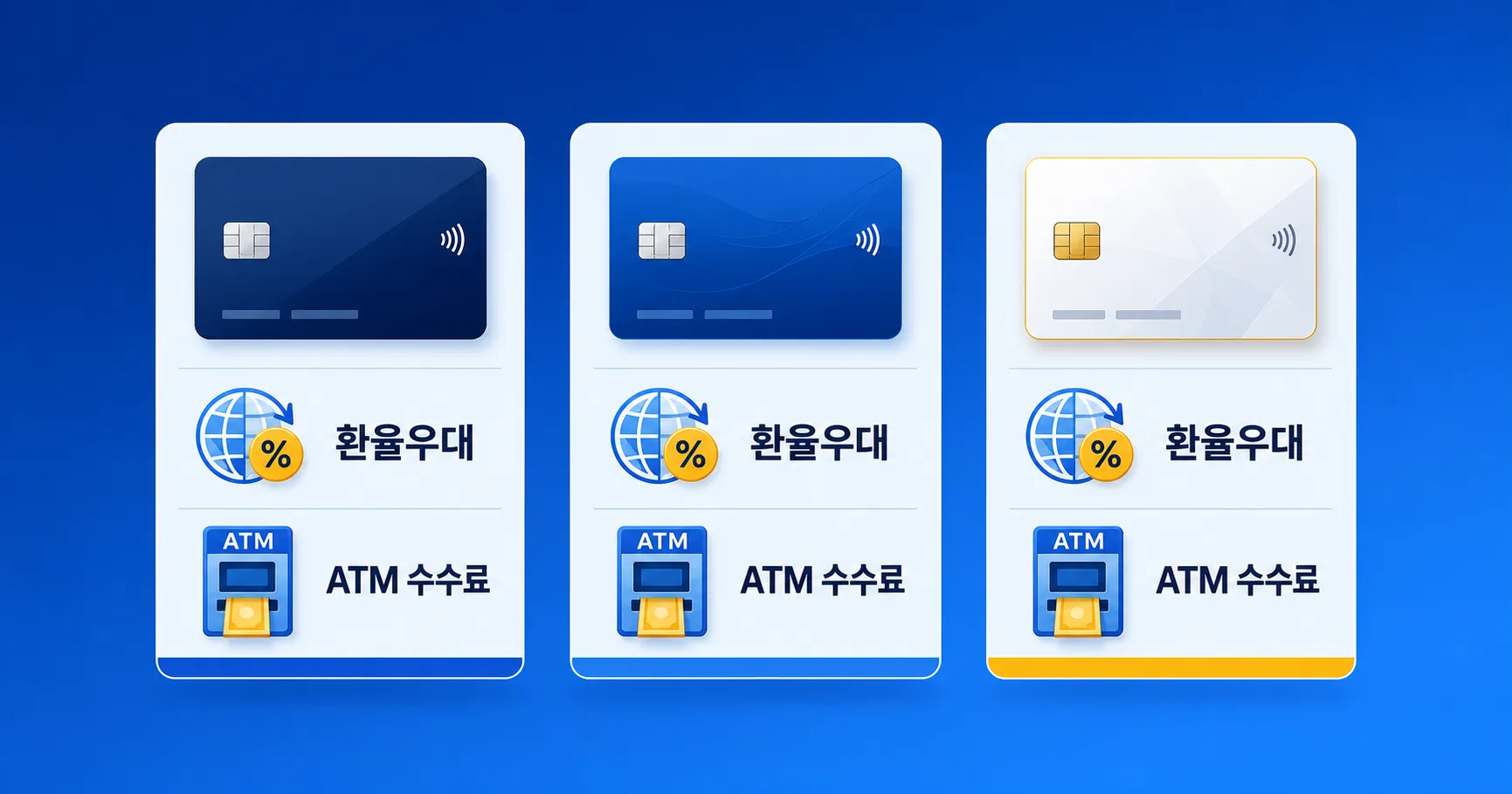
| Item | Travel Wallet | Hana Travelog | Shinhan SOL Travel |
|---|---|---|---|
| Exchange rate benefit | 100% for USD, EUR, JPY; 0.5–2.5% for other currencies | 100% for major currencies (including promotional currencies) | 100% exchange rate benefit |
| Overseas payment fee | Waived | Waived | Waived (normally 1.2%) |
| Overseas ATM withdrawal fee | Free up to $500/month, 2% above that | Free at partner ATMs (local operator fees separate) | Waived (local operator fees separate) |
| Supported currencies | About 38 | Many (broad country coverage) | 42 countries’ currencies |
| Payment network | VISA | Mastercard, UnionPay | Mastercard |
All three cards offer a 100% exchange rate benefit on US, European, and Japanese currencies. The differences come down to other currencies, free ATM withdrawal limits, and which payment network is built in.
Travel Wallet: Pros and Cons
Travel Wallet runs on the VISA network, so it works well across the US, Europe, and Southeast Asia, where VISA merchants are common. You can charge and exchange currency directly in the app, and it supports around 38 currencies.
- Pros: VISA payment network, fast charging and refunds, 100% exchange rate benefit on USD, EUR, and JPY
- Note: A 0.5–2.5% exchange fee applies when charging currencies other than USD, EUR, or JPY
- ATM: Limits of $400 per transaction, $1,000 per day, and $2,000 per month. Withdrawal fees are waived up to $500/month, with a 2% fee above that (local ATM operator fees are separate)
Travel Wallet’s free ATM withdrawals are capped at $500 per month. If you’re planning to withdraw a lot of cash, check this limit in advance.
Hana Travelog: Pros and Cons
Travelog supports both the Mastercard and UnionPay networks, giving it an edge in some regions where VISA has less presence, as well as parts of China and Southeast Asia. It supports a wide range of currencies and offers a 100% exchange rate benefit on major currencies, making it a good fit for trips that involve multiple currencies.
- Pros: choice of Mastercard or UnionPay, broad currency support, high ATM withdrawal limits (around $6,000/day, $10,000/month)
- Note: free ATM withdrawals apply only at partner ATMs, and local ATM operator fees can still apply separately
- Best for: withdrawing local currency at partner locations like convenience store ATMs in Japan
Shinhan SOL Travel: Pros and Cons
The SOL Travel debit card runs on Mastercard, offers a 100% exchange rate benefit, and waives overseas payment and ATM fees. Its standout feature is bonus travel perks, like two free airport lounge visits per year worldwide.
- Pros: 100% exchange rate benefit, airport lounge perks, supports currencies for 42 countries
- Note: the card issuer’s ATM fee is waived, but local ATM operator fees may still be deducted
- Best for: office workers who want lounge access and other perks on top of exchange rate savings
How to Maximize Your Exchange Rate Benefit
Even with the same card, how much money you end up with depends on your timing and currency choices when charging. Just following the checklist below can significantly cut your losses.
- Use a 100%-benefit card for major currencies — USD, EUR, and JPY get 100% on any of these cards, so there’s no need to exchange at a bank
- Check each card’s rate for minor currencies — fees (0.5–2.5%) for Southeast Asian and other currencies vary by card
- Check your destination’s payment network first — in regions where VISA has less coverage, a card that supports Mastercard or UnionPay (Travelog, SOL Travel) has the advantage
- Withdraw within the free ATM limit — Travel Wallet is free up to $500/month, with a 2% fee above that
- Watch for local ATM operator fees — separate from the card issuer’s waiver, the local machine itself may charge a fee
- Split up your charges during periods of sharp exchange rate swings — instead of charging it all at once, spread it out to average your exchange rate
- Check re-exchange fees on leftover foreign currency — see whether a fee applies when converting it back to won after you return
“Card issuer fee waived” and “local ATM operator fee” are two different things. If the local machine’s screen shows a separate fee notice, it’s usually better to choose payment in local currency rather than the displayed exchange rate (DCC, or billing in won).
Frequently Asked Questions (FAQ)
How much better is a travel card than a credit card?
Regular credit cards typically charge around 1.2% of the transaction amount for overseas payments, plus a brand fee on top. Travel cards waive this payment fee entirely. And since you charge the card at a 100% exchange rate benefit, you save on both the exchange and the payment side.
If I had to pick just one card?
If your trip is mainly to the US, Europe, or Japan and you won’t be withdrawing much cash, any of the three works fine. For destinations like Southeast Asia or China, where currencies are more varied or VISA coverage is weaker, Travelog or SOL Travel — which support Mastercard and UnionPay — are the safer choices.
Is ATM withdrawal really fee-free?
The withdrawal fee charged by the card issuer is waived. However, Travel Wallet is only free up to $500 per month, with a 2% fee above that. And across all three cards, a local ATM operator fee may still apply separately.
What do I do with leftover foreign currency?
You can re-exchange it back to won in the app, or keep it stored until your next trip. Re-exchange fees may apply depending on the currency and card, so check the terms in the app before withdrawing or re-exchanging.
Once you settle on your destination and payment habits, choosing a card isn’t hard. Major currencies get a 100% benefit on any card, so there’s little difference there — what really separates them is the payment network (VISA vs. Mastercard/UnionPay) and the free ATM limit. Pick the card whose network matches your destination, time your charges using the checklist above, and you can save substantially on exchange and payment fees.