
On Google Play, 415 people installed this game, and 288 of them deleted it. That is the scorecard through the end of October for a space game that launched on July 9, 2026. Planet Pop: Merge Pinball is a mobile game that EasyTicket’s operator built through vibe coding. You pull back and shoot planets, and when two of the same planet collide, they merge into a bigger one. It is a space merge pinball game, and it launched free on the App Store and Google Play in July 2026.
This game is special to its developer. From features to stages, it is the first game app the developer finished without writing a single line of code by hand. It even looked fairly polished. But the result was a failure. This article follows the whole arc in one go: why it was made, how it was made, and why the people who downloaded it left so quickly.
What kind of game is Planet Pop?
In one line, it is a puzzle that turns “the Suika Game, where you drop fruit” into “a space game where you shoot.” In zero-gravity space, planets do not fall downward. Pull a planet back and release it, and it flies the opposite way, bounces off the walls, and when it hits a planet of the same kind, it becomes the next size up. Judge your angles off the walls well, and you can set off chain merges for combos.
There are 11 planet stages. It starts at the asteroid, then runs through Mercury, Mars, Venus, Earth, Neptune, Uranus, Saturn, Jupiter, and the Sun, and ends with the black hole. On top of that come launch items such as lasers and shockwaves, a three-star challenge in every stage, daily attendance rewards, achievements, a planet encyclopedia, and space terrain devices such as bumpers, portals, and graviton slingshots. As of November 2026, the App Store description lists hundreds of stages, 59 achievements, and 6 launch tools. You can play without an internet connection, and your progress is saved on the device with no sign-up. It is a free game supported by ads (Google AdMob).
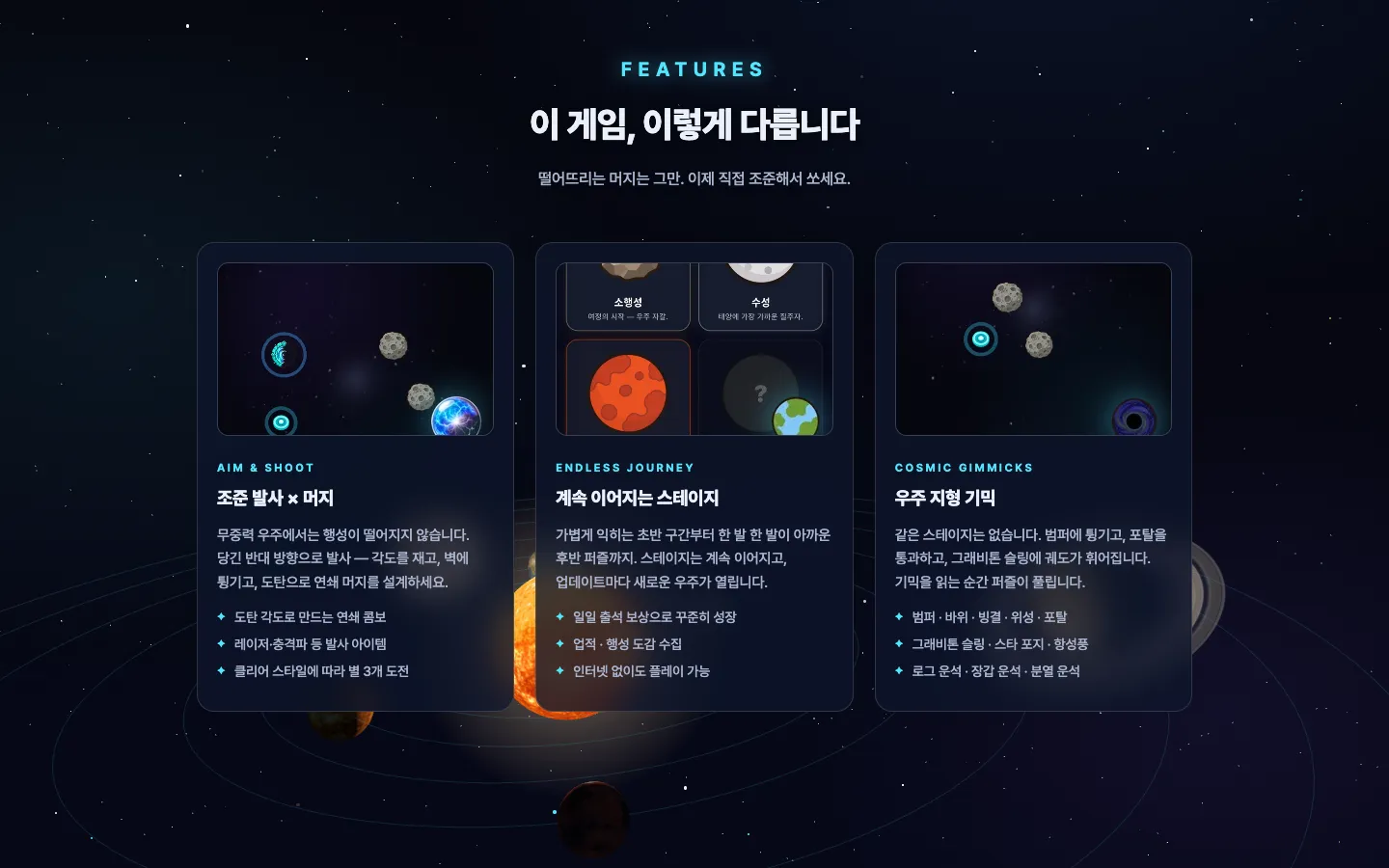
The intro page groups what sets this game apart into three points: aimed launches, connected stages, and space terrain devices.
Why shoot the watermelon?
The story goes back to before “vibe coding” became a common phrase. Even then, the developer made a great many games in Unity, asking AI one question at a time along the way. Several apps went up on the stores, but none of them was a real hit.
As AI got noticeably better, a question came up. Instead of the usual Unity, could a game be made from start to finish in Flutter, which is popular these days for vibe-coded apps? With an app toolkit rather than a game engine, and without fixing the code by hand?
The subject came from the hottest game of the moment, the Suika Game. According to Siliconera, the game spread among Japanese streamers in 2023 and then passed 10 million downloads across its official Switch, iOS, and Android versions (announced in June 2024). Watching that game, where you drop fruit from above and merge it, the developer thought something simple: I want to shoot the watermelon, not drop it. And what if the theme were space? The concept started from those two thoughts.
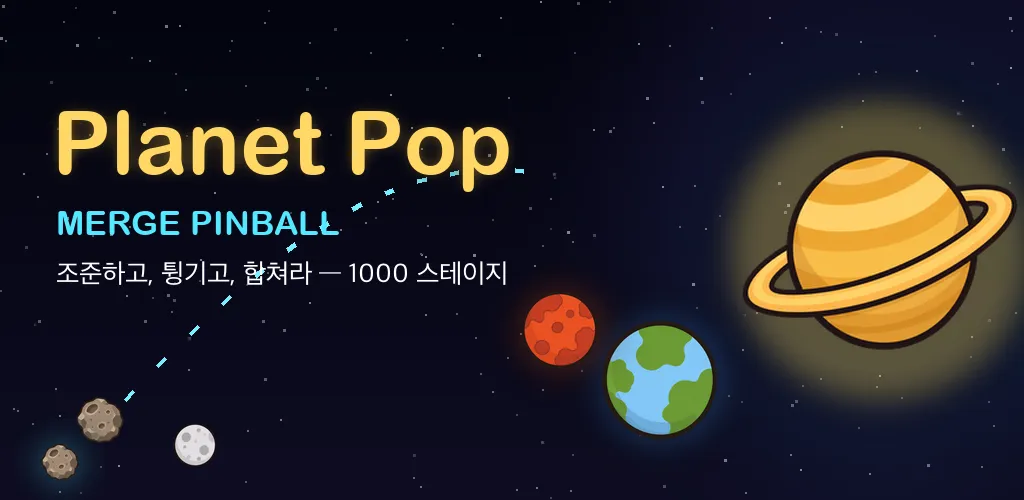
The main image used for sharing. It captures in one picture the flow of shooting a small asteroid and growing it into a big planet.
Swapping fruit for planets settled the stages on their own, because space already has an order that grows from small to large. The zero-gravity setting also fit the idea of “shooting.” Instead of dropping, you pull and shoot, and add the feel of a pinball bouncing off the walls. That is what “merge pinball” at the end of the name means.
The first game finished without a line of code
The biggest difference from the earlier games was scope. Not just the basic action of shooting and merging planets, but stage design, items, terrain devices, the encyclopedia, attendance rewards, and achievements were all built by telling the AI what to do in words, then checking the result and fixing it. The record this game holds is that the developer did not write a single line of code by hand.
Looking at the finished screens, that claim is no exaggeration. The encyclopedia hides planets not yet unlocked behind question marks, and the clear screen neatly shows three stars, the score, and next-stage and retry buttons. It does not look like a stock template. Flutter also has tools such as Flame (a 2D game engine) and Forge2D (a physics engine), so there is no reason a physics game cannot be built. To the original question, “Can a game be released from start to finish even in Flutter?”, the answer turned out to be “yes.”
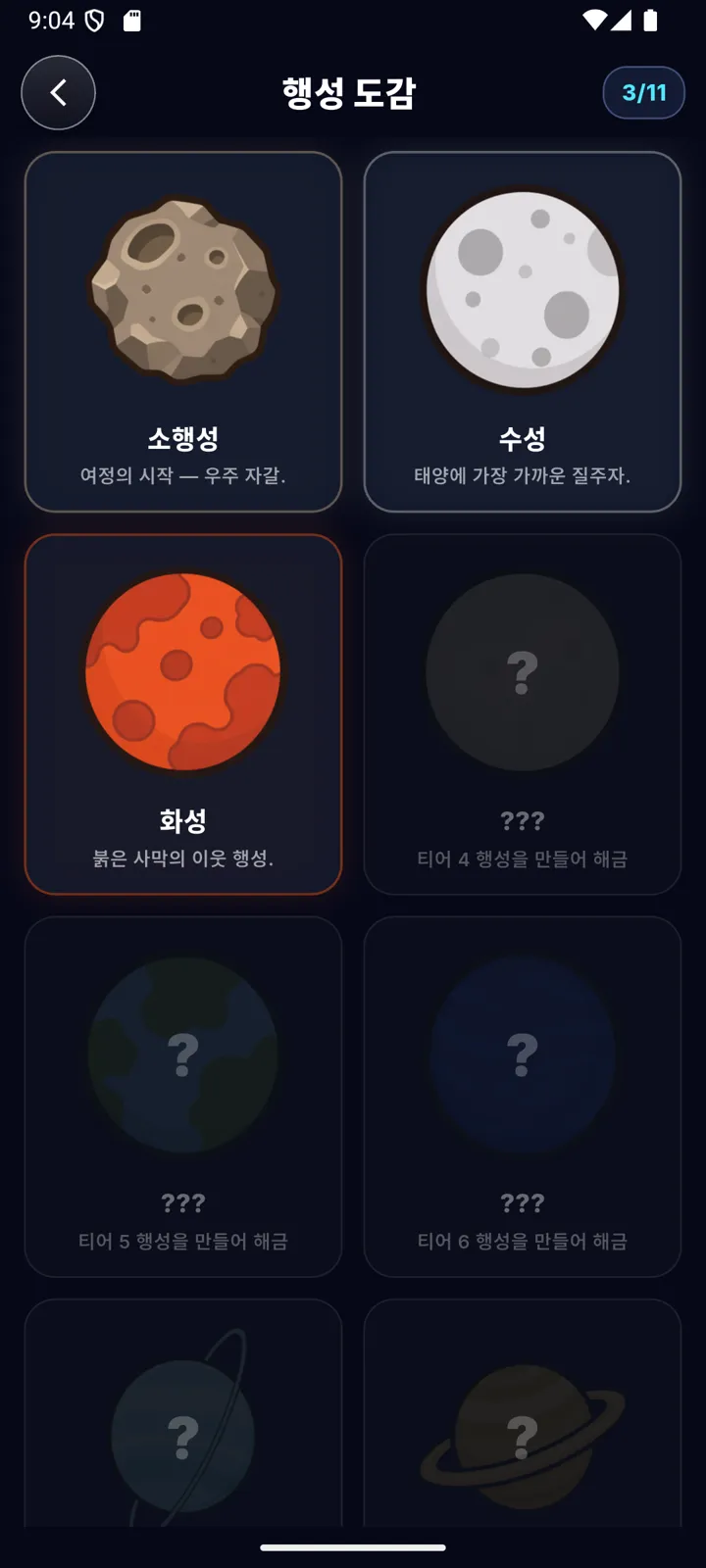
The planet encyclopedia. Of the 11 stages, only the planets you have made are unlocked, and the rest stay as question marks.
What is regrettable is that the developer did not separately write down where things got stuck during development or how they were resolved. All that remains is the finished game and the developer’s retrospective. That retrospective is the key to the rest of the story. Features kept growing, but when the developer played it personally, it did not feel “incredibly fun.” The feature list got filled in all along, but the feel of the first round was never held onto and polished to the end.
How many downloads after launch?
Since it looked polished, expectations rose too. Thinking ad revenue might be worth a try, the developer ran a small Google ad campaign, and launched worldwide, not just in Korea. The thought was that somewhere, someone would enjoy it.
From launch on July 9 through October 31, 557 people newly downloaded it across the two stores. That is 142 first-time downloads on the App Store and 415 new installs on Google Play (Google Play figures run through October 26). On the App Store, there were also 13 separate cases of people who deleted it and downloaded it again.
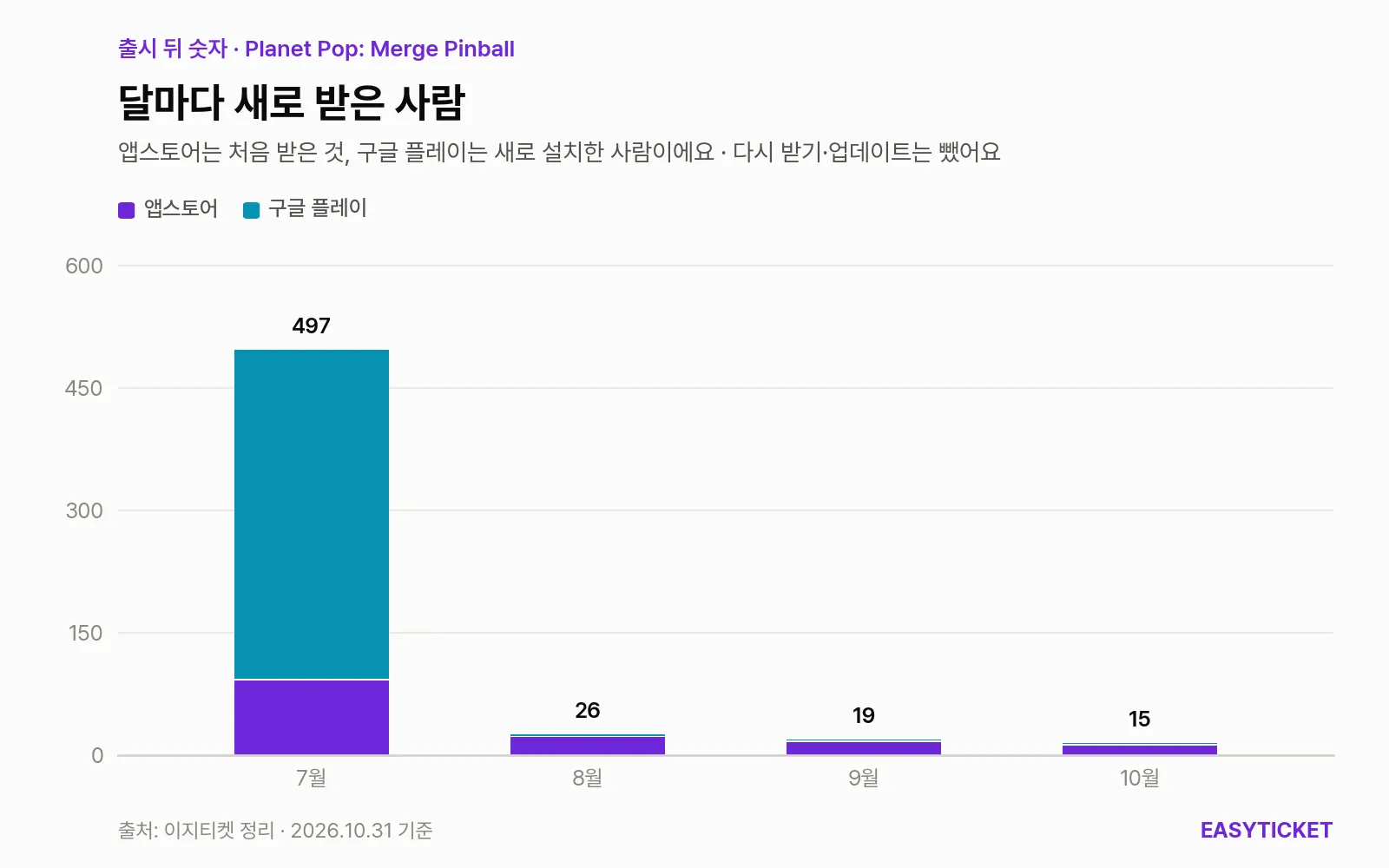
New downloads by month. July alone accounts for most of the four-month total.
The graph says one thing. Of the 557 people, 497 downloaded in July (92 on the App Store, 405 on Google Play). After that it fell to 26 in August, 19 in September, and 15 in October, and looking at Google Play installs alone, there were only 10 across the three months from August to October.
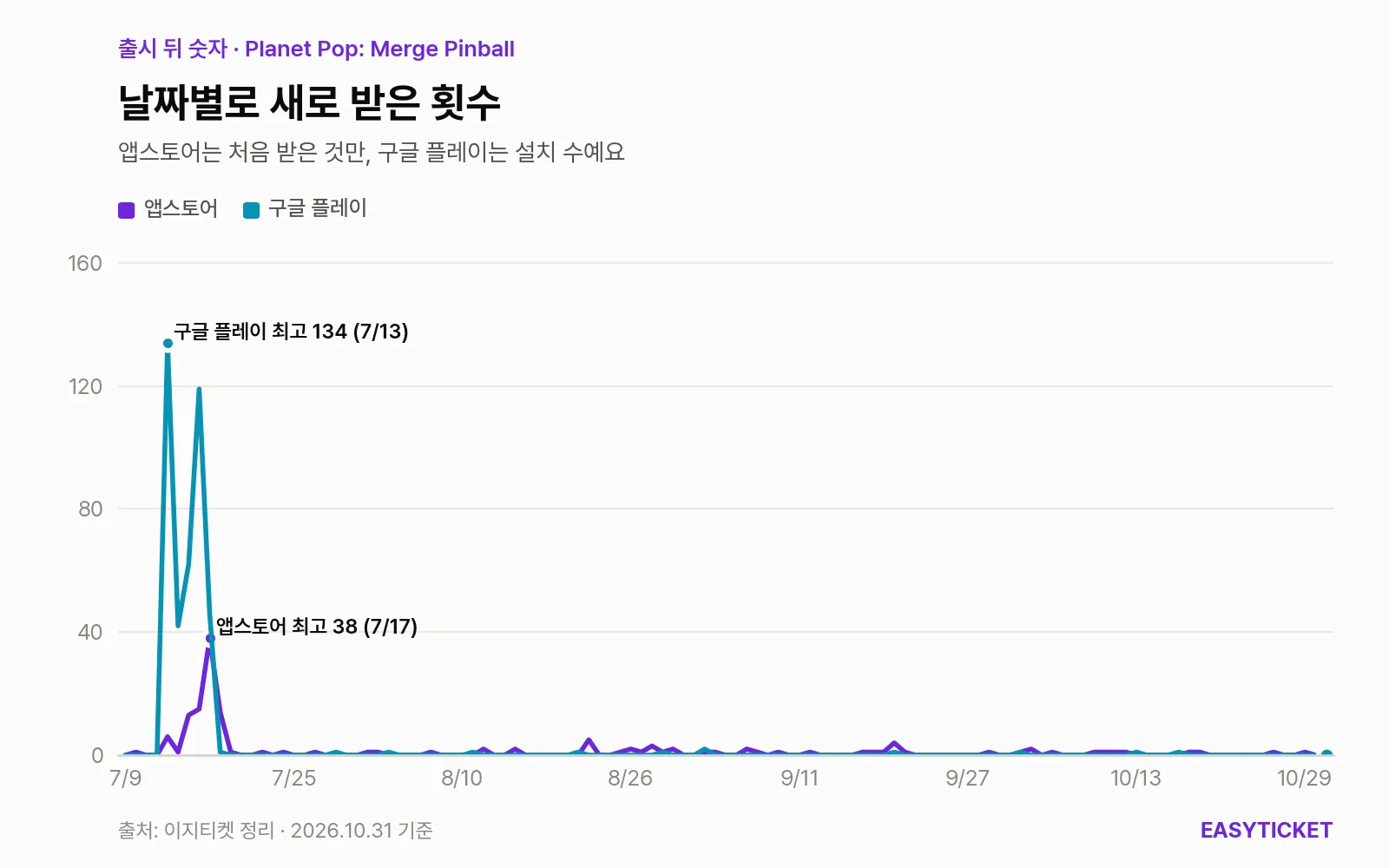
New downloads by day. Five days in mid-July spike, and after that the line sticks to the floor.
Breaking it down by date makes it even clearer. Google Play installs began with 134 on July 13, 403 piled in over the five days through the 17th, and then it cut off sharply to 1 on the 18th. The App Store saw 80 downloads in the same week (the 15th to the 18th). Word of mouth does not stop overnight like this. The start and end are cut clean, as if something was switched on and off, so it is natural to think that most of the people those five days brought in came from the small Google ad campaign the developer ran. The countries of the downloaders are spread widely, like a trace of that. On Google Play the order was Korea with 98, India with 87, Bangladesh with 46, and Nepal with 21, and on the App Store it was the United States with 40, China with 38, Korea with 14, and the Philippines with 11. The App Store downloads came from 88 iPhones and 53 iPads.
The problem is what happened after the download. Of the 415 people who installed on Google Play, 288 deleted it. That is nearly seven in ten. In July alone, 194 deleted it, and even in August to October, when almost no one was newly installing, 94 more deleted it. The people who downloaded in July quietly drained away over several months. As of October 26, the number of Android devices with this game installed is 107. In Korea alone, 98 installed it and 66 deleted it, leaving 34 devices.
Two things seem to have combined to cause so many deletions. One is the nature of the people who came in through ads. They were not looking for anything. They saw an ad in another app and tapped it, and if the first round does not appeal to them, they delete it right away. The other is the game feel the developer pointed to. A game that was not very fun even to the person who made it would have found it hard to hold on to strangers. It has now become an app that, in the developer’s words, almost no one downloads, with only about ten new downloads a month.
Two space games split in the search bar
In August to October, after the ads ended, 60 people newly downloaded the game across the three months. That is how many found it on their own without ads. The first cause the developer named lies here: not thinking about ASO (App Store search optimization). On the App Store, search is nearly everything. Apple says on its Apple Ads page that nearly 65% of downloads happen right after a search. In a Sensor Tower study reported by TechCrunch (May 2017 to April 2018), 56% of game downloads also came from search. The numbers are old, but the direction is the same.
Putting similar “space + merge” games side by side shows the difference. Below is what we saw on each App Store page on November 1, 2026.
| Planet Pop | Sputnika Game (Space Watermelon Game) | Planet Merge - Space x Merge | |
|---|---|---|---|
| Words in the name | Merge Pinball | Space Watermelon Game | Space, Merge |
| Style | Pull and shoot, zero gravity | Drop into a space with gravity | Tap or drag to shoot |
| Rating | 5.0 (1 rating) | 4.4 (74 ratings, Korea) | Not enough to display |
| Language listing | English only | Korean plus 2 others | English-language stores |
| Price | Free, with ads | Free, with ads; remove ads for 3,900 won | Free, with ads |
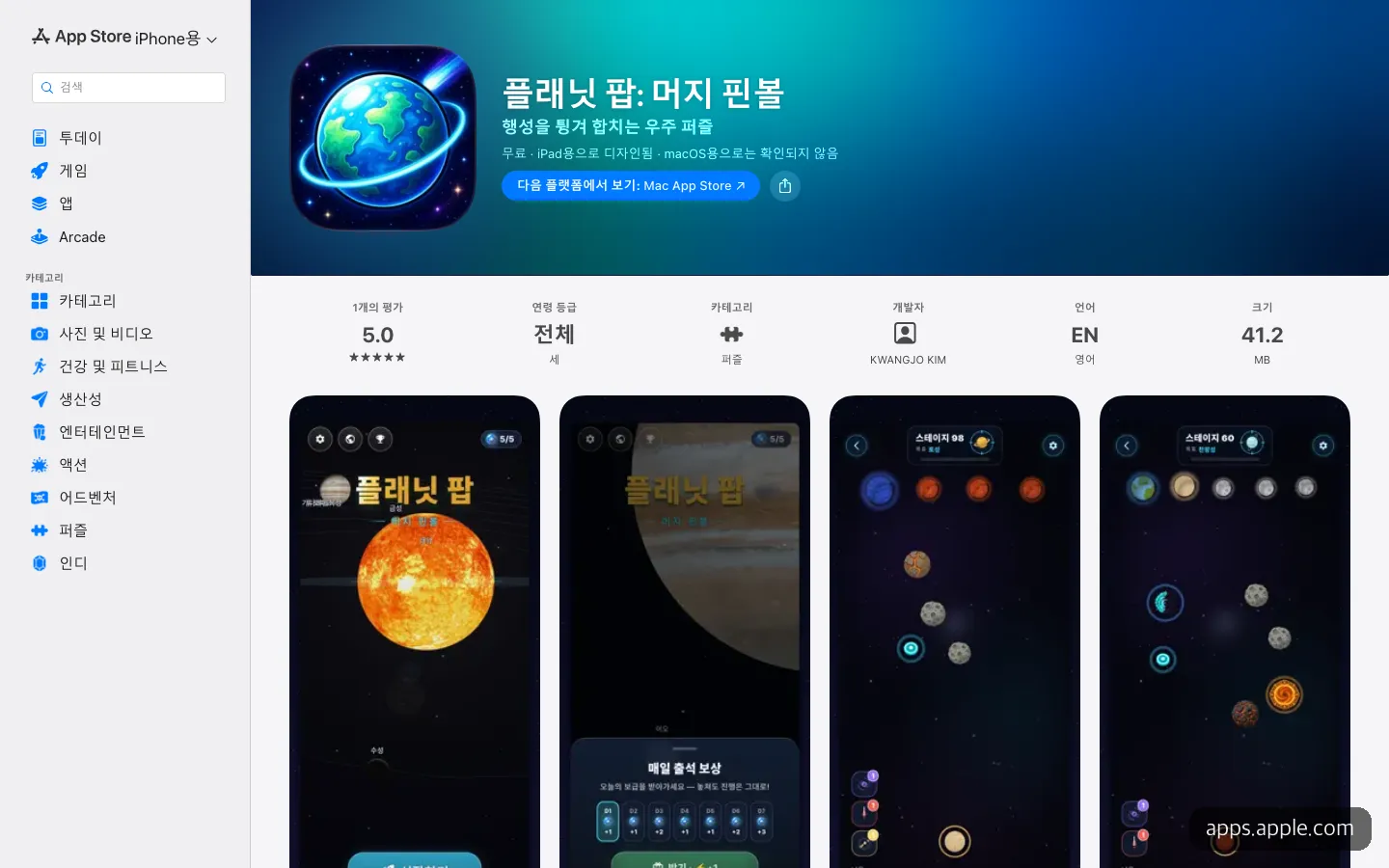
The Korean App Store page in the fourth month after launch. There is 1 rating, and the language field lists English only.
The biggest difference is the name. Sputnika Game puts “Space Watermelon Game” right in parentheses, and its subtitle is “A different kind of watermelon game.” Its name lines up head-on with what people type into the search bar when the Suika Game is trending. Planet Pop, by contrast, started from the Suika Game as its concept, yet the word “watermelon” appears nowhere in its name or subtitle. “Merge pinball” is an accurate phrase for the person who made it, but it was not a phrase that searchers had in mind.
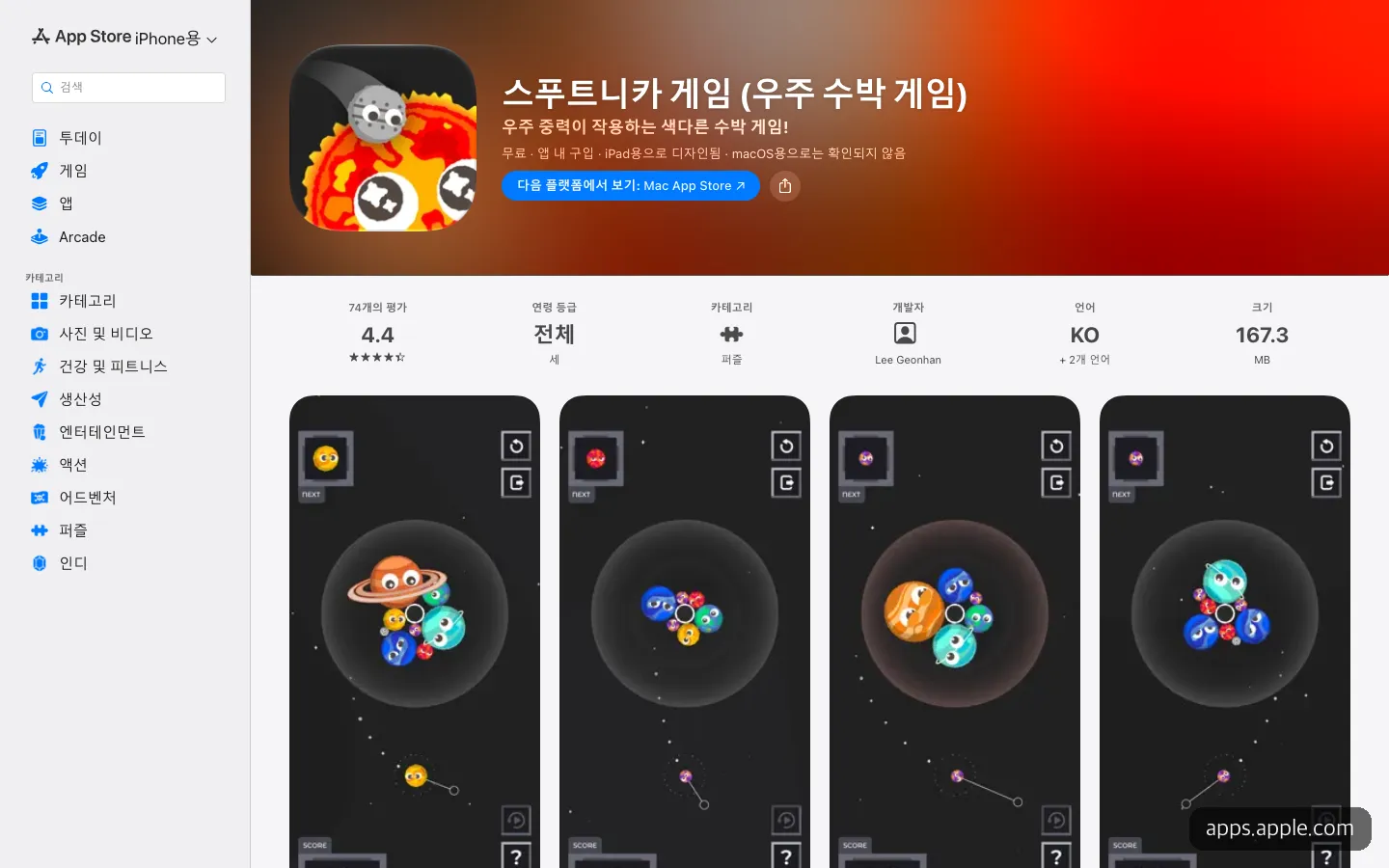
Sputnika Game, another space merge game, puts “Space Watermelon Game” right in parentheses in its name.
There is also a small mismatch. The app name on the Korean page is in Korean, “플래닛 팝: 머지 핀볼,” but the language field in the info section shows English only. The description says Korean and English are supported. It is unclear whether the game was aimed at Koreans or at the world. Decisions like this, regardless of how fun the game is, settle whether someone downloads it from the very first screen of the store.
The second cause hurts more, but it is the honest one: even the developer did not find the game very fun when playing it. The number of people who deleted it, more than two-thirds of installers, points the same way as that judgment. Of the 557 people who downloaded it, the ratings stalled at 1, and it should be seen as both causes working together.
Four things to fix before the next game
Whether to revive Planet Pop now is a separate question, but what to take care of first when making the next game has become clear.
1. Put the words people type into the name and subtitle. If the idea came from the Suika Game, words like “Suika Game” or “planet merge” should be in the name or subtitle. That installs dropped to around ten a month once the ads ended means almost no one was arriving through search.
2. Change the language to fit the countries that downloaded. Releasing worldwide was not in vain. It drew a fair number of downloads from the United States and China on the App Store, and from India and Bangladesh on Google Play. Yet the store language field says English only. The right order is to prepare a separate name, subtitle, and screenshots in the languages of the countries that actually downloaded it.
3. Show the feel of the first 10 seconds in video. A shooting game conveys its fun only when you see it move. Right now both the store and the intro page have only still images, so people download without seeing planets bounce and merge. A first round that did not match expectations led straight to deletion, so it makes sense to put a short gameplay video at the very top.
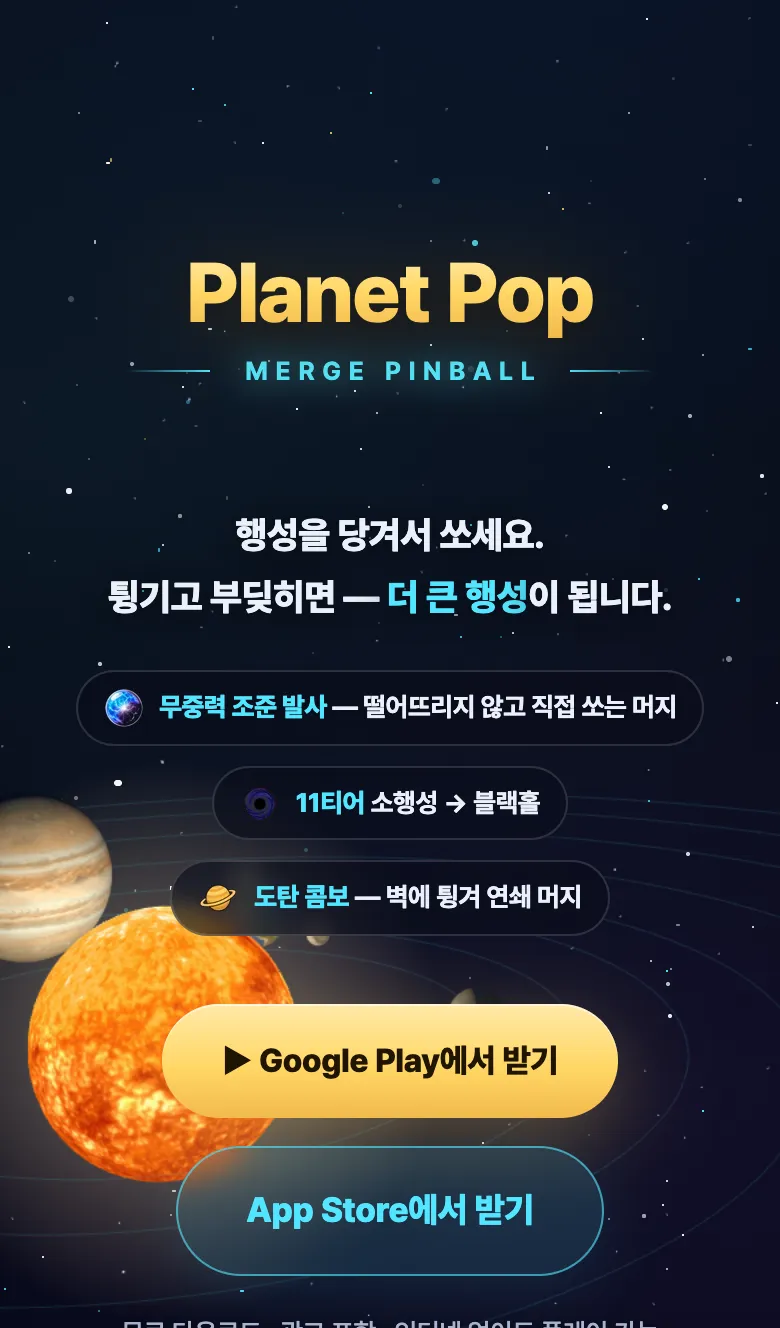
The first screen on a phone. The store buttons are large and easy to tap, but there is nothing showing the game in motion.
When you open the intro page on a phone, the first screen is clean. The store buttons are big and can be tapped right away. What falls short is that there is no way to see how the game moves before tapping those buttons.
4. Verify the fun before ads and features. The ads brought in more than 400 people in five days, but most of them did not stay. Vibe coding creates a similar trap. An encyclopedia, attendance rewards, and achievements can be added quickly, but they cannot substitute for the fun of the first round. It saves money and time to put a test build with only the basic action in someone else’s hands first, see whether “one more round” comes out of them, and only then add features and turn on ads. Promotion is the same. That there was never a single Instagram post about this game alone also means that the moment the ads ended, the way to spread the word ended too.
The developer calls this game a failure and still says they are satisfied. They confirmed that a game can be released from start to finish without code, and they learned from the numbers what happens when something is missing and the people who downloaded it leave quickly. For the next game, the search terms and the first 10 seconds should be decided before starting.
Frequently asked questions
Can I play on both iPhone and Android?
Yes. Since July 2026 it has been available on both the App Store and Google Play. You can play without an internet connection.
Is it an endless mode with a game over, like the Suika Game?
Planet Pop is stage-based. Each stage has a target planet, and if you make the target within your remaining shots, you get a result of 1 to 3 stars. The stages keep continuing.
Can I make a game with vibe coding even if I don’t know how to code?
This game was completed without the developer writing a single line of code by hand, so making one is possible. But being able to make something is a different matter from people finding it, downloading it, and sticking with it. AI will not decide the search terms for the name or the fun of the first round for you.
Sources 8
- Planet Pop: Merge Pinball 소개 페이지
- 플래닛 팝: 머지 핀볼 - App Store
- Planet Pop: Merge Pinball - Google Play
- Siliconera - Suika Game Surpassed 10 Million Downloads
- 스푸트니카 게임 (우주 수박 게임) - App Store
- Planet Merge - Space x Merge - App Store
- Apple Ads Advanced
- TechCrunch - Apple's App Store redesign improved app discovery, report finds
AI helped with research and the first draft; the operator tried the subject firsthand, checked and edited this article before publishing. Let us know if you spot a mistake.