
Open the AI Systems & Services category on Kmong, a Korean freelance marketplace, and you will find 426 listings lined up as cards (at the time of writing). A listing that unblocks you when AI-assisted development stalls starts at 33,000 won, and one that helps deploy a service built with vibe coding starts at 180,000 won. An AI-era side hustle for office workers means handing the work that once took months to learn, such as building sites, designs, videos and apps, over to AI and trying to earn money in the hours after work.
Here is how EasyTicket sees it. AI has clearly lowered the barrier to building things. But the money is not in mass production like blog automation. It is in building things for other people and in small products that carry something you have experienced firsthand.
Side hustles that were out of reach have opened up
A few years ago, putting up a website on your own as an office worker was not easy. You had to learn to code or hire someone, and even a product detail page design or a short video took a few weekends just to learn the tools. Now you describe what you want and a first draft appears. A landing page, an app screen, all of it.
The numbers show this shift too. When the Bank of Korea surveyed 5,512 employed people aged 15 to 64 nationwide in May and June 2025, 63.5% of workers had used generative AI. Those who had used it for work topped half, at 51.8%. The number of people with side jobs has grown as well. According to an analysis of Statistics Korea’s Economically Active Population Survey microdata by the Dong-A Ilbo (a major Korean daily), an average of 676,000 employed people per month held a side job in the second quarter of 2024, the most since 2014. In Shinhan Bank’s “2024 Ordinary People’s Financial Life Report,” the top reason for taking a side job was financial (61.9%).
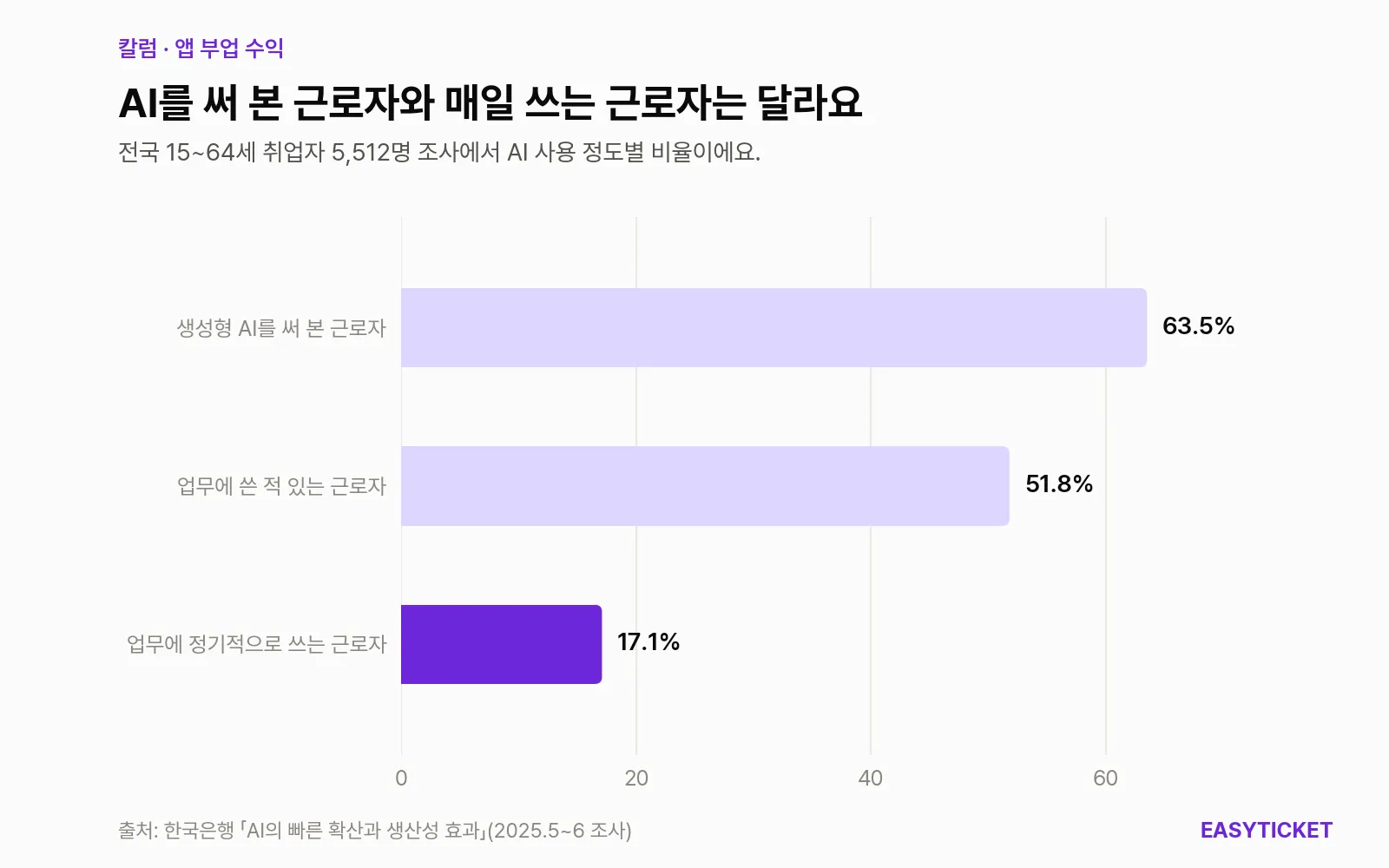
Six in ten have tried it, but fewer than two in ten use it regularly at work.
The bottom bar is the one to look at. Only 17.1% use it regularly for work. Many people have tried AI, but few have made it second nature. The side hustle opportunity sits in that gap, because people who can actually run AI with their own hands are still scarce.
Which AI side hustles are realistic for office workers?
We put the four most talked-about options side by side on the same criteria: what AI took off your plate, and where you get stuck.
| Side hustle | What AI took off your plate | Where you get stuck | EasyTicket’s take |
|---|---|---|---|
| Blog automation | Time spent writing | Google’s spam policy on “scaled content abuse” | We don’t recommend mass auto-publishing. Use AI as an assistant for reviews you write yourself |
| CPA and affiliate pages | Building and designing landing pages | Being judged “thin affiliate,” Fair Trade Commission disclosure rules | Only pages that add comparisons, prices and hands-on testing survive |
| Launching apps and web apps | Time spent learning to code | Revenue concentrates in top apps | Better treated as a portfolio and a path to freelance skills than as income |
| AI freelancing (building for others) | Implementing sites and automations | Price competition, collecting the first reviews | The most realistic first side hustle |
From the table alone, the first two look easiest. They get promoted as solo, automatic and running even while you sleep. But that “automatic” part is exactly where they get stuck.
Where blog automation and CPA pages get stuck
Blog automation means using AI to write posts in bulk and earning ad revenue. CPA marketing is an ad model that pays a fee per action, such as a visitor signing up or submitting an application. Both look better the more pages you make.
The problem is that search engines are aiming at exactly that behavior. With its March 2024 core update, Google introduced “scaled content abuse” as a new spam policy. Google’s spam policy documentation defines it as producing many pages mainly to manipulate search rankings, and says it applies regardless of how the content is generated. The first example listed is “using generative AI tools to generate many pages without adding value.” The same document treats pages that copy a seller’s product descriptions and just add affiliate links as “thin affiliate” pages. By contrast, it says affiliate sites that add original reviews, testing, pricing information and comparisons are valuable.
Naver, Korea’s largest portal, has moved too. According to MTN (Money Today Broadcasting), in May 2026 Naver added an “AI use” label feature to Blog, Cafe, Naver TV and Clip. The label is still only recommended for blogs, but it is mandatory for shopping ads, and violators can be removed from shopping search.
The moment you add an affiliate link, the law follows. When the Fair Trade Commission revised its guidelines on endorsements and testimonials in 2024, it required blog posts to disclose any financial interest in the title or at the start. Reviews that earn a commission through a purchase link are covered, and vague wording such as “may receive a commission” was listed as an example of unclear disclosure.
In short, blogs and CPA pages themselves are not blocked. What is blocked is stamping out content with no human experience behind it. If a page includes a product you tested yourself, an application process you went through yourself, and a table comparing prices, AI is a perfectly good tool for cutting the time it takes to write.
Apps got easier to build and harder to sell
Shipping an app with vibe coding has become a weekend project. As a result, apps are pouring out. In the foreword to its “State of Subscription Apps 2026” report, the CEO of RevenueCat, a subscription payments tool maker, wrote that new subscription apps went from a little over 2,000 a month three years ago to nearly 15,000 now. His view is that AI removed the supply constraint on apps, and demand will not keep pace.
The RevenueCat report covers revenue data from more than 115,000 subscription apps. Within two years of launch, 17.3% of apps reached $1,000 in monthly revenue, and 4.6% reached $10,000.
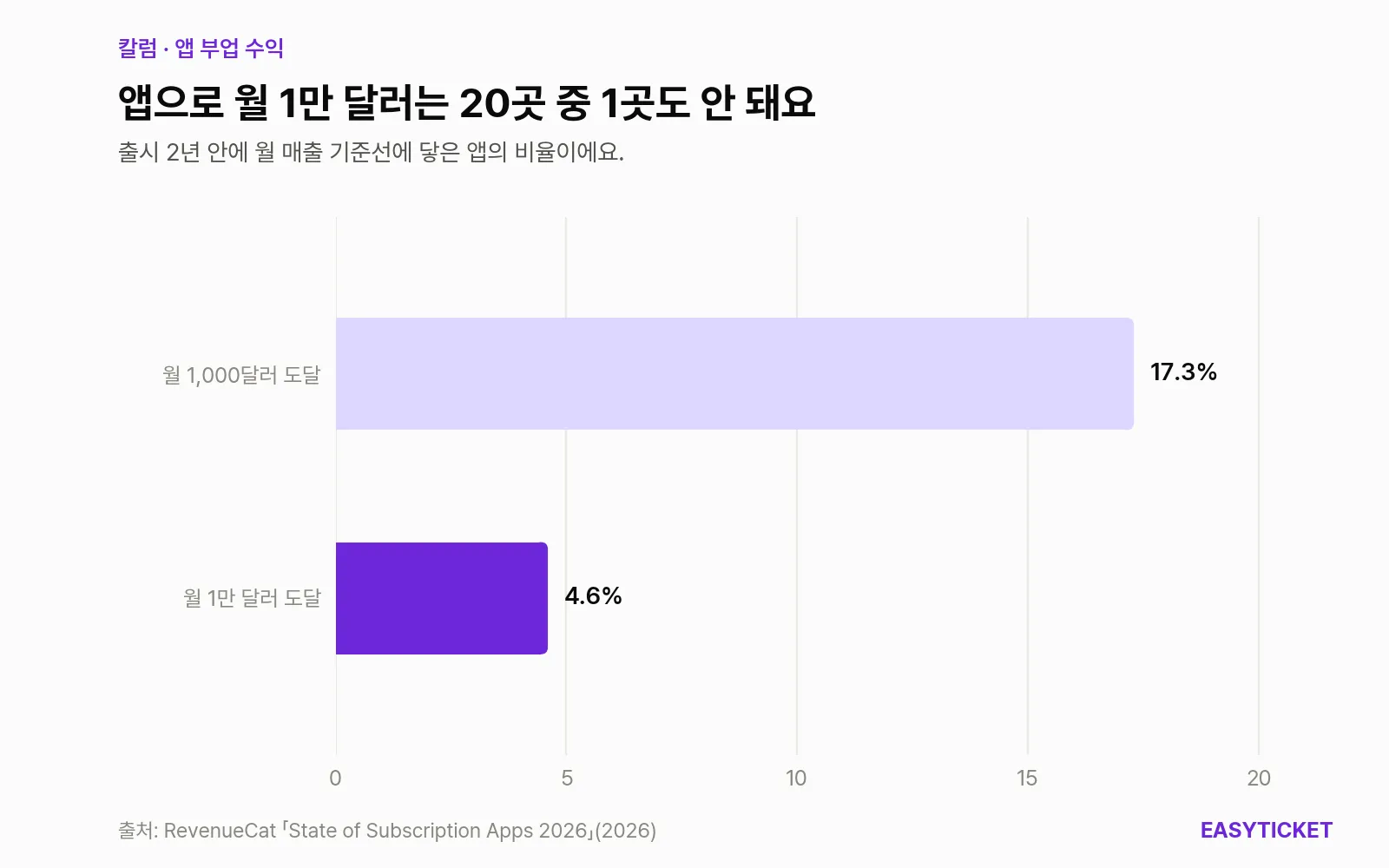
Among subscription apps, fewer than 1 in 20 reached $10,000 a month within two years of launch.
The chart says something simple. Four out of five apps still do not pass $1,000 a month, roughly 1.4 million won, even after two years. In the same report, the top 25% of apps grew more than 80% in a year, while the bottom 25% shrank 33%. Apps with AI features earned 41% more revenue per paying user, but their subscribers also canceled 30% faster.
So if you think of an app as a side hustle, it helps to reset your expectations. Earning a salary’s worth from an app alone is a story about a small minority. What an app does give you is the experience of seeing one through to the end, which becomes the strongest portfolio piece for the “building for others” side hustle in the next section.
Work is gathering on the building side
Few people can use AI well, while many companies and shops want to do something with it. The market that fills that gap is growing fast. According to Unicorn Factory, Kmong split AI freelancing into its own category in June 2025, and within nine months cumulative requests passed 12,000 (announced in April 2026). Over that time the number of AI experts more than doubled, and registered AI services topped 3,800.
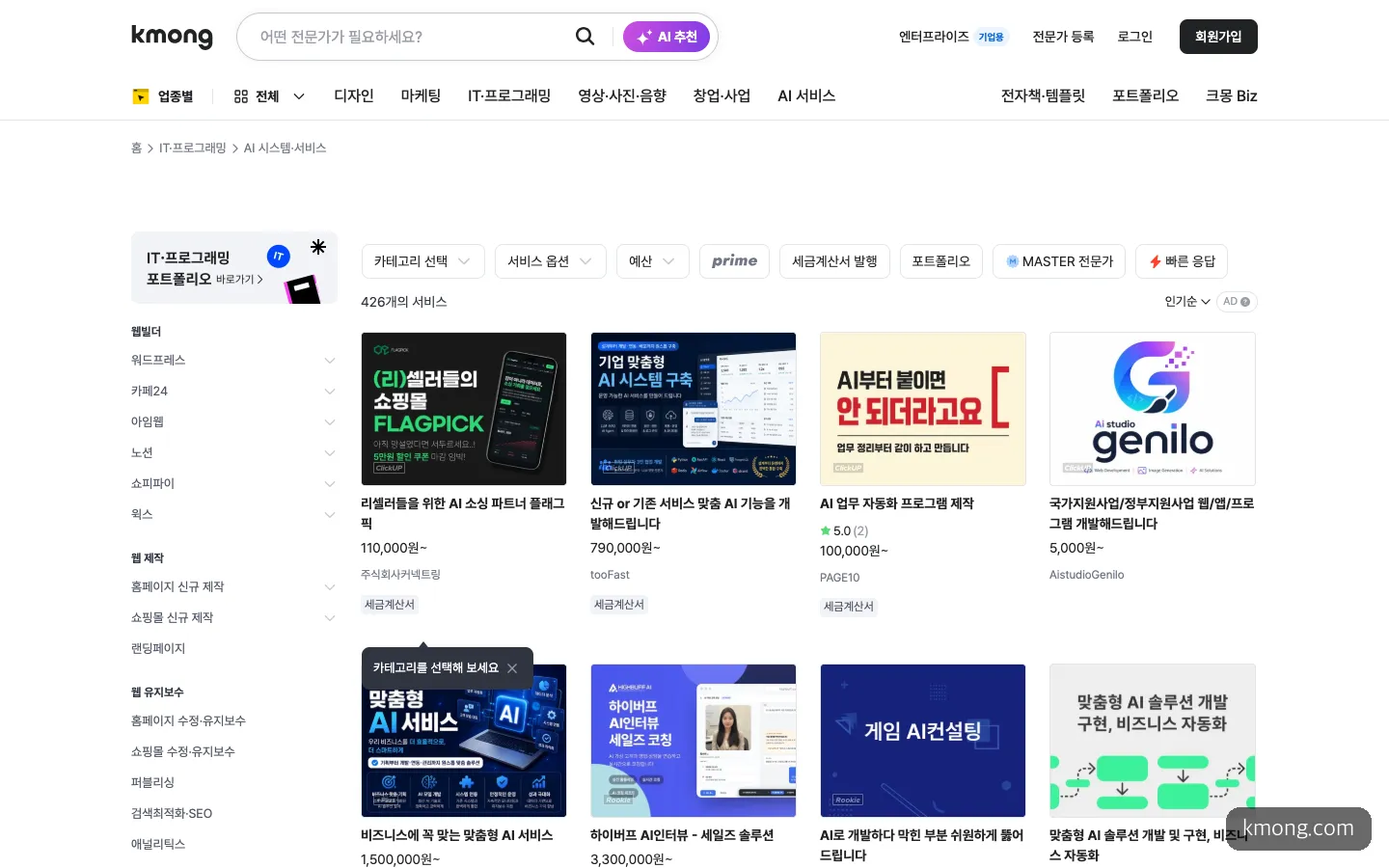
The Kmong AI Systems & Services category. Listings for everything from web development to AI automation line up in rows.
Browsing the Kmong AI Systems & Services category yourself, starting prices range from 5,000 won to 16.5 million won. The left-hand menu lists categories like “revenue automation” next to “build it for you” categories such as web development, app packaging and workflow automation. Among the top cards, many sellers had anywhere from one or two to a dozen or so reviews. That means plenty of newcomers have joined, and it can also be read as a sign that the field has not yet settled.
There are three reasons this approach suits office workers with a day job. You only spend time when work comes in, deadlines and prices are set up front, and knowing your own industry becomes a competitive edge. A former online shopping mall merchandiser (MD) building automation for sellers is one example. If you are starting out, it makes sense to list small, clearly scoped offers first, such as fixing a stuck problem or helping with deployment. Bigger jobs come only after reviews pile up.
On the other hand, the more people can build, the smaller each share gets
This column’s argument has a weak link. You are not the only person who can now build things.
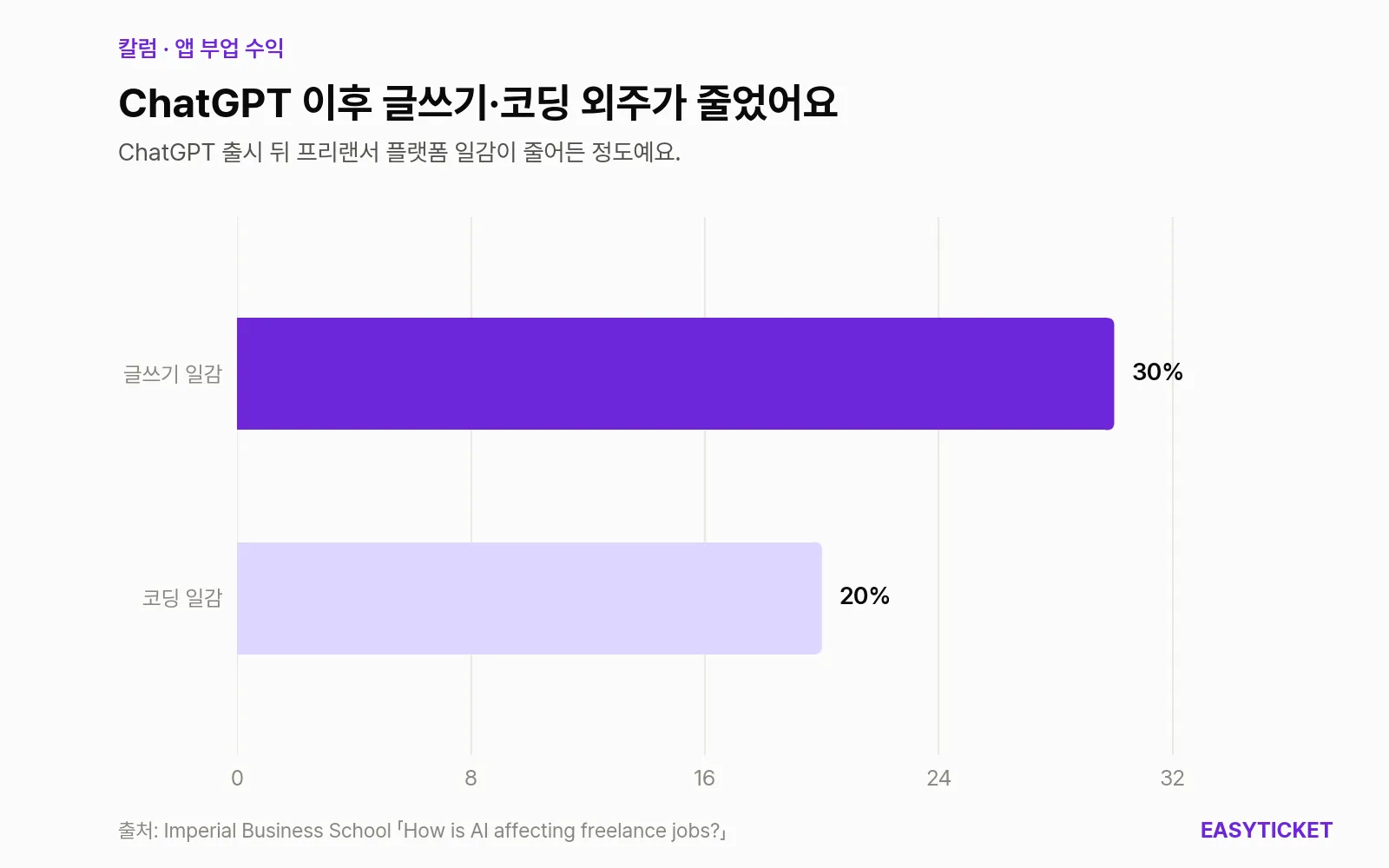
An analysis finds that writing and coding freelance jobs actually fell after ChatGPT arrived.
Research from Imperial College Business School and others found that after ChatGPT launched, writing jobs on freelance platforms fell 30% and coding jobs fell 20%. Work that clients can now do themselves with AI drops out of the freelance market. Read alongside the growth of AI freelancing on Kmong, the picture gets clearer. Simply writing text and code is shrinking, while demand shifts toward solving problems by stitching AI together.
You also have to count your time. In Korea Labor Institute data (January 2024) cited by the Dong-A Ilbo, multiple-job holders earned 210,000 won more in total monthly income than single-job workers, but their hourly income was 13,000 won, which was actually 3,000 won lower. A side hustle is, in the end, selling your time. It is easy to expect AI to shorten that time, but in the Bank of Korea survey, 54.1% of respondents said their working hours did not fall after using AI.
The numbers have limits too. The RevenueCat figures cover only subscription apps that use that company’s tools, so they do not represent apps as a whole. The Kmong figures were released by the company and include no breakdown of earnings by seller. And there is no credible statistic at all on how much people earn from blog automation or CPA pages. Most of the income screenshots you can find online come from posts selling courses or tools, so they are hard to use as evidence.
If you start with two hours after work
There is one question to ask when choosing an AI side hustle: “Does this output contain something I experienced myself?” If it does, a blog, an affiliate page or a freelance service is more likely to last. If it does not, you end up competing on price with tens of thousands of others who can press the same button.
There are three things to watch next: whether Naver’s AI label becomes mandatory for blogs too, how far prices for AI services on freelance marketplaces fall under competition, and whether the concentration of revenue in top apps grows worse amid the flood of new apps. All three point in a direction that favors those who put in what they have experienced over those who stamp things out.
If you pick just one thing to do this week, try automating one annoying task you repeat every day at your main job with AI. If it works, you have the description for your first freelance listing.
Frequently asked questions
Can I do AI freelancing with no coding knowledge at all?
You can start with small jobs. Kmong has many narrowly scoped offers, such as deployment help and workflow automation. But you need to be able to fix things when a client’s problem comes up, so it is safer to start after finishing one project of your own.
Are blog posts written with AI penalized in search?
Using AI alone does not get you blocked. Google’s policy treats mass-producing pages that offer users no value as spam, regardless of how they are generated. If your post contains content you tested and compared yourself, polishing it with AI is not a problem.
What wording should I include in a post with affiliate links?
Under the Fair Trade Commission’s guidelines, blogs must disclose that they receive financial compensation in the title or at the start of the post. Vague phrasing such as “may receive a commission” is treated as unclear disclosure, so it is best to state clearly that you are being compensated.
Can I make money by building an app as a side hustle?
It is possible but rare. In the RevenueCat report, 17.3% of subscription apps reached $1,000 in monthly revenue within two years of launch. Using the experience of building as a freelance portfolio is more realistic than relying on the app’s own income.
Sources 8
- 이투데이 「근로자 10명 중 6명 생성형 AI 사용…업무시간 1.5시간 줄여」(한국은행 보고서 인용)
- 동아일보 「부업 뛰는 직장인들… N잡러 67만 역대최대」
- Google Search Central 「Spam policies for Google web search」
- 머니투데이방송 「네이버, AI 생성물 표기 이중 기준...쇼핑은 의무·블로그는 자율」
- 뉴스서울 「공정거래위원회, 추천·보증 등에 관한 표시·광고심사지침 개정안 행정예고」
- RevenueCat 「State of Subscription Apps 2026」
- Imperial Business School 「How is AI affecting freelance jobs?」
- 유니콘팩토리 「'AI 외주' 서비스 따로 떼어냈더니…크몽, 누적 의뢰 1.2만건 돌파」
AI helped with research and the first draft; the operator tried the subject firsthand, checked and edited this article before publishing. Let us know if you spot a mistake.