
You finish an AI interview and close the window, and then no offer or rejection ever arrives. That is what 51% of people who completed an AI interview reported in a survey released in May 2026 by hiring software company Greenhouse. AI hiring means companies using artificial intelligence for résumé review, skills tests and interview evaluation. When Korea’s Ministry of Employment and Labor surveyed the country’s top 500 companies by revenue in August and September 2025, 86 of the 396 that responded (21.7%) said they use AI in hiring.
EasyTicket does not think the first question about AI hiring is whether AI picks better than people do. The bigger change is that while the cost of applying and the cost of screening both fall, a conversation with someone at the company has become the scarcest resource. This argument has clear weak points, so we lay those out too.
The cost of writing and the cost of screening both dropped
Start with the applying side. In a Greenhouse survey of 1,200 US job seekers released in October 2026, 77% said they used AI in their job search over the past year. 62% said they had tried to get past automated screening, and 40% of those said they had added skills or keywords they did not have. A third had planted hidden text meant to be read only by AI reviewers.
The receiving side leans on machines all the more. In a Fortune interview, Greenhouse CEO Daniel Chait called the loop in which roughly $20 auto-apply tools pour out applications and AI screens them, each feeding the other, an “AI doom loop.” The company figures he cited were an average of about 254 applicants per posting and a 412% increase in applications per recruiter. These are the company’s own numbers with no stated measurement period, so it is safer to read the direction than the size.
The oddest part of this loop is people who write with AI and then worry about looking like they used AI. In the same US survey, 60% said they had changed, or considered changing, how they write so their text would not read as AI-generated. Applicants and companies trade documents while each doubts whether the other side is human.
What the 81% does not say
The 81% on the cover comes from Greenhouse’s 2026 “Future of Hiring Candidate Report.” HCAMag reported that when 2,832 active job seekers aged 18 to 64 in five countries were asked, the share who had been rejected without any conversation with a company person in the past year was in the 80s in each country.
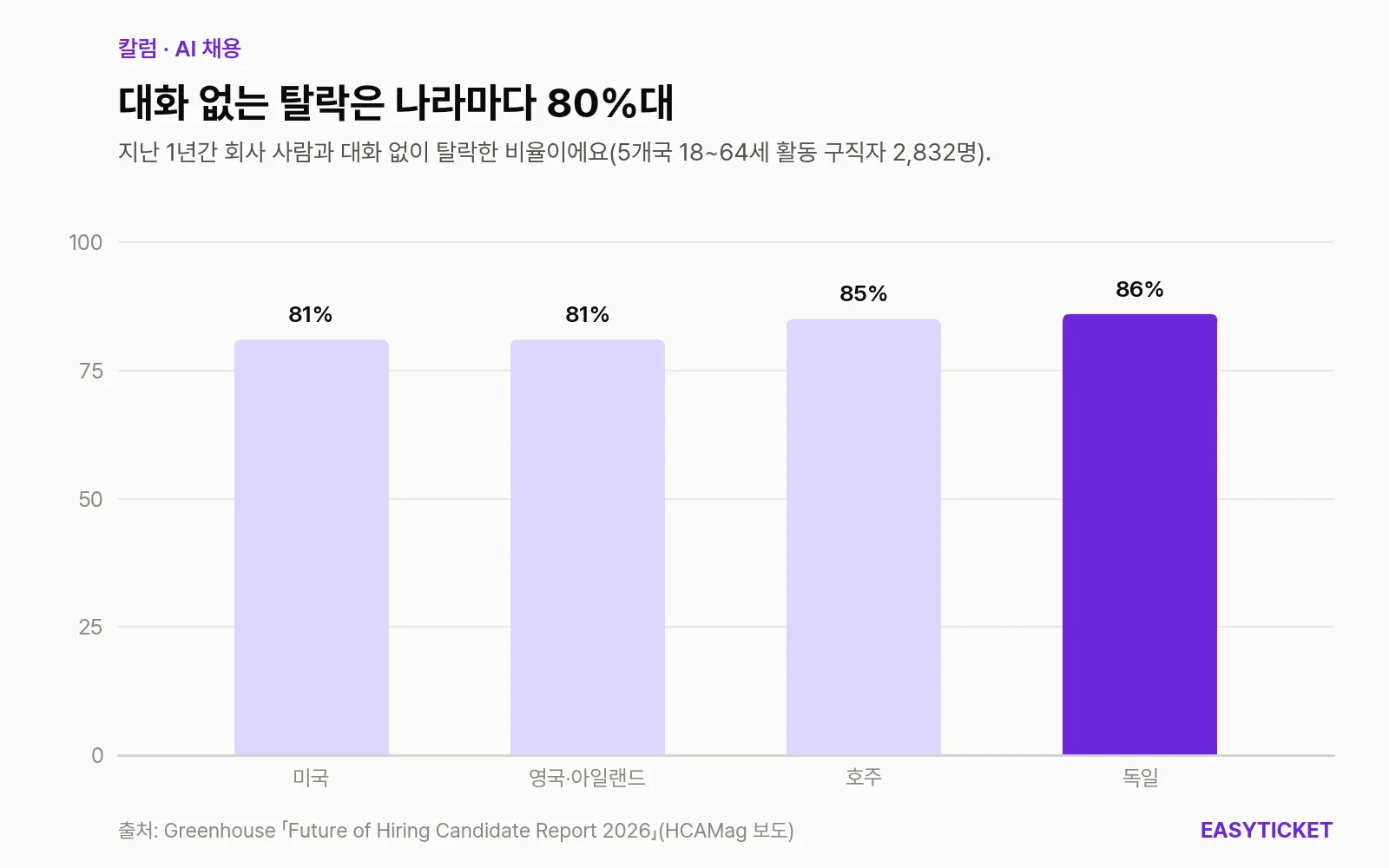
In all four markets, the share who said they had been rejected at least once in the past year without talking to anyone at the company was in the 80s.
This number does not mean “four out of five applications ended without a conversation.” It is the share of people who had that experience at least once in a year. It also does not mean people were rejected because of AI, and résumé rejections were common before AI arrived. There is no published time series, measured the same way, that compares the figure with the period before AI adoption. So “it has gotten harder” cannot be proven by this number alone. It becomes plausible only when set beside data showing that application volume has grown, and even then it is an inference.
You also have to look at what the surveying company sells. Greenhouse sells hiring software, and according to Fortune it acquired Ezra AI Labs to offer AI voice interviews to every applicant. It is a company positioned so that the more serious the problem of rejection without conversation looks, the greater the need for AI interviews appears.
Korea, where the cover letter is wobbling
In Korea, the self-introduction essay (jagisogaeseo, the long-form cover letter) is the first thing to wobble. In a survey of 1,008 Gen Z job seekers by Jinhak Catch (reported in September 2026; the article does not give the survey date), 93% said they had used AI to write a cover letter, and 58% were positive about abolishing it. The top reason among the positive group was “AI has drained the meaning from the screening step” (70%, multiple answers allowed). The most common reason among the 13% who were negative was that there would be fewer chances to show their strengths and experience.
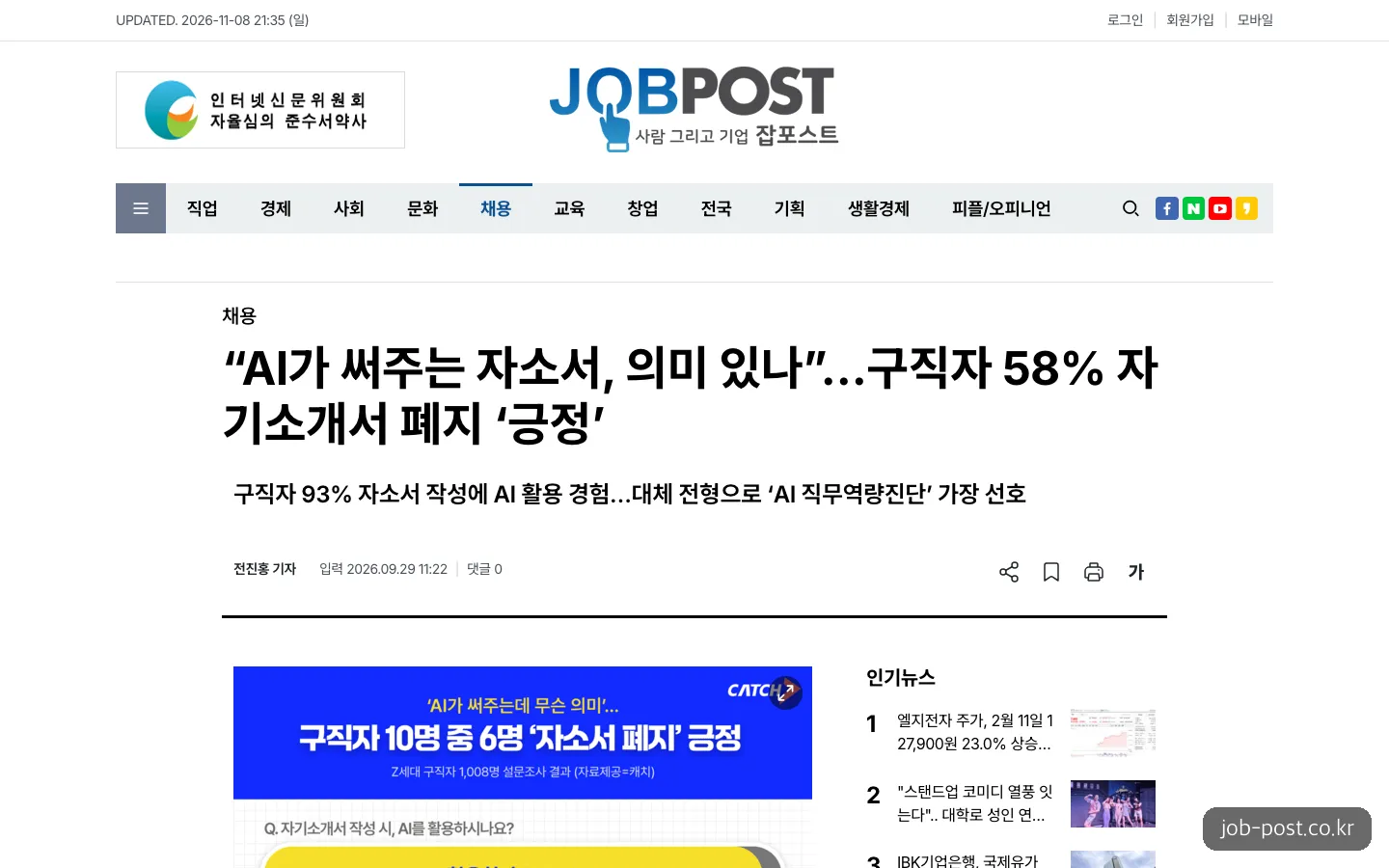
The headline says “job seekers,” but the graphic states that the respondents were 1,008 Gen Z job seekers.
What stands out is the answer to what people want in place of the cover letter.
| Preferred replacement assessment | Share of responses |
|---|---|
| AI job competency assessment | 24% |
| Assignment or project similar to real work | 21% |
| In-depth interview | 17% |
| No additional assessment needed | 15% |
| Portfolio | 13% |
| Personality and job aptitude test | 10% |
AI assessment ranks first, but Catch itself runs an AI job competency test, so this ranking should be read with a discount. Only 17% chose an in-depth interview that involves meeting a person directly. That also suggests that wanting to meet people and choosing the interview as an assessment method are different matters.
The limits of “human interviews are the answer”
The evidence that makes it hard to end at “so people should do the evaluating” is solid. In a field experiment that randomly assigned about 70,000 people to human interviews or AI voice interviews, the AI interview group was 12% more likely to receive a job offer. Job starts and retention were also better, and there was no finding that the productivity of those hired dropped. The caveats are that people made the final decisions and that this is the result from a single site, but it is enough to shake the assumption that an AI interview is automatically a bad experience.
Human interviews do not have a great report card either. In the Greenhouse US survey, three out of four people said they had shown their abilities well in a recent human interview, yet nine out of ten had run into at least one problem, such as the interviewer repeating the résumé’s contents or judging them on first impressions. Among those who had taken an AI interview, 70% said they had shown their abilities well. In a Korean survey of 3,093 young employees, 63.8% also approved of companies running AI-based screening.
That does not make the silence after the interview acceptable, though. Who does the evaluating and whether the result is communicated are separate questions.
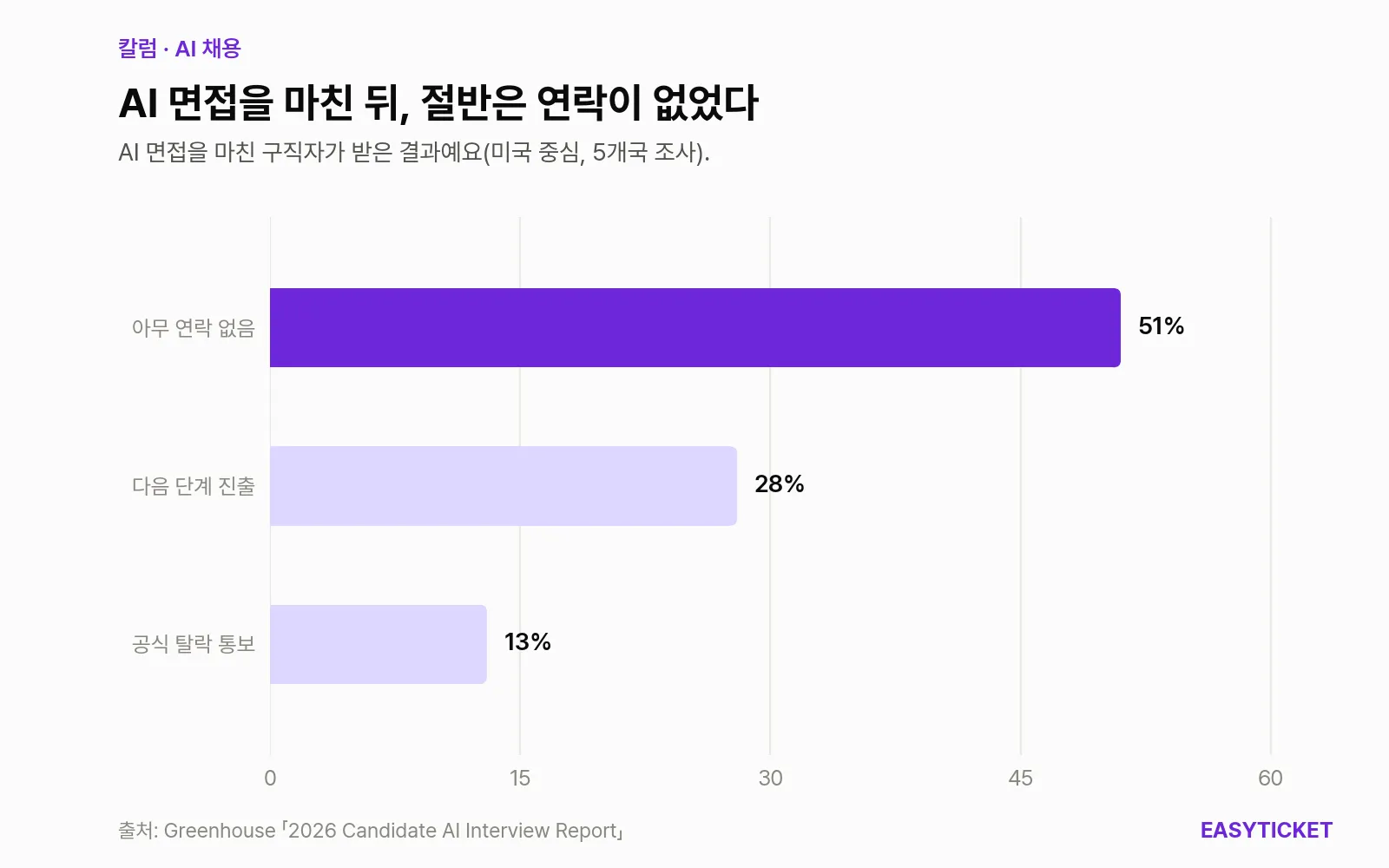
Among people who finished an AI interview, those who heard nothing back outnumbered those who moved on to the next stage.
In the same survey, 38% said they had dropped out of a hiring process because it included an AI interview. EasyTicket reads this as a sign that it is less the use of AI itself than a process where you cannot tell where your answers go that drives people away.
If you are rejected after an AI interview, can you ask why?
You can, but the conditions are demanding. According to Maeil Shinmun, under Article 37-2 of the Personal Information Protection Act, a company that receives such a request must report the outcome of its action within 30 days, and when it refuses, it must give its reasons within 10 days. The level of explanation is not the algorithm’s formula but a concise account of the main factors considered. The problem is that this right presupposes a fully automated decision, and applicants can use it only if they know AI evaluated them. The same article also points out that marking a decision as made by a person in the end can become a route around the right.
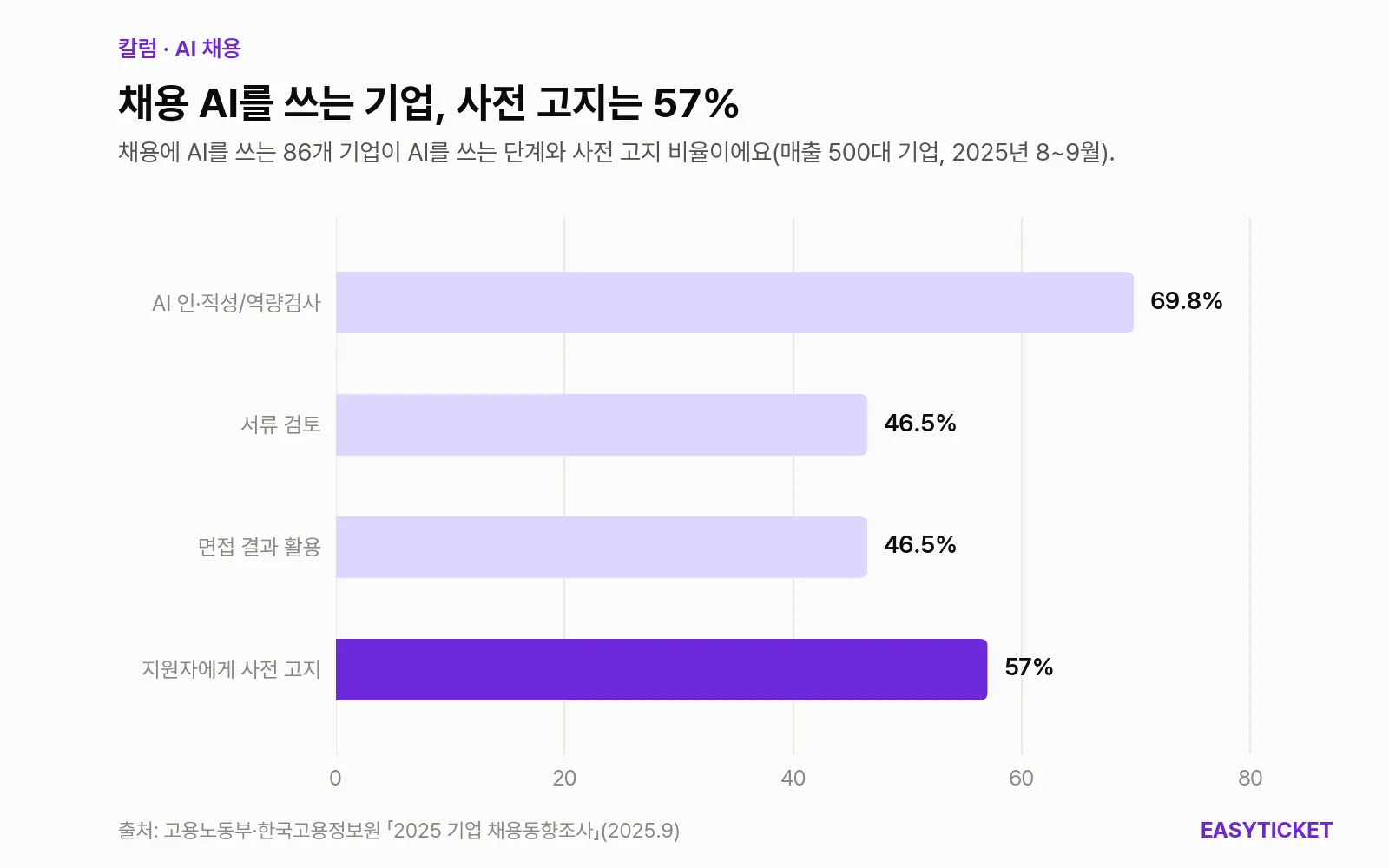
Of the 86 companies that said they use AI in hiring, 57% tell applicants in advance.
Of the 86 companies that told the Ministry of Employment and Labor they use AI in hiring, 57.0% notify applicants in advance. The survey covered the top 500 companies by revenue and was taken in August and September 2025, so it cannot be stretched into a picture of all companies today. In Greenhouse’s May survey, centered on US respondents, 70% said they were not clearly told in advance that AI would evaluate them, and 21% said they found out only after the interview began. The surveys and countries differ, so the two figures cannot be compared, but the direction is the same: notification is lagging.
EasyTicket sees notification as the cheapest improvement and the one that can be made first. It takes one line in a job posting, and it is the starting point for the right to demand an explanation to work.
What to watch next, and what you can do now
The nearest date is January 21, 2027. According to Maeil Shinmun, Korea’s AI Basic Act includes hiring among high-impact AI areas, and its one-year grace period ends that day. In November 2025, the Ministry of Employment and Labor said it would draft hiring AI guidelines and revise the Act on Fair Hiring Procedure to cover advance notice and the ban on discrimination. Whether these were actually issued and enacted cannot be confirmed from public materials, so this is a point to keep watching.
If you are job hunting, it is better to use AI only up to organizing your experience, and to avoid adding skills you lack or planting hidden text. Even if you get through the document screening, you are the one who has to explain things in the interview. If the hiring notice does not say whether AI evaluates candidates, ask. If you learn after a rejection that AI evaluated you, it is worth checking whether you can demand an explanation.
For people building hiring services or application tools with AI, the question is a little different. Auto-apply tools lighten the applicant’s workload, but the moment everyone uses them, they spin the loop described above one more time. If you build one, EasyTicket thinks the opportunity lies less in features that send more applications and more in making notice that AI is evaluating, whether a human reviews, and result notification the product’s defaults.
A machine may be able to decide first who passes, but that is no reason to skip the message saying it is over.
Frequently asked questions
Do small and midsize companies also use AI to evaluate applicants?
The Ministry of Employment and Labor survey covered only the top 500 companies by revenue, so these numbers cannot tell us about small and midsize companies. It is safer not to carry the large-company rates over as they are.
Will the self-introduction essay disappear soon?
It looks more like a change of format than a full abolition. According to JobPost, SK hynix introduced a form for writing about AI skills and job expertise, POSCO added an item for describing real work experience, and Shinhan Bank adopted video interviews in place of cover letter questions.
Does an AI interview reduce bias?
It is hard to say so yet. In Greenhouse’s May survey, the rates of perceived bias were the same in AI interviews and human interviews: 36% for age and 27% for race and ethnicity. These figures reflect what applicants felt, not a measurement of actual discrimination.
Sources 8
- 63% of Job Seekers Have Faced an AI Interview. Most Haven't Had a Good One Yet (Greenhouse)
- 6 in 10 Job Seekers Are Rethinking How They Write to Avoid Sounding Like AI (Greenhouse)
- AI in hiring leaves most job seekers rejected without a conversation (HCAMag)
- 500대 기업 86.7%, 인사업무에 AI 쓴다 (뉴시스)
- AI가 써주는 자소서, 의미 있나…구직자 58% 자기소개서 폐지 긍정 (잡포스트)
- AI 인사 도입 86.7%인데 사전고지 57%…탈락 사유 물을 권리 생겼다 (매일신문)
- Voice AI in Firms: A Natural Field Experiment on Automated Job Interviews (Jabarian·Henkel)
- CEO of the top-rated hiring platform on the AI doom loop (Fortune)
AI helped with research and the first draft; the operator tried the subject firsthand, checked and edited this article before publishing. Let us know if you spot a mistake.