
Have you ever handed a job to an AI and, partway through, seen a notice that you had hit your usage limit? The same thing is now happening at the company level. In November 2026, Bloomberg reported that Apple had cut the daily AI usage budget for some of its engineers from $300 to $200.
The term that explains this trend is the inference paradox. It describes what companies have been going through in 2026: the price of tokens, the units in which AI reads and writes text, is falling, but usage is growing even faster, so total costs do not shrink.
EasyTicket does not expect flat-rate plans to disappear anytime soon. But a meter has now been installed inside them, and the habit of using AI as if it were unlimited is coming to an end. Which model to use for which job, and how much, is now something the user has to decide.
Prices Fell, but Bills Grew
According to material posted on its official account in late October 2026 by the venture capital firm a16z, the average token price has fallen 67% since May of that year, while token spending has grown by more than 120%. The price of the goods dropped to a third, yet the receipt more than doubled. a16z added one short line: “Cheaper tokens don’t mean cheaper bills.”
The cause is a change in how AI works. A Business Watch article explains that chatbots used to simply answer questions, while agents make a plan and then repeat searches, reasoning and external calls. Unlike the days when a person typed a single line, one instruction now sets the AI moving dozens of times on its own, so the meter never gets a chance to stop.
Companies Have Started Setting Employees’ AI Usage
According to a Business Watch summary of Bloomberg reporting (November 8, 2026), Tesla set a limit of $200 per employee per week, and Uber set a limit of $1,500 per month for each AI coding tool. For Apple, Bloomberg’s report as relayed by MacRumors has more detail. Some organizations are reportedly considering lowering the limit to $100 a day, many departments outside engineering are already at $100 a day, and some teams could be capped at $25. Some teams have also been asked to move to cheaper models or AI that runs on the device itself.
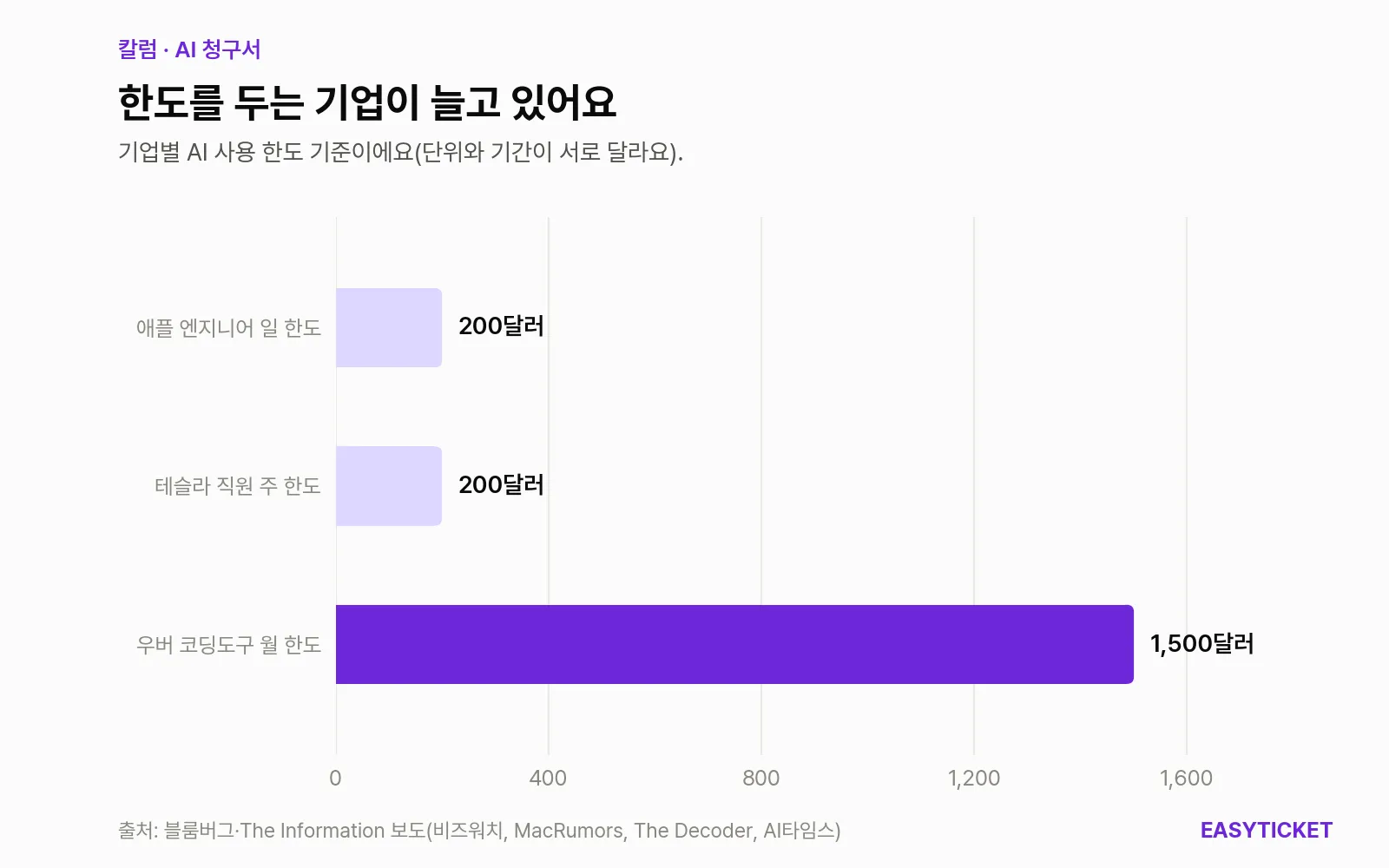
AI usage limits by company. Because the units differ (day, week, month), the bar lengths cannot be compared with one another.
Uber’s bar is the longest in the chart, but that does not mean Uber is the most generous. The periods and the targets all differ, so the figures cannot be lined up in a single row. What this chart shows is not a ranking but the fact that well-known companies have each begun drawing a line by their own standards.
South Korea is no different. According to a June 8, 2026 report in the Korea Economic Daily, AhnLab limited GitHub Copilot usage to 1,000 credits per week (the equivalent of $10 a month) starting June 1, an amount a heavy-using developer could burn through in a few hours. Netmarble set limits by job title and team, and Krafton added an approval step for new AI tool subscriptions.
A Meter Has Come Inside Flat-Rate Plans
The sellers of these tools have moved too. On April 27, 2026, GitHub announced that it was moving all Copilot plans to usage-based billing, and the change took effect June 1. It cited as a problem a structure in which a short question and several hours of autonomous coding are billed at the same price, and wrote that the old approach was “no longer sustainable.”
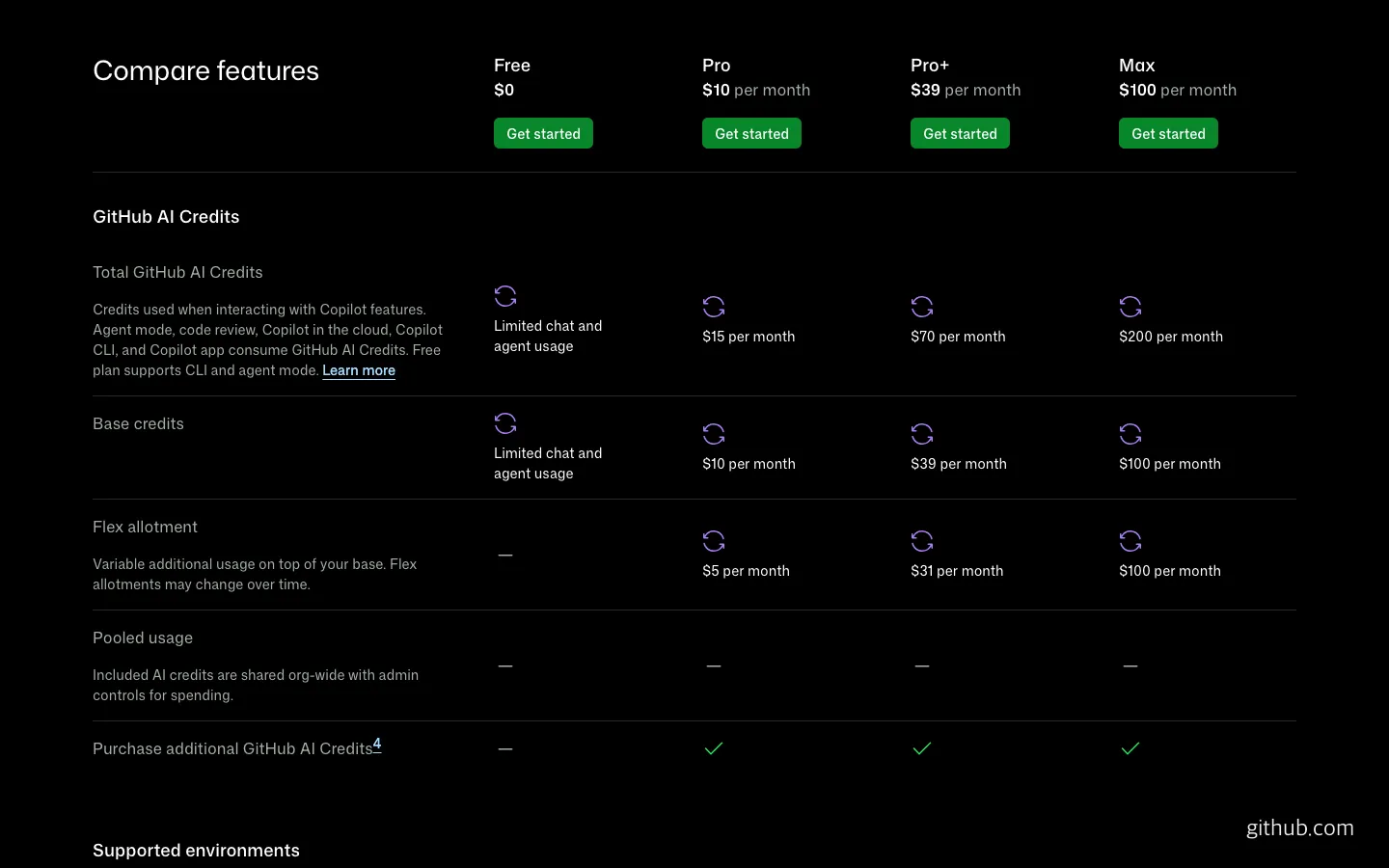
Copilot pricing table. Monthly credits are split into a base portion and a Flex allotment that can change.
Open the pricing table yourself and one phrase stands out. The description of the Flex allotment says “may change over time.” The $10-a-month Pro plan gives $15 worth of credits in total, and $5 of that is this Flex portion. The table itself says that even if the price stays the same, the amount you receive can change. The Claude pricing page words things differently, but the framework is similar.
| Individual plans as of November 2026 | GitHub Copilot | Claude |
|---|---|---|
| Monthly price | Pro $10, Pro+ $39, Max $100 | Pro $20 ($17 a month with annual billing), Max $100, Ultra $200 |
| How usage is shown | Total monthly credits of $15, $70 and $200 | Pro as 1x, Max 5x, Ultra 10x weekly |
| Measuring cycle | Monthly | Every 5 hours, and weekly |
| Conditions that change | Flex allotment can change | How fast you hit the limit varies by model, conversation length and file size |
| Exceptions to the limit | Code completion and next edit suggestions are unlimited | Verified Ultra accounts have no 5-hour limit (a weekly limit still applies) |
Copilot’s “unlimited” attaches only to code completion and next edit suggestions, while agent mode, code review and the CLI use credits. The structure keeps the help you get while typing open to everyone and puts a price only on the work where AI runs on its own for a long time. There is a clear downside, too. When you set credits written in dollars next to limits written in multiples, the table alone does not tell you which is roomier for your work.
Seen Another Way, Subscriptions Are Still a Good Deal
There is solid evidence on the other side, too, against declaring the end of flat rates. According to a SemiAnalysis estimate reported by AI Times in June 2026, when the amount used up to the limit on a $200-a-month subscription is converted to API rates, Claude Max 20x came to as much as $8,000 and ChatGPT Pro 20x to as much as $14,000. That is 40 times and 70 times the subscription fee.
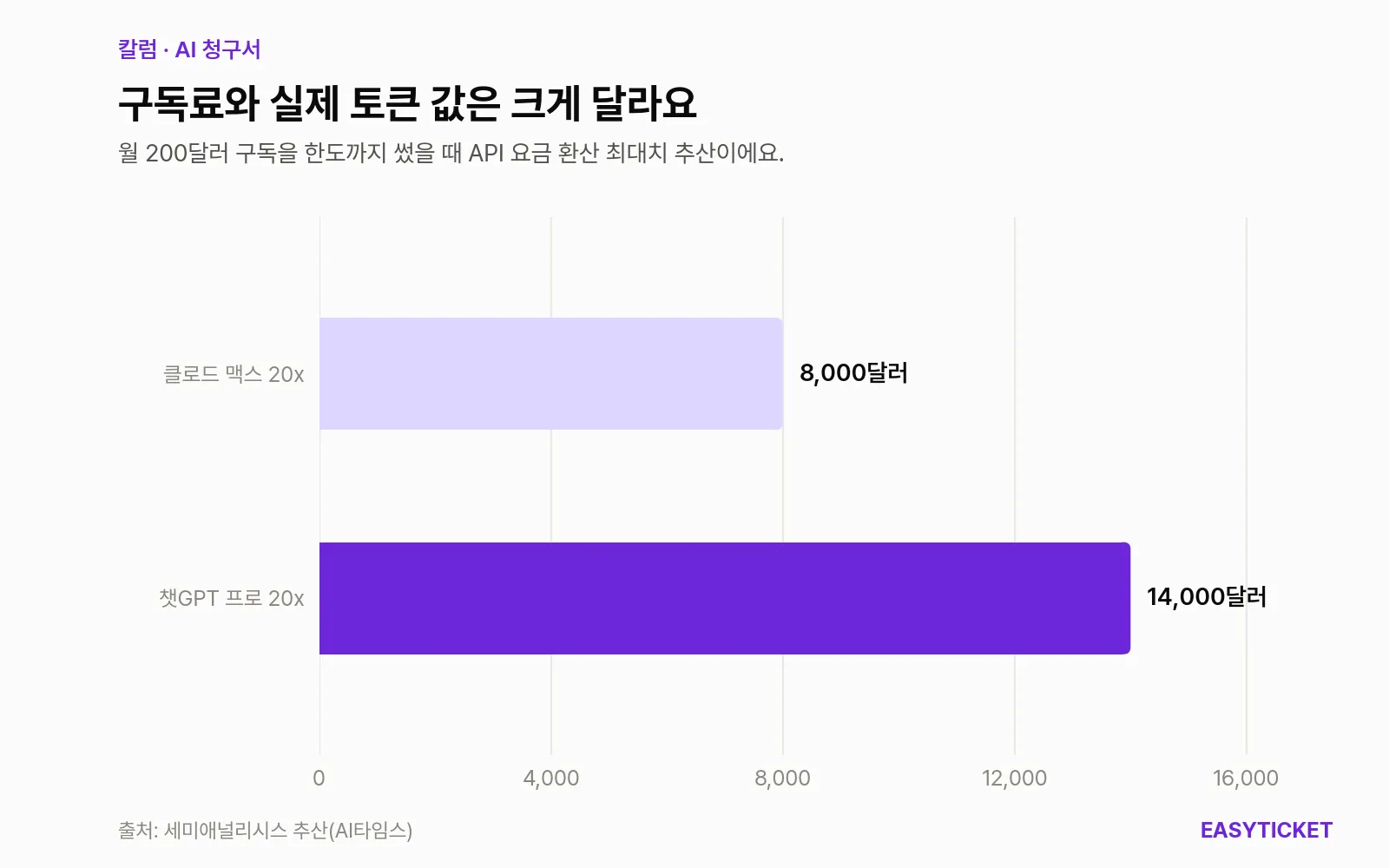
Estimated maximum API-rate equivalent when a $200-a-month subscription is used up to its limit.
SemiAnalysis analyzed that these plans survive because most users do not use up their limits. It judged that this structure is hard to sustain for long, but that it is also not easy to raise prices sharply because of competition. That is why EasyTicket thinks limits and credits are more likely to tighten gradually than flat rates are to vanish suddenly.
It is also a stretch to read corporate limits as a retreat from AI. According to PYMNTS, companies are capping individual employees’ spending while keeping their overall AI budgets large. In a survey the outlet conducted in September 2026, 62% of US companies with annual revenue of $1 billion or more had spent $10 million or more on new AI over the past 12 months. What was cut back was indiscriminate use of expensive models, not AI itself.
The numbers have limits, too. Some Apple employees told Bloomberg that they do not use up most of the $300 limit, in which case the money actually saved may not be large. The a16z figures were confirmed only from a public post this time, so we could not check what sample they came from, and many of the articles on limits rely on secondhand accounts of internal memos and anonymous sourcing. The direction is credible, but the exact scale should be read with care.
How Should You Manage Vibe Coding Costs?
First, there is no need to be scared. The AI spending tally Ramp released in June 2026 pools card and invoice payments from more than 70,000 US customer companies, and the median monthly AI spend per employee was only $11.38. The top 1% was $7,449.
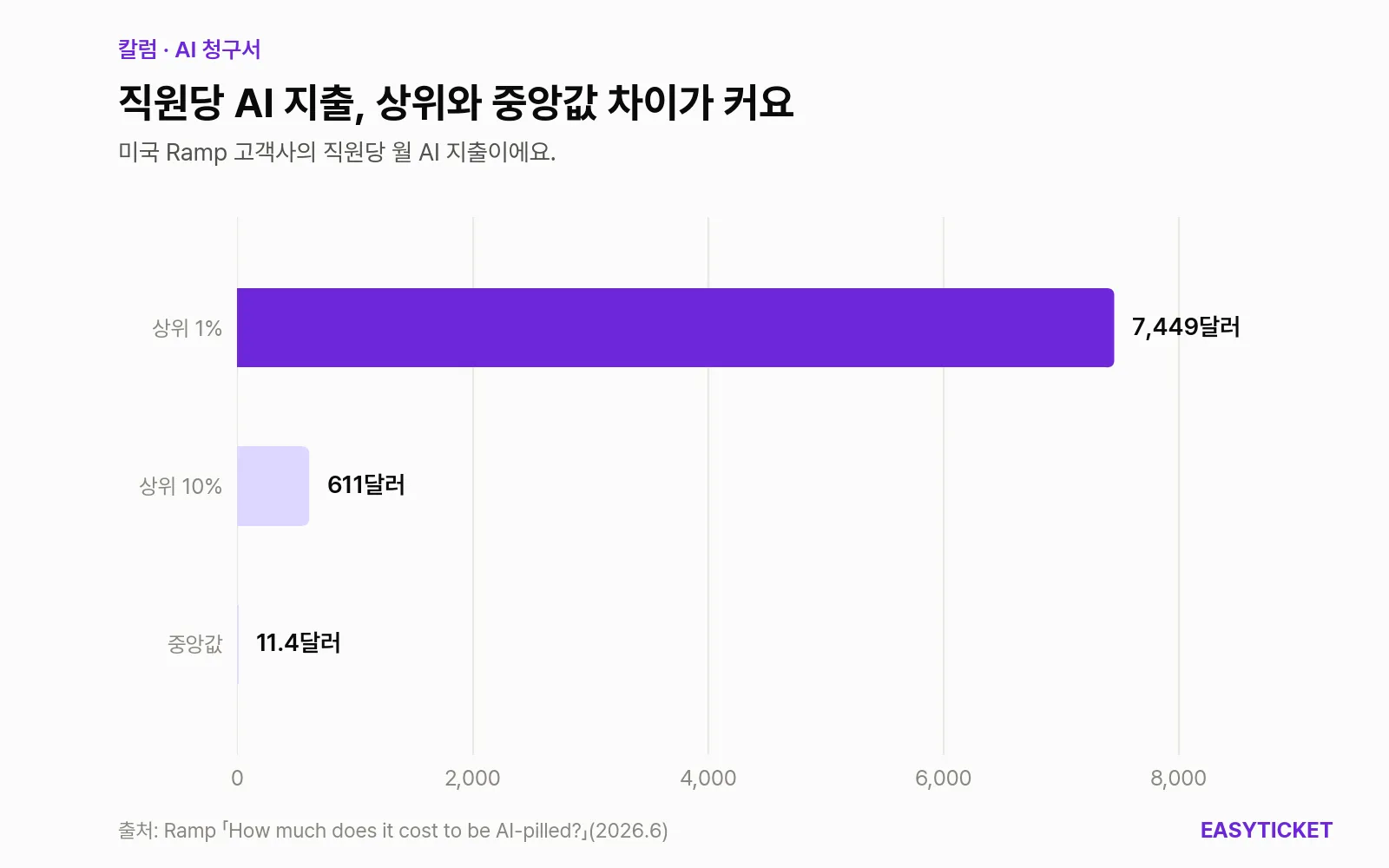
Monthly AI spend per employee at US Ramp customer companies. The gap between the top 1% and the median is more than 650 times.
This means the billing problem is currently concentrated among a small number of heavy users. However, this is a sample of US corporate customers and cannot be carried over to individual vibe coders’ spending, and it is hard to find authoritative statistics that properly measure individual spending. So it is better to set your plan by your own work than to fit yourself to an average.
If you build small apps on weekends, it makes sense to start with one lower-tier subscription and move up only when you hit the limit often. Buying an expensive plan from the start would, as we saw above, most likely put you among the majority who never use up their limits.
There are three places in your habits where you can cut back.
- Split the work among models: The response the Business Watch article points to is also to send simple tasks such as summarizing documents to a lightweight model and only complex analysis to a high-performance one. According to PYMNTS, AT&T cut the cost of some advanced AI tasks by up to 56%, with only a 2% drop in quality.
- Break conversations short: The Claude pricing page says how fast you hit the limit varies with the model, the conversation length and the file size. One long conversation with unrelated files pasted in is the most expensive habit of all.
- Separate jobs that need an agent from jobs that don’t: With a tool like Copilot, where code completion does not use credits, there is no reason to run an agent just to fix a single line.
If you use Claude on the web and in Claude Code together, keep in mind that the limit shrinks for both. They draw from the same usage.
Three Things to Watch Next
The first is whether the amounts labeled as changeable, like Flex, actually shrink. If the price stays the same and only what you receive changes, a de facto price increase can happen without any notice.
The second is whether limits spread into performance reviews. For now they are a cost control tool, but if they shift toward giving more to employees who use AI better, skill with AI becomes the size of the resources you get at work.
The third is the quality of cheaper models. As the Business Watch article notes, even Korean carriers such as KT, SKT and LG Uplus are preparing token management businesses, and the more jobs a lightweight model can handle, the more the expensive models’ share will narrow to the truly hard tasks.
Frequently Asked Questions
Can I do vibe coding on a free plan?
You can get a taste. As of November 2026, Copilot Free includes chat and agent usage in a limited form, and Claude has a free plan as well. If you try to build a whole app, you will likely hit the limit first, and that is the time to decide whether to switch to a paid plan.
Which is cheaper, a subscription or pay-as-you-go API?
If you use AI steadily and heavily, a subscription is likely to come out ahead. As the SemiAnalysis estimate shows, using up to the limit gets you far more tokens than the subscription fee. If you only use it a little now and then, an API where you pay for what you use may be better.
What exactly is a token?
It is the unit in which AI cuts up text to read and write it. Because it counts not only your questions and answers but also the files the AI has read in and earlier conversation, the same question gets more expensive the longer the conversation runs or the more files there are.
Sources 8
- [챗ICT]AI 적당히 쓰라고?…토큰 비용에 빅테크 '골머리' (비즈워치)
- Apple is Putting Employees on an AI Budget (MacRumors)
- Tech Giants Ration Premium AI as Company Budgets Hold (PYMNTS)
- a16z 공식 X 계정, Charts of the Week 안내 글
- GitHub Copilot is moving to usage-based billing (The GitHub Blog)
- AI 요금 폭등…기업 '토큰주의보' (한국경제)
- "월 200불로 1만4000불 토큰 제공"…챗GPT·클로드 '구독료' 실체 (AI타임스)
- How much does it cost to be AI-pilled? (Ramp)
AI helped with research and the first draft; the operator tried the subject firsthand, checked and edited this article before publishing. Let us know if you spot a mistake.