
On October 14, 2026, a game studio posted a teaser video on X for a game it hadn’t even released yet. It passed 2.2 million views in a day, and starting the next day, similar games about smashing through walls and escaping began showing up on Roblox. A vibe coding copycat is a game or app that copies the setup of a viral hit in a few days, sometimes in a single day, using AI coding tools. The phenomenon became noticeably more common in the game industry and app market in the second half of 2026.
Here is how EasyTicket sees it. If the time it takes to copy something has dropped from months to a day, code is no longer a wall. What remains is the strength to keep improving and operating a product, and the trust users place in the original when they recognize it.
Cloning that began the day after a teaser
According to Herald Business’s October 24 report, after the teaser for Pandorio Games’ unreleased game “Escape the Walls” went up, at least seven games with the same idea were found on Roblox as of October 23. All of them were made on or after October 15, the day after the teaser. The outlet Kotaku, citing reporting from Japan’s GameSpark, said a Roblox creator cloned the game within 24 hours.
Korean studios responded more directly. According to the same article, YNOT took down the public demo of its new game “Spookichin” on October 20 after receiving a tip that it was being imitated with AI, and Garage Arts abruptly pulled the demo of “Oh! Robot: Legend of the Mechanic” a day earlier, on October 19. A demo is normally released to hear user reactions and polish the game, so closing that channel was a notable choice.
Platform numbers show where this speed comes from. When Roblox surveyed several thousand creators, 95% said AI had shortened the time it takes them to release new games or updates (as cited by Herald Business). Tools that got faster for everyone who builds got just as fast for those who copy.
Names that lined up before the original
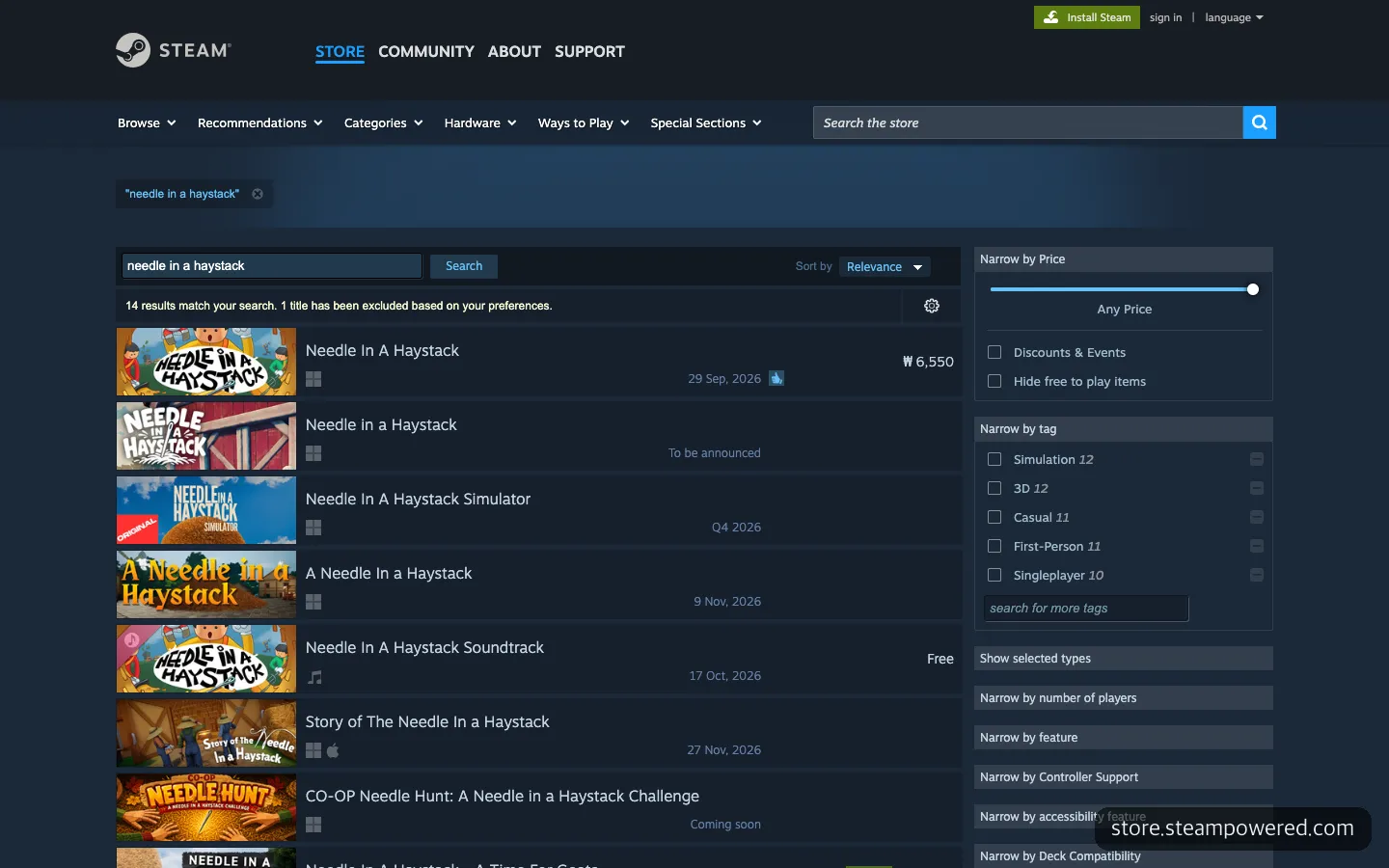
Searching for needle in a haystack on Steam returns a string of games whose names and thumbnail layouts look alike.
Searching Steam for “needle in a haystack” returns 14 results. These names all trace back to “Needle In A Haystack Simulator” by Studio Bitdot, which went viral in August 2026. Kotaku’s October 18 article counted at least 14 games on Steam modeled on it.
If you search yourself, you’ll see an odd scene. The original, marked with an “ORIGINAL” label on its thumbnail, is still listed as coming in “Q4 2026,” while right above it a game with the same name that came out on September 29 is already on sale for 6,550 won. Note, though, that these 14 results include entries split off from a single game, such as a soundtrack and a demo. That is why you shouldn’t read the number of search results as the number of copycats.
A more notable detail lies elsewhere. According to Kotaku, a claim emerged that another game released on October 16 had copied one of the clones that came out on September 29. The article linked this to decompilation using Claude. It describes a situation in which a party that had copied the original was now protesting that it had been copied itself.
A flood of new apps in the App Store
Widen the view beyond games and the numbers get bigger. According to estimates from the app market analytics firm Appfigures, new App Store app submissions in 2025 totaled 557,000. That was up 24% from 448,000 in 2024, and it was the first meaningful increase since 2016, when submissions topped one million.
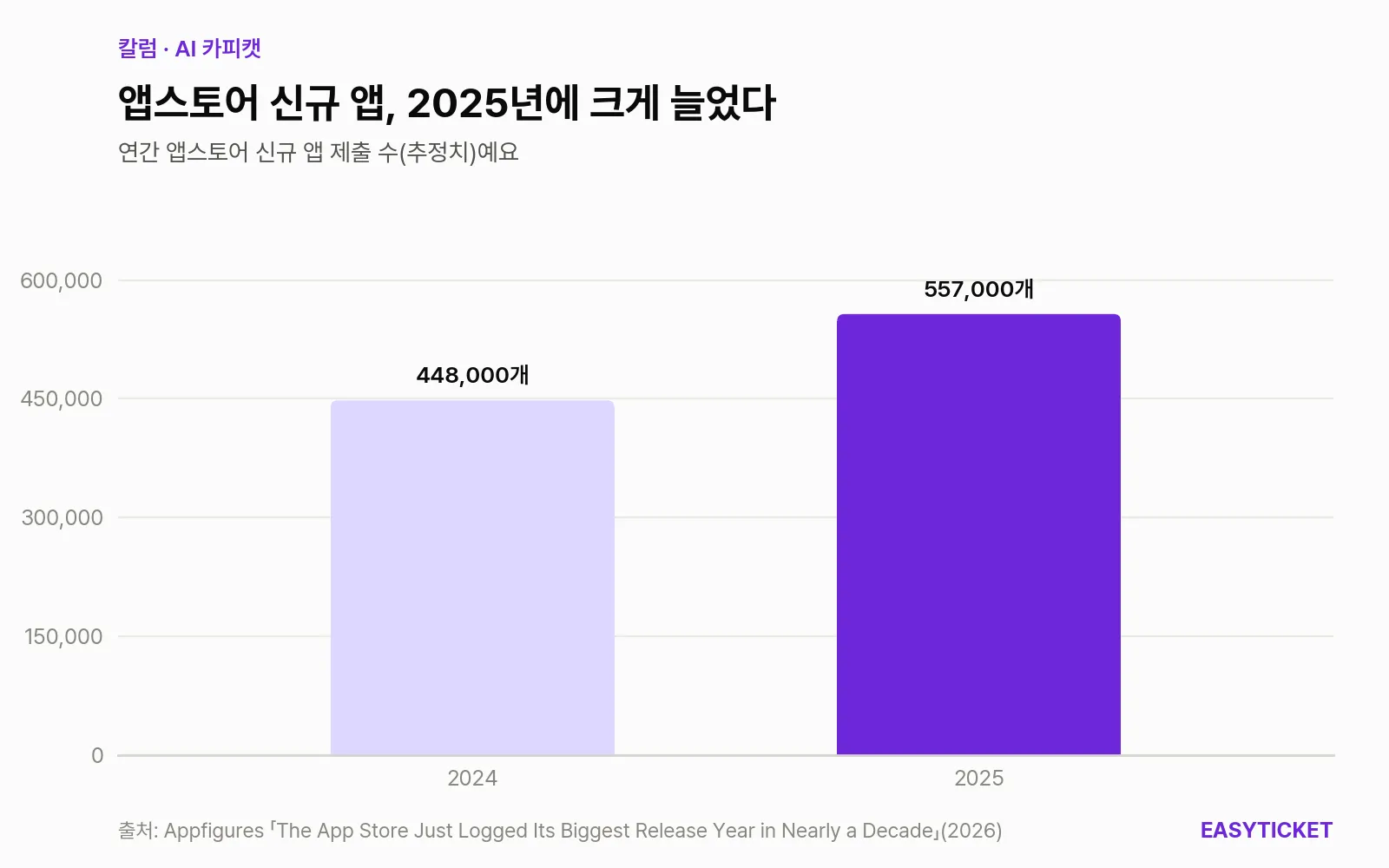
By Appfigures’ estimate, new App Store app submissions in 2025 rose 24% from the previous year.
In 2026 the pace picked up further. Sensor Tower estimates, as relayed by 9to5Mac citing The New York Times, show that the new apps released in the first six months of 2026 come close to the whole of 2025.
Put new releases and downloads side by side within the same Sensor Tower figures, and another story appears.
| Period (Sensor Tower estimates) | New apps released | Downloads |
|---|---|---|
| 2025 | About 600,000 (up 30%) | 35.4 billion (up 3%) |
| First half of 2026 | About 560,000 (nearly double the same period a year earlier) | 17.6 billion (up 2%) |
New apps nearly doubled, but the number of app downloads grew only 2 to 3%. The shelves are filling up fast while the customers stay about the same. Each time another similar app arrives, the chance that the original catches a user’s eye drops accordingly.
Is an AI-made clone illegal?
Mostly, no. On October 14, Plagiarism Today, a publication covering copyright issues, analyzed a case in which a developer used AI coding tools to release a free open-source app resembling Adobe apps such as Photoshop, Lightroom, and Premiere Pro. Its conclusion was that copyright protects the “expression” of code, not its “function.” If the name and logo are different, it is hard to stop through copyright, and only trademark, terms of service, and patent risks remain, it said.
Platform rules go a little further. Apple’s App Store Review Guidelines 4.1 tells developers not to copy popular apps outright or submit them with only a slightly changed name or UI, and 4.3 says Apple will not accept apps that are indistinguishable from common ones or opportunistic variations of popular apps, and that repeat offenders can be removed from the developer program. In 9to5Mac’s reporting, an Apple spokesperson said apps built through vibe coding are held to the same quality, privacy, and security standards. There are no public numbers, however, on how many of the flood of clones these rules actually filter out.
In Korea, Lee Cheol-woo, president of the Korea Game Users Association and a lawyer specializing in games, said in an interview with Herald Business that small studios have no capacity to fight copying. He proposed institutional improvements such as tightening the refusal of age ratings for games that infringe copyright.
Another view: being copied isn’t the same as losing
A flood of copycats doesn’t mean the original always loses. In the “Needle” case, Kotaku reported that Steam users were largely cold toward the clones that came out first. Even when names and screens are copied, it is a sign that users remember quite accurately who made it first.
The words of Maor Shlomo, the founder who sold the vibe coding company Base44 for about $80 million, point the same way. On a podcast reported by Business Insider, he said features can be cloned in weeks to months, so it is hard to have a moat, but he saw infrastructure such as databases, authentication, and user management as hard to copy. The look of a product can be moved in a day, but accumulated data, accounts, and a running operation cannot.
Let’s also note the limits of the numbers. Appfigures named tools such as ChatGPT, Claude, Cursor, and Replit as one of three causes of the rise in new apps, but it did not put a figure on their share. Not every added app was made with AI, and not every one is a copycat. Searching Roblox for “escape the walls” also returns loosely related games such as “escape the jungle,” and the screen doesn’t show when each game was made. It is fair to say there is still no credible tally that precisely counts the scale of copycats.
What this means for vibe coders
EasyTicket reads this trend in two directions. One is that what you make can be cloned in a day. The other is that copying something yourself also takes only a day.
If you are on the making side, it is time to rethink the order of disclosure. A teaser and a demo are a channel for gathering reactions, and also a channel that hands a blueprint to anyone who wants to copy you. For a small game or web app that competes on a single idea, it is better to launch in a state people can use right away than to put up only a teaser. When buzz catches on, the original needs to already be there so users remember it. Names and logos are among the few things you can protect with a trademark, so they are worth securing early.
If you are on the copying side, releasing the same idea in a day has become technically easy. But as the points App Store guidelines 4.1 and 4.3 block and the reactions of Steam users show, it is hard to last. Even if you take a viral setup as a starting point, it only becomes “something different” rather than “something similar” when you add something of your own.
What to watch next
Three things are worth watching. First, whether the trend of delaying public release, like the Korean studios that pulled their demos, spreads across the industry. Second, how forcefully platforms such as Apple, Steam, and Roblox actually apply their standards for filtering similar games and apps. Third, how far policy discussions in Korea, such as the proposed tightening of age rating rules, will go. Until those answers arrive, there is ultimately one thing makers can hold on to: keep improving at a speed no one can copy, and stay beside your users for the long run.
Frequently asked questions
What is vibe coding?
It is a way of making programs by describing what you want to an AI in plain language, rather than writing code line by line yourself. The term is known to have been first used by Andrej Karpathy in February 2025, and Collins Dictionary chose it as its Word of the Year for 2025.
Are all the similar games that appear in Roblox or Steam searches clones?
No. Search results also include derivative entries from the same game, such as a soundtrack or a demo, and games that only share a similar name. To know which game came first, you need to look at release dates and press coverage together.
Did AI really speed up game development?
At least the people making games feel that way. In a Roblox survey of several thousand creators, 95% said AI had shortened the time it takes them to release new games or updates.
Sources 8
- “이건 충격, 원작보다 짝퉁이 먼저 나온다”…‘AI 복제 게임’ 업계 발칵 - 헤럴드경제
- Devs Of Needle In A Haystack Clone Angry It's Been Cloned By AI - Kotaku
- The App Store Just Logged Its Biggest Release Year in Nearly a Decade - Appfigures
- Report: App Store added nearly as many new apps in H1 2026 as in all of 2025 - 9to5Mac
- App Review Guidelines - Apple Developer
- Copyright and the Vibe-Coded Adobe Clones - Plagiarism Today
- Vibe coding startups face a big copycat risk - Business Insider
- Vibe coding named Collins Dictionary's word of the year - CNN
AI helped with research and the first draft; the operator tried the subject firsthand, checked and edited this article before publishing. Let us know if you spot a mistake.